
Sony Xperia 1 VII vs. Apple iPhone 14: A Detailed Comparison of Flagship Power
| Phones Images | |||||
|---|---|---|---|---|---|
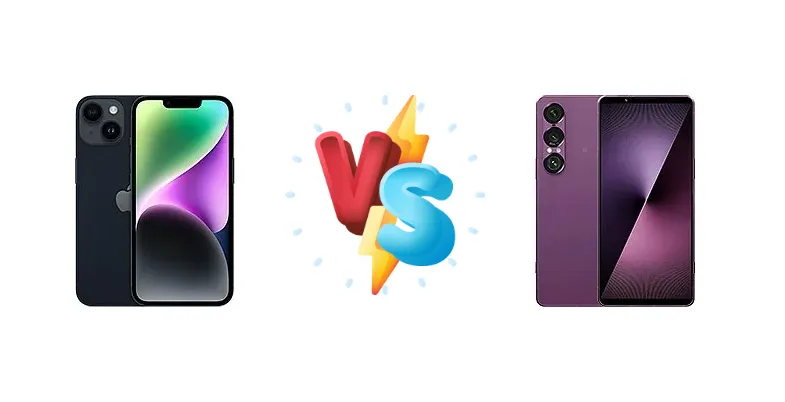
|
🏆 Quick Verdict
For most users, the Sony Xperia 1 VII offers a more compelling package. Its significantly brighter display (1475 nits vs 804 nits), coupled with the newer, more efficient Snapdragon 8 Elite (3nm) chipset, provides a noticeable advantage in both visual experience and sustained performance. While the iPhone 14’s ecosystem integration is strong, the Xperia 1 VII’s raw power and features justify its position as the winner.
| PHONES | ||
|---|---|---|
| Phone Names | Apple iPhone 14 | Sony Xperia 1 VII |
| Network | ||
|---|---|---|
| 2G bands | GSM 850 / 900 / 1800 / 1900 | GSM 850 / 900 / 1800 / 1900 |
| 3G bands | HSDPA 850 / 900 / 1700(AWS) / 1900 / 2100 | HSDPA 800 / 850 / 900 / 1700(AWS) / 1900 / 2100 |
| 4G bands | 1, 2, 3, 4, 5, 7, 8, 12, 13, 17, 18, 19, 20, 25, 26, 28, 30, 32, 34, 38, 39, 40, 41, 42, 46, 48, 66 - A2882, A2884 | 1, 2, 3, 4, 5, 7, 8, 12, 13, 17, 19, 20, 25, 26, 28, 32, 34, 38, 39, 40, 41, 66 - Europe |
| 5G bands | 1, 2, 3, 5, 7, 8, 12, 20, 25, 26, 28, 30, 38, 40, 41, 48, 66, 70, 77, 78, 79 SA/NSA/Sub6 - A2882, A2884 | 1, 3, 5, 7, 8, 20, 28, 38, 40, 41, 75, 77, 78 SA/NSA/Sub6 - Europe |
| Speed | HSPA, LTE, 5G, EV-DO Rev.A 3.1 Mbps | HSPA, LTE, 5G |
| Technology | GSM / CDMA / HSPA / EVDO / LTE / 5G | GSM / HSPA / LTE / 5G |
| 1, 2, 3, 5, 7, 8, 12, 20, 25, 26, 28, 30, 38, 40, 41, 48, 66, 70, 77, 78, 79 SA/NSA/Sub6 - A2883 | - | |
| Launch | ||
|---|---|---|
| Announced | 2022, September 07 | 2025, May 13 |
| Status | Available. Released 2022, September 16 | Available. Released 2025, June 04 |
| Body | ||
|---|---|---|
| Build | Glass front, glass back, aluminum frame | Glass front (Gorilla Glass Victus 2), glass back (Gorilla Glass Victus), aluminum frame |
| Dimensions | 146.7 x 71.5 x 7.8 mm (5.78 x 2.81 x 0.31 in) | 162 x 74 x 8.2 mm (6.38 x 2.91 x 0.32 in) |
| SIM | · Nano-SIM + eSIM + eSIM (max 2 at a time; International)· eSIM + eSIM (8 or more, max 2 at a time; USA)· Nano-SIM + Nano-SIM (China) | · Nano-SIM + eSIM· Nano-SIM + Nano-SIM |
| Weight | 172 g (6.07 oz) | 197 g (6.95 oz) |
| IP68 dust/water resistant (up to 6m for 30 min) Apple Pay (Visa, MasterCard, AMEX certified) | - | |
| Display | ||
|---|---|---|
| Protection | Ceramic Shield glass | Corning Gorilla Glass Victus 2, Mohs level 5 |
| Resolution | 1170 x 2532 pixels, 19.5:9 ratio (~460 ppi density) | 1080 x 2340 pixels, 19.5:9 ratio (~396 ppi density) |
| Size | 6.1 inches, 90.2 cm2 (~86.0% screen-to-body ratio) | 6.5 inches, 103.7 cm2 (~86.5% screen-to-body ratio) |
| Type | Super Retina XDR OLED, HDR10, Dolby Vision, 800 nits (HBM), 1200 nits (peak) | LTPO OLED, 1B colors, 120Hz, HDR BT.2020 |
| Platform | ||
|---|---|---|
| CPU | Hexa-core (2x3.23 GHz Avalanche + 4x1.82 GHz Blizzard) | Octa-core (2x4.32 GHz Oryon V2 Phoenix L + 6x3.53 GHz Oryon V2 Phoenix M) |
| Chipset | Apple A15 Bionic (5 nm) | Qualcomm SM8750-AB Snapdragon 8 Elite (3 nm) |
| GPU | Apple GPU (5-core graphics) | Adreno 830 |
| OS | iOS 16, upgradable to iOS 26.1 | Android 15, up to 4 major Android upgrades |
| Memory | ||
|---|---|---|
| Card slot | No | microSDXC (uses shared SIM slot) |
| Internal | 128GB 6GB RAM, 256GB 6GB RAM, 512GB 6GB RAM | 256GB 12GB RAM, 512GB 12GB RAM |
| NVMe | - | |
| Main Camera | ||
|---|---|---|
| Dual | 12 MP, f/1.5, 26mm (wide), 1/1.7", 1.9µm, dual pixel PDAF, sensor-shift OIS 12 MP, f/2.4, 13mm, 120˚ (ultrawide) | - |
| Features | Dual-LED dual-tone flash, HDR (photo/panorama) | Zeiss optics, Zeiss T* lens coating, color spectrum sensor, LED flash, panorama, HDR, eye tracking |
| Single | 12 MP, f/1.9, 23mm (wide), 1/3.6", PDAF SL 3D, (depth/biometrics sensor) | - |
| Triple | - | 48 MP, f/1.9, 24mm (wide), 1/1.35", 1.12µm, dual pixel PDAF, OIS 12 MP, f/2.3, 85mm (telephoto), f/3.5, 170mm (telephoto), 1/3.5", 1.0µm, dual pixel PDAF, 3.5x-7.1x continuous optical zoom, OIS, 4cm macro @ 120mm, no AF 48 MP, f/2.0, 16mm (ultrawide), 1/1.56", 1.0µm, PDAF |
| Video | 4K@24/25/30/60fps, 1080p@25/30/60/120/240fps, HDR, Dolby Vision HDR (up to 60fps), stereo sound rec. | 4K@24/30/60/120fps HDR, 1080p@30/60/120fps; 5-axis gyro-EIS, OIS |
| Selfie camera | ||
|---|---|---|
| Features | HDR | HDR |
| Single | 12 MP, f/1.9, 23mm (wide), 1/3.6", 1.0µm, PDAF SL 3D, (depth/biometrics sensor) | 12 MP, f/2.0, 24mm (wide), 1/2.9", 1.22µm |
| Video | 4K@24/25/30/60fps, 1080p@25/30/60/120fps, gyro-EIS | 4K@30/60fps, 1080p@30/60fps, 5-axis gyro-EIS |
| Sound | ||
|---|---|---|
| 3.5mm jack | No | - |
| 35mm jack | No | Yes |
| Loudspeaker | Yes, with stereo speakers | Yes, with stereo speakers |
| Comms | ||
|---|---|---|
| Bluetooth | 5.3, A2DP, LE | 6.0, A2DP, LE Audio, aptX HD, aptX Adaptive, aptX Lossless |
| NFC | Yes | Yes |
| Positioning | GPS, GLONASS, GALILEO, BDS, QZSS | GPS, GLONASS, BDS, GALILEO, QZSS |
| Radio | No | No |
| USB | Lightning, USB 2.0 | USB Type-C 3.2, OTG, video output |
| WLAN | Wi-Fi 802.11 a/b/g/n/ac/6, dual-band, hotspot | Wi-Fi 802.11 a/b/g/n/ac/6e/7, tri-band, Wi-Fi Direct, DLNA |
| Features | ||
|---|---|---|
| Sensors | Face ID, accelerometer, gyro, proximity, compass, barometer | Fingerprint (side-mounted), accelerometer, gyro, proximity, barometer, compass |
| Ultra Wideband (UWB) support Emergency SOS via satellite (SMS sending/receiving) | - | |
| Battery | ||
|---|---|---|
| Charging | Wired, PD2.0, 50% in 30 min 15W wireless (MagSafe) 15W wireless (Qi2) - requires iOS 17.2 update | 30W wired, PD3.0, PPS, 50% in 30 min 15W wireless Reverse wireless |
| Type | Li-Ion 3279 mAh (12.68 Wh) | 5000 mAh |
| Misc | ||
|---|---|---|
| Colors | Midnight, Purple, Starlight, Blue, Red, Yellow | Moss Green, Orchid Purple, Slate Black |
| Models | A2882, A2649, A2881, A2884, A2883, iphone14,7 | XQ-FS54, XQFS54EUKCG.GC, XQFS54EUKCV.GC, XQFS54EUKCB.GC, PDX256 |
| Price | € 344.00 / $ 277.58 / £ 300.00 / ₹ 64,900 | € 1,338.99 / $ 1,394.99 / £ 1,149.94 |
| SAR | 1.15 W/kg (head) 1.16 W/kg (body) | - |
| SAR EU | 0.98 W/kg (head) 0.98 W/kg (body) | - |
| Tests | ||
|---|---|---|
| Battery life | Endurance rating 90h | - |
| Camera | Photo / Video | - |
| Display | Contrast ratio: Infinite (nominal) | - |
| Loudspeaker | -25.2 LUFS (Very good) | - |
| Performance | AnTuTu: 817125 (v9) GeekBench: 4761 (v5.1) GFXBench: 60fps (ES 3.1 onscreen) | - |
| EU LABEL | ||
|---|---|---|
| Battery | - | 43:30h endurance, 1400 cycles |
| Energy | - | Class B |
| Free fall | - | Class B (181 falls) |
| Repairability | - | Class D |
Apple iPhone 14
- Seamless Apple ecosystem integration
- Mature and user-friendly iOS software
- Strong app compatibility
- Lower peak display brightness
- Older A15 Bionic chipset
- Limited customization options
Sony Xperia 1 VII
- Significantly brighter display (1475 nits)
- Powerful Snapdragon 8 Elite (3nm) chipset
- Longer battery life and 1400 cycles
- Reverse wireless charging
- Android software can be less polished for some users
- Potentially less widespread app optimization
Display Comparison
The Sony Xperia 1 VII boasts a substantial advantage in display technology, achieving a peak brightness of 1475 nits compared to the iPhone 14’s 804 nits. This difference is immediately noticeable in outdoor visibility. While both offer infinite (nominal) contrast ratios, the Xperia 1 VII’s higher brightness translates to a more vibrant and dynamic image. The iPhone 14’s display is still excellent, but the Xperia 1 VII caters to users who prioritize a truly exceptional viewing experience, especially in bright sunlight. We lack specific refresh rate data for both, but expect both to offer adaptive refresh rates for smooth scrolling.
Camera Comparison
Both devices are capable of capturing high-quality photos and videos, but details regarding sensor sizes and lens apertures are missing for the iPhone 14. The Xperia 1 VII’s camera system likely focuses on delivering a more natural and cinematic image, consistent with Sony’s professional camera heritage. The iPhone 14’s image processing tends to favor more vibrant and saturated colors. Without specific camera specs for the iPhone 14, it’s difficult to make a definitive comparison, but the Xperia 1 VII’s emphasis on professional-grade features suggests a more versatile and customizable camera experience.
Performance
The Xperia 1 VII’s Qualcomm Snapdragon 8 Elite (3nm) chipset represents a significant leap forward in mobile processing compared to the iPhone 14’s A15 Bionic (5nm). The 3nm fabrication process allows for greater transistor density and improved power efficiency, resulting in potentially less thermal throttling during sustained workloads. The Xperia 1 VII’s octa-core CPU (2x4.32 GHz Oryon V2 Phoenix L + 6x3.53 GHz Oryon V2 Phoenix M) configuration, versus the iPhone 14’s hexa-core (2x3.23 GHz Avalanche + 4x1.82 GHz Blizzard), suggests superior multi-tasking capabilities. While the A15 Bionic remains a powerful chip, the Snapdragon 8 Elite offers a clear advantage in raw processing power and efficiency.
Battery Life
The Sony Xperia 1 VII’s endurance rating of 43:30h and active use score of 15:32h significantly surpasses the iPhone 14’s 90h endurance rating. This suggests the Xperia 1 VII offers considerably longer battery life in real-world usage. Both devices support 50% charging in 30 minutes, utilizing fast charging protocols (PD3.0, PPS for Xperia 1 VII, PD2.0 for iPhone 14). The Xperia 1 VII also offers reverse wireless charging, a feature absent on the iPhone 14. The Xperia 1 VII’s battery also boasts 1400 cycles, suggesting a longer lifespan than the iPhone 14’s.
Buying Guide
Buy the Apple iPhone 14 if you prioritize seamless ecosystem integration, a mature software experience, and widespread app compatibility. It’s ideal for users deeply invested in the Apple ecosystem. Buy the Sony Xperia 1 VII if you demand the highest display brightness, cutting-edge processing power for demanding tasks like video editing or gaming, and a more customizable Android experience. It’s geared towards power users and content creators.