
iPhone 14 vs. Samsung Galaxy Z Flip 5G: A Detailed Comparison
| Phones Images | |||||
|---|---|---|---|---|---|
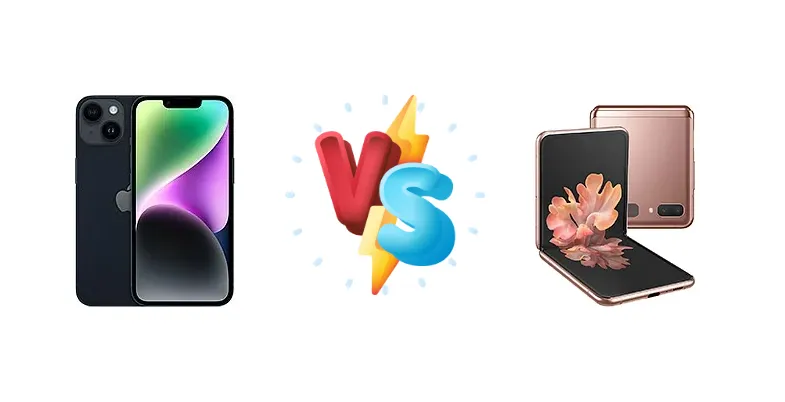
|
🏆 Quick Verdict
For the average user prioritizing consistent performance, long-term software support, and reliable battery life, the iPhone 14 is the stronger choice. Its A15 Bionic chip and 90-hour endurance rating provide a more dependable experience, despite the Z Flip 5G’s innovative design.
| PHONES | ||
|---|---|---|
| Phone Names | Apple iPhone 14 | Samsung Galaxy Z Flip 5G |
| Network | ||
|---|---|---|
| 2G bands | GSM 850 / 900 / 1800 / 1900 | GSM 850 / 900 / 1800 / 1900 |
| 3G bands | HSDPA 850 / 900 / 1700(AWS) / 1900 / 2100 | HSDPA 850 / 900 / 1700(AWS) / 1900 / 2100 - International, Canada |
| 4G bands | 1, 2, 3, 4, 5, 7, 8, 12, 13, 17, 18, 19, 20, 25, 26, 28, 30, 32, 34, 38, 39, 40, 41, 42, 46, 48, 66 - A2882, A2884 | 1, 2, 3, 4, 5, 7, 8, 12, 13, 14, 18, 19, 20, 25, 26, 28, 29, 30, 38, 39, 40, 41, 66, 71 - International |
| 5G bands | 1, 2, 3, 5, 7, 8, 12, 20, 25, 26, 28, 30, 38, 40, 41, 48, 66, 70, 77, 78, 79 SA/NSA/Sub6 - A2882, A2884 | 1, 41, 77, 78, 79 Sub6 - China, Hong Kong |
| Speed | HSPA, LTE, 5G, EV-DO Rev.A 3.1 Mbps | HSPA 42.2/5.76 Mbps, LTE (6CA) Cat20 2000/200 Mbps, 5G |
| Technology | GSM / CDMA / HSPA / EVDO / LTE / 5G | GSM / CDMA / HSPA / EVDO / LTE / 5G |
| 1, 2, 3, 5, 7, 8, 12, 20, 25, 26, 28, 30, 38, 40, 41, 48, 66, 70, 77, 78, 79 SA/NSA/Sub6 - A2883 | 41, 66, 71 Sub6 - Canada | |
| Launch | ||
|---|---|---|
| Announced | 2022, September 07 | 2020, July 22 |
| Status | Available. Released 2022, September 16 | Available. Released 2020, August 07 |
| Body | ||
|---|---|---|
| Build | Glass front, glass back, aluminum frame | Plastic front, glass back (Gorilla Glass 6), aluminum frame |
| Dimensions | 146.7 x 71.5 x 7.8 mm (5.78 x 2.81 x 0.31 in) | Unfolded: 167.3 x 73.6 x 7.2 mm Folded: 87.4 x 73.6 x 17.3 mm |
| SIM | · Nano-SIM + eSIM + eSIM (max 2 at a time; International)· eSIM + eSIM (8 or more, max 2 at a time; USA)· Nano-SIM + Nano-SIM (China) | Nano-SIM + eSIM |
| Weight | 172 g (6.07 oz) | 183 g (6.46 oz) |
| IP68 dust/water resistant (up to 6m for 30 min) Apple Pay (Visa, MasterCard, AMEX certified) | - | |
| Display | ||
|---|---|---|
| Protection | Ceramic Shield glass | - |
| Resolution | 1170 x 2532 pixels, 19.5:9 ratio (~460 ppi density) | 1080 x 2636 pixels (~425 ppi density) |
| Size | 6.1 inches, 90.2 cm2 (~86.0% screen-to-body ratio) | 6.7 inches, 101.6 cm2 (~82.5% screen-to-body ratio) |
| Type | Super Retina XDR OLED, HDR10, Dolby Vision, 800 nits (HBM), 1200 nits (peak) | Foldable Dynamic AMOLED, HDR10+ |
| - | Cover display: Super AMOLED, 1.1 inches, 112 x 300 pixels | |
| Platform | ||
|---|---|---|
| CPU | Hexa-core (2x3.23 GHz Avalanche + 4x1.82 GHz Blizzard) | Octa-core (1x3.09 GHz Cortex-A77 & 3x2.40 GHz Cortex-A77 & 4x1.80 GHz Cortex-A55) |
| Chipset | Apple A15 Bionic (5 nm) | Qualcomm SM8250 Snapdragon 865 5G+ (7 nm+) |
| GPU | Apple GPU (5-core graphics) | Adreno 650 |
| OS | iOS 16, upgradable to iOS 26.1 | Android 10, upgradable to Android 13, One UI 5 |
| Memory | ||
|---|---|---|
| Card slot | No | No |
| Internal | 128GB 6GB RAM, 256GB 6GB RAM, 512GB 6GB RAM | 256GB 8GB RAM |
| NVMe | UFS 3.0 | |
| Main Camera | ||
|---|---|---|
| Dual | 12 MP, f/1.5, 26mm (wide), 1/1.7", 1.9µm, dual pixel PDAF, sensor-shift OIS 12 MP, f/2.4, 13mm, 120˚ (ultrawide) | 12 MP, f/1.8, 27mm (wide), 1/2.55", 1.4µm, dual pixel PDAF, OIS 12 MP, f/2.2, 123˚ (ultrawide), 1.12µm |
| Features | Dual-LED dual-tone flash, HDR (photo/panorama) | LED flash, HDR, panorama |
| Single | 12 MP, f/1.9, 23mm (wide), 1/3.6", PDAF SL 3D, (depth/biometrics sensor) | - |
| Video | 4K@24/25/30/60fps, 1080p@25/30/60/120/240fps, HDR, Dolby Vision HDR (up to 60fps), stereo sound rec. | 4K@30/60fps, 1080p@60/240fps, 720p@960fps, HDR10+ |
| Selfie camera | ||
|---|---|---|
| Features | HDR | HDR |
| Single | 12 MP, f/1.9, 23mm (wide), 1/3.6", 1.0µm, PDAF SL 3D, (depth/biometrics sensor) | 10 MP, f/2.4, 26mm (wide), 1.22µm |
| Video | 4K@24/25/30/60fps, 1080p@25/30/60/120fps, gyro-EIS | 4K@30fps |
| Sound | ||
|---|---|---|
| 3.5mm jack | No | No |
| 35mm jack | No | No |
| Loudspeaker | Yes, with stereo speakers | Yes |
| - | 32-bit/384kHz audio Tuned by AKG | |
| Comms | ||
|---|---|---|
| Bluetooth | 5.3, A2DP, LE | 5.0, A2DP, LE |
| NFC | Yes | Yes |
| Positioning | GPS, GLONASS, GALILEO, BDS, QZSS | GPS, GLONASS, GALILEO, BDS |
| Radio | No | No |
| USB | Lightning, USB 2.0 | USB Type-C 2.0, OTG |
| WLAN | Wi-Fi 802.11 a/b/g/n/ac/6, dual-band, hotspot | Wi-Fi 802.11 a/b/g/n/ac/6, dual-band, Wi-Fi Direct |
| Features | ||
|---|---|---|
| Sensors | Face ID, accelerometer, gyro, proximity, compass, barometer | Fingerprint (side-mounted), accelerometer, gyro, proximity, compass, barometer |
| Ultra Wideband (UWB) support Emergency SOS via satellite (SMS sending/receiving) | Samsung Pay (Visa, MasterCard certified) | |
| Battery | ||
|---|---|---|
| Charging | Wired, PD2.0, 50% in 30 min 15W wireless (MagSafe) 15W wireless (Qi2) - requires iOS 17.2 update | 15W wired 9W wireless |
| Type | Li-Ion 3279 mAh (12.68 Wh) | Li-Po 3300 mAh |
| Misc | ||
|---|---|---|
| Colors | Midnight, Purple, Starlight, Blue, Red, Yellow | Mystic Grey, Mystic Bronze, Mystic White |
| Models | A2882, A2649, A2881, A2884, A2883, iphone14,7 | SM-F707B, SM-F707N, SM-F7070, SM-F707U, SM-F707U1, SM-F707W |
| Price | € 344.00 / $ 277.58 / £ 300.00 / ₹ 64,900 | About 800 EUR |
| SAR | 1.15 W/kg (head) 1.16 W/kg (body) | 0.80 W/kg (head) 1.01 W/kg (body) |
| SAR EU | 0.98 W/kg (head) 0.98 W/kg (body) | 0.80 W/kg (head) 1.45 W/kg (body) |
| Tests | ||
|---|---|---|
| Battery life | Endurance rating 90h | - |
| Camera | Photo / Video | - |
| Display | Contrast ratio: Infinite (nominal) | - |
| Loudspeaker | -25.2 LUFS (Very good) | - |
| Performance | AnTuTu: 817125 (v9) GeekBench: 4761 (v5.1) GFXBench: 60fps (ES 3.1 onscreen) | - |
Apple iPhone 14
- Superior processing power with the A15 Bionic chip.
- Exceptional battery life with a 90-hour endurance rating.
- Excellent video recording capabilities and image processing.
- Traditional smartphone design lacks the novelty of a foldable.
- No expandable storage option.
Samsung Galaxy Z Flip 5G
- Unique and eye-catching foldable design.
- Compact and pocketable form factor when folded.
- Flex Mode allows for hands-free use.
- Less powerful Snapdragon 865 chip compared to the A15 Bionic.
- Shorter battery life and slower charging speeds.
- Potential durability concerns with the folding display.
Display Comparison
The iPhone 14 boasts a measured peak brightness of 804 nits, providing excellent visibility in outdoor conditions. While the Z Flip 5G’s display specifications aren’t provided, Samsung typically excels in color accuracy. However, the Z Flip 5G’s foldable nature introduces a crease, a visual compromise the iPhone 14 avoids. The iPhone 14’s infinite (nominal) contrast ratio ensures deep blacks and vibrant colors, a standard for OLED panels. The Z Flip 5G’s durability is a concern given the folding mechanism, potentially impacting long-term display integrity.
Camera Comparison
Both devices offer photo and video capabilities, but details are limited. The iPhone 14’s image signal processor (ISP), integrated within the A15 Bionic, is known for its excellent dynamic range and color accuracy in both photos and videos. The Z Flip 5G’s camera performance relies heavily on Samsung’s software processing, which often prioritizes vibrant colors. Without sensor size information for the Z Flip 5G, it’s difficult to assess low-light performance, but the iPhone 14 generally excels in this area. The iPhone 14’s video recording capabilities are a significant advantage, offering cinematic mode and ProRes video recording.
Performance
Apple’s A15 Bionic (5nm) chip in the iPhone 14 significantly outperforms the Qualcomm Snapdragon 865 5G+ (7nm+) found in the Z Flip 5G. The A15’s hexa-core architecture (2x3.23 GHz Avalanche + 4x1.82 GHz Blizzard) delivers superior single-core and multi-core performance. The Snapdragon 865’s octa-core configuration, while capable, is built on a less efficient node, potentially leading to more thermal throttling during sustained workloads. The iPhone 14 benefits from Apple’s tight software-hardware integration, optimizing performance and efficiency.
Battery Life
The iPhone 14’s endurance rating of 90 hours is a substantial advantage over the Z Flip 5G. While the Z Flip 5G offers 15W wired and 9W wireless charging, the iPhone 14 supports faster 50% charge in 30 minutes with wired PD2.0, and 15W wireless charging with both MagSafe and Qi2 (requiring iOS 17.2). The smaller battery capacity inherent in the Z Flip 5G’s compact foldable design necessitates more frequent charging, making the iPhone 14 a better choice for users who prioritize battery life.
Buying Guide
Buy the Apple iPhone 14 if you need a phone that ‘just works’ with a proven track record of software updates, excellent video recording capabilities, and all-day battery life. Buy the Samsung Galaxy Z Flip 5G if you prioritize a unique, head-turning design and enjoy the novelty of a foldable form factor, accepting trade-offs in battery and processing power.