
iPhone 14 vs. Samsung Galaxy S23 FE: A Detailed Comparison
| Phones Images | |||||
|---|---|---|---|---|---|
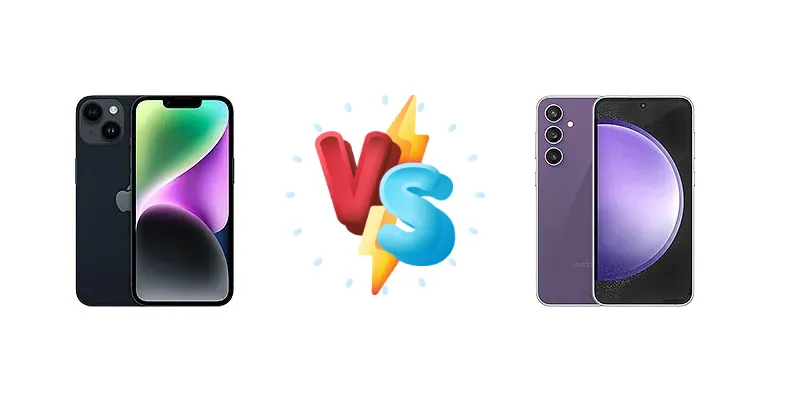
|
🏆 Quick Verdict
For the average user prioritizing a seamless software experience and long-term software support, the iPhone 14 remains a solid choice. However, the Samsung Galaxy S23 FE offers a brighter display, faster charging, and a more versatile camera system for a potentially lower price, making it the winner for value-conscious buyers.
| PHONES | ||
|---|---|---|
| Phone Names | Apple iPhone 14 | Samsung Galaxy S23 FE |
| Network | ||
|---|---|---|
| 2G bands | GSM 850 / 900 / 1800 / 1900 | GSM 850 / 900 / 1800 / 1900 |
| 3G bands | HSDPA 850 / 900 / 1700(AWS) / 1900 / 2100 | HSDPA 850 / 900 / 1700(AWS) / 1900 / 2100 |
| 4G bands | 1, 2, 3, 4, 5, 7, 8, 12, 13, 17, 18, 19, 20, 25, 26, 28, 30, 32, 34, 38, 39, 40, 41, 42, 46, 48, 66 - A2882, A2884 | 1, 2, 3, 4, 5, 7, 8, 12, 13, 17, 20, 26, 28, 38, 40, 41, 66 - International |
| 5G bands | 1, 2, 3, 5, 7, 8, 12, 20, 25, 26, 28, 30, 38, 40, 41, 48, 66, 70, 77, 78, 79 SA/NSA/Sub6 - A2882, A2884 | 1, 2, 3, 5, 7, 8, 20, 28, 38, 40, 41, 66, 77, 78 SA/NSA/Sub6 - International |
| Speed | HSPA, LTE, 5G, EV-DO Rev.A 3.1 Mbps | HSPA, LTE, 5G |
| Technology | GSM / CDMA / HSPA / EVDO / LTE / 5G | GSM / HSPA / LTE / 5G |
| 1, 2, 3, 5, 7, 8, 12, 20, 25, 26, 28, 30, 38, 40, 41, 48, 66, 70, 77, 78, 79 SA/NSA/Sub6 - A2883 | - | |
| Launch | ||
|---|---|---|
| Announced | 2022, September 07 | 2023, October 04 |
| Status | Available. Released 2022, September 16 | Available. Released 2023, October 05 |
| Body | ||
|---|---|---|
| Build | Glass front, glass back, aluminum frame | Glass front (Gorilla Glass 5), glass back (Gorilla Glass 5), aluminum frame |
| Dimensions | 146.7 x 71.5 x 7.8 mm (5.78 x 2.81 x 0.31 in) | 158 x 76.5 x 8.2 mm (6.22 x 3.01 x 0.32 in) |
| SIM | · Nano-SIM + eSIM + eSIM (max 2 at a time; International)· eSIM + eSIM (8 or more, max 2 at a time; USA)· Nano-SIM + Nano-SIM (China) | · Nano-SIM· Nano-SIM + Nano-SIM· Nano-SIM + Nano-SIM + eSIM (max 2 at a time) |
| Weight | 172 g (6.07 oz) | 209 g (7.37 oz) |
| IP68 dust/water resistant (up to 6m for 30 min) Apple Pay (Visa, MasterCard, AMEX certified) | - | |
| Display | ||
|---|---|---|
| Protection | Ceramic Shield glass | Corning Gorilla Glass 5 |
| Resolution | 1170 x 2532 pixels, 19.5:9 ratio (~460 ppi density) | 1080 x 2340 pixels, 19.5:9 ratio (~403 ppi density) |
| Size | 6.1 inches, 90.2 cm2 (~86.0% screen-to-body ratio) | 6.4 inches, 100.5 cm2 (~83.2% screen-to-body ratio) |
| Type | Super Retina XDR OLED, HDR10, Dolby Vision, 800 nits (HBM), 1200 nits (peak) | Dynamic AMOLED 2X, 120Hz, HDR10+, 1450 nits (peak) |
| Platform | ||
|---|---|---|
| CPU | Hexa-core (2x3.23 GHz Avalanche + 4x1.82 GHz Blizzard) | Octa-core (1x2.8 GHz Cortex-X2 & 3x2.50 GHz Cortex-A710 & 4x1.8 GHz Cortex-A510) - InternationalOcta-core (1x3.00 GHz Cortex-X2 & 3x2.50 GHz Cortex-A710 & 4x1.80 GHz Cortex-A510) - USA |
| Chipset | Apple A15 Bionic (5 nm) | Exynos 2200 (4 nm) - InternationalQualcomm SM8450 Snapdragon 8 Gen 1 (4 nm) - USA |
| GPU | Apple GPU (5-core graphics) | Xclipse 920 - InternationalAdreno 730 - USA |
| OS | iOS 16, upgradable to iOS 26.1 | Android 13, up to 4 major Android upgrades, One UI 8 |
| Memory | ||
|---|---|---|
| Card slot | No | No |
| Internal | 128GB 6GB RAM, 256GB 6GB RAM, 512GB 6GB RAM | 128GB 8GB RAM, 256GB 8GB RAM |
| NVMe | - | |
| Main Camera | ||
|---|---|---|
| Dual | 12 MP, f/1.5, 26mm (wide), 1/1.7", 1.9µm, dual pixel PDAF, sensor-shift OIS 12 MP, f/2.4, 13mm, 120˚ (ultrawide) | - |
| Features | Dual-LED dual-tone flash, HDR (photo/panorama) | LED flash, HDR, panorama |
| Single | 12 MP, f/1.9, 23mm (wide), 1/3.6", PDAF SL 3D, (depth/biometrics sensor) | - |
| Triple | - | 50 MP, f/1.8, 23mm (wide), 1/1.57", 1.0µm, dual pixel PDAF, OIS 8 MP, f/2.4, 76mm (telephoto), 1/4.5", 1.0µm, PDAF, OIS, 3x optical zoom 12 MP, f/2.2, 13mm, 123˚ (ultrawide), 1/3.0", 1.12µm |
| Video | 4K@24/25/30/60fps, 1080p@25/30/60/120/240fps, HDR, Dolby Vision HDR (up to 60fps), stereo sound rec. | 8K@24fps, 4K@30/60fps, 1080p@30/60/120/240fps |
| Selfie camera | ||
|---|---|---|
| Features | HDR | - |
| Single | 12 MP, f/1.9, 23mm (wide), 1/3.6", 1.0µm, PDAF SL 3D, (depth/biometrics sensor) | 10 MP, f/2.4, 25mm (wide), 1/3.0", 1.22µm |
| Video | 4K@24/25/30/60fps, 1080p@25/30/60/120fps, gyro-EIS | 4K@30/60fps, 1080p@30/60fps; gyro-EIS |
| Sound | ||
|---|---|---|
| 3.5mm jack | No | - |
| 35mm jack | No | No |
| Loudspeaker | Yes, with stereo speakers | Yes, with stereo speakers |
| Comms | ||
|---|---|---|
| Bluetooth | 5.3, A2DP, LE | 5.3, A2DP, LE |
| NFC | Yes | Yes |
| Positioning | GPS, GLONASS, GALILEO, BDS, QZSS | GPS, GLONASS, GALILEO, BDS |
| Radio | No | Unspecified |
| USB | Lightning, USB 2.0 | USB Type-C, OTG |
| WLAN | Wi-Fi 802.11 a/b/g/n/ac/6, dual-band, hotspot | Wi-Fi 802.11 a/b/g/n/ac/6e, dual-band, Wi-Fi Direct |
| Features | ||
|---|---|---|
| Sensors | Face ID, accelerometer, gyro, proximity, compass, barometer | Fingerprint (under display, optical), accelerometer, gyro, compass |
| Ultra Wideband (UWB) support Emergency SOS via satellite (SMS sending/receiving) | - | |
| Battery | ||
|---|---|---|
| Charging | Wired, PD2.0, 50% in 30 min 15W wireless (MagSafe) 15W wireless (Qi2) - requires iOS 17.2 update | 25W wired, PD3.0, 50% in 30 min 15W wireless Reverse wireless |
| Type | Li-Ion 3279 mAh (12.68 Wh) | Li-Ion 4500 mAh |
| Misc | ||
|---|---|---|
| Colors | Midnight, Purple, Starlight, Blue, Red, Yellow | Mint, Cream, Graphite, Purple, Indigo, Tangerine |
| Models | A2882, A2649, A2881, A2884, A2883, iphone14,7 | SM-S711B, SM-S711B/DS, SM-S711U1, SM-S711U, SM-S711W, SM-S7110, SM-S711N |
| Price | € 344.00 / $ 277.58 / £ 300.00 / ₹ 64,900 | $ 219.95 / C$ 327.90 / £ 248.99 / € 272.00 / ₹ 34,999 |
| SAR | 1.15 W/kg (head) 1.16 W/kg (body) | 0.80 W/kg (head) 0.72 W/kg (body) |
| SAR EU | 0.98 W/kg (head) 0.98 W/kg (body) | 0.76 W/kg (head) 1.04 W/kg (body) |
| Tests | ||
|---|---|---|
| Battery life | Endurance rating 90h | - |
| Camera | Photo / Video | - |
| Display | Contrast ratio: Infinite (nominal) | - |
| Loudspeaker | -25.2 LUFS (Very good) | - |
| Performance | AnTuTu: 817125 (v9) GeekBench: 4761 (v5.1) GFXBench: 60fps (ES 3.1 onscreen) | - |
Apple iPhone 14
- Excellent video recording quality
- Long-term software support
- Optimized performance and software integration
- Lower peak display brightness
- Slower charging speeds
- No telephoto lens
Samsung Galaxy S23 FE
- Brighter display for outdoor visibility
- Faster wired and wireless charging
- More versatile camera system with telephoto lens
- Potentially shorter software support lifecycle
- Exynos variant may experience throttling
- Samsung’s image processing may not appeal to all
Display Comparison
The Samsung Galaxy S23 FE boasts a significantly brighter display, reaching 985 nits measured, compared to the iPhone 14’s 804 nits. This translates to better visibility under direct sunlight. While both offer excellent contrast – the iPhone 14 with its ‘infinite’ (nominal) ratio and the S23 FE likely similar – the S23 FE’s higher peak brightness is a clear advantage. Both lack high refresh rate displays, a notable omission for a flagship-level device. The S23 FE’s panel technology isn’t specified, but it’s likely AMOLED, offering vibrant colors, while the iPhone 14 uses a Super Retina XDR display.
Camera Comparison
Both phones feature capable photo and video cameras, but approach image processing differently. The iPhone 14 is renowned for its natural-looking photos and exceptional video quality. The S23 FE, while offering a versatile camera system, relies more on Samsung’s signature vibrant color processing. Sensor sizes aren’t specified, but the S23 FE likely has a larger main sensor. Both phones offer optical image stabilization (OIS). The S23 FE’s inclusion of a telephoto lens provides additional zoom capabilities absent on the standard iPhone 14. The 2MP macro camera on the S23 FE is largely a marketing feature and offers limited practical benefit.
Performance
The iPhone 14’s A15 Bionic (5nm) chip remains a formidable performer, featuring a hexa-core CPU with high-performance Avalanche cores clocked at 3.23 GHz. However, the Galaxy S23 FE’s chipset varies by region: the Exynos 2200 (4nm) internationally and the Snapdragon 8 Gen 1 (4nm) in the USA. While the Snapdragon 8 Gen 1 generally outperforms the Exynos 2200, both are octa-core processors with a Cortex-X2 prime core. The 4nm process node on both S23 FE chipsets offers improved efficiency over older 5nm designs, but the A15 Bionic’s architectural advantages and software optimization often translate to smoother performance in real-world use. The S23 FE’s RAM configuration isn’t specified, but it’s likely LPDDR5, while the iPhone 14 uses LPDDR5 as well. Thermal management will be a key differentiator, with the Exynos 2200 historically prone to throttling under sustained load.
Battery Life
The Galaxy S23 FE offers faster charging with 25W wired charging (PD3.0) and 15W wireless charging, achieving 50% charge in 30 minutes. The iPhone 14 supports 15W wireless charging via MagSafe and Qi2 (with iOS 17.2) and 50% charge in 30 minutes with wired PD2.0. While the iPhone 14 boasts an endurance rating of 90 hours, this is a lab-based metric. The S23 FE’s active use score of 8:28h provides a more realistic indication of real-world battery performance. The S23 FE also includes reverse wireless charging, a feature absent on the iPhone 14.
Buying Guide
Buy the Apple iPhone 14 if you need a phone with guaranteed long-term software updates, a tightly integrated ecosystem, and prioritize video recording quality. Buy the Samsung Galaxy S23 FE if you prefer a vibrant display, faster charging speeds, and a more customizable Android experience, and are comfortable with a potentially shorter software support lifecycle.