
iPhone 14 vs. Motorola Edge+ (2023): A Deep Dive into Performance, Battery, and Value
| Phones Images | |||||
|---|---|---|---|---|---|
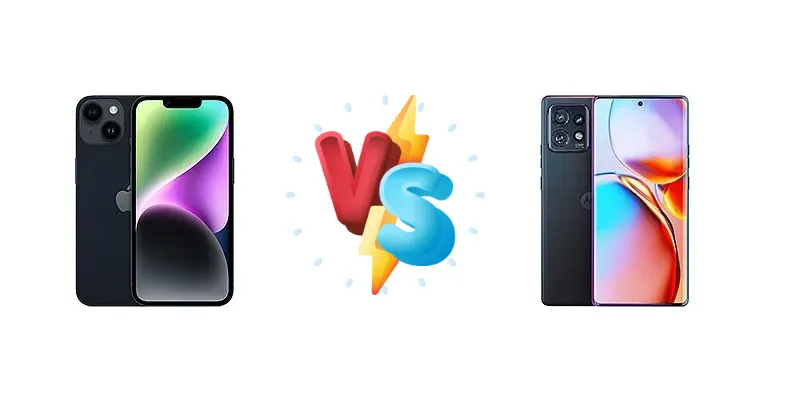
|
🏆 Quick Verdict
For users deeply embedded in the Apple ecosystem prioritizing seamless software integration and long-term support, the iPhone 14 remains a solid choice. However, the Motorola Edge+ (2023) delivers superior charging speeds and raw processing power thanks to the Snapdragon 8 Gen 2, making it the winner for Android enthusiasts and power users.
| PHONES | ||
|---|---|---|
| Phone Names | Apple iPhone 14 | Motorola Edge+ (2023) |
| Network | ||
|---|---|---|
| 2G bands | GSM 850 / 900 / 1800 / 1900 | GSM 850 / 900 / 1800 / 1900 |
| 3G bands | HSDPA 850 / 900 / 1700(AWS) / 1900 / 2100 | HSDPA 850 / 900 / 1700(AWS) / 1900 / 2100 |
| 4G bands | 1, 2, 3, 4, 5, 7, 8, 12, 13, 17, 18, 19, 20, 25, 26, 28, 30, 32, 34, 38, 39, 40, 41, 42, 46, 48, 66 - A2882, A2884 | 1, 2, 3, 4, 5, 7, 8, 12, 13, 14, 17, 18, 20, 25, 26, 28, 29, 30, 38, 39, 40, 41, 41, 46, 48, 66, 71 |
| 5G bands | 1, 2, 3, 5, 7, 8, 12, 20, 25, 26, 28, 30, 38, 40, 41, 48, 66, 70, 77, 78, 79 SA/NSA/Sub6 - A2882, A2884 | 1, 2, 3, 5, 7, 12, 14, 20, 25, 26, 28, 29, 30, 38, 41, 41, 48, 66, 70, 71, 77, 78 SA/NSA/Sub6/mmWave |
| Speed | HSPA, LTE, 5G, EV-DO Rev.A 3.1 Mbps | HSPA, LTE, 5G |
| Technology | GSM / CDMA / HSPA / EVDO / LTE / 5G | GSM / HSPA / LTE / 5G |
| 1, 2, 3, 5, 7, 8, 12, 20, 25, 26, 28, 30, 38, 40, 41, 48, 66, 70, 77, 78, 79 SA/NSA/Sub6 - A2883 | - | |
| Launch | ||
|---|---|---|
| Announced | 2022, September 07 | 2023, May 02 |
| Status | Available. Released 2022, September 16 | Available. Released 2023, May 19 |
| Body | ||
|---|---|---|
| Build | Glass front, glass back, aluminum frame | Glass front (Gorilla Glass Victus), glass back (Gorilla Glass Victus), aluminum frame |
| Dimensions | 146.7 x 71.5 x 7.8 mm (5.78 x 2.81 x 0.31 in) | 161.2 x 74 x 8.6 mm (6.35 x 2.91 x 0.34 in) |
| SIM | · Nano-SIM + eSIM + eSIM (max 2 at a time; International)· eSIM + eSIM (8 or more, max 2 at a time; USA)· Nano-SIM + Nano-SIM (China) | Nano-SIM + eSIM |
| Weight | 172 g (6.07 oz) | 203 g (7.16 oz) |
| IP68 dust/water resistant (up to 6m for 30 min) Apple Pay (Visa, MasterCard, AMEX certified) | IP68 dust/water resistant (up to 1.5m for 30 min) | |
| Display | ||
|---|---|---|
| Protection | Ceramic Shield glass | Corning Gorilla Glass Victus |
| Resolution | 1170 x 2532 pixels, 19.5:9 ratio (~460 ppi density) | 1080 x 2400 pixels, 20:9 ratio (~395 ppi density) |
| Size | 6.1 inches, 90.2 cm2 (~86.0% screen-to-body ratio) | 6.67 inches, 107.4 cm2 (~90.0% screen-to-body ratio) |
| Type | Super Retina XDR OLED, HDR10, Dolby Vision, 800 nits (HBM), 1200 nits (peak) | OLED, 1B colors, 165Hz, HDR10+, Dolby Vision, 1300 nits (peak) |
| Platform | ||
|---|---|---|
| CPU | Hexa-core (2x3.23 GHz Avalanche + 4x1.82 GHz Blizzard) | Octa-core (1x3.2 GHz Cortex-X3 & 2x2.8 GHz Cortex-A715 & 2x2.8 GHz Cortex-A710 & 3x2.0 GHz Cortex-A510) |
| Chipset | Apple A15 Bionic (5 nm) | Qualcomm SM8550-AB Snapdragon 8 Gen 2 (4 nm) |
| GPU | Apple GPU (5-core graphics) | Adreno 740 |
| OS | iOS 16, upgradable to iOS 26.1 | Android 13, upgradable to Android 14 |
| Memory | ||
|---|---|---|
| Card slot | No | No |
| Internal | 128GB 6GB RAM, 256GB 6GB RAM, 512GB 6GB RAM | 512GB 8GB RAM |
| NVMe | UFS 4.0 | |
| Main Camera | ||
|---|---|---|
| Dual | 12 MP, f/1.5, 26mm (wide), 1/1.7", 1.9µm, dual pixel PDAF, sensor-shift OIS 12 MP, f/2.4, 13mm, 120˚ (ultrawide) | - |
| Features | Dual-LED dual-tone flash, HDR (photo/panorama) | Dual-LED flash, panorama, HDR |
| Single | 12 MP, f/1.9, 23mm (wide), 1/3.6", PDAF SL 3D, (depth/biometrics sensor) | - |
| Triple | - | 50 MP, f/1.8, (wide), 1/1.55", 1.0µm, multi-directional PDAF, OIS 12 MP, f/1.6, (telephoto), 1/2.93", 1.22µm, PDAF, 2x optical zoom 50 MP, f/2.2, 114˚ (ultrawide), 1/2.76", 0.64µm, AF |
| Video | 4K@24/25/30/60fps, 1080p@25/30/60/120/240fps, HDR, Dolby Vision HDR (up to 60fps), stereo sound rec. | 8K@30fps, 4K@30/60fps, 1080p@30/60/120/240/960fps, 10-bit HDR10+, gyro-EIS |
| Selfie camera | ||
|---|---|---|
| Features | HDR | HDR |
| Single | 12 MP, f/1.9, 23mm (wide), 1/3.6", 1.0µm, PDAF SL 3D, (depth/biometrics sensor) | 60 MP, f/2.2, (wide), 1/2.8", 0.61µm |
| Video | 4K@24/25/30/60fps, 1080p@25/30/60/120fps, gyro-EIS | 4K@30/60fps, 1080p@30/60/120/240fps |
| Sound | ||
|---|---|---|
| 3.5mm jack | No | No |
| 35mm jack | No | No |
| Loudspeaker | Yes, with stereo speakers | Yes, with stereo speakers |
| Comms | ||
|---|---|---|
| Bluetooth | 5.3, A2DP, LE | 5.3, A2DP, LE, aptX HD, aptX Adaptive |
| NFC | Yes | Yes |
| Positioning | GPS, GLONASS, GALILEO, BDS, QZSS | GPS, GLONASS, GALILEO, BDS |
| Radio | No | No |
| USB | Lightning, USB 2.0 | USB Type-C 3.2, OTG, DisplayPort 1.4 |
| WLAN | Wi-Fi 802.11 a/b/g/n/ac/6, dual-band, hotspot | Wi-Fi 802.11 a/b/g/n/ac/6e/7, tri-band, Wi-Fi Direct |
| Features | ||
|---|---|---|
| Sensors | Face ID, accelerometer, gyro, proximity, compass, barometer | Fingerprint (under display, optical), accelerometer, gyro, proximity, compass, barometer |
| Ultra Wideband (UWB) support Emergency SOS via satellite (SMS sending/receiving) | Ready For 3.5 support | |
| Battery | ||
|---|---|---|
| Charging | Wired, PD2.0, 50% in 30 min 15W wireless (MagSafe) 15W wireless (Qi2) - requires iOS 17.2 update | 68W wired 15W wireless 5W reverse wired 5W reverse wireless |
| Type | Li-Ion 3279 mAh (12.68 Wh) | Li-Po 5100 mAh |
| Misc | ||
|---|---|---|
| Colors | Midnight, Purple, Starlight, Blue, Red, Yellow | Interstellar Black |
| Models | A2882, A2649, A2881, A2884, A2883, iphone14,7 | - |
| Price | € 344.00 / $ 277.58 / £ 300.00 / ₹ 64,900 | $ 298.99 |
| SAR | 1.15 W/kg (head) 1.16 W/kg (body) | - |
| SAR EU | 0.98 W/kg (head) 0.98 W/kg (body) | - |
| Tests | ||
|---|---|---|
| Battery life | Endurance rating 90h | - |
| Camera | Photo / Video | - |
| Display | Contrast ratio: Infinite (nominal) | - |
| Loudspeaker | -25.2 LUFS (Very good) | - |
| Performance | AnTuTu: 817125 (v9) GeekBench: 4761 (v5.1) GFXBench: 60fps (ES 3.1 onscreen) | - |
Apple iPhone 14
- Seamless iOS ecosystem integration
- Long-term software support
- Excellent video recording quality
- Slower charging speeds
- Less powerful processor compared to Snapdragon 8 Gen 2
- Limited customization options
Motorola Edge+ (2023)
- Faster 68W wired charging
- Powerful Snapdragon 8 Gen 2 processor
- Reverse wireless charging
- Android software update consistency can vary
- Less established brand reputation than Apple
- Camera performance may not match iPhone in all scenarios
Display Comparison
The iPhone 14 boasts a display capable of reaching 804 nits of peak brightness, ensuring excellent visibility outdoors. While the Motorola Edge+ (2023) display specs are not provided, Motorola typically utilizes high-quality OLED panels. The iPhone 14’s ‘infinite’ contrast ratio, typical of OLED technology, delivers deep blacks and vibrant colors. The iPhone 14 also supports Qi2 wireless charging, requiring an iOS 17.2 update, while the Edge+ offers 15W wireless charging. The lack of refresh rate information for the Edge+ is a notable omission, but the iPhone 14’s display is a known quantity, offering a consistently excellent viewing experience.
Camera Comparison
Both devices feature capable camera systems, but detailed specifications are limited. The iPhone 14’s camera is known for its excellent video recording capabilities and computational photography. The Motorola Edge+ (2023) likely benefits from the Snapdragon 8 Gen 2’s advanced image signal processor (ISP). Without sensor size or aperture data for the Edge+, it’s difficult to make a direct comparison. However, Motorola has been increasingly focusing on camera quality in its flagship devices, and the Snapdragon 8 Gen 2’s ISP should deliver strong image processing. The iPhone 14’s strength lies in its consistent, reliable image quality and user-friendly camera app.
Performance
The Motorola Edge+ (2023) leverages the Qualcomm Snapdragon 8 Gen 2 (4nm), an octa-core processor with a Cortex-X3 prime core clocked at 3.2 GHz. This architecture is designed for sustained performance and efficiency. In contrast, the iPhone 14 utilizes Apple’s A15 Bionic (5nm) – a hexa-core chip. While the A15 is incredibly capable, the Snapdragon 8 Gen 2’s more modern architecture and 4nm process node generally translate to better thermal efficiency and potentially higher sustained performance, particularly in demanding tasks like gaming. The Edge+’s CPU configuration, with its mix of Cortex-A715 and A710 cores, provides a broader range of performance profiles than the A15’s Avalanche/Blizzard setup.
Battery Life
The iPhone 14 achieves an endurance rating of 90 hours, indicating solid battery life. The Motorola Edge+ (2023) significantly outpaces the iPhone 14 in charging speed, offering 68W wired charging, capable of a full charge in under an hour. The iPhone 14’s wired charging is limited to PD2.0, reaching 50% in 30 minutes. The Edge+ also offers 15W wireless charging and even 5W reverse wired/wireless charging for accessories. While the iPhone 14’s endurance is respectable, the Edge+’s faster charging and reverse charging capabilities provide a more convenient user experience.
Buying Guide
Buy the Apple iPhone 14 if you need a phone with a mature, polished operating system, guaranteed software updates for years to come, and tight integration with other Apple devices. Buy the Motorola Edge+ (2023) if you prioritize raw performance, incredibly fast charging, and a more open Android experience without sacrificing flagship-level features.