
iPhone 14 vs. Google Pixel 7 Pro: A Deep Dive Comparison
| Phones Images | |||||
|---|---|---|---|---|---|
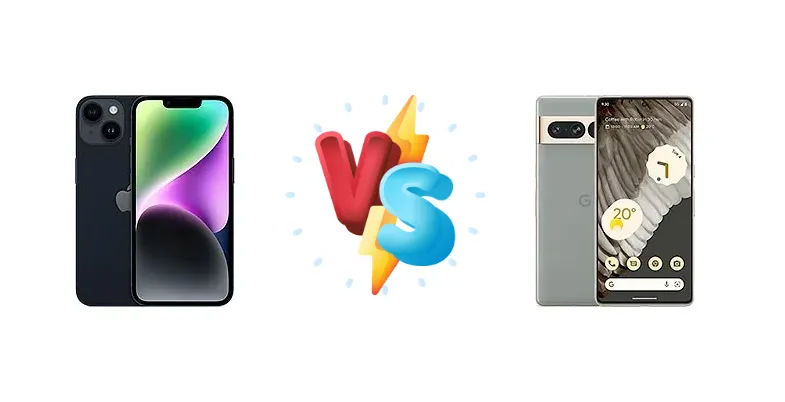
|
🏆 Quick Verdict
For the average user prioritizing a seamless experience and strong resale value, the iPhone 14 emerges as the winner. While the Pixel 7 Pro boasts a brighter display and faster wireless charging, the iPhone 14’s optimized software and established ecosystem provide a more polished overall experience.
| PHONES | ||
|---|---|---|
| Phone Names | Apple iPhone 14 | Google Pixel 7 Pro |
| Network | ||
|---|---|---|
| 2G bands | GSM 850 / 900 / 1800 / 1900 | GSM 850 / 900 / 1800 / 1900 |
| 3G bands | HSDPA 850 / 900 / 1700(AWS) / 1900 / 2100 | HSDPA 800 / 850 / 900 / 1700(AWS) / 1900 / 2100 |
| 4G bands | 1, 2, 3, 4, 5, 7, 8, 12, 13, 17, 18, 19, 20, 25, 26, 28, 30, 32, 34, 38, 39, 40, 41, 42, 46, 48, 66 - A2882, A2884 | 1, 2, 3, 4, 5, 7, 8, 12, 13, 14, 17, 18, 19, 20, 25, 26, 28, 29, 30, 38, 39, 40, 41, 42, 46, 48, 66, 71 - GE2AE |
| 5G bands | 1, 2, 3, 5, 7, 8, 12, 20, 25, 26, 28, 30, 38, 40, 41, 48, 66, 70, 77, 78, 79 SA/NSA/Sub6 - A2882, A2884 | 1, 2, 3, 5, 7, 8, 12, 14, 20, 25, 28, 30, 38, 40, 41, 48, 66, 71, 77, 78, 257, 258, 260, 261 SA/NSA/Sub6/mmWave - GE2AE |
| Speed | HSPA, LTE, 5G, EV-DO Rev.A 3.1 Mbps | HSPA, LTE, 5G |
| Technology | GSM / CDMA / HSPA / EVDO / LTE / 5G | GSM / CDMA / HSPA / EVDO / LTE / 5G |
| 1, 2, 3, 5, 7, 8, 12, 20, 25, 26, 28, 30, 38, 40, 41, 48, 66, 70, 77, 78, 79 SA/NSA/Sub6 - A2883 | 1, 2, 3, 5, 7, 8, 12, 14, 20, 25, 28, 30, 38, 40, 41, 48, 66, 71, 75, 76, 77, 78 SA/NSA/Sub6 - GP4BC | |
| Launch | ||
|---|---|---|
| Announced | 2022, September 07 | 2022, October 06 |
| Status | Available. Released 2022, September 16 | Available. Released 2022, October 13 |
| Body | ||
|---|---|---|
| Build | Glass front, glass back, aluminum frame | Glass front (Gorilla Glass Victus), glass back (Gorilla Glass Victus), aluminum frame |
| Dimensions | 146.7 x 71.5 x 7.8 mm (5.78 x 2.81 x 0.31 in) | 162.9 x 76.6 x 8.9 mm (6.41 x 3.02 x 0.35 in) |
| SIM | · Nano-SIM + eSIM + eSIM (max 2 at a time; International)· eSIM + eSIM (8 or more, max 2 at a time; USA)· Nano-SIM + Nano-SIM (China) | Nano-SIM + eSIM |
| Weight | 172 g (6.07 oz) | 212 g (7.48 oz) |
| IP68 dust/water resistant (up to 6m for 30 min) Apple Pay (Visa, MasterCard, AMEX certified) | IP68 dust/water resistant (up to 1.5m for 30 min) | |
| Display | ||
|---|---|---|
| Protection | Ceramic Shield glass | Corning Gorilla Glass Victus |
| Resolution | 1170 x 2532 pixels, 19.5:9 ratio (~460 ppi density) | 1440 x 3120 pixels, 19.5:9 ratio (~512 ppi density) |
| Size | 6.1 inches, 90.2 cm2 (~86.0% screen-to-body ratio) | 6.7 inches, 110.6 cm2 (~88.7% screen-to-body ratio) |
| Type | Super Retina XDR OLED, HDR10, Dolby Vision, 800 nits (HBM), 1200 nits (peak) | LTPO AMOLED, 120Hz, HDR10+, 1000 nits (HBM), 1500 nits (peak) |
| - | Always-on display | |
| Platform | ||
|---|---|---|
| CPU | Hexa-core (2x3.23 GHz Avalanche + 4x1.82 GHz Blizzard) | Octa-core (2x2.85 GHz Cortex-X1 & 2x2.35 GHz Cortex-A78 & 4x1.80 GHz Cortex-A55) |
| Chipset | Apple A15 Bionic (5 nm) | Google Tensor G2 (5 nm) |
| GPU | Apple GPU (5-core graphics) | Mali-G710 MP7 |
| OS | iOS 16, upgradable to iOS 26.1 | Android 13, upgradable to Android 15, up to 5 major Android upgrades |
| Memory | ||
|---|---|---|
| Card slot | No | No |
| Internal | 128GB 6GB RAM, 256GB 6GB RAM, 512GB 6GB RAM | 128GB 8GB RAM, 256GB 8GB RAM, 128GB 12GB RAM, 256GB 12GB RAM, 512GB 12GB RAM |
| NVMe | UFS 3.1 | |
| Main Camera | ||
|---|---|---|
| Dual | 12 MP, f/1.5, 26mm (wide), 1/1.7", 1.9µm, dual pixel PDAF, sensor-shift OIS 12 MP, f/2.4, 13mm, 120˚ (ultrawide) | - |
| Features | Dual-LED dual-tone flash, HDR (photo/panorama) | Laser AF, Dual-LED flash, Pixel Shift, Auto-HDR, panorama |
| Single | 12 MP, f/1.9, 23mm (wide), 1/3.6", PDAF SL 3D, (depth/biometrics sensor) | 10.8 MP, f/2.2, 21mm (ultrawide), 1/3.1", 1.22µm |
| Triple | - | 50 MP, f/1.9, 25mm (wide), 1/1.31", 1.2µm, dual pixel PDAF, OIS 48 MP, f/3.5, 120mm (periscope telephoto), 1/2.55", 0.7µm, dual pixel PDAF, OIS, 5x optical zoom 12 MP, f/2.2, 126˚ (ultrawide), 1/2.9", 1.25µm, AF |
| Video | 4K@24/25/30/60fps, 1080p@25/30/60/120/240fps, HDR, Dolby Vision HDR (up to 60fps), stereo sound rec. | 4K@30/60fps, 1080p@30/60/120/240fps; gyro-EIS, OIS, 10-bit HDR |
| Selfie camera | ||
|---|---|---|
| Features | HDR | HDR, panorama |
| Single | 12 MP, f/1.9, 23mm (wide), 1/3.6", 1.0µm, PDAF SL 3D, (depth/biometrics sensor) | 10.8 MP, f/2.2, 21mm (ultrawide), 1/3.1", 1.22µm |
| Video | 4K@24/25/30/60fps, 1080p@25/30/60/120fps, gyro-EIS | 4K@30/60fps, 1080p@30/60fps |
| Sound | ||
|---|---|---|
| 3.5mm jack | No | No |
| 35mm jack | No | No |
| Loudspeaker | Yes, with stereo speakers | Yes, with stereo speakers |
| Comms | ||
|---|---|---|
| Bluetooth | 5.3, A2DP, LE | 5.2, A2DP, LE, aptX HD |
| NFC | Yes | Yes |
| Positioning | GPS, GLONASS, GALILEO, BDS, QZSS | GPS (L1+L5), GLONASS (G1), BDS (B1I+B1c+B2a), GALILEO (E1+E5a), QZSS (L1+L5) |
| Radio | No | No |
| USB | Lightning, USB 2.0 | USB Type-C 3.2 |
| WLAN | Wi-Fi 802.11 a/b/g/n/ac/6, dual-band, hotspot | Wi-Fi 802.11 a/b/g/n/ac/6e, tri-band, Wi-Fi Direct |
| Features | ||
|---|---|---|
| Sensors | Face ID, accelerometer, gyro, proximity, compass, barometer | Fingerprint (under display, optical), accelerometer, gyro, proximity, compass, barometer |
| Ultra Wideband (UWB) support Emergency SOS via satellite (SMS sending/receiving) | Ultra Wideband (UWB) support | |
| Battery | ||
|---|---|---|
| Charging | Wired, PD2.0, 50% in 30 min 15W wireless (MagSafe) 15W wireless (Qi2) - requires iOS 17.2 update | 23W wired, PD3.0, 50% in 30 min 23W wireless Reverse wireless |
| Type | Li-Ion 3279 mAh (12.68 Wh) | Li-Ion 5000 mAh |
| Misc | ||
|---|---|---|
| Colors | Midnight, Purple, Starlight, Blue, Red, Yellow | Obsidian, Snow, Hazel |
| Models | A2882, A2649, A2881, A2884, A2883, iphone14,7 | GP4BC, GE2AE, GFE4J |
| Price | € 344.00 / $ 277.58 / £ 300.00 / ₹ 64,900 | € 248.84 / $ 204.00 / £ 259.99 / ₹ 36,999 |
| SAR | 1.15 W/kg (head) 1.16 W/kg (body) | - |
| SAR EU | 0.98 W/kg (head) 0.98 W/kg (body) | - |
| Tests | ||
|---|---|---|
| Battery life | Endurance rating 90h | Endurance rating 83h |
| Camera | Photo / Video | Photo / Video |
| Display | Contrast ratio: Infinite (nominal) | Contrast ratio: Infinite (nominal) |
| Loudspeaker | -25.2 LUFS (Very good) | -24.8 LUFS (Very good) |
| Performance | AnTuTu: 817125 (v9) GeekBench: 4761 (v5.1) GFXBench: 60fps (ES 3.1 onscreen) | AnTuTu: 796369 (v9) GeekBench: 3187 (v5.1) GFXBench: 34fps (ES 3.1 onscreen) |
Apple iPhone 14
- Mature and stable iOS ecosystem
- Excellent video recording capabilities
- Strong resale value
- Lower peak display brightness
- Slower wired charging compared to Pixel 7 Pro
- Less customizable software
Google Pixel 7 Pro
- Brighter display for outdoor visibility
- AI-powered camera features (Magic Eraser, Photo Unblur)
- Faster wired and wireless charging
- Android ecosystem fragmentation
- Software updates may be less consistent
- Potentially lower resale value
Display Comparison
The Pixel 7 Pro’s 6.7-inch display significantly outshines the iPhone 14’s in peak brightness, reaching 1090 nits compared to the iPhone’s 804 nits. This translates to superior visibility under direct sunlight. Both displays share an infinite (nominal) contrast ratio, but the Pixel 7 Pro’s higher brightness is a tangible advantage for outdoor users. While both support wireless charging, the Pixel 7 Pro’s Qi2 support (requiring iOS 17.2 on the iPhone 14) offers a potentially more efficient wireless charging experience in the future.
Camera Comparison
Both phones excel in photography and videography, but approach it differently. The iPhone 14 is renowned for its cinematic mode and consistently high-quality video recording. The Pixel 7 Pro leverages Google’s computational photography prowess, offering features like Magic Eraser and Photo Unblur. While specific sensor details are not provided, the Pixel 7 Pro’s image processing algorithms often produce more vibrant and detailed images, particularly in challenging lighting conditions. The iPhone 14’s strength lies in its natural color reproduction and video stabilization. Both offer excellent image quality, but the Pixel 7 Pro’s AI-driven features provide a unique advantage.
Performance
The iPhone 14’s Apple A15 Bionic, a 5nm chip with a hexa-core CPU, delivers consistently strong performance. However, the Pixel 7 Pro’s Google Tensor G2, also a 5nm chip but with an octa-core CPU, focuses on AI and machine learning tasks. While the A15 Bionic generally benchmarks higher in raw CPU power, the Tensor G2 excels in tasks like image processing and voice recognition. The A15’s 2x3.23 GHz Avalanche cores provide a performance edge in bursty workloads, but the Tensor G2’s broader core configuration may offer better sustained performance in certain scenarios. Both utilize efficient 5nm fabrication, but the architectural differences dictate their strengths.
Battery Life
The iPhone 14 boasts an endurance rating of 90 hours, slightly surpassing the Pixel 7 Pro’s 83 hours. However, the Pixel 7 Pro offers faster wired charging at 23W (PD3.0) compared to the iPhone 14’s 20W (PD2.0), both achieving 50% charge in 30 minutes. The Pixel 7 Pro also supports 23W wireless charging and reverse wireless charging, features absent on the iPhone 14. While the iPhone 14 has a slight edge in overall endurance, the Pixel 7 Pro’s faster and more versatile charging options provide greater convenience.
Buying Guide
Buy the Apple iPhone 14 if you need a phone with a mature ecosystem, guaranteed software updates for years to come, and prioritize video recording quality. Buy the Google Pixel 7 Pro if you prefer a more customizable Android experience, cutting-edge camera features powered by AI, and a significantly brighter display for outdoor visibility.