
iPhone 14 Pro vs Xiaomi 13 Pro: Which Flagship Reigns Supreme?
| Phones Images | |||||
|---|---|---|---|---|---|
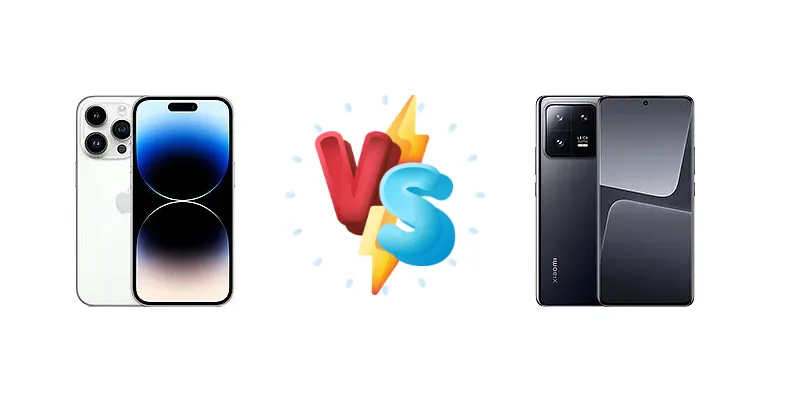
|
🏆 Quick Verdict
For the average user prioritizing all-day battery life and rapid charging, the Xiaomi 13 Pro emerges as the winner. Its 115-hour endurance rating and 120W charging significantly outperform the iPhone 14 Pro’s 86-hour rating and slower charging speeds. However, the iPhone 14 Pro remains a compelling choice for those deeply embedded in the Apple ecosystem.
| PHONES | ||
|---|---|---|
| Phone Names | Apple iPhone 14 Pro | Xiaomi 13 Pro |
| Network | ||
|---|---|---|
| 2G bands | GSM 850 / 900 / 1800 / 1900 | GSM 850 / 900 / 1800 / 1900 |
| 3G bands | HSDPA 850 / 900 / 1700(AWS) / 1900 / 2100 | HSDPA 800 / 850 / 900 / 1700(AWS) / 1900 / 2100 |
| 4G bands | 1, 2, 3, 4, 5, 7, 8, 12, 13, 17, 18, 19, 20, 25, 26, 28, 30, 32, 34, 38, 39, 40, 41, 42, 46, 48, 66 - A2890, A2892 | 1, 2, 3, 4, 5, 7, 8, 12, 13, 17, 18, 19, 20, 25, 26, 28, 32, 38, 39, 40, 41, 42, 48, 66 - International |
| 5G bands | 1, 2, 3, 5, 7, 8, 12, 20, 25, 26, 28, 30, 38, 40, 41, 48, 66, 70, 77, 78, 79 SA/NSA/Sub6 - A2890, A2892 | 1, 3, 5, 7, 8, 20, 28, 38, 40, 41, 66, 71, 75, 77, 78 SA/NSA - International |
| Speed | HSPA, LTE, 5G, EV-DO Rev.A 3.1 Mbps | HSPA, LTE, 5G |
| Technology | GSM / CDMA / HSPA / EVDO / LTE / 5G | GSM / CDMA / HSPA / CDMA2000 / LTE / 5G |
| 1, 2, 3, 5, 7, 8, 12, 20, 25, 26, 28, 30, 38, 40, 41, 48, 66, 70, 77, 78, 79 SA/NSA/Sub6 - A2891 | 1, 3, 5, 8, 28, 38, 40, 41, 77, 78, 79 SA/NSA - China | |
| Launch | ||
|---|---|---|
| Announced | 2022, September 07 | 2022, December 11 |
| Status | Available. Released 2022, September 16 | Available. Released 2022, December 14 |
| Body | ||
|---|---|---|
| Build | Glass front, glass back, stainless steel frame | Glass front (Gorilla Glass Victus), ceramic back or silicone polymer back, aluminum frame |
| Dimensions | 147.5 x 71.5 x 7.9 mm (5.81 x 2.81 x 0.31 in) | 162.9 x 74.6 x 8.4 mm or 8.7 mm |
| SIM | · Nano-SIM + eSIM + eSIM (max 2 at a time; International)· eSIM + eSIM (8 or more, max 2 at a time; USA)· Nano-SIM + Nano-SIM (China) | · Nano-SIM + eSIM· Nano-SIM + Nano-SIM |
| Weight | 206 g (7.27 oz) | 210 g or 229 g (7.41 oz) |
| IP68 dust/water resistant (up to 6m for 30 min) Apple Pay (Visa, MasterCard, AMEX certified) | IP68 dust/water resistant (up to 1.5m for 30 min) | |
| Display | ||
|---|---|---|
| Protection | Ceramic Shield glass | Corning Gorilla Glass Victus |
| Resolution | 1179 x 2556 pixels, 19.5:9 ratio (~460 ppi density) | 1440 x 3200 pixels, 20:9 ratio (~522 ppi density) |
| Size | 6.1 inches, 91.7 cm2 (~87.0% screen-to-body ratio) | 6.73 inches, 108.9 cm2 (~89.6% screen-to-body ratio) |
| Type | LTPO Super Retina XDR OLED, 120Hz, HDR10, Dolby Vision, 1000 nits (typ), 2000 nits (HBM) | LTPO AMOLED, 1B colors, 120Hz, Dolby Vision, HDR10+, 1200 nits (HBM), 1900 nits (peak) |
| Always-On display | - | |
| Platform | ||
|---|---|---|
| CPU | Hexa-core (2x3.46 GHz Everest + 4x2.02 GHz Sawtooth) | Octa-core (1x3.2 GHz Cortex-X3 & 2x2.8 GHz Cortex-A715 & 2x2.8 GHz Cortex-A710 & 3x2.0 GHz Cortex-A510) |
| Chipset | Apple A16 Bionic (4 nm) | Qualcomm SM8550-AB Snapdragon 8 Gen 2 (4 nm) |
| GPU | Apple GPU (5-core graphics) | Adreno 740 |
| OS | iOS 16, upgradable to iOS 26.1 | Android 13, upgradable to Android 14, HyperOS |
| Memory | ||
|---|---|---|
| Card slot | No | No |
| Internal | 128GB 6GB RAM, 256GB 6GB RAM, 512GB 6GB RAM, 1TB 6GB RAM | 128GB 8GB RAM, 256GB 8GB RAM, 256GB 12GB RAM, 512GB 12GB RAM |
| NVMe | UFS 3.1 - 128GB UFS 4.0 - 256/512GB | |
| Main Camera | ||
|---|---|---|
| Features | Dual-LED dual-tone flash, HDR (photo/panorama) | Laser AF, color spectrum sensor, Leica lens, Dual-LED dual-tone flash, HDR, panorama |
| Single | 12 MP, f/1.9, 23mm (wide), 1/3.6", PDAF, OIS (unconfirmed) SL 3D, (depth/biometrics sensor) | - |
| Triple | 48 MP, f/1.8, 24mm (wide), 1/1.28", 1.22µm, dual pixel PDAF, sensor-shift OIS 12 MP, f/2.8, 77mm (telephoto), 1/3.5", 1.0µm, PDAF, OIS, 3x optical zoom 12 MP, f/2.2, 13mm, 120˚ (ultrawide), 1/2.55", 1.4µm, dual pixel PDAF TOF 3D LiDAR scanner (depth) | 50.3 MP, f/1.9, 23mm (wide), 1.0"-type, 1.6µm, dual pixel PDAF, OIS 50 MP, f/2.0, 75mm (telephoto), PDAF (10cm - ∞), 3.2x optical zoom 50 MP, f/2.2, 14mm, 115˚ (ultrawide), AF |
| Video | 4K@24/25/30/60fps, 1080p@25/30/60/120/240fps, 10-bit HDR, Dolby Vision HDR (up to 60fps), ProRes, stereo sound rec. | 8K@24fps (HDR), 4K@24/30/60fps (HDR10+, 10-bit Dolby Vision HDR, 10-bit LOG), 1080p@30/120/240/960fps, 1080p@1920fps, gyro-EIS |
| Selfie camera | ||
|---|---|---|
| Features | HDR | HDR, panorama |
| Single | 12 MP, f/1.9, 23mm (wide), 1/3.6", 1.0µm, PDAF, OIS SL 3D, (depth/biometrics sensor) | 32 MP, f/2.0, 22mm (wide), 1/3.14", 0.7µm |
| Video | 4K@24/25/30/60fps, 1080p@25/30/60/120fps, gyro-EIS | 1080p@30fps |
| Sound | ||
|---|---|---|
| 3.5mm jack | No | No |
| 35mm jack | No | No |
| Loudspeaker | Yes, with stereo speakers | Yes, with stereo speakers |
| - | 24-bit/192kHz audio | |
| Comms | ||
|---|---|---|
| Bluetooth | 5.3, A2DP, LE | 5.3, A2DP, aptX HD, aptX Adaptive |
| Infrared port | - | Yes |
| NFC | Yes | Yes |
| Positioning | GPS (L1+L5), GLONASS, GALILEO, BDS, QZSS | GPS (L1+L5), GLONASS (G1), BDS (B1I+B1c+B2a), GALILEO (E1+E5a), QZSS (L1+L5), NavIC (L5) |
| Radio | No | No |
| USB | Lightning, USB 2.0 | USB Type-C 2.0, OTG |
| WLAN | Wi-Fi 802.11 a/b/g/n/ac/6, dual-band, hotspot | Wi-Fi 802.11 a/b/g/n/ac/6e, dual-band, Wi-Fi Direct |
| Features | ||
|---|---|---|
| Sensors | Face ID, accelerometer, gyro, proximity, compass, barometer | Fingerprint (under display, optical), accelerometer, proximity, gyro, compass, barometer |
| Ultra Wideband (UWB) support Emergency SOS via satellite (SMS sending/receiving) | - | |
| Battery | ||
|---|---|---|
| Charging | Wired, PD2.0, 50% in 30 min 15W wireless (MagSafe) 15W wireless (Qi2) - requires iOS 17.2 update | 120W wired, PD3.0, QC4, 100% in 19 min 50W wireless, 100% in 36 min 10W reverse wireless |
| Type | Li-Ion 3200 mAh (12.38 Wh) | Li-Po 4820 mAh |
| Misc | ||
|---|---|---|
| Colors | Space Black, Silver, Gold, Deep Purple | Ceramic White, Ceramic Black, Ceramic Flora Green, Mountain Blue |
| Models | A2890, A2650, A2889, A2892, iphone15,2 | 2210132G, 2210132C |
| Price | $ 395.67 / C$ 693.35 / £ 403.99 / € 492.99 | About 750 EUR |
| SAR | 1.15 W/kg (head) 1.15 W/kg (body) | - |
| SAR EU | 0.98 W/kg (head) 0.98 W/kg (body) | - |
| Tests | ||
|---|---|---|
| Battery life | Endurance rating 86h | Endurance rating 115h |
| Camera | Photo / Video | Photo / Video |
| Display | Contrast ratio: Infinite (nominal) | Contrast ratio: Infinite (nominal) |
| Loudspeaker | -26.2 LUFS (Good) | -25.6 LUFS (Very good) |
| Performance | AnTuTu: 968412 (v9) GeekBench: 5346 (v5.1) GFXBench: 60fps (ES 3.1 onscreen) | AnTuTu: 1281666 (v9) GeekBench: 5087 (v5.1), 5323 (v6) GFXBench: 64fps (ES 3.1 onscreen) |
Apple iPhone 14 Pro
- Superior peak display brightness for outdoor visibility
- Seamless integration within the Apple ecosystem
- Mature and well-supported iOS software
- Slower charging speeds compared to Xiaomi 13 Pro
- Lower battery endurance rating
- Less customizable software experience
Xiaomi 13 Pro
- Significantly faster 120W wired charging
- Longer battery life with 115-hour endurance rating
- More versatile Android operating system
- Lower peak display brightness
- Software experience may not be as refined as iOS
- Potential for software update delays compared to Apple
Display Comparison
Both the iPhone 14 Pro and Xiaomi 13 Pro boast 'Infinite' contrast ratios, typical of OLED panels. However, the iPhone 14 Pro edges out the Xiaomi 13 Pro in peak brightness, achieving a measured 1791 nits compared to the Xiaomi’s 1253 nits. This translates to superior visibility in direct sunlight. While both likely employ LTPO technology for adaptive refresh rates (not explicitly stated in the data), the iPhone’s higher peak brightness is a tangible advantage for outdoor use. The iPhone 14 Pro’s ProMotion technology, dynamically adjusting up to 120Hz, is likely more refined due to Apple’s tighter hardware-software integration.
Camera Comparison
Both phones feature capable camera systems, but the provided data lacks specifics beyond 'Photo / Video' capabilities. However, Xiaomi’s flagship phones are known for pushing sensor technology, and it’s reasonable to assume the 13 Pro features a larger main sensor than the iPhone 14 Pro. The Snapdragon 8 Gen 2’s ISP (Image Signal Processor) is also a strong performer, capable of handling complex image processing tasks. Apple’s strength lies in its computational photography, delivering consistently pleasing results with excellent dynamic range and color accuracy. Without detailed sensor specs, it’s difficult to definitively declare a winner, but Xiaomi’s history suggests a hardware advantage.
Performance
The chipset battle pits Apple’s hexa-core A16 Bionic (4nm) against Qualcomm’s octa-core Snapdragon 8 Gen 2 (4nm). While core count differs, both are built on a 4nm process, suggesting comparable efficiency. The A16 Bionic’s architecture – 2x3.46 GHz Everest + 4x2.02 GHz Sawtooth – focuses on high-performance cores, while the Snapdragon 8 Gen 2 utilizes a more diverse configuration with a Cortex-X3 prime core, Cortex-A715 and A710 performance cores, and Cortex-A510 efficiency cores. This suggests the Snapdragon 8 Gen 2 may offer better sustained performance under heavy, multi-threaded workloads. The Xiaomi 13 Pro benefits from the Snapdragon’s superior modem capabilities, potentially offering faster and more reliable 5G connectivity.
Battery Life
The Xiaomi 13 Pro decisively wins the battery battle. Its endurance rating of 115 hours significantly surpasses the iPhone 14 Pro’s 86 hours. This is further bolstered by the Xiaomi’s charging prowess: 120W wired charging, achieving 100% in just 19 minutes, versus the iPhone’s slower PD2.0 charging (50% in 30 minutes). The Xiaomi also offers 50W wireless charging (full charge in 36 minutes) and 10W reverse wireless charging, features absent on the iPhone. While the iPhone 14 Pro supports 15W wireless charging via MagSafe and Qi2 (with iOS 17.2), it’s considerably slower than the Xiaomi’s options.
Buying Guide
Buy the Apple iPhone 14 Pro if you need seamless integration with other Apple devices, prioritize a mature software ecosystem with long-term support, and value Apple’s established brand reputation. Buy the Xiaomi 13 Pro if you prefer faster charging, longer battery life, a more customizable Android experience, and are comfortable with a potentially less refined software experience.