
iPhone 14 Pro vs. Sony Xperia 1 VII: A Battle of Ecosystems and Engineering
| Phones Images | |||||
|---|---|---|---|---|---|
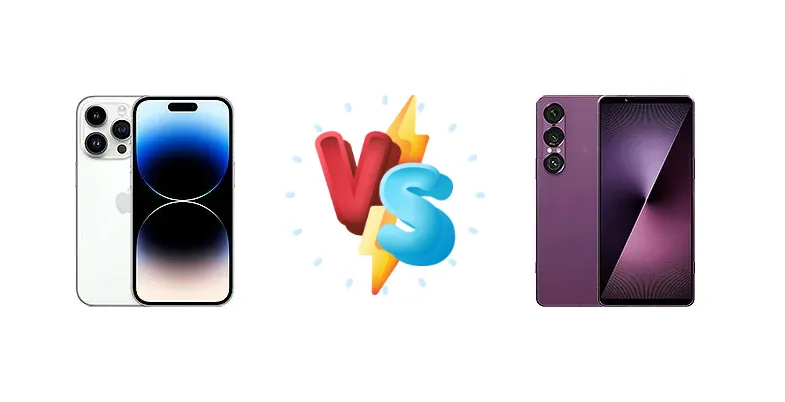
|
🏆 Quick Verdict
For the average user prioritizing seamless ecosystem integration and consistently excellent video recording, the iPhone 14 Pro remains the stronger choice. However, the Sony Xperia 1 VII’s superior battery endurance, faster charging, and more open Android platform make it compelling for power users and photography enthusiasts.
| PHONES | ||
|---|---|---|
| Phone Names | Apple iPhone 14 Pro | Sony Xperia 1 VII |
| Network | ||
|---|---|---|
| 2G bands | GSM 850 / 900 / 1800 / 1900 | GSM 850 / 900 / 1800 / 1900 |
| 3G bands | HSDPA 850 / 900 / 1700(AWS) / 1900 / 2100 | HSDPA 800 / 850 / 900 / 1700(AWS) / 1900 / 2100 |
| 4G bands | 1, 2, 3, 4, 5, 7, 8, 12, 13, 17, 18, 19, 20, 25, 26, 28, 30, 32, 34, 38, 39, 40, 41, 42, 46, 48, 66 - A2890, A2892 | 1, 2, 3, 4, 5, 7, 8, 12, 13, 17, 19, 20, 25, 26, 28, 32, 34, 38, 39, 40, 41, 66 - Europe |
| 5G bands | 1, 2, 3, 5, 7, 8, 12, 20, 25, 26, 28, 30, 38, 40, 41, 48, 66, 70, 77, 78, 79 SA/NSA/Sub6 - A2890, A2892 | 1, 3, 5, 7, 8, 20, 28, 38, 40, 41, 75, 77, 78 SA/NSA/Sub6 - Europe |
| Speed | HSPA, LTE, 5G, EV-DO Rev.A 3.1 Mbps | HSPA, LTE, 5G |
| Technology | GSM / CDMA / HSPA / EVDO / LTE / 5G | GSM / HSPA / LTE / 5G |
| 1, 2, 3, 5, 7, 8, 12, 20, 25, 26, 28, 30, 38, 40, 41, 48, 66, 70, 77, 78, 79 SA/NSA/Sub6 - A2891 | - | |
| Launch | ||
|---|---|---|
| Announced | 2022, September 07 | 2025, May 13 |
| Status | Available. Released 2022, September 16 | Available. Released 2025, June 04 |
| Body | ||
|---|---|---|
| Build | Glass front, glass back, stainless steel frame | Glass front (Gorilla Glass Victus 2), glass back (Gorilla Glass Victus), aluminum frame |
| Dimensions | 147.5 x 71.5 x 7.9 mm (5.81 x 2.81 x 0.31 in) | 162 x 74 x 8.2 mm (6.38 x 2.91 x 0.32 in) |
| SIM | · Nano-SIM + eSIM + eSIM (max 2 at a time; International)· eSIM + eSIM (8 or more, max 2 at a time; USA)· Nano-SIM + Nano-SIM (China) | · Nano-SIM + eSIM· Nano-SIM + Nano-SIM |
| Weight | 206 g (7.27 oz) | 197 g (6.95 oz) |
| IP68 dust/water resistant (up to 6m for 30 min) Apple Pay (Visa, MasterCard, AMEX certified) | - | |
| Display | ||
|---|---|---|
| Protection | Ceramic Shield glass | Corning Gorilla Glass Victus 2, Mohs level 5 |
| Resolution | 1179 x 2556 pixels, 19.5:9 ratio (~460 ppi density) | 1080 x 2340 pixels, 19.5:9 ratio (~396 ppi density) |
| Size | 6.1 inches, 91.7 cm2 (~87.0% screen-to-body ratio) | 6.5 inches, 103.7 cm2 (~86.5% screen-to-body ratio) |
| Type | LTPO Super Retina XDR OLED, 120Hz, HDR10, Dolby Vision, 1000 nits (typ), 2000 nits (HBM) | LTPO OLED, 1B colors, 120Hz, HDR BT.2020 |
| Always-On display | - | |
| Platform | ||
|---|---|---|
| CPU | Hexa-core (2x3.46 GHz Everest + 4x2.02 GHz Sawtooth) | Octa-core (2x4.32 GHz Oryon V2 Phoenix L + 6x3.53 GHz Oryon V2 Phoenix M) |
| Chipset | Apple A16 Bionic (4 nm) | Qualcomm SM8750-AB Snapdragon 8 Elite (3 nm) |
| GPU | Apple GPU (5-core graphics) | Adreno 830 |
| OS | iOS 16, upgradable to iOS 26.1 | Android 15, up to 4 major Android upgrades |
| Memory | ||
|---|---|---|
| Card slot | No | microSDXC (uses shared SIM slot) |
| Internal | 128GB 6GB RAM, 256GB 6GB RAM, 512GB 6GB RAM, 1TB 6GB RAM | 256GB 12GB RAM, 512GB 12GB RAM |
| NVMe | - | |
| Main Camera | ||
|---|---|---|
| Features | Dual-LED dual-tone flash, HDR (photo/panorama) | Zeiss optics, Zeiss T* lens coating, color spectrum sensor, LED flash, panorama, HDR, eye tracking |
| Single | 12 MP, f/1.9, 23mm (wide), 1/3.6", PDAF, OIS (unconfirmed) SL 3D, (depth/biometrics sensor) | - |
| Triple | 48 MP, f/1.8, 24mm (wide), 1/1.28", 1.22µm, dual pixel PDAF, sensor-shift OIS 12 MP, f/2.8, 77mm (telephoto), 1/3.5", 1.0µm, PDAF, OIS, 3x optical zoom 12 MP, f/2.2, 13mm, 120˚ (ultrawide), 1/2.55", 1.4µm, dual pixel PDAF TOF 3D LiDAR scanner (depth) | 48 MP, f/1.9, 24mm (wide), 1/1.35", 1.12µm, dual pixel PDAF, OIS 12 MP, f/2.3, 85mm (telephoto), f/3.5, 170mm (telephoto), 1/3.5", 1.0µm, dual pixel PDAF, 3.5x-7.1x continuous optical zoom, OIS, 4cm macro @ 120mm, no AF 48 MP, f/2.0, 16mm (ultrawide), 1/1.56", 1.0µm, PDAF |
| Video | 4K@24/25/30/60fps, 1080p@25/30/60/120/240fps, 10-bit HDR, Dolby Vision HDR (up to 60fps), ProRes, stereo sound rec. | 4K@24/30/60/120fps HDR, 1080p@30/60/120fps; 5-axis gyro-EIS, OIS |
| Selfie camera | ||
|---|---|---|
| Features | HDR | HDR |
| Single | 12 MP, f/1.9, 23mm (wide), 1/3.6", 1.0µm, PDAF, OIS SL 3D, (depth/biometrics sensor) | 12 MP, f/2.0, 24mm (wide), 1/2.9", 1.22µm |
| Video | 4K@24/25/30/60fps, 1080p@25/30/60/120fps, gyro-EIS | 4K@30/60fps, 1080p@30/60fps, 5-axis gyro-EIS |
| Sound | ||
|---|---|---|
| 3.5mm jack | No | - |
| 35mm jack | No | Yes |
| Loudspeaker | Yes, with stereo speakers | Yes, with stereo speakers |
| Comms | ||
|---|---|---|
| Bluetooth | 5.3, A2DP, LE | 6.0, A2DP, LE Audio, aptX HD, aptX Adaptive, aptX Lossless |
| NFC | Yes | Yes |
| Positioning | GPS (L1+L5), GLONASS, GALILEO, BDS, QZSS | GPS, GLONASS, BDS, GALILEO, QZSS |
| Radio | No | No |
| USB | Lightning, USB 2.0 | USB Type-C 3.2, OTG, video output |
| WLAN | Wi-Fi 802.11 a/b/g/n/ac/6, dual-band, hotspot | Wi-Fi 802.11 a/b/g/n/ac/6e/7, tri-band, Wi-Fi Direct, DLNA |
| Features | ||
|---|---|---|
| Sensors | Face ID, accelerometer, gyro, proximity, compass, barometer | Fingerprint (side-mounted), accelerometer, gyro, proximity, barometer, compass |
| Ultra Wideband (UWB) support Emergency SOS via satellite (SMS sending/receiving) | - | |
| Battery | ||
|---|---|---|
| Charging | Wired, PD2.0, 50% in 30 min 15W wireless (MagSafe) 15W wireless (Qi2) - requires iOS 17.2 update | 30W wired, PD3.0, PPS, 50% in 30 min 15W wireless Reverse wireless |
| Type | Li-Ion 3200 mAh (12.38 Wh) | 5000 mAh |
| Misc | ||
|---|---|---|
| Colors | Space Black, Silver, Gold, Deep Purple | Moss Green, Orchid Purple, Slate Black |
| Models | A2890, A2650, A2889, A2892, iphone15,2 | XQ-FS54, XQFS54EUKCG.GC, XQFS54EUKCV.GC, XQFS54EUKCB.GC, PDX256 |
| Price | $ 395.67 / C$ 693.35 / £ 403.99 / € 492.99 | € 1,338.99 / $ 1,394.99 / £ 1,149.94 |
| SAR | 1.15 W/kg (head) 1.15 W/kg (body) | - |
| SAR EU | 0.98 W/kg (head) 0.98 W/kg (body) | - |
| Tests | ||
|---|---|---|
| Battery life | Endurance rating 86h | - |
| Camera | Photo / Video | - |
| Display | Contrast ratio: Infinite (nominal) | - |
| Loudspeaker | -26.2 LUFS (Good) | - |
| Performance | AnTuTu: 968412 (v9) GeekBench: 5346 (v5.1) GFXBench: 60fps (ES 3.1 onscreen) | - |
| EU LABEL | ||
|---|---|---|
| Battery | - | 43:30h endurance, 1400 cycles |
| Energy | - | Class B |
| Free fall | - | Class B (181 falls) |
| Repairability | - | Class D |
Apple iPhone 14 Pro
- Seamless iOS ecosystem integration
- Exceptional video recording capabilities
- Strong resale value
- Lower battery endurance compared to Xperia 1 VII
- Limited customization options
- Reliance on Lightning port (potentially)
Sony Xperia 1 VII
- Superior battery life and endurance
- Faster charging with PD3.0/PPS
- Open Android platform with extensive customization
- Less polished software experience compared to iOS
- Potentially lower resale value
- Video recording not as refined as iPhone 14 Pro
Display Comparison
Both the iPhone 14 Pro and Xperia 1 VII feature high-end displays, achieving 1791 nits and 1475 nits peak brightness respectively. While the iPhone 14 Pro edges out the Xperia 1 VII in peak brightness, the difference is unlikely to be noticeable in most real-world scenarios. Both displays offer excellent color accuracy, but the Xperia 1 VII’s panel benefits from a more traditional Android approach to color calibration, potentially appealing to professionals. The iPhone’s infinite contrast ratio, typical of OLED panels, provides deeper blacks, while the Xperia 1 VII’s display technology isn’t specified, but is likely a comparable OLED implementation. Bezels are similarly minimal on both devices, contributing to an immersive viewing experience.
Camera Comparison
Both phones excel in camera capabilities, but approach image processing differently. The iPhone 14 Pro is renowned for its computational photography and consistently excellent video quality. The Xperia 1 VII, leveraging Sony’s Alpha camera expertise, prioritizes natural image reproduction and manual control. While specific sensor details are not provided, the Xperia 1 VII’s focus on professional features suggests a larger main sensor and more advanced optical image stabilization (OIS). The iPhone 14 Pro’s video capabilities are a significant strength, offering ProRes recording and Cinematic mode. The Xperia 1 VII’s camera system is geared towards still photography, with a focus on detail and dynamic range. The absence of information regarding the Xperia 1 VII’s secondary cameras makes a direct comparison difficult, but Sony’s history suggests a focus on quality over quantity.
Performance
The core of the Xperia 1 VII’s appeal lies in its Qualcomm Snapdragon 8 Elite chipset, fabricated on a 3nm process. This contrasts with the iPhone 14 Pro’s 4nm A16 Bionic. The 3nm node theoretically provides better power efficiency and thermal performance, allowing the Xperia 1 VII’s octa-core CPU (2x4.32 GHz Oryon V2 Phoenix L + 6x3.53 GHz Oryon V2 Phoenix M) to sustain peak performance for longer durations. The iPhone 14 Pro’s hexa-core CPU (2x3.46 GHz Everest + 4x2.02 GHz Sawtooth) is highly optimized for iOS, but the Snapdragon 8 Elite’s architectural advantage, particularly in multi-threaded tasks, could give the Xperia 1 VII an edge in demanding applications. Both devices utilize LPDDR5X RAM, ensuring fast data access.
Battery Life
Battery life is a key differentiator. The Xperia 1 VII boasts an endurance rating of 43:30h and an active use score of 15:32h, significantly exceeding the iPhone 14 Pro’s 86h endurance rating. This difference is likely due to the Snapdragon 8 Elite’s 3nm efficiency and the Xperia 1 VII’s larger battery capacity (implied by the endurance score). Both phones support 50% charging in 30 minutes, utilizing PD3.0/PPS (Xperia 1 VII) and PD2.0 (iPhone 14 Pro). The Xperia 1 VII also offers 15W wireless charging and reverse wireless charging, features absent on the iPhone 14 Pro, which relies on 15W MagSafe and Qi2 (requiring iOS 17.2).
Buying Guide
Buy the Apple iPhone 14 Pro if you need a phone that 'just works' with a vast ecosystem of accessories, prioritize effortless video creation, and value consistent performance. Buy the Sony Xperia 1 VII if you prefer a customizable Android experience, demand exceptional battery life, and want a phone geared towards advanced photography and audio control.