
iPhone 14 Pro vs Google Pixel 7a: A Deep Dive into Flagship Features and Mid-Range Value
| Phones Images | |||||
|---|---|---|---|---|---|
|
🏆 Quick Verdict
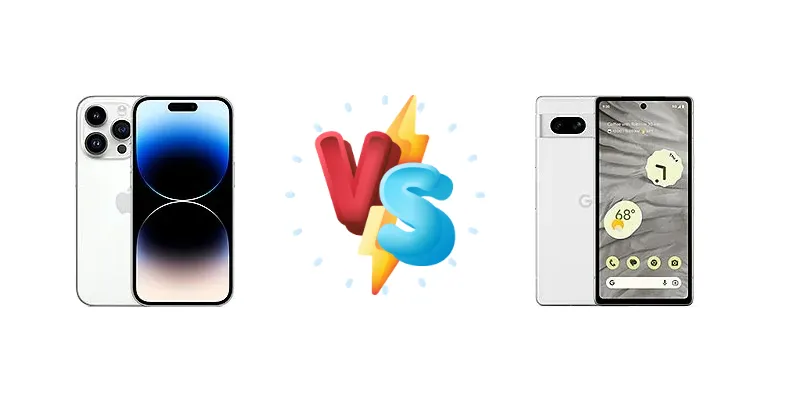
For users deeply embedded in the Apple ecosystem and prioritizing peak performance and display quality, the iPhone 14 Pro remains the superior choice. However, the Pixel 7a offers an exceptional camera experience and Google’s smart features at a significantly lower cost, making it the winner for budget-conscious consumers.
| PHONES | ||
|---|---|---|
| Phone Names | Apple iPhone 14 Pro | Google Pixel 7a |
| Network | ||
|---|---|---|
| 2G bands | GSM 850 / 900 / 1800 / 1900 | GSM 850 / 900 / 1800 / 1900 |
| 3G bands | HSDPA 850 / 900 / 1700(AWS) / 1900 / 2100 | HSDPA 800 / 850 / 900 / 1700(AWS) / 1900 / 2100 |
| 4G bands | 1, 2, 3, 4, 5, 7, 8, 12, 13, 17, 18, 19, 20, 25, 26, 28, 30, 32, 34, 38, 39, 40, 41, 42, 46, 48, 66 - A2890, A2892 | 1, 2, 3, 4, 5, 7, 8, 12, 13, 14, 17, 20, 25, 26, 28, 29, 30, 38, 40, 41, 48, 66, 71 - GWKK3, G0DZQ |
| 5G bands | 1, 2, 3, 5, 7, 8, 12, 20, 25, 26, 28, 30, 38, 40, 41, 48, 66, 70, 77, 78, 79 SA/NSA/Sub6 - A2890, A2892 | 1, 2, 3, 5, 7, 8, 12, 14, 20, 25, 28, 30, 38, 41, 48, 66, 71, 77, 78 SA/NSA/Sub6 - GWKK3 |
| Speed | HSPA, LTE, 5G, EV-DO Rev.A 3.1 Mbps | HSPA, LTE, 5G |
| Technology | GSM / CDMA / HSPA / EVDO / LTE / 5G | GSM / HSPA / LTE / 5G |
| 1, 2, 3, 5, 7, 8, 12, 20, 25, 26, 28, 30, 38, 40, 41, 48, 66, 70, 77, 78, 79 SA/NSA/Sub6 - A2891 | 1, 2, 3, 5, 7, 8, 12, 20, 25, 28, 38, 40, 41, 66, 75, 76, 77, 78, 79 SA/NSA/Sub6 - GHL1X, G82U8 | |
| Launch | ||
|---|---|---|
| Announced | 2022, September 07 | 2023, May 10 |
| Status | Available. Released 2022, September 16 | Available. Released 2023, May 10 |
| Body | ||
|---|---|---|
| Build | Glass front, glass back, stainless steel frame | Glass front (Gorilla Glass 3), aluminum frame, plastic back |
| Dimensions | 147.5 x 71.5 x 7.9 mm (5.81 x 2.81 x 0.31 in) | 152 x 72.9 x 9 mm (5.98 x 2.87 x 0.35 in) |
| SIM | · Nano-SIM + eSIM + eSIM (max 2 at a time; International)· eSIM + eSIM (8 or more, max 2 at a time; USA)· Nano-SIM + Nano-SIM (China) | Nano-SIM + eSIM |
| Weight | 206 g (7.27 oz) | 193.5 g (6.84 oz) |
| IP68 dust/water resistant (up to 6m for 30 min) Apple Pay (Visa, MasterCard, AMEX certified) | IP67 dust/water resistant (up to 1m for 30 min) | |
| Display | ||
|---|---|---|
| Protection | Ceramic Shield glass | Corning Gorilla Glass 3 |
| Resolution | 1179 x 2556 pixels, 19.5:9 ratio (~460 ppi density) | 1080 x 2400 pixels, 20:9 ratio (~429 ppi density) |
| Size | 6.1 inches, 91.7 cm2 (~87.0% screen-to-body ratio) | 6.1 inches, 90.7 cm2 (~81.8% screen-to-body ratio) |
| Type | LTPO Super Retina XDR OLED, 120Hz, HDR10, Dolby Vision, 1000 nits (typ), 2000 nits (HBM) | OLED, HDR, 90Hz |
| Always-On display | Always-on display | |
| Platform | ||
|---|---|---|
| CPU | Hexa-core (2x3.46 GHz Everest + 4x2.02 GHz Sawtooth) | Octa-core (2x2.85 GHz Cortex-X1 & 2x2.35 GHz Cortex-A78 & 4x1.80 GHz Cortex-A55) |
| Chipset | Apple A16 Bionic (4 nm) | Google Tensor G2 (5 nm) |
| GPU | Apple GPU (5-core graphics) | Mali-G710 MP7 |
| OS | iOS 16, upgradable to iOS 26.1 | Android 13, upgradable to Android 15, up to 5 major Android upgrades |
| Memory | ||
|---|---|---|
| Card slot | No | No |
| Internal | 128GB 6GB RAM, 256GB 6GB RAM, 512GB 6GB RAM, 1TB 6GB RAM | 128GB 8GB RAM |
| NVMe | UFS 3.1 | |
| Main Camera | ||
|---|---|---|
| Dual | - | 64 MP, f/1.9, 26mm (wide), 1/1.73", 0.8µm, dual pixel PDAF, OIS 13 MP, f/2.2, 120˚ (ultrawide), 1.12µm |
| Features | Dual-LED dual-tone flash, HDR (photo/panorama) | Dual-LED flash, Pixel Shift, Auto-HDR, panorama |
| Single | 12 MP, f/1.9, 23mm (wide), 1/3.6", PDAF, OIS (unconfirmed) SL 3D, (depth/biometrics sensor) | - |
| Triple | 48 MP, f/1.8, 24mm (wide), 1/1.28", 1.22µm, dual pixel PDAF, sensor-shift OIS 12 MP, f/2.8, 77mm (telephoto), 1/3.5", 1.0µm, PDAF, OIS, 3x optical zoom 12 MP, f/2.2, 13mm, 120˚ (ultrawide), 1/2.55", 1.4µm, dual pixel PDAF TOF 3D LiDAR scanner (depth) | - |
| Video | 4K@24/25/30/60fps, 1080p@25/30/60/120/240fps, 10-bit HDR, Dolby Vision HDR (up to 60fps), ProRes, stereo sound rec. | 4K@30/60fps, 1080p@30/60/120/240fps, OIS |
| Selfie camera | ||
|---|---|---|
| Features | HDR | HDR, panorama |
| Single | 12 MP, f/1.9, 23mm (wide), 1/3.6", 1.0µm, PDAF, OIS SL 3D, (depth/biometrics sensor) | 13 MP, f/2.2, 20mm (ultrawide), 1.12µm |
| Video | 4K@24/25/30/60fps, 1080p@25/30/60/120fps, gyro-EIS | 4K@30fps, 1080p@30fps |
| Sound | ||
|---|---|---|
| 3.5mm jack | No | No |
| 35mm jack | No | No |
| Loudspeaker | Yes, with stereo speakers | Yes, with stereo speakers |
| Comms | ||
|---|---|---|
| Bluetooth | 5.3, A2DP, LE | 5.3, A2DP, LE |
| NFC | Yes | Yes |
| Positioning | GPS (L1+L5), GLONASS, GALILEO, BDS, QZSS | GPS, GLONASS, GALILEO, BDS, QZSS, NavIC |
| Radio | No | No |
| USB | Lightning, USB 2.0 | USB Type-C 3.2 |
| WLAN | Wi-Fi 802.11 a/b/g/n/ac/6, dual-band, hotspot | Wi-Fi 802.11 a/b/g/n/ac/6e, tri-band |
| Features | ||
|---|---|---|
| Sensors | Face ID, accelerometer, gyro, proximity, compass, barometer | Fingerprint (under display, optical), accelerometer, gyro, proximity, compass, barometer |
| Ultra Wideband (UWB) support Emergency SOS via satellite (SMS sending/receiving) | - | |
| Battery | ||
|---|---|---|
| Charging | Wired, PD2.0, 50% in 30 min 15W wireless (MagSafe) 15W wireless (Qi2) - requires iOS 17.2 update | 18W wired, PD3.0 7.5W wireless |
| Type | Li-Ion 3200 mAh (12.38 Wh) | Li-Po 4385 mAh |
| Misc | ||
|---|---|---|
| Colors | Space Black, Silver, Gold, Deep Purple | Charcoal, Snow, Sea, Coral |
| Models | A2890, A2650, A2889, A2892, iphone15,2 | GWKK3, GHL1X, G0DZQ, G82U8 |
| Price | $ 395.67 / C$ 693.35 / £ 403.99 / € 492.99 | € 179.90 / $ 150.00 / £ 170.00 / ₹ 25,980 |
| SAR | 1.15 W/kg (head) 1.15 W/kg (body) | - |
| SAR EU | 0.98 W/kg (head) 0.98 W/kg (body) | - |
| Tests | ||
|---|---|---|
| Battery life | Endurance rating 86h | - |
| Camera | Photo / Video | - |
| Display | Contrast ratio: Infinite (nominal) | - |
| Loudspeaker | -26.2 LUFS (Good) | - |
| Performance | AnTuTu: 968412 (v9) GeekBench: 5346 (v5.1) GFXBench: 60fps (ES 3.1 onscreen) | - |
Apple iPhone 14 Pro
- Significantly brighter and more efficient display
- Superior processing power with the A16 Bionic
- MagSafe ecosystem for convenient accessories
- Higher price point
- Less flexible software customization
Google Pixel 7a
- Exceptional camera performance for the price
- Clean Android experience with guaranteed updates
- More affordable price
- Slower charging speeds
- Less powerful processor compared to the A16 Bionic
Display Comparison
The iPhone 14 Pro boasts a significantly brighter display, reaching a measured 1791 nits, compared to the Pixel 7a’s 1070 nits. This translates to superior visibility in direct sunlight. While both utilize OLED technology, the iPhone 14 Pro’s likely implementation of LTPO allows for variable refresh rates down to 1Hz, conserving battery life during static content viewing – a feature absent in the Pixel 7a. The iPhone’s ‘infinite’ contrast ratio, while a nominal specification, points to deeper blacks and a more vibrant image. The Pixel 7a’s display is still excellent, but the iPhone 14 Pro offers a demonstrably superior visual experience.
Camera Comparison
Both phones are capable of excellent photo and video capture, but approach it differently. While detailed sensor specs are unavailable, the Pixel 7a leverages Google’s renowned computational photography algorithms to produce stunning images, particularly in challenging lighting conditions. The iPhone 14 Pro likely benefits from a larger main sensor and Apple’s ProRes video recording capabilities, appealing to professional videographers. The Pixel 7a’s strength lies in its software-driven enhancements, while the iPhone 14 Pro offers more control and flexibility for experienced photographers. We can expect the iPhone to have a more natural look, while the Pixel will lean towards a more processed, vibrant aesthetic.
Performance
The Apple A16 Bionic, fabricated on a 4nm process, features a hexa-core CPU configuration (2x3.46 GHz Everest + 4x2.02 GHz Sawtooth) and is designed for sustained peak performance. In contrast, the Google Tensor G2, built on a 5nm node, employs an octa-core setup (2x2.85 GHz Cortex-X1 & 2x2.35 GHz Cortex-A78 & 4x1.80 GHz Cortex-A55). While the Tensor G2’s core count is higher, the A16 Bionic’s architectural advantages and tighter software integration generally result in faster real-world performance, particularly in demanding tasks like video editing and gaming. The A16’s efficiency also contributes to better thermal management, potentially reducing throttling during extended use. The Pixel 7a’s Tensor G2 excels in AI-related tasks, such as image processing and voice recognition.
Battery Life
The iPhone 14 Pro achieves an endurance rating of 86 hours, while the Pixel 7a scores 76 hours. This suggests the iPhone offers longer battery life despite a similar capacity (not specified in the data). The iPhone 14 Pro supports faster wired charging with PD2.0 (50% in 30 minutes) and 15W wireless charging via MagSafe and Qi2 (requiring iOS 17.2). The Pixel 7a offers 18W wired charging with PD3.0 and slower 7.5W wireless charging. The iPhone’s MagSafe ecosystem provides convenient accessory compatibility, while the Pixel 7a’s faster wired charging partially offsets its lower endurance rating.
Buying Guide
Buy the Apple iPhone 14 Pro if you require the absolute best mobile performance, a stunningly bright and color-accurate display for content creation, and seamless integration with other Apple devices. Buy the Google Pixel 7a if you prioritize computational photography, a clean Android experience with timely updates, and exceptional value for money without sacrificing key features.