
iPhone 13 Pro vs. Samsung Galaxy S22+: Which Flagship Reigns Supreme?
| Phones Images | |||||
|---|---|---|---|---|---|
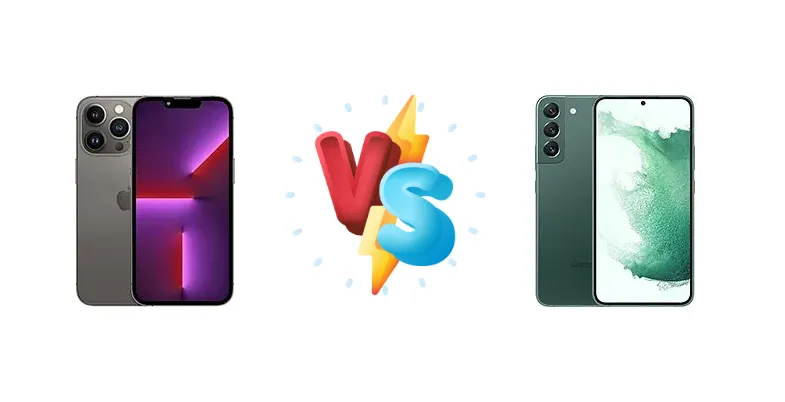
|
🏆 Quick Verdict
For most users, the Samsung Galaxy S22+ emerges as the better value. Its superior battery endurance (97h vs 85h) and brighter display (1214 nits vs 1063 nits) provide tangible benefits in everyday use. While the iPhone 13 Pro’s A15 Bionic is potent, the S22+ offers comparable performance at a potentially lower price point.
| PHONES | ||
|---|---|---|
| Phone Names | Apple iPhone 13 Pro | Samsung Galaxy S22+ 5G |
| Network | ||
|---|---|---|
| 2G bands | GSM 850 / 900 / 1800 / 1900 | GSM 850 / 900 / 1800 / 1900 |
| 3G bands | HSDPA 850 / 900 / 1700(AWS) / 1900 / 2100 | HSDPA 850 / 900 / 1700(AWS) / 1900 / 2100 |
| 4G bands | 1, 2, 3, 4, 5, 7, 8, 12, 13, 17, 18, 19, 20, 25, 26, 28, 30, 32, 34, 38, 39, 40, 41, 42, 46, 48, 66 - A2638, A2639, A2640 | 1, 2, 3, 4, 5, 7, 8, 12, 13, 17, 18, 19, 20, 25, 26, 28, 32, 38, 39, 40, 41, 66 - International |
| 5G bands | 1, 2, 3, 5, 7, 8, 12, 20, 25, 28, 30, 38, 40, 41, 48, 66, 77, 78, 79 SA/NSA/Sub6 - A2638, A2639 | 1, 2, 3, 5, 7, 8, 12, 20, 25, 28, 38, 40, 41, 66, 75, 77, 78 SA/NSA/Sub6 - International |
| Speed | HSPA, LTE, 5G, EV-DO Rev.A 3.1 Mbps | HSPA 42.2/5.76 Mbps, LTE (7CA) Cat20 2000/200 Mbps, 5G (5+ Gbps DL) |
| Technology | GSM / CDMA / HSPA / EVDO / LTE / 5G | GSM / CDMA / HSPA / EVDO / LTE / 5G |
| 1, 2, 3, 5, 7, 8, 12, 20, 25, 28, 29, 30, 38, 40, 41, 48, 66, 71, 77, 78, 79 SA/NSA/Sub6 - A2636 | 1, 3, 5, 7, 8, 20, 28, 38, 41, 66, 71, 260, 261 SA/NSA/Sub6/mmWave - USA | |
| Launch | ||
|---|---|---|
| Announced | 2021, September 14 | 2022, February 09 |
| Status | Available. Released 2021, September 24 | Available. Released 2022, February 25 |
| Body | ||
|---|---|---|
| Build | Glass front, glass back, stainless steel frame | Glass front (Gorilla Glass Victus+), glass back (Gorilla Glass Victus+), aluminum frame |
| Dimensions | 146.7 x 71.5 x 7.7 mm (5.78 x 2.81 x 0.30 in) | 157.4 x 75.8 x 7.6 mm (6.20 x 2.98 x 0.30 in) |
| SIM | · Nano-SIM + eSIM· Nano-SIM + Nano-SIM | · Nano-SIM + eSIM· Nano-SIM + Nano-SIM + eSIM (max 2 at a time) |
| Weight | 204 g (7.20 oz) | 195 g / 196 g (mmWave) (6.88 oz) |
| IP68 dust/water resistant (up to 6m for 30 min) Apple Pay (Visa, MasterCard, AMEX certified) | IP68 dust/water resistant (up to 1.5m for 30 min) Armor aluminum frame with tougher drop and scratch resistance (advertised) | |
| Display | ||
|---|---|---|
| Protection | Ceramic Shield glass | Corning Gorilla Glass Victus+ |
| Resolution | 1170 x 2532 pixels, 19.5:9 ratio (~460 ppi density) | 1080 x 2340 pixels, 19.5:9 ratio (~393 ppi density) |
| Size | 6.1 inches, 90.2 cm2 (~86.0% screen-to-body ratio) | 6.6 inches, 105.3 cm2 (~88.3% screen-to-body ratio) |
| Type | Super Retina XDR OLED, 120Hz, HDR10, Dolby Vision, 1000 nits (HBM), 1200 nits (peak) | Dynamic AMOLED 2X, 120Hz, HDR10+, 1750 nits (peak) |
| - | Always-on display | |
| Platform | ||
|---|---|---|
| CPU | Hexa-core (2x3.23 GHz Avalanche + 4x1.82 GHz Blizzard) | Octa-core (1x2.8 GHz Cortex-X2 & 3x2.50 GHz Cortex-A710 & 4x1.8 GHz Cortex-A510) - EuropeOcta-core (1x3.00 GHz Cortex-X2 & 3x2.50 GHz Cortex-A710 & 4x1.80 GHz Cortex-A510) - ROW |
| Chipset | Apple A15 Bionic (5 nm) | Exynos 2200 (4 nm) - EuropeQualcomm SM8450 Snapdragon 8 Gen 1 (4 nm) - ROW |
| GPU | Apple GPU (5-core graphics) | Xclipse 920 - EuropeAdreno 730 - ROW |
| OS | iOS 15, upgradable to iOS 26.1 | Android 12, up to 4 major Android upgrades, One UI 6.1.1 |
| Memory | ||
|---|---|---|
| Card slot | No | No |
| Internal | 128GB 6GB RAM, 256GB 6GB RAM, 512GB 6GB RAM, 1TB 6GB RAM | 128GB 8GB RAM, 256GB 8GB RAM |
| NVMe | UFS 3.1 | |
| Main Camera | ||
|---|---|---|
| Features | Dual-LED dual-tone flash, HDR (photo/panorama) | LED flash, auto-HDR, panorama |
| Single | 12 MP, f/2.2, 23mm (wide), 1/3.6" SL 3D, (depth/biometrics sensor) | - |
| Triple | 12 MP, f/1.5, 26mm (wide), 1/1.7", 1.9µm, dual pixel PDAF, sensor-shift OIS 12 MP, f/2.8, 77mm (telephoto), PDAF, 1/3.4", 1.0µm, OIS, 3x optical zoom 12 MP, f/1.8, 13mm, 120˚ (ultrawide), 1/3.4", 1.0µm, PDAF TOF 3D LiDAR scanner (depth) | 50 MP, f/1.8, 23mm (wide), 1/1.56", 1.0µm, dual pixel PDAF, OIS 10 MP, f/2.4, 70mm (telephoto), 1/3.94", 1.0µm, PDAF, OIS, 3x optical zoom 12 MP, f/2.2, 13mm, 120˚ (ultrawide), 1/2.55" 1.4µm, Super Steady video |
| Video | 4K@24/25/30/60fps, 1080p@25/30/60/120/240fps, 10‑bit HDR, Dolby Vision HDR (up to 60fps), ProRes, stereo sound rec. | 8K@24fps, 4K@30/60fps, 1080p@30/60/120/240fps, HDR10+, stereo sound rec., gyro-EIS |
| Selfie camera | ||
|---|---|---|
| Features | HDR | HDR |
| Single | 12 MP, f/2.2, 23mm (wide), 1/3.6", 1.0µm SL 3D, (depth/biometrics sensor) | 10 MP, f/2.2, 26mm (wide), 1/3.24", 1.22µm, dual pixel PDAF |
| Video | 4K@24/25/30/60fps, 1080p@25/30/60/120fps, gyro-EIS | 4K@30/60fps, 1080p@30fps |
| Sound | ||
|---|---|---|
| 3.5mm jack | No | No |
| 35mm jack | No | No |
| Loudspeaker | Yes, with stereo speakers | Yes, with stereo speakers |
| - | 32-bit/384kHz audio Tuned by AKG | |
| Comms | ||
|---|---|---|
| Bluetooth | 5.0, A2DP, LE | 5.2, A2DP, LE |
| NFC | Yes | Yes |
| Positioning | GPS, GLONASS, GALILEO, BDS, QZSS | GPS, GLONASS, BDS, GALILEO |
| Radio | No | No |
| USB | Lightning, USB 2.0 | USB Type-C 3.2, OTG |
| WLAN | Wi-Fi 802.11 a/b/g/n/ac/6, dual-band, hotspot | Wi-Fi 802.11 a/b/g/n/ac/6e, dual-band, Wi-Fi Direct |
| Features | ||
|---|---|---|
| Sensors | Face ID, accelerometer, gyro, proximity, compass, barometer | Fingerprint (under display, ultrasonic), accelerometer, gyro, proximity, compass, barometer |
| Ultra Wideband (UWB) support | Samsung DeX, Samsung Wireless DeX (desktop experience support) Bixby natural language commands and dictation Samsung Pay (Visa, MasterCard certified) Ultra Wideband (UWB) support | |
| Battery | ||
|---|---|---|
| Charging | Wired, PD2.0, 50% in 30 min 15W wireless (MagSafe) 15W wireless (Qi2) - requires iOS 17.2 update | 45W wired, PD3.0 15W wireless (Qi) 4.5W reverse wireless |
| Type | Li-Ion 3095 mAh (12.11 Wh) | Li-Ion 4500 mAh |
| Misc | ||
|---|---|---|
| Colors | Graphite, Gold, Silver, Sierra Blue, Alpine Green | Phantom Black, White, Pink Gold, Green, Graphite, Sky Blue, Violet, Cream, Bora Purple |
| Models | A2638, A2483, A2636, A2639, A2640, iPhone14,2 | SM-S906B, SM-S906B/DS, SM-S906U, SM-S906U1, SM-S906W, SM-S906N, SM-S9060, SM-S906E, SM-S906E/DS, SM-S906L |
| Price | € 398.00 / $ 365.86 / £ 300.00 | € 236.99 / $ 194.37 / £ 349.00 |
| SAR | 1.20 W/kg (head) 1.19 W/kg (body) | 1.19 W/kg (head) 1.08 W/kg (body) |
| SAR EU | 0.99 W/kg (head) 0.98 W/kg (body) | 0.57 W/kg (head) 1.40 W/kg (body) |
| Tests | ||
|---|---|---|
| Battery life | Endurance rating 85h | Endurance rating 97h |
| Camera | Photo / Video | Photo / Video |
| Display | Contrast ratio: Infinite (nominal) | Contrast ratio: Infinite (nominal) |
| Loudspeaker | -24.9 LUFS (Very good) | -26.0 LUFS (Very good) |
| Performance | AnTuTu: 794348 (v9) GeekBench: 4687 (v5.1) GFXBench: 60fps (ES 3.1 onscreen) | AnTuTu: 722495 (v8), 886916 (v9) GeekBench: 3528 (v5.1) GFXBench: 68fps (ES 3.1 onscreen) |
Apple iPhone 13 Pro
- Exceptional video recording quality
- Optimized software and ecosystem integration
- Strong resale value
- Slower charging speeds
- Lower peak display brightness
- Less flexible operating system
Samsung Galaxy S22+ 5G
- Brighter and more vibrant display
- Faster charging speeds (45W)
- Reverse wireless charging
- Potential for thermal throttling (Exynos variant)
- Software processing can be aggressive
- Android ecosystem fragmentation
Display Comparison
The Samsung Galaxy S22+ boasts a significantly brighter display, reaching 1214 nits compared to the iPhone 13 Pro’s 1063 nits. This translates to better outdoor visibility, particularly in direct sunlight. Both displays share an 'Infinite' contrast ratio, typical of OLED panels, but the S22+'s higher peak brightness is a clear advantage. While both are excellent, the S22+’s panel is more immediately impactful in real-world viewing conditions. The lack of LTPO on either device means refresh rate scaling isn't as efficient as newer models, but both offer smooth scrolling.
Camera Comparison
Both phones excel in photography and videography, but approach it differently. The iPhone 13 Pro is renowned for its cinematic mode and consistently high-quality video recording. While both offer versatile camera systems, the iPhone’s video capabilities are generally considered superior. The S22+’s camera system, while capable, relies more heavily on software processing, which can sometimes result in over-sharpened images. The lack of detailed sensor information for both devices makes a direct comparison difficult, but the iPhone’s reputation for natural image processing gives it a slight edge for users prioritizing realism.
Performance
The iPhone 13 Pro’s A15 Bionic, fabricated on a 5nm process, delivers exceptional single-core performance. However, the Galaxy S22+’s Exynos 2200 (Europe) or Snapdragon 8 Gen 1 (ROW), built on a 4nm process, offers a competitive octa-core configuration. The Snapdragon variant generally exhibits better thermal management, mitigating potential throttling during sustained workloads. While the A15 excels in raw processing power, the S22+’s more efficient chipset can maintain performance for longer periods, particularly in graphically demanding games. The choice between Exynos and Snapdragon significantly impacts the S22+’s sustained performance.
Battery Life
The Samsung Galaxy S22+ holds a clear advantage in battery endurance, achieving a measured 97 hours compared to the iPhone 13 Pro’s 85 hours. This is despite a similar battery capacity. The S22+ also supports 45W wired charging with PD3.0, allowing for a significantly faster 0-100% charge (estimated under 60 minutes) compared to the iPhone 13 Pro’s 50% in 30 minutes via PD2.0. The S22+ also includes 15W wireless charging and 4.5W reverse wireless charging, features absent on the iPhone 13 Pro without the iOS 17.2 update for Qi2.
Buying Guide
Buy the Apple iPhone 13 Pro if you are deeply embedded in the Apple ecosystem, prioritize video recording quality, and value long-term software support. Buy the Samsung Galaxy S22+ 5G if you prefer a brighter, more vibrant display, faster charging speeds, and the flexibility of the Android operating system, especially if you're a power user who benefits from features like reverse wireless charging.