
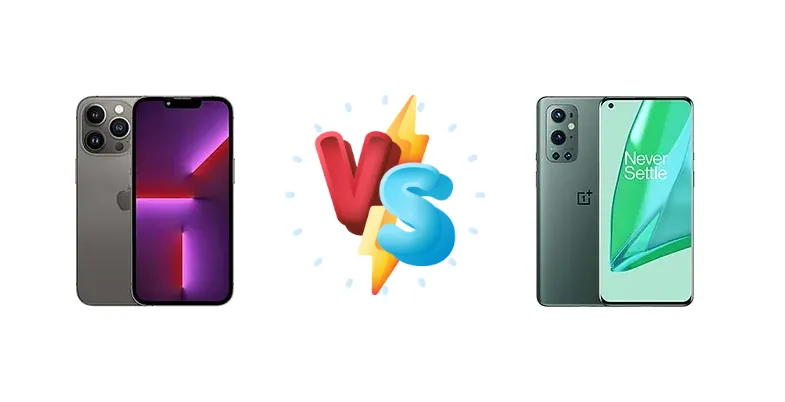
iPhone 13 Pro vs OnePlus 9 Pro: Which Flagship Reigns Supreme?
| Phones Images | |||||
|---|---|---|---|---|---|
|
🏆 Quick Verdict
For the average user prioritizing a seamless experience, long-term software support, and a consistently excellent camera, the iPhone 13 Pro is the better choice. However, the OnePlus 9 Pro’s significantly faster charging and slightly better battery endurance, combined with its lower price point, make it a compelling alternative for power users.
| PHONES | ||
|---|---|---|
| Phone Names | Apple iPhone 13 Pro | OnePlus 9 Pro |
| Network | ||
|---|---|---|
| 2G bands | GSM 850 / 900 / 1800 / 1900 | GSM 850 / 900 / 1800 / 1900 |
| 3G bands | HSDPA 850 / 900 / 1700(AWS) / 1900 / 2100 | HSDPA 800 / 850 / 900 / 1700(AWS) / 1800 / 1900 / 2100 |
| 4G bands | 1, 2, 3, 4, 5, 7, 8, 12, 13, 17, 18, 19, 20, 25, 26, 28, 30, 32, 34, 38, 39, 40, 41, 42, 46, 48, 66 - A2638, A2639, A2640 | 1, 2, 3, 4, 5, 7, 8, 12, 13, 17, 18, 19, 20, 25, 26, 28, 32, 38, 39, 40, 41, 66 - EU |
| 5G bands | 1, 2, 3, 5, 7, 8, 12, 20, 25, 28, 30, 38, 40, 41, 48, 66, 77, 78, 79 SA/NSA/Sub6 - A2638, A2639 | 1, 3, 5, 7, 8, 20, 28, 38, 40, 41, 66, 78 SA/NSA - EU |
| Speed | HSPA, LTE, 5G, EV-DO Rev.A 3.1 Mbps | HSPA 42.2/5.76 Mbps, LTE Cat20 2000/200 Mbps, 5G |
| Technology | GSM / CDMA / HSPA / EVDO / LTE / 5G | GSM / CDMA / HSPA / LTE / 5G |
| 1, 2, 3, 5, 7, 8, 12, 20, 25, 28, 29, 30, 38, 40, 41, 48, 66, 71, 77, 78, 79 SA/NSA/Sub6 - A2636 | 1, 3, 28, 41, 78, 79 SA/NSA - CN | |
| Launch | ||
|---|---|---|
| Announced | 2021, September 14 | 2021, March 23 |
| Status | Available. Released 2021, September 24 | Available. Released 2021, March 30 |
| Body | ||
|---|---|---|
| Build | Glass front, glass back, stainless steel frame | Glass front (Gorilla Glass 5), glass back (Gorilla Glass 5), aluminum frame |
| Dimensions | 146.7 x 71.5 x 7.7 mm (5.78 x 2.81 x 0.30 in) | 163.2 x 73.6 x 8.7 mm (6.43 x 2.90 x 0.34 in) |
| SIM | · Nano-SIM + eSIM· Nano-SIM + Nano-SIM | · Nano-SIM· Nano-SIM + Nano-SIM |
| Weight | 204 g (7.20 oz) | 197 g (6.95 oz) |
| IP68 dust/water resistant (up to 6m for 30 min) Apple Pay (Visa, MasterCard, AMEX certified) | IP68 dust/water resistant (up to 1.5m for 30 min) | |
| Display | ||
|---|---|---|
| Protection | Ceramic Shield glass | Corning Gorilla Glass 5 |
| Resolution | 1170 x 2532 pixels, 19.5:9 ratio (~460 ppi density) | 1440 x 3216 pixels, 20:9 ratio (~525 ppi density) |
| Size | 6.1 inches, 90.2 cm2 (~86.0% screen-to-body ratio) | 6.7 inches, 108.4 cm2 (~90.3% screen-to-body ratio) |
| Type | Super Retina XDR OLED, 120Hz, HDR10, Dolby Vision, 1000 nits (HBM), 1200 nits (peak) | LTPO Fluid2 AMOLED, 1B colors, 120Hz, HDR10+, 1300 nits (peak) |
| - | Always-on display | |
| Platform | ||
|---|---|---|
| CPU | Hexa-core (2x3.23 GHz Avalanche + 4x1.82 GHz Blizzard) | Octa-core (1x2.84 GHz Cortex-X1 & 3x2.42 GHz Cortex-A78 & 4x1.80 GHz Cortex-A55 |
| Chipset | Apple A15 Bionic (5 nm) | Qualcomm SM8350 Snapdragon 888 5G (5 nm) |
| GPU | Apple GPU (5-core graphics) | Adreno 660 |
| OS | iOS 15, upgradable to iOS 26.1 | Android 11, upgradable to Android 14, OxygenOS 14 |
| Memory | ||
|---|---|---|
| Card slot | No | No |
| Internal | 128GB 6GB RAM, 256GB 6GB RAM, 512GB 6GB RAM, 1TB 6GB RAM | 128GB 8GB RAM, 256GB 8GB RAM, 256GB 12GB RAM |
| NVMe | UFS 3.1 | |
| Main Camera | ||
|---|---|---|
| Features | Dual-LED dual-tone flash, HDR (photo/panorama) | Laser AF, color spectrum sensor, Hasselblad Color Calibration, dual-LED flash, HDR, panorama |
| Quad | - | 48 MP, f/1.8, 23mm (wide), 1/1.43", 1.12µm, multi-directional PDAF, OIS 8 MP, f/2.4, 77mm (telephoto), 1.0µm, PDAF, OIS, 3.3x optical zoom 50 MP, f/2.2, 14mm (ultrawide), 1/1.56", 1.0µm, AF 2 MP, f/2.4, (monochrome) |
| Single | 12 MP, f/2.2, 23mm (wide), 1/3.6" SL 3D, (depth/biometrics sensor) | 16 MP, f/2.4, (wide), 1/3.06", 1.0µm |
| Triple | 12 MP, f/1.5, 26mm (wide), 1/1.7", 1.9µm, dual pixel PDAF, sensor-shift OIS 12 MP, f/2.8, 77mm (telephoto), PDAF, 1/3.4", 1.0µm, OIS, 3x optical zoom 12 MP, f/1.8, 13mm, 120˚ (ultrawide), 1/3.4", 1.0µm, PDAF TOF 3D LiDAR scanner (depth) | - |
| Video | 4K@24/25/30/60fps, 1080p@25/30/60/120/240fps, 10‑bit HDR, Dolby Vision HDR (up to 60fps), ProRes, stereo sound rec. | 8K@30fps, 4K@30/60/120fps, 1080p@30/60/240fps, Auto HDR, gyro-EIS |
| Selfie camera | ||
|---|---|---|
| Features | HDR | HDR |
| Single | 12 MP, f/2.2, 23mm (wide), 1/3.6", 1.0µm SL 3D, (depth/biometrics sensor) | 16 MP, f/2.4, (wide), 1/3.06", 1.0µm |
| Video | 4K@24/25/30/60fps, 1080p@25/30/60/120fps, gyro-EIS | 1080p@30fps, gyro-EIS |
| Sound | ||
|---|---|---|
| 3.5mm jack | No | No |
| 35mm jack | No | No |
| Loudspeaker | Yes, with stereo speakers | Yes, with stereo speakers |
| - | 24-bit/192kHz audio | |
| Comms | ||
|---|---|---|
| Bluetooth | 5.0, A2DP, LE | 5.2, A2DP, LE, aptX HD |
| NFC | Yes | Yes |
| Positioning | GPS, GLONASS, GALILEO, BDS, QZSS | GPS (L1+L5), GLONASS (G1), BDS (B1), GALILEO (E1+E5a) |
| Radio | No | No |
| USB | Lightning, USB 2.0 | USB Type-C 3.1, OTG |
| WLAN | Wi-Fi 802.11 a/b/g/n/ac/6, dual-band, hotspot | Wi-Fi 802.11 a/b/g/n/ac/6, dual-band, Wi-Fi Direct, DLNA |
| Features | ||
|---|---|---|
| Sensors | Face ID, accelerometer, gyro, proximity, compass, barometer | Fingerprint (under display, optical), accelerometer, gyro, proximity, compass |
| Ultra Wideband (UWB) support | - | |
| Battery | ||
|---|---|---|
| Charging | Wired, PD2.0, 50% in 30 min 15W wireless (MagSafe) 15W wireless (Qi2) - requires iOS 17.2 update | 65W wired, PD, 100% in 29 min 50W wireless, 100% in 43 min 5W reverse wireless |
| Type | Li-Ion 3095 mAh (12.11 Wh) | Li-Po 4500 mAh |
| Misc | ||
|---|---|---|
| Colors | Graphite, Gold, Silver, Sierra Blue, Alpine Green | Morning Mist, Forest Green, Stellar Black |
| Models | A2638, A2483, A2636, A2639, A2640, iPhone14,2 | LE2121, LE2125, LE2123, LE2120, LE2127 |
| Price | € 398.00 / $ 365.86 / £ 300.00 | € 246.17 / $ 264.95 / £ 287.00 |
| SAR | 1.20 W/kg (head) 1.19 W/kg (body) | - |
| SAR EU | 0.99 W/kg (head) 0.98 W/kg (body) | - |
| Tests | ||
|---|---|---|
| Battery life | Endurance rating 85h | Endurance rating 86h |
| Camera | Photo / Video | Photo / Video |
| Display | Contrast ratio: Infinite (nominal) | - |
| Loudspeaker | -24.9 LUFS (Very good) | -24.1 LUFS (Very good) |
| Performance | AnTuTu: 794348 (v9) GeekBench: 4687 (v5.1) GFXBench: 60fps (ES 3.1 onscreen) | - |
Apple iPhone 13 Pro
- Superior video recording quality
- Long-term software support
- Brighter, more vibrant display
- Slower charging speeds
- Less customizable software
OnePlus 9 Pro
- Significantly faster charging
- More affordable price
- Customizable Android experience
- Shorter software support lifecycle
- Slightly dimmer display
Display Comparison
Both phones feature excellent displays, but the iPhone 13 Pro edges ahead with a measured peak brightness of 1063 nits compared to the OnePlus 9 Pro’s 859 nits. This translates to better visibility in direct sunlight. While both offer vibrant colors, the iPhone’s 'infinite' contrast ratio (typical of OLED) provides deeper blacks. The OnePlus 9 Pro’s display is still very good, but the iPhone’s is demonstrably brighter and offers a more visually impactful experience. Neither specification details refresh rate, but both are expected to have 120Hz adaptive refresh rates.
Camera Comparison
Both phones are equipped with capable camera systems, but Apple’s strength lies in its computational photography and video capabilities. While both offer photo and video recording, the iPhone 13 Pro’s image processing consistently delivers natural-looking images with excellent dynamic range. The OnePlus 9 Pro, developed in partnership with Hasselblad, aims for more vibrant and saturated colors. Sensor sizes and lens apertures are not specified, but the iPhone’s video recording quality is generally considered superior. The OnePlus 9 Pro’s camera system is excellent, but Apple’s software and video capabilities give it an edge.
Performance
The Apple A15 Bionic, built on a 5nm process, and the Qualcomm Snapdragon 888 (also 5nm) represent the pinnacle of mobile silicon. The A15’s hexa-core architecture (2x3.23 GHz Avalanche + 4x1.82 GHz Blizzard) is optimized for both peak performance and efficiency. While the Snapdragon 888’s octa-core configuration (1x2.84 GHz Cortex-X1 & 3x2.42 GHz Cortex-A78 & 4x1.80 GHz Cortex-A55) offers more cores, Apple’s chip design and software integration typically result in superior real-world performance, particularly in sustained tasks. The A15’s Neural Engine also provides a significant advantage in machine learning tasks.
Battery Life
The OnePlus 9 Pro boasts a slightly better endurance rating of 86 hours compared to the iPhone 13 Pro’s 85 hours. However, the real differentiator is charging speed. The OnePlus 9 Pro’s 65W wired charging can fully charge the battery in just 29 minutes, a significant advantage over the iPhone 13 Pro’s 50% charge in 30 minutes via PD2.0. The OnePlus 9 Pro also offers 50W wireless charging (43 minutes to full) and 5W reverse wireless charging, features absent on the iPhone 13 Pro, which relies on 15W MagSafe and Qi2 (requiring iOS 17.2).
Buying Guide
Buy the Apple iPhone 13 Pro if you need a phone that 'just works,' values a polished software experience with guaranteed updates for years, and prioritizes video recording quality. Buy the OnePlus 9 Pro if you prefer faster charging speeds, a more customizable Android experience, and are comfortable with a potentially shorter software support lifecycle.