
iPhone 13 Pro vs. Google Pixel 6 Pro: Which Flagship Reigns Supreme?
| Phones Images | |||||
|---|---|---|---|---|---|
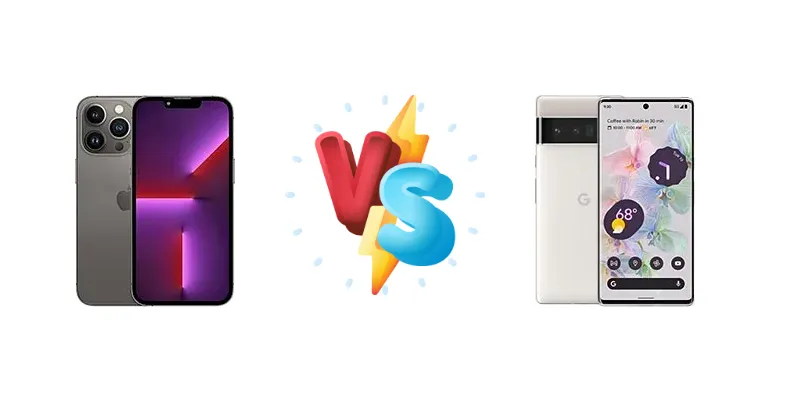
|
🏆 Quick Verdict
For most users, the iPhone 13 Pro emerges as the slightly more refined choice. Its consistently excellent performance, superior video recording capabilities, and longer-term software support outweigh the Pixel 6 Pro’s strengths in computational photography. However, the Pixel 6 Pro remains a strong contender for Android enthusiasts prioritizing camera innovation.
| PHONES | ||
|---|---|---|
| Phone Names | Apple iPhone 13 Pro | Google Pixel 6 Pro |
| Network | ||
|---|---|---|
| 2G bands | GSM 850 / 900 / 1800 / 1900 | GSM 850 / 900 / 1800 / 1900 |
| 3G bands | HSDPA 850 / 900 / 1700(AWS) / 1900 / 2100 | HSDPA 800 / 850 / 900 / 1700(AWS) / 1900 / 2100 |
| 4G bands | 1, 2, 3, 4, 5, 7, 8, 12, 13, 17, 18, 19, 20, 25, 26, 28, 30, 32, 34, 38, 39, 40, 41, 42, 46, 48, 66 - A2638, A2639, A2640 | 1, 2, 3, 4, 5, 7, 8, 12, 13, 14, 17, 18, 19, 20, 25, 26, 28, 29, 30, 32, 38, 39, 40, 41, 42, 46, 48, 66, 71 - GLUOG, G8VOU |
| 5G bands | 1, 2, 3, 5, 7, 8, 12, 20, 25, 28, 30, 38, 40, 41, 48, 66, 77, 78, 79 SA/NSA/Sub6 - A2638, A2639 | 1, 2, 3, 5, 7, 8, 12, 14, 20, 25, 28, 30, 38, 40, 41, 48, 66, 71, 77, 78, 257, 258, 260, 261 SA/NSA/Sub6/mmWave - G8VOU |
| Speed | HSPA, LTE, 5G, EV-DO Rev.A 3.1 Mbps | HSPA, LTE, 5G |
| Technology | GSM / CDMA / HSPA / EVDO / LTE / 5G | GSM / CDMA / HSPA / EVDO / LTE / 5G |
| 1, 2, 3, 5, 7, 8, 12, 20, 25, 28, 29, 30, 38, 40, 41, 48, 66, 71, 77, 78, 79 SA/NSA/Sub6 - A2636 | 1, 2, 3, 5, 7, 8, 12, 14, 20, 25, 28, 30, 38, 40, 41, 48, 66, 71, 77, 78 SA/NSA/Sub6 - GLUOG | |
| Launch | ||
|---|---|---|
| Announced | 2021, September 14 | 2021, October 19 |
| Status | Available. Released 2021, September 24 | Available. Released 2021, October 28 |
| Body | ||
|---|---|---|
| Build | Glass front, glass back, stainless steel frame | Glass front (Gorilla Glass Victus), glass back (Gorilla Glass Victus), aluminum frame |
| Dimensions | 146.7 x 71.5 x 7.7 mm (5.78 x 2.81 x 0.30 in) | 163.9 x 75.9 x 8.9 mm (6.45 x 2.99 x 0.35 in) |
| SIM | · Nano-SIM + eSIM· Nano-SIM + Nano-SIM | Nano-SIM + eSIM |
| Weight | 204 g (7.20 oz) | 210 g (7.41 oz) |
| IP68 dust/water resistant (up to 6m for 30 min) Apple Pay (Visa, MasterCard, AMEX certified) | IP68 dust/water resistant (up to 1.5m for 30 min) | |
| Display | ||
|---|---|---|
| Protection | Ceramic Shield glass | Corning Gorilla Glass Victus |
| Resolution | 1170 x 2532 pixels, 19.5:9 ratio (~460 ppi density) | 1440 x 3120 pixels, 19.5:9 ratio (~512 ppi density) |
| Size | 6.1 inches, 90.2 cm2 (~86.0% screen-to-body ratio) | 6.7 inches, 110.6 cm2 (~88.9% screen-to-body ratio) |
| Type | Super Retina XDR OLED, 120Hz, HDR10, Dolby Vision, 1000 nits (HBM), 1200 nits (peak) | LTPO AMOLED, 120Hz, HDR10+ |
| - | Always-on display | |
| Platform | ||
|---|---|---|
| CPU | Hexa-core (2x3.23 GHz Avalanche + 4x1.82 GHz Blizzard) | Octa-core (2x2.80 GHz Cortex-X1 & 2x2.25 GHz Cortex-A76 & 4x1.80 GHz Cortex-A55) |
| Chipset | Apple A15 Bionic (5 nm) | Google Tensor (5 nm) |
| GPU | Apple GPU (5-core graphics) | Mali-G78 MP20 |
| OS | iOS 15, upgradable to iOS 26.1 | Android 12, upgradable to Android 15, up to 5 major Android upgrades |
| Memory | ||
|---|---|---|
| Card slot | No | No |
| Internal | 128GB 6GB RAM, 256GB 6GB RAM, 512GB 6GB RAM, 1TB 6GB RAM | 128GB 12GB RAM, 256GB 12GB RAM, 512GB 12GB RAM |
| NVMe | UFS 3.1 | |
| Main Camera | ||
|---|---|---|
| Features | Dual-LED dual-tone flash, HDR (photo/panorama) | Laser AF, Dual-LED flash, Pixel Shift, Auto-HDR, panorama |
| Single | 12 MP, f/2.2, 23mm (wide), 1/3.6" SL 3D, (depth/biometrics sensor) | 11.1 MP, f/2.2, 20mm (ultrawide), 1.22µm |
| Triple | 12 MP, f/1.5, 26mm (wide), 1/1.7", 1.9µm, dual pixel PDAF, sensor-shift OIS 12 MP, f/2.8, 77mm (telephoto), PDAF, 1/3.4", 1.0µm, OIS, 3x optical zoom 12 MP, f/1.8, 13mm, 120˚ (ultrawide), 1/3.4", 1.0µm, PDAF TOF 3D LiDAR scanner (depth) | 50 MP, f/1.9, 25mm (wide), 1/1.31", 1.2µm, dual pixel PDAF, OIS 48 MP, f/3.5, 104mm (periscope telephoto), 1/2.0", 0.8µm, PDAF, OIS, 4x optical zoom 12 MP, f/2.2, 17mm, 114˚ (ultrawide), 1.25µm |
| Video | 4K@24/25/30/60fps, 1080p@25/30/60/120/240fps, 10‑bit HDR, Dolby Vision HDR (up to 60fps), ProRes, stereo sound rec. | 4K@30/60fps, 1080p@30/60/120/240fps; gyro-EIS, OIS |
| Selfie camera | ||
|---|---|---|
| Features | HDR | HDR, panorama |
| Single | 12 MP, f/2.2, 23mm (wide), 1/3.6", 1.0µm SL 3D, (depth/biometrics sensor) | 11.1 MP, f/2.2, 20mm (ultrawide), 1.22µm |
| Video | 4K@24/25/30/60fps, 1080p@25/30/60/120fps, gyro-EIS | 4K@30fps, 1080p@30/60fps |
| Sound | ||
|---|---|---|
| 3.5mm jack | No | No |
| 35mm jack | No | No |
| Loudspeaker | Yes, with stereo speakers | Yes, with stereo speakers |
| Comms | ||
|---|---|---|
| Bluetooth | 5.0, A2DP, LE | 5.2, A2DP, LE, aptX HD |
| NFC | Yes | Yes |
| Positioning | GPS, GLONASS, GALILEO, BDS, QZSS | GPS (L1+L5), GLONASS (G1), BDS (B1I+B1c+B2a), GALILEO (E1+E5a), QZSS (L1+L5) |
| Radio | No | No |
| USB | Lightning, USB 2.0 | USB Type-C 3.1 |
| WLAN | Wi-Fi 802.11 a/b/g/n/ac/6, dual-band, hotspot | Wi-Fi 802.11 a/b/g/n/ac/6e, dual-band, Wi-Fi Direct |
| Features | ||
|---|---|---|
| Sensors | Face ID, accelerometer, gyro, proximity, compass, barometer | Fingerprint (under display, optical), accelerometer, gyro, proximity, compass, barometer |
| Ultra Wideband (UWB) support | Ultra Wideband (UWB) support | |
| Battery | ||
|---|---|---|
| Charging | Wired, PD2.0, 50% in 30 min 15W wireless (MagSafe) 15W wireless (Qi2) - requires iOS 17.2 update | 23W wired, PD3.0, 50% in 30 min 23W wireless Reverse wireless |
| Type | Li-Ion 3095 mAh (12.11 Wh) | Li-Ion 5003 mAh |
| Misc | ||
|---|---|---|
| Colors | Graphite, Gold, Silver, Sierra Blue, Alpine Green | Cloudy White, Sorta Sunny, Stormy Black |
| Models | A2638, A2483, A2636, A2639, A2640, iPhone14,2 | GLUOG, G8VOU, GF5KQ |
| Price | € 398.00 / $ 365.86 / £ 300.00 | € 199.99 / $ 204.99 / £ 275.00 / ₹ 29,699 |
| SAR | 1.20 W/kg (head) 1.19 W/kg (body) | - |
| SAR EU | 0.99 W/kg (head) 0.98 W/kg (body) | - |
| Tests | ||
|---|---|---|
| Battery life | Endurance rating 85h | Endurance rating 84h |
| Camera | Photo / Video | - |
| Display | Contrast ratio: Infinite (nominal) | Contrast ratio: Infinite (nominal) |
| Loudspeaker | -24.9 LUFS (Very good) | - |
| Performance | AnTuTu: 794348 (v9) GeekBench: 4687 (v5.1) GFXBench: 60fps (ES 3.1 onscreen) | AnTuTu: 585485 (v8), 719815 (v9) GeekBench: 2831 (v5.1) GFXBench: 39 fps (ES 3.1 onscreen) |
Apple iPhone 13 Pro
- Superior CPU performance with the A15 Bionic
- Exceptional video recording quality, including ProRes
- Smoother display with ProMotion technology
- Slower wired charging compared to Pixel 6 Pro
- No reverse wireless charging
Google Pixel 6 Pro
- Innovative computational photography features
- Faster wired and wireless charging
- Reverse wireless charging capability
- Less consistent CPU performance than A15 Bionic
- Display is dimmer than iPhone 13 Pro
Display Comparison
The iPhone 13 Pro boasts a brighter display, reaching a measured 1063 nits compared to the Pixel 6 Pro’s 846 nits. This translates to better visibility under direct sunlight. Both feature 'infinite' contrast ratios typical of OLED panels, but the iPhone 13 Pro’s ProMotion technology (adaptive refresh rate up to 120Hz) provides smoother scrolling and animations, a noticeable benefit for users who frequently browse or game. While both displays are excellent, the iPhone’s higher peak brightness and adaptive refresh rate give it a slight edge.
Camera Comparison
The Pixel 6 Pro’s strength lies in its computational photography prowess, leveraging Google’s Tensor chip for features like Magic Eraser and Face Unblur. However, the iPhone 13 Pro excels in video recording, offering ProRes video capture and superior stabilization. While sensor sizes aren’t specified, the iPhone’s image processing tends towards natural colors, while the Pixel 6 Pro often boosts saturation and contrast. The Pixel 6 Pro’s telephoto lens offers impressive zoom capabilities, but the iPhone 13 Pro’s overall video quality and more natural photo processing give it an advantage for content creators.
Performance
Both the Apple A15 Bionic and Google Tensor are 5nm chipsets, but their architectures differ significantly. The A15’s hexa-core configuration (2x3.23 GHz Avalanche + 4x1.82 GHz Blizzard) focuses on raw CPU power, while the Tensor’s octa-core setup (2x2.80 GHz Cortex-X1 & 2x2.25 GHz Cortex-A76 & 4x1.80 GHz Cortex-A55) emphasizes AI and machine learning tasks. In real-world use, the A15 consistently demonstrates faster app launch times and smoother multitasking. The Tensor excels in tasks like voice recognition and image processing, but falls behind in sustained CPU-intensive workloads. While both are capable, the A15 provides a more consistently powerful experience.
Battery Life
Both phones achieve an endurance rating of approximately 84-85 hours, indicating similar overall battery life. The Pixel 6 Pro offers faster wired charging at 23W (PD3.0) compared to the iPhone 13 Pro’s 20W (PD2.0), both achieving 50% charge in around 30 minutes. The Pixel 6 Pro also supports 23W wireless charging and reverse wireless charging, features absent on the iPhone 13 Pro, which relies on 15W MagSafe and Qi2 (with iOS 17.2). The Pixel 6 Pro’s charging versatility provides more options for users.
Buying Guide
Buy the Apple iPhone 13 Pro if you need a consistently fast and reliable smartphone experience, prioritize video recording quality, and value seamless integration with the Apple ecosystem. Buy the Google Pixel 6 Pro if you prefer a clean Android experience, are passionate about computational photography and Google’s AI features, and desire faster wireless charging and reverse wireless charging capabilities.