
iPhone 13 mini vs. Sony Xperia 5 III: A Compact Flagship Face-Off
| Phones Images | |||||
|---|---|---|---|---|---|
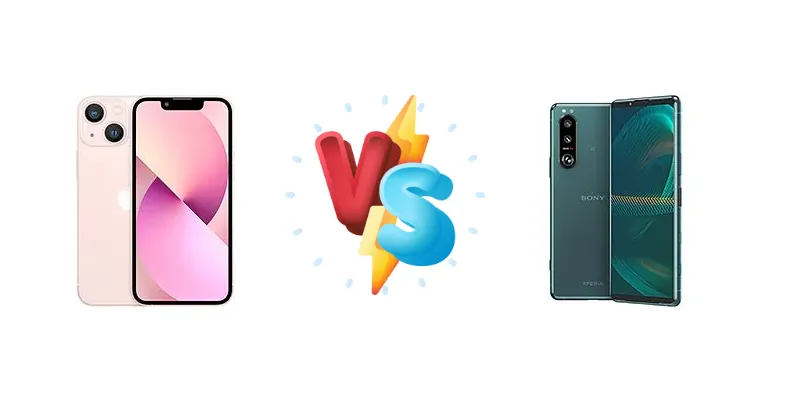
|
🏆 Quick Verdict
For the average user, the Sony Xperia 5 III emerges as the stronger choice. Its superior battery endurance, rated at 100 hours versus the iPhone 13 mini’s 75, provides a tangible benefit for all-day use. While the iPhone 13 mini boasts the A15 Bionic’s raw power, the Xperia 5 III offers a more balanced package.
| PHONES | ||
|---|---|---|
| Phone Names | Apple iPhone 13 mini | Sony Xperia 5 III |
| Network | ||
|---|---|---|
| 2G bands | GSM 850 / 900 / 1800 / 1900 | GSM 850 / 900 / 1800 / 1900 |
| 3G bands | HSDPA 850 / 900 / 1700(AWS) / 1900 / 2100 | HSDPA 800 / 850 / 900 / 1700(AWS) / 1900 / 2100 |
| 4G bands | 1, 2, 3, 4, 5, 7, 8, 12, 13, 17, 18, 19, 20, 25, 26, 28, 30, 32, 34, 38, 39, 40, 41, 42, 46, 48, 66 - A2628, A2629, A2630 | 1, 2, 3, 4, 5, 7, 8, 12, 13, 17, 19, 20, 25, 26, 28, 29, 32, 34, 38, 39, 40, 41, 46, 48, 66, 71 - USA |
| 5G bands | 1, 2, 3, 5, 7, 8, 12, 20, 25, 28, 29, 30, 38, 40, 41, 48, 66, 71, 77, 78, 79 Sub6/mmWave - A2628 | 1, 2, 3, 5, 7, 8, 20, 28, 38, 40, 41, 66, 71, 77, 78 SA/NSA/Sub6 - USA |
| Speed | HSPA, LTE, 5G, EV-DO Rev.A 3.1 Mbps | HSPA, LTE, 5G |
| Technology | GSM / CDMA / HSPA / EVDO / LTE / 5G | GSM / HSPA / LTE / 5G |
| 1, 2, 3, 5, 7, 8, 12, 20, 25, 28, 30, 38, 40, 41, 48, 66, 77, 78, 79 SA/NSA/Sub6 - A2629, A2630 | 1, 3, 5, 7, 8, 28, 38, 40, 41, 77, 78, 79 SA/NSA/Sub6 - Asia | |
| Launch | ||
|---|---|---|
| Announced | 2021, September 14 | 2021, April 14 |
| Status | Available. Released 2021, September 24 | Available. Released 2021, October 08 |
| Body | ||
|---|---|---|
| Build | Glass front, glass back, aluminum frame | Glass front (Gorilla Glass 6), glass back (Gorilla Glass 6), aluminum frame |
| Dimensions | 131.5 x 64.2 x 7.7 mm (5.18 x 2.53 x 0.30 in) | 157 x 68 x 8.2 mm (6.18 x 2.68 x 0.32 in) |
| SIM | · Nano-SIM + eSIM· Nano-SIM + Nano-SIM | · Nano-SIM· Nano-SIM + Nano-SIM |
| Weight | 141 g (4.97 oz) | 168 g (5.93 oz) |
| IP68 dust/water resistant (up to 6m for 30 min) Apple Pay (Visa, MasterCard, AMEX certified) | IP65/IP68 dust/water resistant (up to 1.5m for 30 min) | |
| Display | ||
|---|---|---|
| Protection | Ceramic Shield glass | Corning Gorilla Glass 6 |
| Resolution | 1080 x 2340 pixels, 19.5:9 ratio (~476 ppi density) | 1080 x 2520 pixels, 21:9 ratio (~449 ppi density) |
| Size | 5.4 inches, 71.9 cm2 (~85.1% screen-to-body ratio) | 6.1 inches, 86.9 cm2 (~81.4% screen-to-body ratio) |
| Type | Super Retina XDR OLED, HDR10, Dolby Vision, 800 nits (HBM), 1200 nits (peak) | OLED, 1B colors, 120Hz, HDR BT.2020 |
| Platform | ||
|---|---|---|
| CPU | Hexa-core (2x3.23 GHz Avalanche + 4x1.82 GHz Blizzard) | Octa-core (1x2.84 GHz Cortex-X1 & 3x2.42 GHz Cortex-A78 & 4x1.80 GHz Cortex-A55) |
| Chipset | Apple A15 Bionic (5 nm) | Qualcomm SM8350 Snapdragon 888 5G (5 nm) |
| GPU | Apple GPU (4-core graphics) | Adreno 660 |
| OS | iOS 15, upgradable to iOS 26.1 | Android 11, upgradable to Android 13 |
| Memory | ||
|---|---|---|
| Card slot | No | microSDXC (uses shared SIM slot) |
| Internal | 128GB 4GB RAM, 256GB 4GB RAM, 512GB 4GB RAM | 128GB 8GB RAM, 256GB 8GB RAM |
| NVMe | UFS 3.X | |
| Main Camera | ||
|---|---|---|
| Dual | 12 MP, f/1.6, 26mm (wide), 1/1.9", 1.7µm, dual pixel PDAF, sensor-shift OIS 12 MP, f/2.4, 120˚, 13mm (ultrawide), 1/3.4", 1.0µm | - |
| Features | Dual-LED dual-tone flash, HDR (photo/panorama) | Zeiss optics, Zeiss T* lens coating, color spectrum sensor, LED flash, panorama, HDR, eye tracking |
| Single | 12 MP, f/2.2, 23mm (wide), 1/3.6" SL 3D, (depth/biometrics sensor) | 8 MP, f/2.0, 24mm (wide), 1/4", 1.12µm |
| Triple | - | 12 MP, f/1.7, 24mm (wide), 1/1.7", 1.8µm, dual pixel PDAF, OIS 12 MP, f/2.3, 70mm (telephoto), f/2.8, 105mm (telephoto), 1/2.9", dual pixel PDAF, 3x/4.4x optical zoom, OIS 12 MP, f/2.2, 124˚, 16mm (ultrawide), 1/2.6", dual pixel PDAF |
| Video | 4K@24/25/30/60fps, 1080p@25/30/60/120/240fps, HDR, Dolby Vision HDR (up to 60fps), stereo sound rec. | 4K@24/25/30/60/120fps HDR, 1080p@30/60/120fps; 5-axis gyro-EIS, OIS |
| Selfie camera | ||
|---|---|---|
| Features | HDR | HDR |
| Single | 12 MP, f/2.2, 23mm (wide), 1/3.6", 1.0µm SL 3D, (depth/biometrics sensor) | 8 MP, f/2.0, 24mm (wide), 1/4.0", 1.12µm |
| Video | 4K@24/25/30/60fps, 1080p@25/30/60/120fps, gyro-EIS | 1080p@30fps, 5-axis gyro-EIS |
| Sound | ||
|---|---|---|
| 3.5mm jack | No | Yes |
| 35mm jack | No | Yes |
| Loudspeaker | Yes, with stereo speakers | Yes, with stereo speakers |
| - | 24-bit/192kHz audio Dynamic vibration system | |
| Comms | ||
|---|---|---|
| Bluetooth | 5.0, A2DP, LE | 5.2, A2DP, LE, aptX HD, aptX Adaptive |
| NFC | Yes | Yes |
| Positioning | GPS, GLONASS, GALILEO, BDS, QZSS | GPS, GLONASS, BDS, GALILEO, QZSS |
| Radio | No | No |
| USB | Lightning, USB 2.0 | USB Type-C 3.1, OTG, video output |
| WLAN | Wi-Fi 802.11 a/b/g/n/ac/6, dual-band, hotspot | Wi-Fi 802.11 a/b/g/n/ac/6, dual-band, Wi-Fi Direct, DLNA |
| Features | ||
|---|---|---|
| Sensors | Face ID, accelerometer, gyro, proximity, compass, barometer | Fingerprint (side-mounted), accelerometer, gyro, proximity, barometer, compass |
| Ultra Wideband (UWB) support | Native Sony Alpha camera support | |
| Battery | ||
|---|---|---|
| Charging | Wired, PD2.0, 50% in 30 min 15W wireless (MagSafe) 15W wireless (Qi2) - requires iOS 17.2 update | Wired, PD, 50% in 30 min |
| Type | Li-Ion 2438 mAh (9.34 Wh) | Li-Po 4500 mAh |
| Misc | ||
|---|---|---|
| Colors | Starlight, Midnight, Blue, Pink, Red, Green | Black, Green, Pink |
| Models | A2628, A2481, A2626, A2629, A2630, iphone14,4 | XQBQ62/G, XQBQ52G.UKCX, XQBQ52B.UKCX, XQ-BQ52, XQ-BQ72, XQ-BQ42, XQ-BQ62, SO-53B |
| Price | € 299.00 / $ 240.00 / £ 244.89 | € 431.90 / £ 199.99 |
| SAR | 1.19 W/kg (head) 1.19 W/kg (body) | - |
| SAR EU | 0.97 W/kg (head) 0.98 W/kg (body) | - |
| Tests | ||
|---|---|---|
| Battery life | Endurance rating 75h | Endurance rating 100h |
| Camera | Photo / Video | Photo / Video |
| Display | Contrast ratio: Infinite (nominal) | Contrast ratio: Infinite (nominal) |
| Loudspeaker | -25.9 LUFS (Very good) | -26.7 LUFS (Good) |
| Performance | AnTuTu: 772512 (v9) GeekBench: 4681 (v5.1) GFXBench: 60fps (ES 3.1 onscreen) | AnTuTu: 708394 (v9) GeekBench: 3549 (v5.1) GFXBench: 53fps (ES 3.1 onscreen) |
Apple iPhone 13 mini
- Exceptional processor performance with the A15 Bionic.
- Seamless iOS ecosystem and software updates.
- Convenience of MagSafe wireless charging.
- Significantly shorter battery life compared to the Xperia 5 III.
- Less customization options in iOS.
- Smaller display size may not suit all users.
Sony Xperia 5 III
- Superior battery endurance for all-day use.
- More customizable Android experience.
- Advanced camera features for photography enthusiasts.
- Processor performance slightly behind the A15 Bionic.
- No wireless charging support.
- Software updates may be less frequent than on iOS.
Display Comparison
The iPhone 13 mini’s display achieves a peak brightness of 831 nits, offering excellent visibility in bright conditions. However, the Sony Xperia 5 III, despite a lower 590 nits peak brightness, compensates with a 120Hz refresh rate (not specified for the iPhone 13 mini, assumed 60Hz) for smoother scrolling and animations. Both displays share an infinite (nominal) contrast ratio, typical of OLED panels. The Xperia 5 III’s slightly larger screen size, while still compact, provides a more immersive viewing experience for video content.
Camera Comparison
Both devices offer capable camera systems, but their approaches differ. The iPhone 13 mini excels in computational photography, delivering consistently excellent results in various lighting conditions. The Xperia 5 III, leveraging Sony’s Alpha camera technology, provides more manual control and customization options for photography enthusiasts. While specific sensor details are missing, the Xperia 5 III’s emphasis on real-time tracking and dedicated photography modes caters to a more advanced user. Both are capable of Photo and Video, but the Xperia 5 III’s focus on pro-level features gives it an edge for serious photographers.
Performance
Apple’s A15 Bionic (5nm) chipset in the iPhone 13 mini features a hexa-core CPU configuration – 2x3.23 GHz Avalanche and 4x1.82 GHz Blizzard cores – delivering exceptional single-core performance. The Sony Xperia 5 III utilizes the Qualcomm Snapdragon 888 5G (5nm) with an octa-core CPU (1x2.84 GHz Cortex-X1, 3x2.42 GHz Cortex-A78, 4x1.80 GHz Cortex-A55). While the A15 Bionic generally outperforms the Snapdragon 888 in raw CPU benchmarks, the Xperia 5 III’s thermal design and software optimizations contribute to sustained performance during extended gaming sessions. The iPhone 13 mini’s advantage lies in its optimized software ecosystem, but the Snapdragon 888 offers broader compatibility with Android applications.
Battery Life
The Sony Xperia 5 III’s endurance rating of 100 hours significantly surpasses the iPhone 13 mini’s 75 hours. This translates to a noticeable difference in real-world usage, allowing the Xperia 5 III to comfortably last a full day on a single charge, even with heavy use. Both devices support 50% charging in 30 minutes via wired PD charging. The iPhone 13 mini adds 15W wireless charging with MagSafe and Qi2 (requiring iOS 17.2), while the Xperia 5 III only supports wired charging.
Buying Guide
Buy the Apple iPhone 13 mini if you prioritize seamless iOS integration, a powerful processor for demanding tasks like video editing, and the convenience of MagSafe wireless charging. Buy the Sony Xperia 5 III if you value exceptional battery life, a more customizable Android experience, and a focus on multimedia consumption with its dedicated features and slightly larger display.