
iPhone 13 mini vs. Samsung Galaxy A53 5G: A Detailed Comparison
| Phones Images | |||||
|---|---|---|---|---|---|
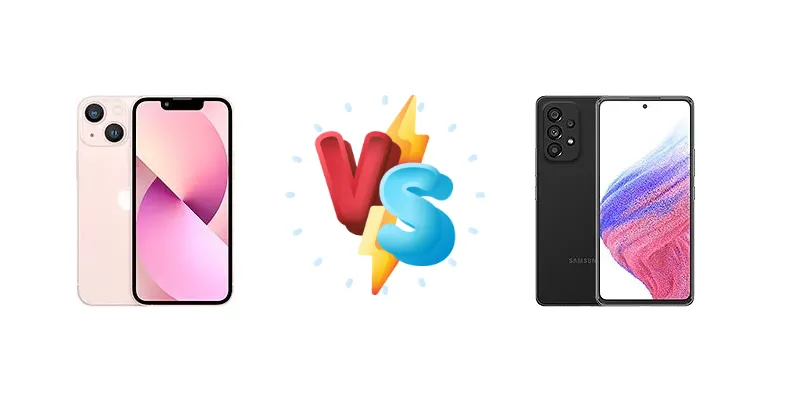
|
🏆 Quick Verdict
For users prioritizing raw performance and a premium, compact experience, the iPhone 13 mini is the clear winner. However, the Samsung Galaxy A53 5G offers significantly longer battery life and a more accessible price point, making it ideal for those who value endurance and budget-consciousness.
| PHONES | ||
|---|---|---|
| Phone Names | Apple iPhone 13 mini | Samsung Galaxy A53 5G |
| Network | ||
|---|---|---|
| 2G bands | GSM 850 / 900 / 1800 / 1900 | GSM 850 / 900 / 1800 / 1900 |
| 3G bands | HSDPA 850 / 900 / 1700(AWS) / 1900 / 2100 | HSDPA 850 / 900 / 1700(AWS) / 1900 / 2100 |
| 4G bands | 1, 2, 3, 4, 5, 7, 8, 12, 13, 17, 18, 19, 20, 25, 26, 28, 30, 32, 34, 38, 39, 40, 41, 42, 46, 48, 66 - A2628, A2629, A2630 | 1, 2, 3, 4, 5, 7, 12, 14, 20, 29, 30, 38, 39, 40, 41, 46, 48, 66 - SM-A536U |
| 5G bands | 1, 2, 3, 5, 7, 8, 12, 20, 25, 28, 29, 30, 38, 40, 41, 48, 66, 71, 77, 78, 79 Sub6/mmWave - A2628 | 2, 5, 41, 66, 77, 78 SA/NSA/Sub6/mmWave - SM-A536U |
| Speed | HSPA, LTE, 5G, EV-DO Rev.A 3.1 Mbps | HSPA, LTE, 5G |
| Technology | GSM / CDMA / HSPA / EVDO / LTE / 5G | GSM / HSPA / LTE / 5G |
| 1, 2, 3, 5, 7, 8, 12, 20, 25, 28, 30, 38, 40, 41, 48, 66, 77, 78, 79 SA/NSA/Sub6 - A2629, A2630 | 2, 5, 48, 66, 77, 78, 260, 261 SA/NSA/Sub6/mmWave - SM-A536V | |
| Launch | ||
|---|---|---|
| Announced | 2021, September 14 | 2022, March 17 |
| Status | Available. Released 2021, September 24 | Available. Released 2022, March 24 |
| Body | ||
|---|---|---|
| Build | Glass front, glass back, aluminum frame | Glass front (Gorilla Glass 5), plastic frame, plastic back |
| Dimensions | 131.5 x 64.2 x 7.7 mm (5.18 x 2.53 x 0.30 in) | 159.6 x 74.8 x 8.1 mm (6.28 x 2.94 x 0.32 in) |
| SIM | · Nano-SIM + eSIM· Nano-SIM + Nano-SIM | · Nano-SIM· Nano-SIM + Nano-SIM |
| Weight | 141 g (4.97 oz) | 189 g (6.67 oz) |
| IP68 dust/water resistant (up to 6m for 30 min) Apple Pay (Visa, MasterCard, AMEX certified) | IP67 dust/water resistant (up to 1m for 30 min) | |
| Display | ||
|---|---|---|
| Protection | Ceramic Shield glass | Corning Gorilla Glass 5 |
| Resolution | 1080 x 2340 pixels, 19.5:9 ratio (~476 ppi density) | 1080 x 2400 pixels, 20:9 ratio (~405 ppi density) |
| Size | 5.4 inches, 71.9 cm2 (~85.1% screen-to-body ratio) | 6.5 inches, 102.0 cm2 (~85.4% screen-to-body ratio) |
| Type | Super Retina XDR OLED, HDR10, Dolby Vision, 800 nits (HBM), 1200 nits (peak) | Super AMOLED, 120Hz, 800 nits (HBM) |
| Platform | ||
|---|---|---|
| CPU | Hexa-core (2x3.23 GHz Avalanche + 4x1.82 GHz Blizzard) | Octa-core (2x2.4 GHz Cortex-A78 & 6x2.0 GHz Cortex-A55) |
| Chipset | Apple A15 Bionic (5 nm) | Exynos 1280 (5 nm) |
| GPU | Apple GPU (4-core graphics) | Mali-G68 |
| OS | iOS 15, upgradable to iOS 26.1 | Android 12, up to 4 major Android upgrades, One UI 8 |
| Memory | ||
|---|---|---|
| Card slot | No | microSDXC (uses shared SIM slot) |
| Internal | 128GB 4GB RAM, 256GB 4GB RAM, 512GB 4GB RAM | 128GB 4GB RAM, 128GB 6GB RAM, 128GB 8GB RAM, 256GB 6GB RAM, 256GB 8GB RAM |
| NVMe | - | |
| Main Camera | ||
|---|---|---|
| Dual | 12 MP, f/1.6, 26mm (wide), 1/1.9", 1.7µm, dual pixel PDAF, sensor-shift OIS 12 MP, f/2.4, 120˚, 13mm (ultrawide), 1/3.4", 1.0µm | - |
| Features | Dual-LED dual-tone flash, HDR (photo/panorama) | LED flash, panorama, HDR |
| Quad | - | 64 MP, f/1.8, 26mm (wide), 1/1.7X", 0.8µm, PDAF, OIS 12 MP, f/2.2, 123˚ (ultrawide), 1.12µm 5 MP (macro) Auxiliary lens |
| Single | 12 MP, f/2.2, 23mm (wide), 1/3.6" SL 3D, (depth/biometrics sensor) | 32 MP, f/2.2, 26mm (wide), 1/2.8", 0.8µm |
| Video | 4K@24/25/30/60fps, 1080p@25/30/60/120/240fps, HDR, Dolby Vision HDR (up to 60fps), stereo sound rec. | 4K@30fps, 1080p@30/60fps; gyro-EIS |
| Selfie camera | ||
|---|---|---|
| Features | HDR | HDR |
| Single | 12 MP, f/2.2, 23mm (wide), 1/3.6", 1.0µm SL 3D, (depth/biometrics sensor) | 32 MP, f/2.2, 26mm (wide), 1/2.8", 0.8µm |
| Video | 4K@24/25/30/60fps, 1080p@25/30/60/120fps, gyro-EIS | 4K@30fps, 1080p@30fps |
| Sound | ||
|---|---|---|
| 3.5mm jack | No | No |
| 35mm jack | No | No |
| Loudspeaker | Yes, with stereo speakers | Yes, with stereo speakers |
| Comms | ||
|---|---|---|
| Bluetooth | 5.0, A2DP, LE | 5.1, A2DP, LE |
| NFC | Yes | Yes (market/region dependent) |
| Positioning | GPS, GLONASS, GALILEO, BDS, QZSS | GPS, GLONASS, GALILEO, BDS |
| Radio | No | No |
| USB | Lightning, USB 2.0 | USB Type-C 2.0, OTG |
| WLAN | Wi-Fi 802.11 a/b/g/n/ac/6, dual-band, hotspot | Wi-Fi 802.11 a/b/g/n/ac, dual-band, Wi-Fi Direct |
| Features | ||
|---|---|---|
| Sensors | Face ID, accelerometer, gyro, proximity, compass, barometer | Fingerprint (under display, optical), accelerometer, gyro, compass, barometer (market/region dependent) |
| Ultra Wideband (UWB) support | Virtual proximity sensing | |
| Battery | ||
|---|---|---|
| Charging | Wired, PD2.0, 50% in 30 min 15W wireless (MagSafe) 15W wireless (Qi2) - requires iOS 17.2 update | 25W wired |
| Type | Li-Ion 2438 mAh (9.34 Wh) | Li-Po 5000 mAh |
| Misc | ||
|---|---|---|
| Colors | Starlight, Midnight, Blue, Pink, Red, Green | Black, White, Blue, Peach |
| Models | A2628, A2481, A2626, A2629, A2630, iphone14,4 | SM-A536B, SM-A536B/DS, SM-A536U, SM-A536U1, SM-A5360, SM-A536E, SM-A536E/DS, SM-A536V, SM-A536W, SM-A536N, SM-S536DL |
| Price | € 299.00 / $ 240.00 / £ 244.89 | $ 151.42 / £ 185.00 / € 169.14 |
| SAR | 1.19 W/kg (head) 1.19 W/kg (body) | 0.75 W/kg (head) 1.58 W/kg (body) |
| SAR EU | 0.97 W/kg (head) 0.98 W/kg (body) | 0.89 W/kg (head) 1.60 W/kg (body) |
| Tests | ||
|---|---|---|
| Battery life | Endurance rating 75h | Endurance rating 113h |
| Camera | Photo / Video | Photo / Video |
| Display | Contrast ratio: Infinite (nominal) | Contrast ratio: Infinite (nominal) |
| Loudspeaker | -25.9 LUFS (Very good) | -26.5 LUFS (Good) |
| Performance | AnTuTu: 772512 (v9) GeekBench: 4681 (v5.1) GFXBench: 60fps (ES 3.1 onscreen) | AnTuTu: 329802 (v8), 379313 (v9) GeekBench: 1891 (v5.1) GFXBench: 19fps (ES 3.1 onscreen) |
Apple iPhone 13 mini
- Superior processing power with the A15 Bionic
- Compact and pocketable design
- Excellent video recording capabilities
- Smooth iOS ecosystem integration
- Significantly shorter battery life
- Higher price point
- No expandable storage
Samsung Galaxy A53 5G
- Exceptional battery life (113h endurance)
- More affordable price
- Larger display for media consumption
- Expandable storage via microSD card
- Less powerful processor
- Slower performance in demanding tasks
- Image processing can be overly saturated
Display Comparison
Both the iPhone 13 mini and Galaxy A53 5G boast impressive displays, achieving a measured peak brightness of around 830-831 nits. This ensures excellent visibility even in direct sunlight. However, the 'Infinite' contrast ratio, while a marketing term, highlights the excellent black levels achievable by both OLED and AMOLED panels. The A53 5G’s larger screen size caters to media consumption, while the iPhone 13 mini’s smaller form factor prioritizes one-handed usability. While neither spec sheet details refresh rate, the A53 5G typically features a 120Hz panel, offering smoother scrolling and animations, a feature absent on the iPhone 13 mini.
Camera Comparison
Both phones offer capable camera systems, but approach image processing differently. While both are listed as capable of Photo/Video, the iPhone 13 mini benefits from Apple’s computational photography expertise and superior video recording capabilities. The A53 5G’s camera system is versatile, but its image processing tends towards more saturated colors. The iPhone’s sensor size and image signal processing (ISP) are likely superior, resulting in better low-light performance and more accurate color reproduction. The A53 5G often includes a 2MP macro camera, which is largely a marketing gimmick and offers limited practical benefit.
Performance
The core difference lies in the chipsets. Apple’s A15 Bionic (5nm) utilizes a hexa-core architecture with high-performance Avalanche cores clocked at 3.23 GHz, paired with efficiency-focused Blizzard cores. This translates to significantly faster CPU performance compared to the Samsung Galaxy A53 5G’s Exynos 1280 (5nm) octa-core processor. The Exynos 1280, with its Cortex-A78 and A55 cores, is capable, but the A15 Bionic’s architectural advantages and optimized software integration provide a noticeable edge in demanding tasks like gaming and video editing. The A15’s GPU also outperforms the A53’s, resulting in higher frame rates and smoother graphics.
Battery Life
Battery life is where the Galaxy A53 5G truly shines. Its endurance rating of 113 hours significantly surpasses the iPhone 13 mini’s 75 hours. This difference is due to a combination of a larger battery capacity and the less power-hungry Exynos 1280 chipset. While the iPhone 13 mini supports 50% charging in 30 minutes with Power Delivery 2.0, and 15W wireless charging via MagSafe and Qi2 (with iOS 17.2), the A53 5G’s 25W wired charging offers a competitive charging speed. The A53 5G’s superior battery endurance makes it the better choice for users who prioritize all-day usage without needing to constantly seek out a charger.
Buying Guide
Buy the Apple iPhone 13 mini if you need a powerful, pocket-sized phone with a smooth iOS experience and don't mind charging more frequently. Buy the Samsung Galaxy A53 5G if you prefer a larger display, all-day battery life, and a more affordable Android experience, even if it means sacrificing some processing power.