
iPhone 13 mini vs. Google Pixel 6a: A Compact Flagship Face-Off
| Phones Images | |||||
|---|---|---|---|---|---|
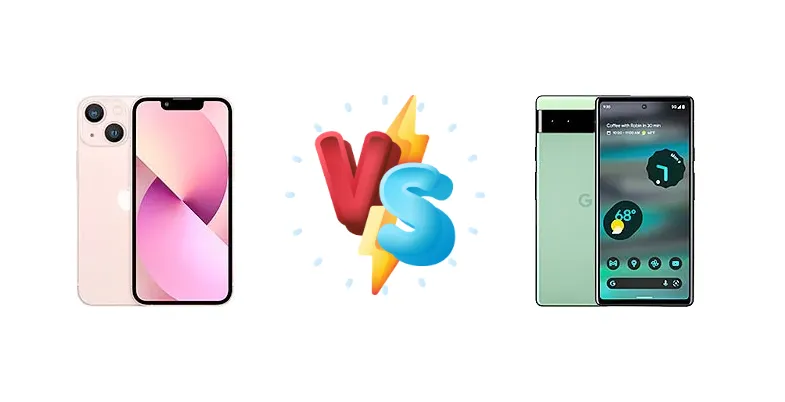
|
🏆 Quick Verdict
For users prioritizing raw performance and a seamless ecosystem, the iPhone 13 mini remains a strong choice. However, the Pixel 6a’s significantly longer battery life and intelligent camera features make it the better option for most users seeking all-day usability and computational photography prowess.
| PHONES | ||
|---|---|---|
| Phone Names | Apple iPhone 13 mini | Google Pixel 6a |
| Network | ||
|---|---|---|
| 2G bands | GSM 850 / 900 / 1800 / 1900 | GSM 850 / 900 / 1800 / 1900 |
| 3G bands | HSDPA 850 / 900 / 1700(AWS) / 1900 / 2100 | HSDPA 800 / 850 / 900 / 1700(AWS) / 1900 / 2100 |
| 4G bands | 1, 2, 3, 4, 5, 7, 8, 12, 13, 17, 18, 19, 20, 25, 26, 28, 30, 32, 34, 38, 39, 40, 41, 42, 46, 48, 66 - A2628, A2629, A2630 | 1, 2, 3, 4, 5, 7, 8, 12, 13, 14, 17, 18, 19, 20, 25, 26, 28, 29, 30, 38, 39, 40, 41, 42, 48, 66, 71 - GX7AS, GB62Z (USA/Canada) |
| 5G bands | 1, 2, 3, 5, 7, 8, 12, 20, 25, 28, 29, 30, 38, 40, 41, 48, 66, 71, 77, 78, 79 Sub6/mmWave - A2628 | 1, 2, 3, 5, 7, 8, 12, 20, 25, 28, 30, 38, 40, 41, 48, 66, 71, 77, 78 SA/NSA/Sub6 - GX7AS (USA/Canada) |
| Speed | HSPA, LTE, 5G, EV-DO Rev.A 3.1 Mbps | HSPA, LTE, 5G |
| Technology | GSM / CDMA / HSPA / EVDO / LTE / 5G | GSM / HSPA / LTE / 5G |
| 1, 2, 3, 5, 7, 8, 12, 20, 25, 28, 30, 38, 40, 41, 48, 66, 77, 78, 79 SA/NSA/Sub6 - A2629, A2630 | 1, 2, 3, 5, 7, 8, 12, 20, 25, 28, 30, 40, 48, 66, 71, 77, 78 SA/NSA/Sub6 - G1AZG (International) | |
| Launch | ||
|---|---|---|
| Announced | 2021, September 14 | 2022, May 11 |
| Status | Available. Released 2021, September 24 | Available. Released 2022, July 21 |
| Body | ||
|---|---|---|
| Build | Glass front, glass back, aluminum frame | Glass front (Gorilla Glass 3), aluminum frame, plastic back |
| Dimensions | 131.5 x 64.2 x 7.7 mm (5.18 x 2.53 x 0.30 in) | 152.2 x 71.8 x 8.9 mm (5.99 x 2.83 x 0.35 in) |
| SIM | · Nano-SIM + eSIM· Nano-SIM + Nano-SIM | Nano-SIM + eSIM |
| Weight | 141 g (4.97 oz) | 178 g (6.28 oz) |
| IP68 dust/water resistant (up to 6m for 30 min) Apple Pay (Visa, MasterCard, AMEX certified) | IP67 dust/water resistant (up to 1m for 30 min) | |
| Display | ||
|---|---|---|
| Protection | Ceramic Shield glass | Corning Gorilla Glass 3 |
| Resolution | 1080 x 2340 pixels, 19.5:9 ratio (~476 ppi density) | 1080 x 2400 pixels, 20:9 ratio (~429 ppi density) |
| Size | 5.4 inches, 71.9 cm2 (~85.1% screen-to-body ratio) | 6.1 inches, 90.7 cm2 (~83.0% screen-to-body ratio) |
| Type | Super Retina XDR OLED, HDR10, Dolby Vision, 800 nits (HBM), 1200 nits (peak) | OLED, HDR |
| - | Always-on display | |
| Platform | ||
|---|---|---|
| CPU | Hexa-core (2x3.23 GHz Avalanche + 4x1.82 GHz Blizzard) | Octa-core (2x2.80 GHz Cortex-X1 & 2x2.25 GHz Cortex-A76 & 4x1.80 GHz Cortex-A55) |
| Chipset | Apple A15 Bionic (5 nm) | Google Tensor (5 nm) |
| GPU | Apple GPU (4-core graphics) | Mali-G78 MP20 |
| OS | iOS 15, upgradable to iOS 26.1 | Android 12, upgradable to Android 15, up to 5 major Android upgrades |
| Memory | ||
|---|---|---|
| Card slot | No | No |
| Internal | 128GB 4GB RAM, 256GB 4GB RAM, 512GB 4GB RAM | 128GB 6GB RAM |
| NVMe | UFS 3.1 | |
| Main Camera | ||
|---|---|---|
| Dual | 12 MP, f/1.6, 26mm (wide), 1/1.9", 1.7µm, dual pixel PDAF, sensor-shift OIS 12 MP, f/2.4, 120˚, 13mm (ultrawide), 1/3.4", 1.0µm | 12.2 MP, f/1.7, 27mm, (wide), 1/2.55", 1.4µm, dual pixel PDAF, OIS 12 MP, f/2.2, 17mm, 114˚ (ultrawide), 1.25µm |
| Features | Dual-LED dual-tone flash, HDR (photo/panorama) | Dual-LED flash, Pixel Shift, Auto-HDR, panorama |
| Single | 12 MP, f/2.2, 23mm (wide), 1/3.6" SL 3D, (depth/biometrics sensor) | 8 MP, f/2.0, 24mm (wide), 1.12µm |
| Video | 4K@24/25/30/60fps, 1080p@25/30/60/120/240fps, HDR, Dolby Vision HDR (up to 60fps), stereo sound rec. | 4K@30/60fps, 1080p@30/60/120/240fps; gyro-EIS, OIS |
| Selfie camera | ||
|---|---|---|
| Features | HDR | HDR, panorama |
| Single | 12 MP, f/2.2, 23mm (wide), 1/3.6", 1.0µm SL 3D, (depth/biometrics sensor) | 8 MP, f/2.0, 24mm (wide), 1.12µm |
| Video | 4K@24/25/30/60fps, 1080p@25/30/60/120fps, gyro-EIS | 1080p@30fps |
| Sound | ||
|---|---|---|
| 3.5mm jack | No | No |
| 35mm jack | No | No |
| Loudspeaker | Yes, with stereo speakers | Yes, with stereo speakers |
| Comms | ||
|---|---|---|
| Bluetooth | 5.0, A2DP, LE | 5.2, A2DP, LE |
| NFC | Yes | Yes |
| Positioning | GPS, GLONASS, GALILEO, BDS, QZSS | GPS, GLONASS, GALILEO, QZSS |
| Radio | No | No |
| USB | Lightning, USB 2.0 | USB Type-C 3.1 |
| WLAN | Wi-Fi 802.11 a/b/g/n/ac/6, dual-band, hotspot | Wi-Fi 802.11 a/b/g/n/ac/6e, dual-band, Wi-Fi Direct |
| Features | ||
|---|---|---|
| Sensors | Face ID, accelerometer, gyro, proximity, compass, barometer | Fingerprint (under display, optical), accelerometer, gyro, proximity, compass, barometer |
| Ultra Wideband (UWB) support | - | |
| Battery | ||
|---|---|---|
| Charging | Wired, PD2.0, 50% in 30 min 15W wireless (MagSafe) 15W wireless (Qi2) - requires iOS 17.2 update | 18W wired, PD3.0 |
| Type | Li-Ion 2438 mAh (9.34 Wh) | Li-Po 4410 mAh |
| Misc | ||
|---|---|---|
| Colors | Starlight, Midnight, Blue, Pink, Red, Green | Chalk, Charcoal, Sage |
| Models | A2628, A2481, A2626, A2629, A2630, iphone14,4 | GX7AS, GB62Z, G1AZG, GB17L |
| Price | € 299.00 / $ 240.00 / £ 244.89 | $ 138.99 / C$ 228.74 / ₹ 23,999 |
| SAR | 1.19 W/kg (head) 1.19 W/kg (body) | - |
| SAR EU | 0.97 W/kg (head) 0.98 W/kg (body) | - |
| Tests | ||
|---|---|---|
| Battery life | Endurance rating 75h | Endurance rating 94h |
| Camera | Photo / Video | - |
| Display | Contrast ratio: Infinite (nominal) | Contrast ratio: Infinite (nominal) |
| Loudspeaker | -25.9 LUFS (Very good) | - |
| Performance | AnTuTu: 772512 (v9) GeekBench: 4681 (v5.1) GFXBench: 60fps (ES 3.1 onscreen) | - |
Apple iPhone 13 mini
- Unmatched CPU performance with the A15 Bionic.
- Premium build quality and compact design.
- Excellent video recording capabilities.
- Significantly shorter battery life compared to the Pixel 6a.
- Higher price point.
- Limited customization options.
Google Pixel 6a
- Exceptional battery life for all-day use.
- AI-powered camera features like Magic Eraser.
- More affordable price.
- Less powerful processor than the A15 Bionic.
- Slightly less refined build quality.
- Charging speed is slower than some competitors.
Display Comparison
Both the iPhone 13 mini and Pixel 6a feature 'infinite' contrast ratios, typical of OLED panels. However, the Pixel 6a edges out the iPhone 13 mini in peak brightness, reaching 876 nits compared to the iPhone’s 831 nits. This translates to slightly better visibility in direct sunlight for the Pixel. While neither phone boasts a high refresh rate, the difference in brightness is a tangible benefit for outdoor use. The iPhone 13 mini’s color accuracy is renowned, but the Pixel 6a’s display is also well-calibrated, making this a relatively minor distinction.
Camera Comparison
Both phones excel in photography, but approach it differently. The iPhone 13 mini leverages Apple’s computational photography expertise, delivering consistently accurate colors and excellent dynamic range. The Pixel 6a, powered by the Tensor chip, focuses on AI-driven enhancements like Magic Eraser and Face Unblur. While detailed sensor specs are not provided, the Pixel 6a’s image processing excels in low-light conditions, often producing brighter and more detailed images. The iPhone 13 mini’s video recording capabilities are generally considered superior, offering cinematic mode and ProRes video recording (though ProRes requires significant storage).
Performance
The core difference lies in the chipsets. Apple’s A15 Bionic (5nm) utilizes a hexa-core architecture with high-performance Avalanche cores clocked at 3.23 GHz, offering exceptional single-core performance. Google’s Tensor (5nm) employs an octa-core configuration, combining Cortex-X1, A76, and A55 cores. While the Tensor offers more cores, the A15’s architectural efficiency and optimized software integration provide a noticeable advantage in tasks like video editing and gaming. The A15’s GPU is also demonstrably more powerful. However, the Tensor’s AI capabilities are a key differentiator, powering features like real-time translation and advanced image processing.
Battery Life
Battery life is where the Pixel 6a truly shines. Its endurance rating of 94 hours significantly surpasses the iPhone 13 mini’s 75 hours. This translates to a full day of moderate to heavy use on the Pixel 6a, while the iPhone 13 mini may require a top-up before the end of the day for power users. The Pixel 6a supports 18W wired charging with PD3.0, while the iPhone 13 mini offers 15W wired charging with PD2.0 and 15W wireless charging via MagSafe/Qi2 (requiring iOS 17.2 for Qi2). The Pixel 6a’s faster wired charging provides a quicker boost when needed.
Buying Guide
Buy the Apple iPhone 13 mini if you absolutely need the most responsive performance in a small form factor and are deeply invested in the Apple ecosystem. Its A15 Bionic chip provides a noticeable edge in demanding tasks. Buy the Google Pixel 6a if you prioritize battery life, value Google’s AI-driven features like Magic Eraser, and prefer a more affordable price without sacrificing core smartphone functionality.