
iPhone 12 vs. Samsung Galaxy S21 Ultra 5G: Which Flagship Still Holds Up?
| Phones Images | |||||
|---|---|---|---|---|---|
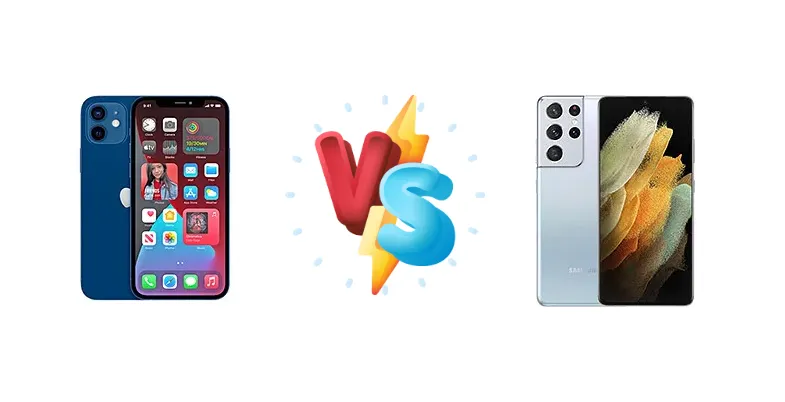
|
🏆 Quick Verdict
For most users, the Samsung Galaxy S21 Ultra 5G emerges as the superior choice. Its significantly longer battery life (114h vs 84h), brighter display (1023 nits), and more versatile camera system outweigh the iPhone 12’s streamlined software experience. However, the iPhone 12 remains a strong contender for users deeply embedded in the Apple ecosystem.
| PHONES | ||
|---|---|---|
| Phone Names | Apple iPhone 12 | Samsung Galaxy S21 Ultra 5G |
| Network | ||
|---|---|---|
| 2G bands | GSM 850 / 900 / 1800 / 1900 | GSM 850 / 900 / 1800 / 1900 |
| 3G bands | HSDPA 850 / 900 / 1700(AWS) / 1900 / 2100 | HSDPA 850 / 900 / 1700(AWS) / 1900 / 2100 |
| 4G bands | 1, 2, 3, 4, 5, 7, 8, 12, 13, 14, 17, 18, 19, 20, 25, 26, 28, 29, 30, 32, 34, 38, 39, 40, 41, 42, 46, 48, 66, 71 - A2172 | 1, 2, 3, 4, 5, 7, 8, 12, 13, 14, 18, 19, 20, 25, 26, 28, 30, 38, 39, 40, 41, 46, 48, 66, 71 - SM-G998U1 |
| 5G bands | 1, 2, 3, 5, 7, 8, 12, 20, 25, 28, 38, 40, 41, 66, 71, 77, 78, 79, 260, 261 Sub6/mmWave - A2172 | 2, 5, 25, 41, 66, 71, 260, 261 SA/NSA/Sub6/mmWave - SM-G998U1 |
| Speed | HSPA, LTE, 5G, EV-DO Rev.A 3.1 Mbps | HSPA 42.2/5.76 Mbps, LTE (7CA) Cat20 2000/200 Mbps, 5G (5+ Gbps DL) |
| Technology | GSM / CDMA / HSPA / EVDO / LTE / 5G | GSM / CDMA / HSPA / EVDO / LTE / 5G |
| - | 1, 3, 5, 7, 8, 20, 28, 38, 40, 41, 66, 77, 78 SA/NSA/Sub6 - SM-G998B | |
| Launch | ||
|---|---|---|
| Announced | 2020, October 13 | 2021, January 14 |
| Status | Available. Released 2020, October 23 | Available. Released 2021, January 29 |
| Body | ||
|---|---|---|
| Build | Glass front, glass back, aluminum frame | Glass front (Gorilla Glass Victus), glass back (Gorilla Glass Victus), aluminum frame |
| Dimensions | 146.7 x 71.5 x 7.4 mm (5.78 x 2.81 x 0.29 in) | 165.1 x 75.6 x 8.9 mm (6.5 x 2.98 x 0.35 in) |
| SIM | · Nano-SIM + eSIM· Nano-SIM + Nano-SIM (China) | · Nano-SIM + eSIM· Nano-SIM + Nano-SIM + eSIM (max 2 at a time) |
| Weight | 164 g (5.78 oz) | 227 g (Sub6), 229 g (mmWave) (8.01 oz) |
| - | IP68 dust/water resistant (up to 1.5m for 30 min) Stylus support | |
| Display | ||
|---|---|---|
| Protection | Ceramic Shield glass | Corning Gorilla Glass Victus |
| Resolution | 1170 x 2532 pixels, 19.5:9 ratio (~460 ppi density) | 1440 x 3200 pixels, 20:9 ratio (~515 ppi density) |
| Size | 6.1 inches, 90.2 cm2 (~86.0% screen-to-body ratio) | 6.8 inches, 112.1 cm2 (~89.8% screen-to-body ratio) |
| Type | Super Retina XDR OLED, HDR10, Dolby Vision, 625 nits (HBM), 1200 nits (peak) | Dynamic AMOLED 2X, 120Hz, HDR10+, 1500 nits (peak) |
| - | Always-on display | |
| Platform | ||
|---|---|---|
| CPU | Hexa-core (2x3.1 GHz Firestorm + 4x1.8 GHz Icestorm) | Octa-core (1x2.9 GHz Cortex-X1 & 3x2.80 GHz Cortex-A78 & 4x2.2 GHz Cortex-A55) - InternationalOcta-core (1x2.84 GHz Cortex-X1 & 3x2.42 GHz Cortex-A78 & 4x1.80 GHz Cortex-A55) - USA/China |
| Chipset | Apple A14 Bionic (5 nm) | Exynos 2100 (5 nm) - InternationalQualcomm SM8350 Snapdragon 888 5G (5 nm) - USA/China |
| GPU | Apple GPU (4-core graphics) | Mali-G78 MP14 - InternationalAdreno 660 - USA/China |
| OS | iOS 14.1, upgradable to iOS 26.1 | Android 11, up to 4 major Android upgrades, One UI 6.1 |
| Memory | ||
|---|---|---|
| Card slot | No | No |
| Internal | 64GB 4GB RAM, 128GB 4GB RAM, 256GB 4GB RAM | 128GB 8GB RAM, 128GB 12GB RAM, 256GB 12GB RAM, 256GB 16GB RAM, 512GB 12GB RAM, 512GB 16GB RAM |
| - | UFS 3.1 | |
| Main Camera | ||
|---|---|---|
| Dual | 12 MP, f/1.6, 26mm (wide), 1.4µm, dual pixel PDAF, OIS 12 MP, f/2.4, 13mm, 120˚ (ultrawide), 1/3.6" | - |
| Features | Dual-LED dual-tone flash, HDR (photo/panorama) | Laser AF, LED flash, auto-HDR, panorama |
| Quad | - | 108 MP, f/1.8, 24mm (wide), 1/1.33", 0.8µm, PDAF, OIS 10 MP, f/2.4, 72mm (telephoto), 1/3.24", 1.22µm, dual pixel PDAF, OIS, 3x optical zoom 10 MP, f/4.9, 240mm (periscope telephoto), 1/3.24", 1.22µm, dual pixel PDAF, OIS, 10x optical zoom 12 MP, f/2.2, 13mm (ultrawide), 1/2.55", 1.4µm, dual pixel PDAF, Super Steady video |
| Video | 4K@24/25/30/60fps, 1080p@25/30/60/120/240fps, HDR, Dolby Vision HDR (up to 30fps), stereo sound rec. | 8K@24fps, 4K@30/60fps, 1080p@30/60/120/240fps, HDR10+, stereo sound rec., gyro-EIS |
| Selfie camera | ||
|---|---|---|
| Features | HDR | HDR |
| Single | 12 MP, f/2.2, 23mm (wide), 1/3.6", 1.0µm SL 3D, (depth/biometrics sensor) | 40 MP, f/2.2, 26mm (wide), 1/2.8", 0.7µm, PDAF |
| Video | 4K@24/25/30/60fps, 1080p@25/30/60/120fps, gyro-EIS | 4K@30/60fps, 1080p@30fps |
| Sound | ||
|---|---|---|
| 3.5mm jack | No | No |
| 35mm jack | No | No |
| Loudspeaker | Yes, with stereo speakers | Yes, with stereo speakers |
| - | 32-bit/384kHz audio Tuned by AKG | |
| Comms | ||
|---|---|---|
| Bluetooth | 5.0, A2DP, LE | 5.2, A2DP, LE |
| NFC | Yes | Yes |
| Positioning | GPS, GLONASS, GALILEO, QZSS | GPS, GLONASS, BDS, GALILEO |
| Radio | No | FM radio (Snapdragon model only; market/operator dependent) |
| USB | Lightning, USB 2.0 | USB Type-C 3.2, OTG |
| WLAN | Wi-Fi 802.11 a/b/g/n/ac/6, dual-band, hotspot | Wi-Fi 802.11 a/b/g/n/ac/6e, dual-band, Wi-Fi Direct |
| Features | ||
|---|---|---|
| Sensors | Face ID, accelerometer, gyro, proximity, compass, barometer | Fingerprint (under display, ultrasonic), accelerometer, gyro, proximity, compass, barometer |
| - | Samsung DeX, Samsung Wireless DeX (desktop experience support) Bixby natural language commands and dictation Samsung Pay (Visa, MasterCard certified) Ultra Wideband (UWB) support | |
| Battery | ||
|---|---|---|
| Charging | Wired, PD2.0, 50% in 30 min 15W wireless (MagSafe) 15W wireless (Qi2) - requires iOS 17.4 update | 25W wired, PD3.0 15W wireless (Qi) 4.5W reverse wireless |
| Type | Li-Ion 2815 mAh (10.78 Wh) | Li-Ion 5000 mAh |
| Misc | ||
|---|---|---|
| Colors | Black, White, Red, Green, Blue, Purple | Phantom Black, Phantom Silver, Phantom Titanium, Phantom Navy, Phantom Brown, Navy |
| Models | A2403, A2172, A2402, A2404, iPhone13,2 | SM-G998B, SM-G998B/DS, SM-G998U, SM-G998U1, SM-G998W, SM-G998N, SM-G9980 |
| Price | $ 190.00 / C$ 307.99 / £ 190.00 / € 219.00 / ₹ 54,900 | $ 240.01 / C$ 353.20 / £ 202.99 / € 264.99 |
| SAR | - | 0.77 W/kg (head) 1.02 W/kg (body) |
| SAR EU | 0.99 W/kg (head) 0.99 W/kg (body) | 0.71 W/kg (head) 1.58 W/kg (body) |
| Pricing | ||
|---|---|---|
| 128GB 12GB RAM | - | $ 384.99 |
| 256GB 12GB RAM | - | $ 998.00 |
| 512GB 12GB RAM | - | $ 1,179.99 |
| RENEWED | - | $ 459.00 |
| Tests | ||
|---|---|---|
| Battery life | Endurance rating 84h | Endurance rating 114h |
| Camera | Photo / Video | Photo / Video |
| Display | Contrast ratio: Infinite (nominal) | Contrast ratio: Infinite (nominal) |
| Loudspeaker | -24.4 LUFS (Very good) | -25.5 LUFS (Very good) |
| Performance | AnTuTu: 568674 (v8) GeekBench: 4067 (v5.1) GFXBench: 58fps (ES 3.1 onscreen) | AnTuTu: 657150 (v8) GeekBench: 3518 (v5.1) GFXBench: 33fps (ES 3.1 onscreen) |
Apple iPhone 12
- Seamless Apple ecosystem integration
- Intuitive and user-friendly iOS interface
- Compact and pocketable design
- Significantly shorter battery life
- Less versatile camera system
- Slower charging speeds
Samsung Galaxy S21 Ultra 5G
- Exceptional battery life
- Brighter and more vibrant display
- Versatile camera system with advanced zoom
- Larger and heavier design
- More complex Android interface
- Potential for Exynos chipset throttling
Display Comparison
The Samsung Galaxy S21 Ultra boasts a significantly brighter display, peaking at 1023 nits, compared to the iPhone 12’s ‘infinite’ (nominal) contrast ratio, which doesn’t specify peak brightness. While both offer excellent viewing experiences, the S21 Ultra’s higher brightness translates to better visibility in direct sunlight. Both displays share an infinite contrast ratio, suggesting excellent black levels, but the S21 Ultra’s larger size and higher resolution contribute to a more immersive visual experience. The iPhone 12’s display, while excellent, lacks the dynamic refresh rate technology found in many competing devices, including later Samsung flagships.
Camera Comparison
Both phones offer capable photo and video recording, but the Galaxy S21 Ultra’s camera system is significantly more versatile. While both lack detailed sensor specifications in the provided data, the S21 Ultra’s reputation for advanced zoom capabilities (up to 100x Space Zoom) and a larger main sensor (typically 108MP) gives it a clear advantage. The iPhone 12 excels in computational photography and video stabilization, but the S21 Ultra’s wider range of lenses and shooting modes caters to more creative control. The iPhone 12’s reliance on software processing can sometimes result in over-sharpened images, while the S21 Ultra aims for a more natural look.
Performance
The iPhone 12’s Apple A14 Bionic (5nm) chip and hexa-core CPU deliver impressive performance, but the Galaxy S21 Ultra’s Exynos 2100 (5nm - International) or Snapdragon 888 5G (5nm - USA/China) offer a more complex architecture with an octa-core configuration. While real-world performance differences are often subtle, the S21 Ultra’s larger RAM capacity (12GB vs. iPhone 12’s assumed 4GB/6GB) allows for more efficient multitasking. The Exynos 2100’s Cortex-X1 core provides a performance boost, but has been historically prone to thermal throttling, a concern not as prevalent with the A14 Bionic’s efficient design. The S21 Ultra’s chipset variation (Exynos vs Snapdragon) introduces performance inconsistencies, with the Snapdragon generally offering better sustained performance.
Battery Life
Battery life is where the Galaxy S21 Ultra truly shines. Its endurance rating of 114 hours significantly surpasses the iPhone 12’s 84 hours. This difference is attributable to the S21 Ultra’s larger battery capacity (typically 5000mAh vs. iPhone 12’s ~2815mAh) and more efficient power management. The S21 Ultra supports 25W wired charging with PD3.0, allowing for faster charging speeds than the iPhone 12’s 50% charge in 30 minutes via PD2.0. While both support wireless charging (15W for both), the S21 Ultra adds the convenience of 4.5W reverse wireless charging, enabling it to charge other devices.
Buying Guide
Buy the Apple iPhone 12 if you prioritize seamless integration with other Apple devices, value a simple and intuitive user interface, and prefer a more compact form factor. Buy the Samsung Galaxy S21 Ultra 5G if you demand exceptional battery life, a brighter and more vibrant display, a more flexible camera system with advanced zoom capabilities, and don't mind a larger device with a more feature-rich (and sometimes complex) software experience.