
iPhone 12 vs OnePlus 9RT 5G: A Detailed Comparison of Apple's Ecosystem and OnePlus's Speed
| Phones Images | |||||
|---|---|---|---|---|---|
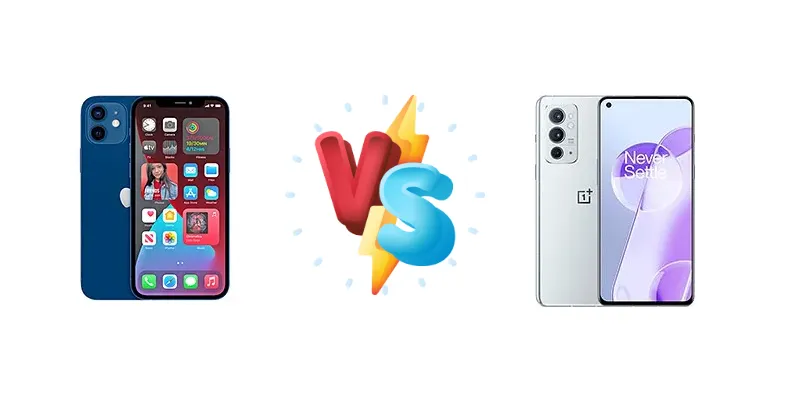
|
🏆 Quick Verdict
For the average user prioritizing long-term software support and a seamless ecosystem, the iPhone 12 is the better choice. However, the OnePlus 9RT 5G offers significantly faster charging and comparable performance for those who prioritize speed and value, especially at its current price.
| PHONES | ||
|---|---|---|
| Phone Names | Apple iPhone 12 | OnePlus 9RT 5G |
| Network | ||
|---|---|---|
| 2G bands | GSM 850 / 900 / 1800 / 1900 | GSM 850 / 900 / 1800 / 1900 |
| 3G bands | HSDPA 850 / 900 / 1700(AWS) / 1900 / 2100 | HSDPA 800 / 850 / 900 / 1700(AWS) / 1800 / 1900 / 2100 |
| 4G bands | 1, 2, 3, 4, 5, 7, 8, 12, 13, 14, 17, 18, 19, 20, 25, 26, 28, 29, 30, 32, 34, 38, 39, 40, 41, 42, 46, 48, 66, 71 - A2172 | 1, 2, 3, 4, 5, 7, 8, 12, 17, 18, 19, 20, 26, 28, 34, 38, 39, 40, 41 - Global |
| 5G bands | 1, 2, 3, 5, 7, 8, 12, 20, 25, 28, 38, 40, 41, 66, 71, 77, 78, 79, 260, 261 Sub6/mmWave - A2172 | 1, 3, 5, 8, 28, 40, 41, 78 SA/NSA - Global |
| Speed | HSPA, LTE, 5G, EV-DO Rev.A 3.1 Mbps | HSPA 42.2/5.76 Mbps, LTE Cat18 1200/200 Mbps, 5G |
| Technology | GSM / CDMA / HSPA / EVDO / LTE / 5G | GSM / CDMA / HSPA / EVDO / LTE / 5G |
| - | CDMA2000 1xEV-DO | |
| Launch | ||
|---|---|---|
| Announced | 2020, October 13 | 2021, October 13 |
| Status | Available. Released 2020, October 23 | Available. Released 2021, October 19 |
| Body | ||
|---|---|---|
| Build | Glass front, glass back, aluminum frame | Glass front (Gorilla Glass 5), glass back (Gorilla Glass 5), aluminum frame |
| Dimensions | 146.7 x 71.5 x 7.4 mm (5.78 x 2.81 x 0.29 in) | 162.2 x 74.6 x 8.3 mm (6.39 x 2.94 x 0.33 in) |
| SIM | · Nano-SIM + eSIM· Nano-SIM + Nano-SIM (China) | Nano-SIM + Nano-SIM |
| Weight | 164 g (5.78 oz) | 198.5 g (7.02 oz) |
| Display | ||
|---|---|---|
| Protection | Ceramic Shield glass | Corning Gorilla Glass 5 |
| Resolution | 1170 x 2532 pixels, 19.5:9 ratio (~460 ppi density) | 1080 x 2400 pixels, 20:9 ratio (~397 ppi density) |
| Size | 6.1 inches, 90.2 cm2 (~86.0% screen-to-body ratio) | 6.62 inches, 106.3 cm2 (~87.9% screen-to-body ratio) |
| Type | Super Retina XDR OLED, HDR10, Dolby Vision, 625 nits (HBM), 1200 nits (peak) | AMOLED, 120Hz, HDR10+ |
| - | Always-on display | |
| Platform | ||
|---|---|---|
| CPU | Hexa-core (2x3.1 GHz Firestorm + 4x1.8 GHz Icestorm) | Octa-core (1x2.84 GHz Cortex-X1 & 3x2.42 GHz Cortex-A78 & 4x1.80 GHz Cortex-A55) |
| Chipset | Apple A14 Bionic (5 nm) | Qualcomm SM8350 Snapdragon 888 5G (5 nm) |
| GPU | Apple GPU (4-core graphics) | Adreno 660 |
| OS | iOS 14.1, upgradable to iOS 26.1 | Android 11, upgradable to Android 13, OxygenOS 13 |
| Memory | ||
|---|---|---|
| Card slot | No | No |
| Internal | 64GB 4GB RAM, 128GB 4GB RAM, 256GB 4GB RAM | 128GB 8GB RAM, 256GB 8GB RAM, 256GB 12GB RAM |
| - | UFS 3.1 | |
| Main Camera | ||
|---|---|---|
| Dual | 12 MP, f/1.6, 26mm (wide), 1.4µm, dual pixel PDAF, OIS 12 MP, f/2.4, 13mm, 120˚ (ultrawide), 1/3.6" | - |
| Features | Dual-LED dual-tone flash, HDR (photo/panorama) | Dual-LED flash, HDR, panorama |
| Quad | - | 50 MP, f/1.8, 24mm (wide), 1/1.56”, 1.0µm, PDAF, OIS 16 MP, f/2.2, 14mm, 123˚ (ultrawide), 1/3.6", 1.0µm 2 MP (macro) |
| Single | - | 16 MP, f/2.4, (wide), 1/3.06", 1.0µm |
| Video | 4K@24/25/30/60fps, 1080p@25/30/60/120/240fps, HDR, Dolby Vision HDR (up to 30fps), stereo sound rec. | 4K@30/60fps, 1080p@30/60/240fps, Auto HDR, gyro-EIS |
| Selfie camera | ||
|---|---|---|
| Features | HDR | HDR |
| Single | 12 MP, f/2.2, 23mm (wide), 1/3.6", 1.0µm SL 3D, (depth/biometrics sensor) | 16 MP, f/2.4, (wide), 1/3.06", 1.0µm |
| Video | 4K@24/25/30/60fps, 1080p@25/30/60/120fps, gyro-EIS | 1080p@30fps, gyro-EIS |
| Sound | ||
|---|---|---|
| 3.5mm jack | No | No |
| 35mm jack | No | No |
| Loudspeaker | Yes, with stereo speakers | Yes, with stereo speakers |
| Comms | ||
|---|---|---|
| Bluetooth | 5.0, A2DP, LE | 5.2, A2DP, LE |
| NFC | Yes | Yes |
| Positioning | GPS, GLONASS, GALILEO, QZSS | GPS (L1+L5), GLONASS (G1), BDS (B1), GALILEO (E1+E5a) |
| Radio | No | No |
| USB | Lightning, USB 2.0 | USB Type-C 2.0, OTG |
| WLAN | Wi-Fi 802.11 a/b/g/n/ac/6, dual-band, hotspot | Wi-Fi 802.11 a/b/g/n/ac/6, dual-band, Wi-Fi Direct |
| Features | ||
|---|---|---|
| Sensors | Face ID, accelerometer, gyro, proximity, compass, barometer | Fingerprint (under display, optical), accelerometer, gyro, proximity, compass |
| Battery | ||
|---|---|---|
| Charging | Wired, PD2.0, 50% in 30 min 15W wireless (MagSafe) 15W wireless (Qi2) - requires iOS 17.4 update | 65W wired, 100% in 29 min |
| Type | Li-Ion 2815 mAh (10.78 Wh) | Li-Po 4500 mAh |
| Misc | ||
|---|---|---|
| Colors | Black, White, Red, Green, Blue, Purple | Hacker Black, Nano Silver, Blue |
| Models | A2403, A2172, A2402, A2404, iPhone13,2 | MT2110, MT2111 |
| Price | $ 190.00 / C$ 307.99 / £ 190.00 / € 219.00 / ₹ 54,900 | About 590 EUR |
| SAR EU | 0.99 W/kg (head) 0.99 W/kg (body) | - |
| Tests | ||
|---|---|---|
| Battery life | Endurance rating 84h | - |
| Camera | Photo / Video | - |
| Display | Contrast ratio: Infinite (nominal) | - |
| Loudspeaker | -24.4 LUFS (Very good) | - |
| Performance | AnTuTu: 568674 (v8) GeekBench: 4067 (v5.1) GFXBench: 58fps (ES 3.1 onscreen) | - |
Apple iPhone 12
- Long-term software support from Apple
- Seamless integration with Apple ecosystem
- Excellent video recording capabilities
- Slower charging speeds compared to OnePlus 9RT
- Less customizable operating system
OnePlus 9RT 5G
- 65W SuperVOOC charging for incredibly fast top-ups
- Competitive performance with Snapdragon 888
- More affordable price point
- Shorter software support lifespan compared to iPhone
- Less refined camera image processing
Display Comparison
Both phones feature displays that are adequate for everyday use, but detailed specifications are limited for the iPhone 12. The iPhone 12 boasts an infinite (nominal) contrast ratio, typical of OLED panels, providing deep blacks and vibrant colors. The OnePlus 9RT’s display specifications are not provided, but OnePlus typically prioritizes high refresh rates in this segment. The iPhone 12’s display benefits from Apple’s color calibration, ensuring accuracy for content creation. The lack of refresh rate information for the 9RT means it may not be as smooth for scrolling and gaming as some competitors.
Camera Comparison
Both phones offer capable camera systems, but specifics are limited. The iPhone 12’s camera is known for its consistent image quality and excellent video recording capabilities. The OnePlus 9RT’s camera specifications are not detailed, but OnePlus often focuses on delivering vibrant, social media-ready images. Without sensor size or aperture information for the 9RT, it’s difficult to assess its low-light performance relative to the iPhone 12. The iPhone 12’s video capabilities are likely superior due to Apple’s advanced image signal processing.
Performance
The core difference lies in the chipsets: Apple’s A14 Bionic (5nm) versus Qualcomm’s Snapdragon 888 5G (5nm). The A14 Bionic utilizes a hexa-core architecture (2x3.1 GHz Firestorm + 4x1.8 GHz Icestorm), while the Snapdragon 888 employs an octa-core configuration (1x2.84 GHz Cortex-X1 & 3x2.42 GHz Cortex-A78 & 4x1.80 GHz Cortex-A55). While the Snapdragon 888 has more cores, the A14 Bionic’s architecture is optimized for efficiency and single-core performance, often resulting in smoother app launches and responsiveness. The 5nm fabrication process is shared, suggesting comparable power efficiency, but the A14’s design gives it an edge in sustained performance. The OnePlus 9RT benefits from potentially more aggressive thermal management to sustain peak performance.
Battery Life
The iPhone 12 has an endurance rating of 84 hours, indicating solid battery life. It supports wired charging via PD2.0 (50% in 30 min) and 15W wireless charging with MagSafe and Qi2 (requires iOS 17.4). The OnePlus 9RT 5G shines with its 65W wired charging, achieving a 100% charge in just 29 minutes. While the iPhone 12 offers wireless charging convenience, the 9RT’s significantly faster wired charging is a major advantage for users who prioritize quick top-ups. The iPhone 12’s longer endurance rating suggests it may last longer on a single charge under moderate use, but the 9RT’s charging speed mitigates this difference.
Buying Guide
Buy the Apple iPhone 12 if you need a phone with guaranteed software updates for years to come, a tightly integrated ecosystem of devices, and a strong resale value. Buy the OnePlus 9RT 5G if you prefer faster charging speeds, a more customizable Android experience, and are looking for maximum performance per dollar, even if it means a shorter software support lifespan.