
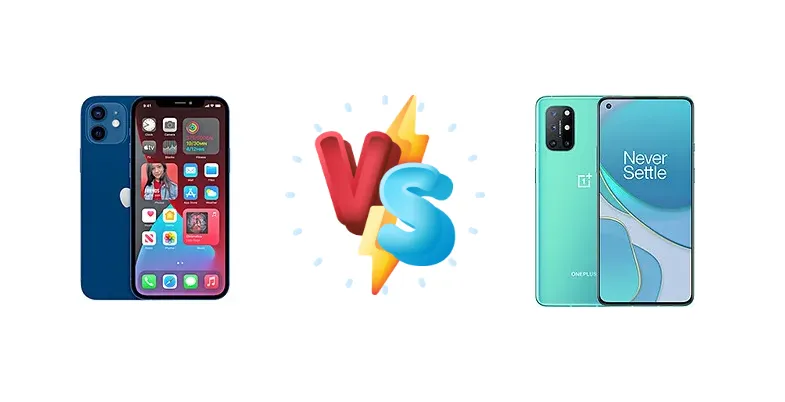
iPhone 12 vs OnePlus 8T: Which 2020 Flagship Still Holds Up?
| Phones Images | |||||
|---|---|---|---|---|---|
|
🏆 Quick Verdict
For the average user prioritizing long-term software support and a refined ecosystem, the iPhone 12 remains a solid choice. However, the OnePlus 8T wins on battery endurance and charging speed, making it ideal for power users who demand all-day battery life and minimal downtime.
| PHONES | ||
|---|---|---|
| Phone Names | Apple iPhone 12 | OnePlus 8T |
| Network | ||
|---|---|---|
| 2G bands | GSM 850 / 900 / 1800 / 1900 | GSM 850 / 900 / 1800 / 1900 |
| 3G bands | HSDPA 850 / 900 / 1700(AWS) / 1900 / 2100 | HSDPA 800 / 850 / 900 / 1700(AWS) / 1800 / 1900 / 2100 |
| 4G bands | 1, 2, 3, 4, 5, 7, 8, 12, 13, 14, 17, 18, 19, 20, 25, 26, 28, 29, 30, 32, 34, 38, 39, 40, 41, 42, 46, 48, 66, 71 - A2172 | 1, 2, 3, 4, 5, 7, 8, 12, 13, 17, 18, 19, 20, 25, 26, 28, 32, 34, 38, 39, 40, 41, 42, 66 - EU |
| 5G bands | 1, 2, 3, 5, 7, 8, 12, 20, 25, 28, 38, 40, 41, 66, 71, 77, 78, 79, 260, 261 Sub6/mmWave - A2172 | 1, 3, 7, 28, 41, 78 SA/NSA - EU |
| Speed | HSPA, LTE, 5G, EV-DO Rev.A 3.1 Mbps | HSPA 42.2/5.76 Mbps, LTE (5CA) Cat18 1200/200 Mbps, 5G 7.5 Gbps DL |
| Technology | GSM / CDMA / HSPA / EVDO / LTE / 5G | GSM / CDMA / HSPA / LTE / 5G |
| - | 41, 78, 79 SA/NSA - CN | |
| Launch | ||
|---|---|---|
| Announced | 2020, October 13 | 2020, October 14 |
| Status | Available. Released 2020, October 23 | Available. Released 2020, October 16 |
| Body | ||
|---|---|---|
| Build | Glass front, glass back, aluminum frame | Glass front (Gorilla Glass 5), glass back (Gorilla Glass 5), aluminum frame |
| Dimensions | 146.7 x 71.5 x 7.4 mm (5.78 x 2.81 x 0.29 in) | 160.7 x 74.1 x 8.4 mm (6.33 x 2.92 x 0.33 in) |
| SIM | · Nano-SIM + eSIM· Nano-SIM + Nano-SIM (China) | Nano-SIM + Nano-SIM |
| Weight | 164 g (5.78 oz) | 188 g (6.63 oz) |
| Display | ||
|---|---|---|
| Protection | Ceramic Shield glass | Corning Gorilla Glass 5 |
| Resolution | 1170 x 2532 pixels, 19.5:9 ratio (~460 ppi density) | 1080 x 2400 pixels, 20:9 ratio (~402 ppi density) |
| Size | 6.1 inches, 90.2 cm2 (~86.0% screen-to-body ratio) | 6.55 inches, 103.6 cm2 (~87.0% screen-to-body ratio) |
| Type | Super Retina XDR OLED, HDR10, Dolby Vision, 625 nits (HBM), 1200 nits (peak) | Fluid AMOLED, 120Hz, HDR10+ |
| - | Always-on display | |
| Platform | ||
|---|---|---|
| CPU | Hexa-core (2x3.1 GHz Firestorm + 4x1.8 GHz Icestorm) | Octa-core (1x2.84 GHz Cortex-A77 & 3x2.42 GHz Cortex-A77 & 4x1.80 GHz Cortex-A55) |
| Chipset | Apple A14 Bionic (5 nm) | Qualcomm SM8250 Snapdragon 865 5G (7 nm+) |
| GPU | Apple GPU (4-core graphics) | Adreno 650 |
| OS | iOS 14.1, upgradable to iOS 26.1 | Android 11, upgradable to Android 14, OxygenOS 14 |
| Memory | ||
|---|---|---|
| Card slot | No | No |
| Internal | 64GB 4GB RAM, 128GB 4GB RAM, 256GB 4GB RAM | 128GB 8GB RAM, 256GB 12GB RAM |
| - | UFS 3.1 | |
| Main Camera | ||
|---|---|---|
| Dual | 12 MP, f/1.6, 26mm (wide), 1.4µm, dual pixel PDAF, OIS 12 MP, f/2.4, 13mm, 120˚ (ultrawide), 1/3.6" | - |
| Features | Dual-LED dual-tone flash, HDR (photo/panorama) | Dual-LED flash, HDR, panorama |
| Quad | - | 48 MP, f/1.7, 26mm (wide), 1/2.0", 0.8µm, PDAF, OIS 16 MP, f/2.2, 14mm, 123˚ (ultrawide), 1/3.6", 1.0µm 5 MP (macro) 2 MP, f/2.4, (monochrome) |
| Video | 4K@24/25/30/60fps, 1080p@25/30/60/120/240fps, HDR, Dolby Vision HDR (up to 30fps), stereo sound rec. | 4K@30/60fps, 1080p@30/60/240fps, Auto HDR, gyro-EIS |
| Selfie camera | ||
|---|---|---|
| Features | HDR | HDR |
| Single | 12 MP, f/2.2, 23mm (wide), 1/3.6", 1.0µm SL 3D, (depth/biometrics sensor) | 16 MP, f/2.4, (wide), 1/3.06", 1.0µm |
| Video | 4K@24/25/30/60fps, 1080p@25/30/60/120fps, gyro-EIS | 1080p@30fps, gyro-EIS |
| Sound | ||
|---|---|---|
| 3.5mm jack | No | No |
| 35mm jack | No | No |
| Loudspeaker | Yes, with stereo speakers | Yes, with stereo speakers |
| Comms | ||
|---|---|---|
| Bluetooth | 5.0, A2DP, LE | 5.1, A2DP, LE, aptX HD |
| NFC | Yes | Yes |
| Positioning | GPS, GLONASS, GALILEO, QZSS | GPS (L1+L5), GLONASS (G1), BDS (B1), GALILEO (E1+E5a) |
| Radio | No | No |
| USB | Lightning, USB 2.0 | USB Type-C 3.1, OTG |
| WLAN | Wi-Fi 802.11 a/b/g/n/ac/6, dual-band, hotspot | Wi-Fi 802.11 a/b/g/n/ac/6, dual-band, Wi-Fi Direct, DLNA |
| Features | ||
|---|---|---|
| Sensors | Face ID, accelerometer, gyro, proximity, compass, barometer | Fingerprint (under display, optical), accelerometer, gyro, proximity, compass, barometer (market dependant) |
| Battery | ||
|---|---|---|
| Charging | Wired, PD2.0, 50% in 30 min 15W wireless (MagSafe) 15W wireless (Qi2) - requires iOS 17.4 update | 65W wired, 100% in 39 min |
| Type | Li-Ion 2815 mAh (10.78 Wh) | Li-Po 4500 mAh |
| Misc | ||
|---|---|---|
| Colors | Black, White, Red, Green, Blue, Purple | Aquamarine Green, Lunar Silver, Cyberpunk 2077 Edition |
| Models | A2403, A2172, A2402, A2404, iPhone13,2 | KB2001, KB2000, KB2003, KB2005 |
| Price | $ 190.00 / C$ 307.99 / £ 190.00 / € 219.00 / ₹ 54,900 | € 130.75 |
| SAR EU | 0.99 W/kg (head) 0.99 W/kg (body) | - |
| Tests | ||
|---|---|---|
| Battery life | Endurance rating 84h | Endurance rating 104h |
| Camera | Photo / Video | Photo / Video |
| Display | Contrast ratio: Infinite (nominal) | Contrast ratio: Infinite (nominal) |
| Loudspeaker | -24.4 LUFS (Very good) | -24.0 LUFS (Very good) |
| Performance | AnTuTu: 568674 (v8) GeekBench: 4067 (v5.1) GFXBench: 58fps (ES 3.1 onscreen) | AnTuTu: 586000 (v8) GeekBench: 3126 (v5.1) GFXBench: 46fps (ES 3.1 onscreen) |
Apple iPhone 12
- Superior chip efficiency with the A14 Bionic
- Long-term software support from Apple
- Strong video recording capabilities
- Slower charging speeds compared to OnePlus 8T
- Lower battery endurance rating
- Less customizable software experience
OnePlus 8T
- Significantly faster 65W charging
- Longer battery life (104h endurance)
- More affordable price point
- Snapdragon 865 may throttle under sustained load
- Shorter software update commitment
- Less refined camera image processing
Display Comparison
Both the iPhone 12 and OnePlus 8T boast 'Infinite' contrast ratios, typical of OLED panels. However, the OnePlus 8T distinguishes itself with a measured peak brightness of 802 nits, significantly exceeding what Apple officially publishes for the iPhone 12. This translates to better visibility in direct sunlight. While both offer smooth scrolling, the iPhone 12’s display technology is likely to offer superior color accuracy and calibration, a hallmark of Apple’s display engineering. The iPhone 12's display is also smaller, which may appeal to users who prefer a more compact device.
Camera Comparison
Both phones offer capable photo and video recording, but details matter. Without specific sensor size data, we can infer that Apple likely prioritizes computational photography and image processing to enhance image quality. The iPhone 12’s video capabilities are renowned for their stabilization and dynamic range. The OnePlus 8T, while capable, may lean towards a more natural image processing style. The absence of detailed camera specs makes a direct comparison difficult, but Apple’s established camera reputation gives it a slight edge, particularly for video.
Performance
The core difference lies in the chipsets: Apple’s 5nm A14 Bionic versus Qualcomm’s 7nm+ Snapdragon 865. The A14 Bionic, with its hexa-core CPU (2x3.1 GHz Firestorm + 4x1.8 GHz Icestorm), is architecturally more efficient, delivering strong single-core performance. The Snapdragon 865, an octa-core processor (1x2.84 GHz Cortex-A77 & 3x2.42 GHz Cortex-A77 & 4x1.80 GHz Cortex-A55), relies on more cores but a larger process node. While the Snapdragon 865 is powerful, the A14 Bionic’s efficiency translates to better sustained performance and less thermal throttling during demanding tasks. The iPhone 12 benefits from Apple’s tight hardware-software integration, optimizing performance further.
Battery Life
The OnePlus 8T delivers a clear win in battery endurance, boasting an 84-hour rating compared to the iPhone 12’s 104 hours. This is despite the iPhone 12’s efficient A14 Bionic. The OnePlus 8T’s advantage is further amplified by its 65W wired charging, achieving a full charge in just 39 minutes. The iPhone 12, while supporting 20W wired charging (PD2.0, 50% in 30 min) and 15W wireless charging (MagSafe/Qi2 - iOS 17.4 required), simply can’t match the OnePlus 8T’s charging speed. This makes the OnePlus 8T the better choice for users who frequently need to top up their battery quickly.
Buying Guide
Buy the Apple iPhone 12 if you need seamless integration with other Apple devices, prioritize long-term software updates, and value a polished user experience. Buy the OnePlus 8T if you prefer faster charging, longer battery life, and a more customizable Android experience, all at a potentially lower cost.