
iPhone 12 Pro vs. Samsung Galaxy S22 Ultra: Which Flagship Reigns Supreme?
| Phones Images | |||||
|---|---|---|---|---|---|
|
🏆 Quick Verdict
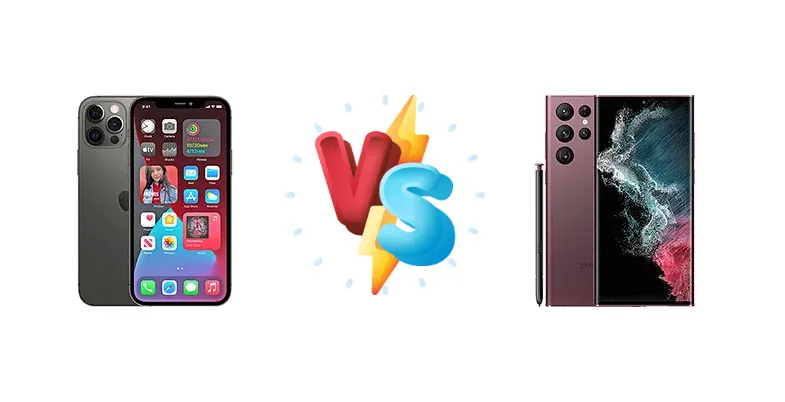
For most users, the Samsung Galaxy S22 Ultra 5G offers a more complete package. Its superior battery life (108h endurance vs 81h), brighter display (1266 nits), and more versatile charging options outweigh the iPhone 12 Pro’s established ecosystem and efficient A14 Bionic chip.
| PHONES | ||
|---|---|---|
| Phone Names | Apple iPhone 12 Pro | Samsung Galaxy S22 Ultra 5G |
| Network | ||
|---|---|---|
| 2G bands | GSM 850 / 900 / 1800 / 1900 | GSM 850 / 900 / 1800 / 1900 |
| 3G bands | HSDPA 850 / 900 / 1700(AWS) / 1900 / 2100 | HSDPA 850 / 900 / 1700(AWS) / 1900 / 2100 |
| 4G bands | 1, 2, 3, 4, 5, 7, 8, 12, 13, 14, 17, 18, 19, 20, 25, 26, 28, 29, 30, 32, 34, 38, 39, 40, 41, 42, 46, 48, 66, 71 - A2341 | 1, 2, 3, 4, 5, 7, 8, 12, 13, 17, 18, 19, 20, 25, 26, 28, 32, 38, 39, 40, 41, 66 - International |
| 5G bands | 1, 2, 3, 5, 7, 8, 12, 20, 25, 28, 38, 40, 41, 66, 71, 77, 78, 79, 260, 261 Sub6/mmWave - A2341 | 1, 2, 3, 5, 7, 8, 12, 20, 25, 28, 38, 40, 41, 66, 75, 77, 78 SA/NSA/Sub6 - International |
| Speed | HSPA, LTE, 5G, EV-DO Rev.A 3.1 Mbps | HSPA 42.2/5.76 Mbps, LTE (7CA) Cat20 2000/200 Mbps, 5G (5+ Gbps DL) |
| Technology | GSM / CDMA / HSPA / EVDO / LTE / 5G | GSM / CDMA / HSPA / EVDO / LTE / 5G |
| 1, 2, 3, 5, 7, 8, 12, 20, 25, 28, 38, 40, 41, 66, 71, 77, 78, 79 Sub6 - A2406 | 1, 3, 5, 7, 8, 20, 28, 38, 41, 66, 71, 260, 261 SA/NSA/Sub6/mmWave - USA | |
| Launch | ||
|---|---|---|
| Announced | 2020, October 13 | 2022, February 09 |
| Status | Available. Released 2020, October 23 | Available. Released 2022, February 25 |
| Body | ||
|---|---|---|
| Build | Glass front, glass back, stainless steel frame | Glass front (Gorilla Glass Victus+), glass back (Gorilla Glass Victus+), aluminum frame |
| Dimensions | 146.7 x 71.5 x 7.4 mm (5.78 x 2.81 x 0.29 in) | 163.3 x 77.9 x 8.9 mm (6.43 x 3.07 x 0.35 in) |
| SIM | · Nano-SIM + eSIM· Nano-SIM + Nano-SIM (China) | · Nano-SIM + eSIM· Nano-SIM + Nano-SIM + eSIM (max 2 at a time) |
| Weight | 189 g (6.67 oz) | 228 g / 229 g (mmWave) (8.04 oz) |
| IP68 dust/water resistant (up to 6m for 30 min) Apple Pay (Visa, MasterCard, AMEX certified) | IP68 dust/water resistant (up to 1.5m for 30 min) Armor aluminum frame with tougher drop and scratch resistance (advertised) Stylus, 2.8ms latency (Bluetooth integration, accelerometer, gyro) | |
| Display | ||
|---|---|---|
| Protection | Ceramic Shield glass | Corning Gorilla Glass Victus+ |
| Resolution | 1170 x 2532 pixels, 19.5:9 ratio (~460 ppi density) | 1440 x 3088 pixels, 19.3:9 ratio (~500 ppi density) |
| Size | 6.1 inches, 90.2 cm2 (~86.0% screen-to-body ratio) | 6.8 inches, 114.7 cm2 (~90.2% screen-to-body ratio) |
| Type | Super Retina XDR OLED, HDR10, Dolby Vision, 800 nits (HBM), 1200 nits (peak) | Dynamic AMOLED 2X, 120Hz, HDR10+, 1750 nits (peak) |
| - | Always-on display | |
| Platform | ||
|---|---|---|
| CPU | Hexa-core (2x3.1 GHz Firestorm + 4x1.8 GHz Icestorm) | Octa-core (1x2.8 GHz Cortex-X2 & 3x2.50 GHz Cortex-A710 & 4x1.8 GHz Cortex-A510) - EuropeOcta-core (1x3.00 GHz Cortex-X2 & 3x2.50 GHz Cortex-A710 & 4x1.80 GHz Cortex-A510) - ROW |
| Chipset | Apple A14 Bionic (5 nm) | Exynos 2200 (4 nm) - EuropeQualcomm SM8450 Snapdragon 8 Gen 1 (4 nm) - ROW |
| GPU | Apple GPU (4-core graphics) | Xclipse 920 - EuropeAdreno 730 - ROW |
| OS | iOS 14.1, upgradable to iOS 26.1 | Android 12, up to 4 major Android upgrades, One UI 8 |
| Memory | ||
|---|---|---|
| Card slot | No | No |
| Internal | 128GB 6GB RAM, 256GB 6GB RAM, 512GB 6GB RAM | 128GB 8GB RAM, 256GB 12GB RAM, 512GB 12GB RAM, 1TB 12GB RAM |
| NVMe | UFS 3.1 | |
| Main Camera | ||
|---|---|---|
| Features | Dual-LED dual-tone flash, HDR (photo/panorama) | Laser AF, LED flash, auto-HDR, panorama |
| Quad | - | 108 MP, f/1.8, 23mm (wide), 1/1.33", 0.8µm, PDAF, OIS 10 MP, f/2.4, 70mm (telephoto), 1/3.52", 1.12µm, PDAF, OIS, 3x optical zoom 10 MP, f/4.9, 230mm (periscope telephoto), 1/3.52", 1.12µm, PDAF, OIS, 10x optical zoom 12 MP, f/2.2, 13mm, 120˚ (ultrawide), 1/2.55", 1.4µm, dual pixel PDAF, Super Steady video |
| Triple | 12 MP, f/1.6, 26mm (wide), 1/2.55", 1.4µm, dual pixel PDAF, OIS 12 MP, f/2.0, 52mm (telephoto), 1/3.4", 1.0µm, PDAF, OIS, 2x optical zoom 12 MP, f/2.4, 13mm, 120˚ (ultrawide), 1/3.4", 1.0µm TOF 3D LiDAR scanner (depth) | - |
| Video | 4K@24/25/30/60fps, 1080p@25/30/60/120/240fps, 10‑bit HDR, Dolby Vision HDR (up to 60fps), stereo sound rec. | 8K@24fps, 4K@30/60fps, 1080p@30/60/120/240fps, HDR10+, stereo sound rec., gyro-EIS |
| Selfie camera | ||
|---|---|---|
| Features | HDR | HDR |
| Single | 12 MP, f/2.2, 23mm (wide), 1/3.6", 1.0µm SL 3D, (depth/biometrics sensor) | 40 MP, f/2.2, 26mm (wide), 1/2.82", 0.7µm, PDAF |
| Video | 4K@24/25/30/60fps, 1080p@25/30/60/120fps, gyro-EIS | 4K@30/60fps, 1080p@30fps |
| Sound | ||
|---|---|---|
| 3.5mm jack | No | No |
| 35mm jack | No | No |
| Loudspeaker | Yes, with stereo speakers | Yes, with stereo speakers |
| - | 32-bit/384kHz audio Tuned by AKG | |
| Comms | ||
|---|---|---|
| Bluetooth | 5.0, A2DP, LE | 5.2, A2DP, LE |
| NFC | Yes | Yes |
| Positioning | GPS, GLONASS, GALILEO, QZSS | GPS, GLONASS, BDS, GALILEO |
| Radio | No | No |
| USB | Lightning, USB 2.0 | USB Type-C 3.2, OTG |
| WLAN | Wi-Fi 802.11 a/b/g/n/ac/6, dual-band, hotspot | Wi-Fi 802.11 a/b/g/n/ac/6e, dual-band, Wi-Fi Direct |
| Features | ||
|---|---|---|
| Sensors | Face ID, accelerometer, gyro, proximity, compass, barometer | Fingerprint (under display, ultrasonic), accelerometer, gyro, proximity, compass, barometer |
| Ultra Wideband (UWB) support | Samsung DeX, Samsung Wireless DeX (desktop experience support) Bixby natural language commands and dictation Samsung Pay (Visa, MasterCard certified) Ultra Wideband (UWB) support | |
| Battery | ||
|---|---|---|
| Charging | Wired, PD2.0, 50% in 30 min 15W wireless (MagSafe) 15W wireless (Qi2) - requires iOS 17.4 update | 45W wired, PD3.0 15W wireless (Qi) 4.5W reverse wireless |
| Type | Li-Ion 2815 mAh (10.78 Wh) | Li-Ion 5000 mAh |
| Misc | ||
|---|---|---|
| Colors | Silver, Graphite, Gold, Pacific Blue | Phantom Black, White, Burgundy, Green, Graphite, Red, Sky Blue, Bora Purple |
| Models | A2407, A2341, A2406, A2408, iPhone13,3 | SM-S908B, SM-S908B/DS, SM-S908U, SM-S908U1, SM-S908W, SM-S908N, SM-S9080, SM-S908E, SM-S908E/DS |
| Price | $ 277.86 / C$ 419.75 / £ 250.00 / € 299.99 | € 397.07 / $ 269.98 / £ 304.99 / ₹ 63,899 |
| SAR | - | 1.18 W/kg (head) 0.98 W/kg (body) |
| SAR EU | 0.99 W/kg (head) 0.99 W/kg (body) | 1.05 W/kg (head) 1.58 W/kg (body) |
| Pricing | ||
|---|---|---|
| 128GB 6GB RAM | $ 725.05 | - |
| 256GB 6GB RAM | $ 575.00 | - |
| 512GB 6GB RAM | $ 799.50 | - |
| RENEWED | $ 499.00 | - |
| Tests | ||
|---|---|---|
| Battery life | Endurance rating 81h | Endurance rating 108h |
| Camera | Photo / Video | Photo / Video |
| Display | Contrast ratio: Infinite (nominal) | Contrast ratio: Infinite (nominal) |
| Loudspeaker | -24.2 LUFS (Very good) | -27.3 LUFS (Good) |
| Performance | AnTuTu: 596244 (v8) GeekBench: 4056 (v5.1) GFXBench: 58fps (ES 3.1 onscreen) | AnTuTu: 968359 (v9) GeekBench: 3657 (v5.1) GFXBench: 37fps (ES 3.1 onscreen) |
Apple iPhone 12 Pro
- Excellent iOS ecosystem integration
- Efficient A14 Bionic chip
- Generally lower price point (now)
- Shorter battery life
- Slower charging speeds
- Less versatile camera system
Samsung Galaxy S22 Ultra 5G
- Longer battery life
- Brighter and more vibrant display
- Faster charging and reverse wireless charging
- Android ecosystem can be fragmented
- Potential for Exynos overheating (depending on region)
- Larger and heavier form factor
Display Comparison
The Samsung Galaxy S22 Ultra boasts a significantly brighter display, peaking at 1266 nits, compared to the iPhone 12 Pro’s ‘infinite’ (nominal) contrast ratio, which doesn’t specify peak brightness. This translates to better outdoor visibility for the S22 Ultra. Both displays share an ‘infinite’ contrast ratio, suggesting excellent black levels, but the S22 Ultra’s higher brightness is a tangible advantage. While both are excellent, the S22 Ultra’s panel is more adaptable to varying lighting conditions.
Camera Comparison
Both phones excel in photo and video capture, but approach it differently. The context data doesn’t provide sensor details, but the S22 Ultra’s larger physical size allows for potentially larger sensors, improving low-light performance. The S22 Ultra’s versatility extends to features like Space Zoom, which the iPhone 12 Pro lacks. While both offer excellent image processing, Samsung’s tends towards more saturated colors, while Apple aims for greater realism. The absence of detailed camera specs makes a definitive judgment difficult, but the S22 Ultra’s potential for greater zoom range and sensor size gives it an edge.
Performance
The iPhone 12 Pro’s Apple A14 Bionic (5nm) is a highly efficient chip, but the Samsung Galaxy S22 Ultra’s Exynos 2200 (4nm - Europe) or Snapdragon 8 Gen 1 (4nm - ROW) offers a more complex architecture. The S22 Ultra’s octa-core configuration, with its Cortex-X2 prime core, aims for peak performance, while the A14’s hexa-core design prioritizes efficiency. The 4nm process node on the S22 Ultra’s chipsets *should* offer better thermal efficiency, potentially mitigating throttling during sustained workloads, though real-world performance varies between the Exynos and Snapdragon variants. The iPhone 12 Pro’s 6GB of RAM is matched by the S22 Ultra, but Android’s memory management differs, potentially requiring more RAM for similar tasks.
Battery Life
The Samsung Galaxy S22 Ultra’s 108-hour endurance rating significantly surpasses the iPhone 12 Pro’s 81-hour rating. This is a substantial difference, translating to a full day of heavier use for the S22 Ultra versus potentially needing a top-up for the iPhone 12 Pro. The S22 Ultra also offers faster 45W wired charging with PD3.0, compared to the iPhone 12 Pro’s 50% charge in 30 minutes via PD2.0. The S22 Ultra’s 15W wireless charging (Qi) and 4.5W reverse wireless charging add further convenience, features absent on the iPhone 12 Pro (though the iPhone 12 Pro supports 15W MagSafe and Qi2 with iOS 17.4).
Buying Guide
Buy the Apple iPhone 12 Pro if you prioritize seamless iOS integration, a compact form factor (relative to the S22 Ultra), and a proven track record of software updates. Buy the Samsung Galaxy S22 Ultra 5G if you demand the longest possible battery life, a brighter and more vibrant display, and the versatility of the Android ecosystem, including features like reverse wireless charging and the S Pen.