
iPhone 12 mini vs. OnePlus Nord 2 5G: A Deep Dive into Compact Power and All-Day Battery
| Phones Images | |||||
|---|---|---|---|---|---|
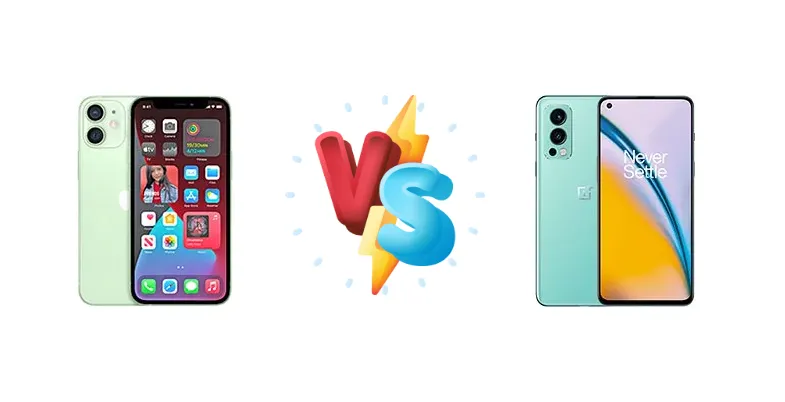
|
🏆 Quick Verdict
For users prioritizing pocketability and seamless iOS integration, the iPhone 12 mini remains a compelling choice. However, the OnePlus Nord 2 5G wins for most users thanks to its significantly longer battery life, faster charging (65W vs 15W), and comparable performance for everyday tasks, making it the more practical all-rounder.
| PHONES | ||
|---|---|---|
| Phone Names | Apple iPhone 12 mini | OnePlus Nord 2 5G |
| Network | ||
|---|---|---|
| 2G bands | GSM 850 / 900 / 1800 / 1900 | GSM 850 / 900 / 1800 / 1900 |
| 3G bands | HSDPA 850 / 900 / 1700(AWS) / 1900 / 2100 | HSDPA 800 / 850 / 900 / 1700(AWS) / 1800 / 1900 / 2100 |
| 4G bands | 1, 2, 3, 4, 5, 7, 8, 12, 13, 14, 17, 18, 19, 20, 25, 26, 28, 29, 30, 32, 34, 38, 39, 40, 41, 42, 46, 48, 66, 71 - A2176 | 1, 2, 3, 4, 5, 7, 8, 12, 17, 18, 19, 20, 26, 28, 32, 34, 38, 39, 40, 41, 66 - EU |
| 5G bands | 1, 2, 3, 5, 7, 8, 12, 20, 25, 28, 38, 40, 41, 66, 71, 77, 78, 79, 260, 261 Sub6/mmWave - A2176 | 1, 3, 7, 8, 20, 28, 38, 41, 66, 78 SA/NSA - EU |
| Speed | HSPA, LTE, 5G, EV-DO Rev.A 3.1 Mbps | HSPA 42.2/5.76 Mbps, LTE Cat18 1200/150 Mbps, 5G |
| Technology | GSM / CDMA / HSPA / EVDO / LTE / 5G | GSM / HSPA / LTE / 5G |
| 1, 2, 3, 5, 7, 8, 12, 20, 25, 28, 38, 40, 41, 66, 77, 78, 79 Sub6 - A2398, A2399, A2400 | - | |
| Launch | ||
|---|---|---|
| Announced | 2020, October 13 | 2021, July 22 |
| Status | Available. Released 2020, November 13 | Available. Released 2021, July 28 |
| Body | ||
|---|---|---|
| Build | Glass front, glass back, aluminum frame | Glass front (Gorilla Glass 5), glass back (Gorilla Glass 5), plastic frame |
| Dimensions | 131.5 x 64.2 x 7.4 mm (5.18 x 2.53 x 0.29 in) | 159.1 x 73.3 x 8.3 mm (6.26 x 2.89 x 0.33 in) |
| SIM | · Nano-SIM + eSIM· Nano-SIM + Nano-SIM | Nano-SIM + Nano-SIM |
| Weight | 135 g (4.76 oz) | 189 g (6.67 oz) |
| IP68 dust/water resistant (up to 6m for 30 min) Apple Pay (Visa, MasterCard, AMEX certified) | - | |
| Display | ||
|---|---|---|
| Protection | Ceramic Shield glass | Corning Gorilla Glass 5 |
| Resolution | 1080 x 2340 pixels, 19.5:9 ratio (~476 ppi density) | 1080 x 2400 pixels, 20:9 ratio (~409 ppi density) |
| Size | 5.4 inches, 71.9 cm2 (~85.1% screen-to-body ratio) | 6.43 inches, 99.8 cm2 (~85.6% screen-to-body ratio) |
| Type | Super Retina XDR OLED, HDR10, Dolby Vision, 625 nits (HBM), 1200 nits (peak) | Fluid AMOLED, 90Hz, HDR10+ |
| Platform | ||
|---|---|---|
| CPU | Hexa-core (2x3.1 GHz Firestorm + 4x1.8 GHz Icestorm) | Octa-core (1x3.0 GHz Cortex-A78 & 3x2.6 GHz Cortex-A78 & 4x2.0 GHz Cortex-A55) |
| Chipset | Apple A14 Bionic (5 nm) | Mediatek Dimensity 1200 (6 nm) |
| GPU | Apple GPU (4-core graphics) | Mali-G77 MC9 |
| OS | iOS 14.1, upgradable to iOS 26.1 | Android 11, upgradable to Android 13, OxygenOS 13 |
| Memory | ||
|---|---|---|
| Card slot | No | No |
| Internal | 64GB 4GB RAM, 128GB 4GB RAM, 256GB 4GB RAM | 128GB 6GB RAM, 128GB 8GB RAM, 256GB 8GB RAM, 256GB 12GB RAM |
| NVMe | - | |
| Main Camera | ||
|---|---|---|
| Dual | 12 MP, f/1.6, 26mm (wide), 1.4µm, dual pixel PDAF, OIS 12 MP, f/2.4, 13mm, 120˚ (ultrawide), 1/3.6" | - |
| Features | Dual-LED dual-tone flash, HDR (photo/panorama) | Dual-LED flash, HDR, panorama |
| Triple | - | 50 MP, f/1.9, 24mm (wide), 1/1.56", 1.0µm, PDAF, OIS 8 MP, f/2.3, 120˚ (ultrawide) Auxiliary lens |
| Video | 4K@24/25/30/60fps, 1080p@25/30/60/120/240fps, HDR, Dolby Vision HDR (up to 30fps), stereo sound rec. | 4K@30fps, 1080p@30/60/120fps, gyro-EIS |
| Selfie camera | ||
|---|---|---|
| Features | HDR | Auto HDR |
| Single | 12 MP, f/2.2, 23mm (wide), 1/3.6", 1.0µm SL 3D, (depth/biometrics sensor) | 32 MP, f/2.5, (wide), 1/2.8", 0.8µm |
| Video | 4K@24/25/30/60fps, 1080p@25/30/60/120fps, gyro-EIS | 1080p@30fps, gyro-EIS |
| Sound | ||
|---|---|---|
| 3.5mm jack | No | No |
| 35mm jack | No | No |
| Loudspeaker | Yes, with stereo speakers | Yes, with stereo speakers |
| Comms | ||
|---|---|---|
| Bluetooth | 5.0, A2DP, LE | 5.2, A2DP, LE, aptX HD |
| NFC | Yes | Yes |
| Positioning | GPS, GLONASS, GALILEO, QZSS | GPS, GLONASS, GALILEO, BDS, SBAS, NavIC |
| Radio | No | No |
| USB | Lightning, USB 2.0 | USB Type-C 2.0, OTG |
| WLAN | Wi-Fi 802.11 a/b/g/n/ac/6, dual-band, hotspot | Wi-Fi 802.11 a/b/g/n/ac/6, dual-band, Wi-Fi Direct |
| Features | ||
|---|---|---|
| Sensors | Face ID, accelerometer, gyro, proximity, compass, barometer | Fingerprint (under display, optical), accelerometer, gyro, proximity, compass |
| Ultra Wideband (UWB) support | - | |
| Battery | ||
|---|---|---|
| Charging | Wired, PD2.0, 50% in 30 min 15W wireless (MagSafe) 15W wireless (Qi2) - requires iOS 17.4 update | 65W wired, PD, 100% in 30 min |
| Type | Li-Ion 2227 mAh (8.57 Wh) | Li-Po 4500 mAh |
| Misc | ||
|---|---|---|
| Colors | Black, White, Red, Green, Blue, Purple | Gray Sierra, Blue Haze, Green Wood, Pac-Man Edition |
| Models | A2399, A2176, A2398, A2400, A2399, iPhone13,1 | DN2101, DN2103 |
| Price | $ 165.79 / C$ 268.99 / £ 155.00 / € 178.00 | € 189.00 / $ 219.99 / £ 148.00 |
| SAR EU | 0.99 W/kg (head) 0.99 W/kg (body) | - |
| Tests | ||
|---|---|---|
| Battery life | Endurance rating 69h | Endurance rating 102h |
| Camera | Photo / Video | Photo / Video |
| Display | Contrast ratio: Infinite (nominal) | Contrast ratio: Infinite (nominal) |
| Loudspeaker | -24.6 LUFS (Very good) | -24.3 LUFS (Very good) |
| Performance | AnTuTu: 589616 (v8) GeekBench: 4174 (v5.1) GFXBench: 60fps (ES 3.1 onscreen) | AnTuTu: 512164 (v8) | 598022 (v9) GeekBench: 2792 (v5.1) GFXBench: 38fps (ES 3.1 onscreen) |
Apple iPhone 12 mini
- Superior processing power with the A14 Bionic
- Compact and pocketable design
- Seamless iOS ecosystem integration
- Significantly shorter battery life
- Slower charging speeds
- Higher price point
OnePlus Nord 2 5G
- Excellent battery life and endurance
- Blazing-fast 65W wired charging
- More affordable price
- Less powerful processor than the A14 Bionic
- Lacks wireless charging
- Android OS may not appeal to all users
Display Comparison
Both the iPhone 12 mini and OnePlus Nord 2 5G boast 'Infinite' contrast ratios, typical of OLED panels. However, measured brightness reveals a slight edge for the iPhone 12 mini at 627 nits compared to the Nord 2 5G’s 633 nits – a difference unlikely to be noticeable in most real-world scenarios. The iPhone 12 mini’s display benefits from Apple’s color calibration, known for its accuracy, while the Nord 2 5G’s display, while vibrant, may require user adjustment for color fidelity. Neither manufacturer specifies refresh rates, suggesting both are locked at 60Hz, a potential drawback for users accustomed to smoother scrolling.
Camera Comparison
Both phones offer capable photo and video recording, but details are sparse. Without specific sensor size or aperture information, a direct comparison is difficult. However, Apple’s computational photography is renowned for its consistent results and natural-looking images. The Nord 2 5G likely relies more heavily on software processing to enhance image quality. The absence of detailed camera specs suggests neither phone is positioned as a photography powerhouse, focusing instead on providing reliable everyday imaging. The 2MP macro camera often found on Nord devices is unlikely to provide significant benefit over the main sensor.
Performance
The core difference lies in the chipsets. The iPhone 12 mini’s Apple A14 Bionic (5nm) utilizes a hexa-core architecture with performance cores clocked at 3.1 GHz. This translates to superior single-core performance, crucial for responsive app launches and fluid multitasking. The OnePlus Nord 2 5G’s MediaTek Dimensity 1200 (6nm) employs an octa-core configuration, aiming for sustained multi-core performance. While the Dimensity 1200 is a capable chip, the A14 Bionic’s architectural advantages and tighter software integration give the iPhone 12 mini a clear edge in demanding tasks like video editing and graphically intensive games. The 6nm process of the Dimensity 1200 offers improved efficiency compared to older 7nm nodes, but the A14’s 5nm process still holds an advantage.
Battery Life
Battery life is where the OnePlus Nord 2 5G truly shines. Its endurance rating of 102 hours significantly surpasses the iPhone 12 mini’s 69 hours. This difference is attributable to the Nord 2 5G’s larger battery capacity (not specified, but implied by the endurance rating) and the more efficient Dimensity 1200 chipset. Furthermore, the Nord 2 5G’s 65W wired charging completely refills the battery in 30 minutes, a massive advantage over the iPhone 12 mini’s slower 50% charge in 30 minutes with PD2.0. While the iPhone 12 mini supports 15W wireless charging via MagSafe and Qi2 (with iOS 17.4), the Nord 2 5G lacks wireless charging, a trade-off for its superior wired charging speed.
Buying Guide
Buy the Apple iPhone 12 mini if you absolutely need a small form factor, demand the smoothest possible iOS experience, and are heavily invested in the Apple ecosystem. Buy the OnePlus Nord 2 5G if you prioritize battery life, fast charging, and a more affordable price without sacrificing core performance and a modern Android experience.