
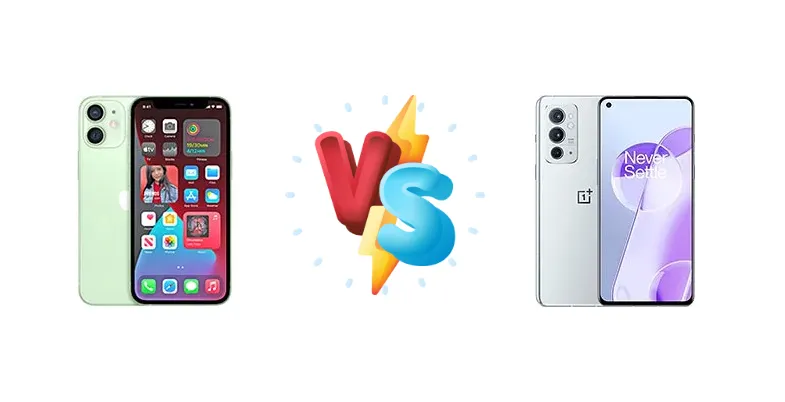
iPhone 12 mini vs. OnePlus 9RT 5G: A Deep Dive into Compact Power and Fast Charging
| Phones Images | |||||
|---|---|---|---|---|---|
|
🏆 Quick Verdict
For most users, the OnePlus 9RT 5G offers a more compelling package. Its significantly faster 65W charging, coupled with the Snapdragon 888’s raw power, outweighs the iPhone 12 mini’s software ecosystem advantages. However, the iPhone 12 mini remains the king of one-handed usability.
| PHONES | ||
|---|---|---|
| Phone Names | Apple iPhone 12 mini | OnePlus 9RT 5G |
| Network | ||
|---|---|---|
| 2G bands | GSM 850 / 900 / 1800 / 1900 | GSM 850 / 900 / 1800 / 1900 |
| 3G bands | HSDPA 850 / 900 / 1700(AWS) / 1900 / 2100 | HSDPA 800 / 850 / 900 / 1700(AWS) / 1800 / 1900 / 2100 |
| 4G bands | 1, 2, 3, 4, 5, 7, 8, 12, 13, 14, 17, 18, 19, 20, 25, 26, 28, 29, 30, 32, 34, 38, 39, 40, 41, 42, 46, 48, 66, 71 - A2176 | 1, 2, 3, 4, 5, 7, 8, 12, 17, 18, 19, 20, 26, 28, 34, 38, 39, 40, 41 - Global |
| 5G bands | 1, 2, 3, 5, 7, 8, 12, 20, 25, 28, 38, 40, 41, 66, 71, 77, 78, 79, 260, 261 Sub6/mmWave - A2176 | 1, 3, 5, 8, 28, 40, 41, 78 SA/NSA - Global |
| Speed | HSPA, LTE, 5G, EV-DO Rev.A 3.1 Mbps | HSPA 42.2/5.76 Mbps, LTE Cat18 1200/200 Mbps, 5G |
| Technology | GSM / CDMA / HSPA / EVDO / LTE / 5G | GSM / CDMA / HSPA / EVDO / LTE / 5G |
| 1, 2, 3, 5, 7, 8, 12, 20, 25, 28, 38, 40, 41, 66, 77, 78, 79 Sub6 - A2398, A2399, A2400 | CDMA2000 1xEV-DO | |
| Launch | ||
|---|---|---|
| Announced | 2020, October 13 | 2021, October 13 |
| Status | Available. Released 2020, November 13 | Available. Released 2021, October 19 |
| Body | ||
|---|---|---|
| Build | Glass front, glass back, aluminum frame | Glass front (Gorilla Glass 5), glass back (Gorilla Glass 5), aluminum frame |
| Dimensions | 131.5 x 64.2 x 7.4 mm (5.18 x 2.53 x 0.29 in) | 162.2 x 74.6 x 8.3 mm (6.39 x 2.94 x 0.33 in) |
| SIM | · Nano-SIM + eSIM· Nano-SIM + Nano-SIM | Nano-SIM + Nano-SIM |
| Weight | 135 g (4.76 oz) | 198.5 g (7.02 oz) |
| IP68 dust/water resistant (up to 6m for 30 min) Apple Pay (Visa, MasterCard, AMEX certified) | - | |
| Display | ||
|---|---|---|
| Protection | Ceramic Shield glass | Corning Gorilla Glass 5 |
| Resolution | 1080 x 2340 pixels, 19.5:9 ratio (~476 ppi density) | 1080 x 2400 pixels, 20:9 ratio (~397 ppi density) |
| Size | 5.4 inches, 71.9 cm2 (~85.1% screen-to-body ratio) | 6.62 inches, 106.3 cm2 (~87.9% screen-to-body ratio) |
| Type | Super Retina XDR OLED, HDR10, Dolby Vision, 625 nits (HBM), 1200 nits (peak) | AMOLED, 120Hz, HDR10+ |
| - | Always-on display | |
| Platform | ||
|---|---|---|
| CPU | Hexa-core (2x3.1 GHz Firestorm + 4x1.8 GHz Icestorm) | Octa-core (1x2.84 GHz Cortex-X1 & 3x2.42 GHz Cortex-A78 & 4x1.80 GHz Cortex-A55) |
| Chipset | Apple A14 Bionic (5 nm) | Qualcomm SM8350 Snapdragon 888 5G (5 nm) |
| GPU | Apple GPU (4-core graphics) | Adreno 660 |
| OS | iOS 14.1, upgradable to iOS 26.1 | Android 11, upgradable to Android 13, OxygenOS 13 |
| Memory | ||
|---|---|---|
| Card slot | No | No |
| Internal | 64GB 4GB RAM, 128GB 4GB RAM, 256GB 4GB RAM | 128GB 8GB RAM, 256GB 8GB RAM, 256GB 12GB RAM |
| NVMe | UFS 3.1 | |
| Main Camera | ||
|---|---|---|
| Dual | 12 MP, f/1.6, 26mm (wide), 1.4µm, dual pixel PDAF, OIS 12 MP, f/2.4, 13mm, 120˚ (ultrawide), 1/3.6" | - |
| Features | Dual-LED dual-tone flash, HDR (photo/panorama) | Dual-LED flash, HDR, panorama |
| Quad | - | 50 MP, f/1.8, 24mm (wide), 1/1.56”, 1.0µm, PDAF, OIS 16 MP, f/2.2, 14mm, 123˚ (ultrawide), 1/3.6", 1.0µm 2 MP (macro) |
| Single | - | 16 MP, f/2.4, (wide), 1/3.06", 1.0µm |
| Video | 4K@24/25/30/60fps, 1080p@25/30/60/120/240fps, HDR, Dolby Vision HDR (up to 30fps), stereo sound rec. | 4K@30/60fps, 1080p@30/60/240fps, Auto HDR, gyro-EIS |
| Selfie camera | ||
|---|---|---|
| Features | HDR | HDR |
| Single | 12 MP, f/2.2, 23mm (wide), 1/3.6", 1.0µm SL 3D, (depth/biometrics sensor) | 16 MP, f/2.4, (wide), 1/3.06", 1.0µm |
| Video | 4K@24/25/30/60fps, 1080p@25/30/60/120fps, gyro-EIS | 1080p@30fps, gyro-EIS |
| Sound | ||
|---|---|---|
| 3.5mm jack | No | No |
| 35mm jack | No | No |
| Loudspeaker | Yes, with stereo speakers | Yes, with stereo speakers |
| Comms | ||
|---|---|---|
| Bluetooth | 5.0, A2DP, LE | 5.2, A2DP, LE |
| NFC | Yes | Yes |
| Positioning | GPS, GLONASS, GALILEO, QZSS | GPS (L1+L5), GLONASS (G1), BDS (B1), GALILEO (E1+E5a) |
| Radio | No | No |
| USB | Lightning, USB 2.0 | USB Type-C 2.0, OTG |
| WLAN | Wi-Fi 802.11 a/b/g/n/ac/6, dual-band, hotspot | Wi-Fi 802.11 a/b/g/n/ac/6, dual-band, Wi-Fi Direct |
| Features | ||
|---|---|---|
| Sensors | Face ID, accelerometer, gyro, proximity, compass, barometer | Fingerprint (under display, optical), accelerometer, gyro, proximity, compass |
| Ultra Wideband (UWB) support | - | |
| Battery | ||
|---|---|---|
| Charging | Wired, PD2.0, 50% in 30 min 15W wireless (MagSafe) 15W wireless (Qi2) - requires iOS 17.4 update | 65W wired, 100% in 29 min |
| Type | Li-Ion 2227 mAh (8.57 Wh) | Li-Po 4500 mAh |
| Misc | ||
|---|---|---|
| Colors | Black, White, Red, Green, Blue, Purple | Hacker Black, Nano Silver, Blue |
| Models | A2399, A2176, A2398, A2400, A2399, iPhone13,1 | MT2110, MT2111 |
| Price | $ 165.79 / C$ 268.99 / £ 155.00 / € 178.00 | About 590 EUR |
| SAR EU | 0.99 W/kg (head) 0.99 W/kg (body) | - |
| Tests | ||
|---|---|---|
| Battery life | Endurance rating 69h | - |
| Camera | Photo / Video | - |
| Display | Contrast ratio: Infinite (nominal) | - |
| Loudspeaker | -24.6 LUFS (Very good) | - |
| Performance | AnTuTu: 589616 (v8) GeekBench: 4174 (v5.1) GFXBench: 60fps (ES 3.1 onscreen) | - |
Apple iPhone 12 mini
- Extremely compact and pocketable design
- Seamless iOS ecosystem integration
- Excellent video recording quality
- Slower charging speeds
- Lower peak performance compared to Snapdragon 888
- Battery life is a compromise due to size
OnePlus 9RT 5G
- Blazing-fast 65W wired charging
- Powerful Snapdragon 888 processor
- Potentially better value for money
- Larger form factor than the iPhone 12 mini
- Potential for thermal throttling under heavy load
- OxygenOS software experience may not appeal to all
Display Comparison
The iPhone 12 mini boasts a high-quality display capable of reaching 627 nits of peak brightness, ensuring excellent visibility outdoors. While the OnePlus 9RT’s display specs aren’t provided, OnePlus typically prioritizes high refresh rates and color accuracy in this segment. The iPhone 12 mini’s infinite (nominal) contrast ratio, typical of OLED panels, delivers deep blacks and vibrant colors. The absence of refresh rate information for the 9RT means the iPhone 12 mini likely offers a smoother visual experience, though this is a trade-off against potential battery drain.
Camera Comparison
Both phones offer capable camera systems, but details are limited. The iPhone 12 mini’s camera is known for its computational photography prowess and excellent video recording capabilities. The OnePlus 9RT’s camera performance relies heavily on its image processing algorithms and sensor quality, which aren’t specified. Without sensor size or aperture information for the 9RT, it’s difficult to make a direct comparison. The iPhone’s established video quality and consistent performance give it an edge for content creators.
Performance
The core difference lies in the chipsets: Apple’s A14 Bionic (5nm) versus Qualcomm’s Snapdragon 888 5G (5nm). The A14 Bionic utilizes a hexa-core architecture (2x3.1 GHz Firestorm + 4x1.8 GHz Icestorm) optimized for efficiency and single-core performance. The Snapdragon 888, with its octa-core configuration (1x2.84 GHz Cortex-X1 & 3x2.42 GHz Cortex-A78 & 4x1.80 GHz Cortex-A55), focuses on multi-core performance and GPU capabilities. While the A14 Bionic is incredibly efficient, the Snapdragon 888 generally offers higher peak performance, particularly in graphically intensive games. However, the 5nm Snapdragon 888 is known to generate more heat, potentially leading to thermal throttling during sustained workloads, a concern the A14 Bionic mitigates.
Battery Life
The iPhone 12 mini’s endurance rating of 69 hours suggests reasonable battery life, but it’s a compromise given its compact size. The OnePlus 9RT 5G’s battery capacity is unknown, but its standout feature is the 65W wired charging, capable of reaching 100% in just 29 minutes. This is a massive advantage over the iPhone 12 mini’s slower wired charging (50% in 30 minutes) and 15W wireless charging (MagSafe/Qi2). The 9RT’s charging speed significantly reduces downtime, making it ideal for users who need a quick power boost.
Buying Guide
Buy the Apple iPhone 12 mini if you prioritize a truly pocketable form factor, seamless iOS integration, and long-term software support. You’ll appreciate its ease of use and the established Apple ecosystem. Buy the OnePlus 9RT 5G if you value blazing-fast charging, a more powerful processor for demanding tasks like gaming, and a generally lower price point. It’s the better choice for power users and those who frequently top up their phones.