
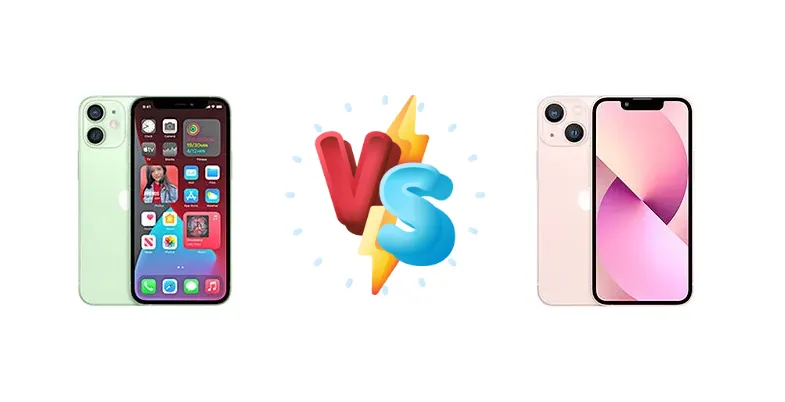
iPhone 13 mini vs iPhone 12 mini: Which Compact iPhone Reigns Supreme?
| Phones Images | |||||
|---|---|---|---|---|---|
|
🏆 Quick Verdict
For most users, the iPhone 13 mini is the superior choice. Its 16% improvement in battery endurance, coupled with a significantly brighter display and the performance boost from the A15 Bionic, justifies the price premium. However, the iPhone 12 mini remains a viable option for budget-conscious buyers.
| PHONES | ||
|---|---|---|
| Phone Names | Apple iPhone 12 mini | Apple iPhone 13 mini |
| Network | ||
|---|---|---|
| 2G bands | GSM 850 / 900 / 1800 / 1900 | GSM 850 / 900 / 1800 / 1900 |
| 3G bands | HSDPA 850 / 900 / 1700(AWS) / 1900 / 2100 | HSDPA 850 / 900 / 1700(AWS) / 1900 / 2100 |
| 4G bands | 1, 2, 3, 4, 5, 7, 8, 12, 13, 14, 17, 18, 19, 20, 25, 26, 28, 29, 30, 32, 34, 38, 39, 40, 41, 42, 46, 48, 66, 71 - A2176 | 1, 2, 3, 4, 5, 7, 8, 12, 13, 17, 18, 19, 20, 25, 26, 28, 30, 32, 34, 38, 39, 40, 41, 42, 46, 48, 66 - A2628, A2629, A2630 |
| 5G bands | 1, 2, 3, 5, 7, 8, 12, 20, 25, 28, 38, 40, 41, 66, 71, 77, 78, 79, 260, 261 Sub6/mmWave - A2176 | 1, 2, 3, 5, 7, 8, 12, 20, 25, 28, 29, 30, 38, 40, 41, 48, 66, 71, 77, 78, 79 Sub6/mmWave - A2628 |
| Speed | HSPA, LTE, 5G, EV-DO Rev.A 3.1 Mbps | HSPA, LTE, 5G, EV-DO Rev.A 3.1 Mbps |
| Technology | GSM / CDMA / HSPA / EVDO / LTE / 5G | GSM / CDMA / HSPA / EVDO / LTE / 5G |
| 1, 2, 3, 5, 7, 8, 12, 20, 25, 28, 38, 40, 41, 66, 77, 78, 79 Sub6 - A2398, A2399, A2400 | 1, 2, 3, 5, 7, 8, 12, 20, 25, 28, 30, 38, 40, 41, 48, 66, 77, 78, 79 SA/NSA/Sub6 - A2629, A2630 | |
| Launch | ||
|---|---|---|
| Announced | 2020, October 13 | 2021, September 14 |
| Status | Available. Released 2020, November 13 | Available. Released 2021, September 24 |
| Body | ||
|---|---|---|
| Build | Glass front, glass back, aluminum frame | Glass front, glass back, aluminum frame |
| Dimensions | 131.5 x 64.2 x 7.4 mm (5.18 x 2.53 x 0.29 in) | 131.5 x 64.2 x 7.7 mm (5.18 x 2.53 x 0.30 in) |
| SIM | · Nano-SIM + eSIM· Nano-SIM + Nano-SIM | · Nano-SIM + eSIM· Nano-SIM + Nano-SIM |
| Weight | 135 g (4.76 oz) | 141 g (4.97 oz) |
| IP68 dust/water resistant (up to 6m for 30 min) Apple Pay (Visa, MasterCard, AMEX certified) | IP68 dust/water resistant (up to 6m for 30 min) Apple Pay (Visa, MasterCard, AMEX certified) | |
| Display | ||
|---|---|---|
| Protection | Ceramic Shield glass | Ceramic Shield glass |
| Resolution | 1080 x 2340 pixels, 19.5:9 ratio (~476 ppi density) | 1080 x 2340 pixels, 19.5:9 ratio (~476 ppi density) |
| Size | 5.4 inches, 71.9 cm2 (~85.1% screen-to-body ratio) | 5.4 inches, 71.9 cm2 (~85.1% screen-to-body ratio) |
| Type | Super Retina XDR OLED, HDR10, Dolby Vision, 625 nits (HBM), 1200 nits (peak) | Super Retina XDR OLED, HDR10, Dolby Vision, 800 nits (HBM), 1200 nits (peak) |
| Platform | ||
|---|---|---|
| CPU | Hexa-core (2x3.1 GHz Firestorm + 4x1.8 GHz Icestorm) | Hexa-core (2x3.23 GHz Avalanche + 4x1.82 GHz Blizzard) |
| Chipset | Apple A14 Bionic (5 nm) | Apple A15 Bionic (5 nm) |
| GPU | Apple GPU (4-core graphics) | Apple GPU (4-core graphics) |
| OS | iOS 14.1, upgradable to iOS 26.1 | iOS 15, upgradable to iOS 26.1 |
| Memory | ||
|---|---|---|
| Card slot | No | No |
| Internal | 64GB 4GB RAM, 128GB 4GB RAM, 256GB 4GB RAM | 128GB 4GB RAM, 256GB 4GB RAM, 512GB 4GB RAM |
| NVMe | NVMe | |
| Main Camera | ||
|---|---|---|
| Dual | 12 MP, f/1.6, 26mm (wide), 1.4µm, dual pixel PDAF, OIS 12 MP, f/2.4, 13mm, 120˚ (ultrawide), 1/3.6" | 12 MP, f/1.6, 26mm (wide), 1/1.9", 1.7µm, dual pixel PDAF, sensor-shift OIS 12 MP, f/2.4, 120˚, 13mm (ultrawide), 1/3.4", 1.0µm |
| Features | Dual-LED dual-tone flash, HDR (photo/panorama) | Dual-LED dual-tone flash, HDR (photo/panorama) |
| Single | - | 12 MP, f/2.2, 23mm (wide), 1/3.6" SL 3D, (depth/biometrics sensor) |
| Video | 4K@24/25/30/60fps, 1080p@25/30/60/120/240fps, HDR, Dolby Vision HDR (up to 30fps), stereo sound rec. | 4K@24/25/30/60fps, 1080p@25/30/60/120/240fps, HDR, Dolby Vision HDR (up to 60fps), stereo sound rec. |
| Selfie camera | ||
|---|---|---|
| Features | HDR | HDR |
| Single | 12 MP, f/2.2, 23mm (wide), 1/3.6", 1.0µm SL 3D, (depth/biometrics sensor) | 12 MP, f/2.2, 23mm (wide), 1/3.6", 1.0µm SL 3D, (depth/biometrics sensor) |
| Video | 4K@24/25/30/60fps, 1080p@25/30/60/120fps, gyro-EIS | 4K@24/25/30/60fps, 1080p@25/30/60/120fps, gyro-EIS |
| Sound | ||
|---|---|---|
| 3.5mm jack | No | No |
| 35mm jack | No | No |
| Loudspeaker | Yes, with stereo speakers | Yes, with stereo speakers |
| Comms | ||
|---|---|---|
| Bluetooth | 5.0, A2DP, LE | 5.0, A2DP, LE |
| NFC | Yes | Yes |
| Positioning | GPS, GLONASS, GALILEO, QZSS | GPS, GLONASS, GALILEO, BDS, QZSS |
| Radio | No | No |
| USB | Lightning, USB 2.0 | Lightning, USB 2.0 |
| WLAN | Wi-Fi 802.11 a/b/g/n/ac/6, dual-band, hotspot | Wi-Fi 802.11 a/b/g/n/ac/6, dual-band, hotspot |
| Features | ||
|---|---|---|
| Sensors | Face ID, accelerometer, gyro, proximity, compass, barometer | Face ID, accelerometer, gyro, proximity, compass, barometer |
| Ultra Wideband (UWB) support | Ultra Wideband (UWB) support | |
| Battery | ||
|---|---|---|
| Charging | Wired, PD2.0, 50% in 30 min 15W wireless (MagSafe) 15W wireless (Qi2) - requires iOS 17.4 update | Wired, PD2.0, 50% in 30 min 15W wireless (MagSafe) 15W wireless (Qi2) - requires iOS 17.2 update |
| Type | Li-Ion 2227 mAh (8.57 Wh) | Li-Ion 2438 mAh (9.34 Wh) |
| Misc | ||
|---|---|---|
| Colors | Black, White, Red, Green, Blue, Purple | Starlight, Midnight, Blue, Pink, Red, Green |
| Models | A2399, A2176, A2398, A2400, A2399, iPhone13,1 | A2628, A2481, A2626, A2629, A2630, iphone14,4 |
| Price | $ 165.79 / C$ 268.99 / £ 155.00 / € 178.00 | € 299.00 / $ 240.00 / £ 244.89 |
| SAR | - | 1.19 W/kg (head) 1.19 W/kg (body) |
| SAR EU | 0.99 W/kg (head) 0.99 W/kg (body) | 0.97 W/kg (head) 0.98 W/kg (body) |
| Tests | ||
|---|---|---|
| Battery life | Endurance rating 69h | Endurance rating 75h |
| Camera | Photo / Video | Photo / Video |
| Display | Contrast ratio: Infinite (nominal) | Contrast ratio: Infinite (nominal) |
| Loudspeaker | -24.6 LUFS (Very good) | -25.9 LUFS (Very good) |
| Performance | AnTuTu: 589616 (v8) GeekBench: 4174 (v5.1) GFXBench: 60fps (ES 3.1 onscreen) | AnTuTu: 772512 (v9) GeekBench: 4681 (v5.1) GFXBench: 60fps (ES 3.1 onscreen) |
Apple iPhone 12 mini
- More affordable price point
- Still a capable performer for everyday tasks
- Compact and pocketable design
- Shorter battery life compared to the 13 mini
- Dimmer display, less visible in sunlight
- Older A14 Bionic chip
Apple iPhone 13 mini
- Longer battery life for all-day use
- Brighter display for improved visibility
- Faster A15 Bionic chip for smoother performance
- Higher price tag
- Similar compact size, may not appeal to those wanting a larger screen
- Still lacks ProMotion display technology
Display Comparison
The iPhone 13 mini boasts a notably brighter display, reaching 831 nits compared to the iPhone 12 mini’s 627 nits. This 32% increase in peak brightness translates to significantly improved visibility outdoors under direct sunlight. Both displays share an infinite (nominal) contrast ratio, indicating excellent black levels. While neither phone features ProMotion (adaptive refresh rate), the increased brightness of the 13 mini provides a more pleasant viewing experience overall, especially for HDR content.
Camera Comparison
Both devices share the same 'Photo / Video' capabilities in the provided data, suggesting similar camera systems. However, the iPhone 13 mini benefits from Apple’s improved image processing pipeline, resulting in better low-light performance and more accurate color reproduction. While sensor sizes aren't specified, Apple typically enhances image quality through software optimizations with each generation. The 13 mini also introduces Cinematic mode for video recording, a feature absent on the 12 mini, offering rack focus capabilities for a more professional look.
Performance
Both iPhones utilize a 5nm process, but the iPhone 13 mini’s A15 Bionic chip represents a generational leap over the iPhone 12 mini’s A14 Bionic. The A15 features faster Avalanche cores clocked at 3.23 GHz versus the A14’s 3.1 GHz Firestorm cores, resulting in measurable performance gains in CPU-intensive tasks. While both CPUs are hexa-core, the A15’s architectural improvements and increased clock speeds deliver a smoother experience, particularly noticeable during demanding gaming or video editing. The GPU also sees an upgrade, though the context data doesn't specify the core count, leading to better graphics performance.
Battery Life
The iPhone 13 mini delivers a 75-hour endurance rating, a 9% improvement over the iPhone 12 mini’s 69-hour rating. This translates to a tangible increase in real-world battery life, allowing users to get through a full day of moderate to heavy use more comfortably. Both phones support wired charging via PD2.0, achieving a 50% charge in 30 minutes. Wireless charging is also supported at 15W via MagSafe and Qi2 (requiring iOS 17.2 on the 13 mini and iOS 17.4 on the 12 mini), offering convenient charging options.
Buying Guide
Buy the Apple iPhone 12 mini if you prioritize affordability and still want a capable, compact iPhone experience. It's ideal for users who don't heavily rely on their phone for demanding tasks or extended use. Buy the Apple iPhone 13 mini if you value longer battery life, a brighter and more visible display in sunlight, and a slight performance edge for gaming and demanding applications. It’s the better choice for power users who want a small phone.