
iPhone 11 vs Xiaomi Mi 9 Lite: A Detailed Comparison of Apple's and Xiaomi's Mid-Range Offerings
| Phones Images | |||||
|---|---|---|---|---|---|
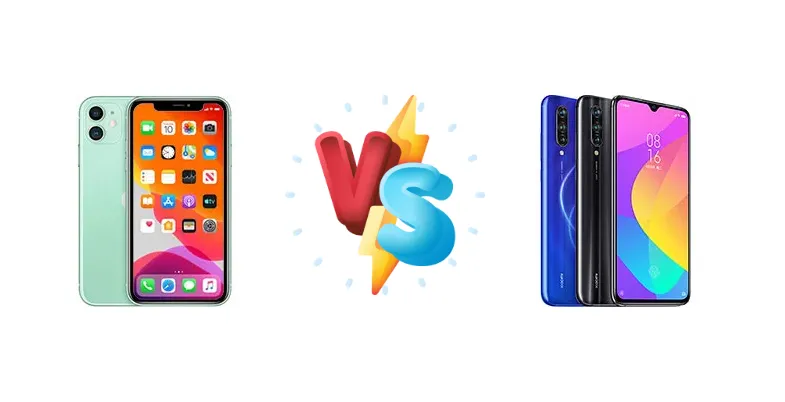
|
🏆 Quick Verdict
For most users, the iPhone 11 is the superior choice, offering a significantly more powerful processor and a more refined user experience. However, the Xiaomi Mi 9 Lite excels in battery endurance and provides excellent value for budget-conscious buyers.
| PHONES | ||
|---|---|---|
| Phone Names | Apple iPhone 11 | Xiaomi Mi 9 Lite |
| Network | ||
|---|---|---|
| 2G bands | GSM 850 / 900 / 1800 / 1900 | GSM 850 / 900 / 1800 / 1900 |
| 3G bands | HSDPA 850 / 900 / 1700(AWS) / 1900 / 2100 | HSDPA 850 / 900 / 1700(AWS) / 1900 / 2100 |
| 4G bands | 1, 2, 3, 4, 5, 7, 8, 11, 12, 13, 17, 18, 19, 20, 21, 25, 26, 28, 29, 30, 32, 34, 38, 39, 40, 41, 42, 46, 48, 66 - A2221 | 1, 2, 3, 4, 5, 7, 8, 20, 28, 38, 40 |
| Speed | HSPA 42.2/5.76 Mbps, LTE Cat16 1024/150 Mbps, EV-DO Rev.A 3.1 Mbps | HSPA, LTE |
| Technology | GSM / CDMA / HSPA / EVDO / LTE | GSM / HSPA / LTE |
| 1, 2, 3, 4, 5, 7, 8, 12, 13, 14, 17, 18, 19, 20, 25, 26, 29, 30, 34, 38, 39, 40, 41, 42, 46, 48, 66, 71 - A2111, A2223 | - | |
| Launch | ||
|---|---|---|
| Announced | 2019, September 10 | 2019, September 16. Released 2019, September 16 |
| Status | Available. Released 2019, September 20 | Discontinued |
| Body | ||
|---|---|---|
| Build | Glass front (Corning-made glass), glass back (Corning-made glass), aluminum frame (7000 series) | Glass front (Gorilla Glass 5), glass back (Gorilla Glass 5), aluminum frame |
| Dimensions | 150.9 x 75.7 x 8.3 mm (5.94 x 2.98 x 0.33 in) | 156.8 x 74.5 x 8.7 mm (6.17 x 2.93 x 0.34 in) |
| SIM | · Nano-SIM + eSIM· Nano-SIM + Nano-SIM (China) | Nano-SIM + Nano-SIM |
| Weight | 194 g (6.84 oz) | 179 g (6.31 oz) |
| IP68 dust/water resistant (up to 2m for 30 min) Apple Pay (Visa, MasterCard, AMEX certified) | - | |
| Display | ||
|---|---|---|
| Protection | Scratch-resistant glass | Corning Gorilla Glass 5 |
| Resolution | 828 x 1792 pixels, 19.5:9 ratio (~326 ppi density) | 1080 x 2340 pixels, 19.5:9 ratio (~403 ppi density) |
| Size | 6.1 inches, 90.3 cm2 (~79.0% screen-to-body ratio) | 6.39 inches, 100.2 cm2 (~85.8% screen-to-body ratio) |
| Type | Liquid Retina IPS LCD, 625 nits (typ) | Super AMOLED, HDR, 430 nits (typ) |
| Platform | ||
|---|---|---|
| CPU | Hexa-core (2x2.65 GHz Lightning + 4x1.8 GHz Thunder) | Octa-core (2x2.2 GHz Kryo 360 Gold & 6x1.7 GHz Kryo 360 Silver) |
| Chipset | Apple A13 Bionic (7 nm+) | Qualcomm SDM710 Snapdragon 710 (10 nm) |
| GPU | Apple GPU (4-core graphics) | Adreno 616 |
| OS | iOS 13, upgradable to iOS 26.1 | Android 9.0 (Pie), upgradable to Android 11, MIUI 12.5 |
| Memory | ||
|---|---|---|
| Card slot | No | microSDXC (uses shared SIM slot) |
| Internal | 64GB 4GB RAM, 128GB 4GB RAM, 256GB 4GB RAM | 64GB 6GB RAM, 128GB 6GB RAM |
| NVMe | UFS 2.1 | |
| Main Camera | ||
|---|---|---|
| Dual | 12 MP, f/1.8, 26mm (wide), 1/2.55", 1.4µm, dual pixel PDAF, OIS 12 MP, f/2.4, 120˚, 13mm (ultrawide), 1/3.6" | - |
| Features | Dual-LED dual-tone flash, HDR (photo/panorama) | LED flash, HDR, panorama |
| Triple | - | 48 MP, f/1.8, (wide), 1/2.0", 0.8µm, PDAF 8 MP, (ultrawide), 1/4.0", 1.12µm Auxiliary lens |
| Video | 4K@24/25/30/60fps, 1080p@25/30/60/120/240fps, HDR, stereo sound rec. | 4K@30fps, 1080p@30/60/120fps, 720p@960fps |
| Selfie camera | ||
|---|---|---|
| Features | HDR | HDR |
| Single | 12 MP, f/2.2, 23mm (wide), 1/3.6", 1.0µm SL 3D, (depth/biometrics sensor) | 32 MP, f/2.0, 26mm (wide), 1/2.8", 0.8µm |
| Video | 4K@24/25/30/60fps, 1080p@25/30/60/120fps, gyro-EIS | 1080p@30fps |
| Sound | ||
|---|---|---|
| 3.5mm jack | No | Yes |
| 35mm jack | No | Yes |
| Loudspeaker | Yes, with stereo speakers | Yes |
| Comms | ||
|---|---|---|
| Bluetooth | 5.0, A2DP, LE | 5.0, A2DP, LE, aptX HD |
| Infrared port | - | Yes |
| NFC | Yes | Yes |
| Positioning | GPS, GLONASS, GALILEO, QZSS | GPS, GLONASS, GALILEO, BDS |
| Radio | No | FM radio |
| USB | Lightning, USB 2.0 | USB Type-C 2.0 |
| WLAN | Wi-Fi 802.11 a/b/g/n/ac/6, dual-band, hotspot | Wi-Fi 802.11 a/b/g/n/ac, dual-band, Wi-Fi Direct |
| Features | ||
|---|---|---|
| Sensors | Face ID, accelerometer, gyro, proximity, compass, barometer | Fingerprint (under display, optical), accelerometer, gyro, proximity, compass |
| Ultra Wideband (UWB) support | - | |
| Battery | ||
|---|---|---|
| Charging | Wired, PD2.0, 50% in 30 min Wireless (Qi) | 18W wired |
| Type | Li-Ion 3110 mAh, non-removable (11.91 Wh) | Li-Po 4030 mAh, non-removable |
| Misc | ||
|---|---|---|
| Colors | Black, Green, Yellow, Purple, Red, White | Pearl White, Aurora Blue, Onyx Grey |
| Models | A2221, A2111, A2223, iPhone12,1 | M1904F3BG |
| Price | $ 167.50 / C$ 228.68 / £ 175.00 / € 193.32 | About 320 EUR |
| SAR | 1.09 W/kg (head) 1.18 W/kg (body) | 1.19 W/kg (head) 1.15 W/kg (body) |
| SAR EU | 0.95 W/kg (head) 0.99 W/kg (body) | 1.42 W/kg (head) 1.40 W/kg (body) |
| Pricing | ||
|---|---|---|
| 128GB 4GB RAM | $ 359.95 | - |
| 256GB 4GB RAM | $ 469.99 | - |
| 64GB 4GB RAM | $ 292.79 | - |
| RENEWED | £ 214.00 | - |
| Tests | ||
|---|---|---|
| Audio quality | Noise -94.2dB / Crosstalk -80.8dB | Noise -90.3dB / Crosstalk -93.1dB |
| Battery life | Endurance rating 94h | Endurance rating 106h |
| Camera | Photo / Video | Photo / Video |
| Display | Contrast ratio: 1505:1 (nominal) | Contrast ratio: Infinite (nominal) |
| Loudspeaker | Voice 70dB / Noise 72dB / Ring 76dB | -30.2 LUFS (Below average) |
| Performance | AnTuTu: 419453 (v7) GeekBench: 13882 (v4.4) GFXBench: 60fps (ES 3.1 onscreen) | AnTuTu: 175478 (v7), 215277 (v8) GeekBench: 5989 (v4.4), 1518 (v5.1) GFXBench: 12fps (ES 3.1 onscreen) |
Apple iPhone 11
- Significantly faster processor (A13 Bionic)
- Superior build quality and materials
- Stronger ecosystem integration and software support
- Higher price point
- Shorter battery life compared to Mi 9 Lite
- Slower charging speed than some competitors
Xiaomi Mi 9 Lite
- Excellent battery life (106h endurance)
- More affordable price
- Modern design with an AMOLED display
- Less powerful processor (Snapdragon 710)
- Potentially slower software updates
- Lower peak display brightness
Display Comparison
The iPhone 11 boasts a contrast ratio of 1505:1 and a peak brightness of 644 nits, providing a vibrant and easily viewable display. The Mi 9 Lite, while claiming an 'infinite' contrast ratio (typical for AMOLED panels), only reaches 597 nits of peak brightness. This means the iPhone 11 will perform better in direct sunlight. While the Mi 9 Lite’s AMOLED technology offers potentially deeper blacks, the iPhone 11’s color accuracy is likely superior, benefiting content creators and those who value accurate color reproduction.
Camera Comparison
Both phones offer capable camera systems, but the iPhone 11 likely holds an edge in overall image quality due to Apple’s image processing algorithms. While both are listed as having Photo/Video capabilities, the iPhone 11 benefits from Apple’s computational photography expertise. The Mi 9 Lite’s camera performance is respectable for its price point, but it likely won’t match the iPhone 11’s dynamic range and detail in challenging lighting conditions. Ignoring the often-underperforming 2MP macro lenses found on both devices, the primary sensor and image processing are key differentiators.
Performance
The Apple A13 Bionic chip, fabricated on a 7nm+ process, significantly outperforms the Qualcomm Snapdragon 710 (10nm) found in the Mi 9 Lite. The A13’s hexa-core CPU (2x2.65 GHz Lightning + 4x1.8 GHz Thunder) delivers substantially faster processing speeds, particularly in demanding tasks. While the Mi 9 Lite’s octa-core CPU offers more cores, the A13’s architectural advantages and superior single-core performance translate to a smoother and more responsive user experience. The iPhone 11 will handle graphically intensive games and applications with greater ease.
Battery Life
The Xiaomi Mi 9 Lite takes the lead in battery endurance with a rating of 106 hours, compared to the iPhone 11’s 94 hours. This suggests the Mi 9 Lite will last longer on a single charge, particularly with moderate usage. However, the iPhone 11 supports faster wired charging with PD2.0 (50% in 30 minutes) and Qi wireless charging, while the Mi 9 Lite is limited to 18W wired charging. This means the iPhone 11 can replenish its battery more quickly when needed, partially offsetting the Mi 9 Lite’s longer overall endurance.
Buying Guide
Buy the Apple iPhone 11 if you prioritize performance, seamless software updates, and integration with the Apple ecosystem. It’s ideal for users who frequently edit photos/videos, play demanding games, or rely on Apple’s services. Buy the Xiaomi Mi 9 Lite if you value long battery life, a modern design, and affordability. It’s a great option for everyday users who prioritize efficiency and don’t require the absolute highest performance.