
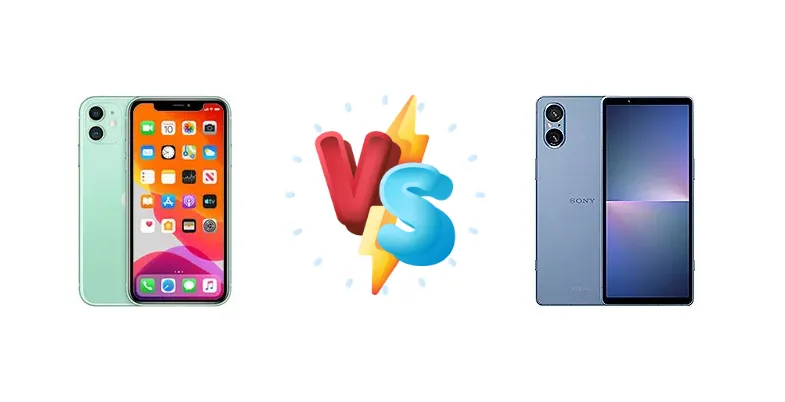
iPhone 11 vs. Sony Xperia 5 V: A Detailed Comparison of Apple's Classic and Sony's Compact Flagship
| Phones Images | |||||
|---|---|---|---|---|---|
|
🏆 Quick Verdict
For most users, the Sony Xperia 5 V is the superior choice. Its significantly faster Snapdragon 8 Gen 2 chipset, longer battery endurance (130h vs 94h), and modern charging capabilities outweigh the iPhone 11's lower price point. However, the iPhone 11 remains a viable option for those deeply invested in the Apple ecosystem and prioritizing simplicity.
| PHONES | ||
|---|---|---|
| Phone Names | Apple iPhone 11 | Sony Xperia 5 V |
| Network | ||
|---|---|---|
| 2G bands | GSM 850 / 900 / 1800 / 1900 | GSM 850 / 900 / 1800 / 1900 |
| 3G bands | HSDPA 850 / 900 / 1700(AWS) / 1900 / 2100 | HSDPA 800 / 850 / 900 / 1700(AWS) / 1900 / 2100 |
| 4G bands | 1, 2, 3, 4, 5, 7, 8, 11, 12, 13, 17, 18, 19, 20, 21, 25, 26, 28, 29, 30, 32, 34, 38, 39, 40, 41, 42, 46, 48, 66 - A2221 | 1, 2, 3, 4, 5, 7, 8, 12, 13, 17, 19, 20, 25, 26, 28, 29, 32, 34, 38, 39, 40, 41, 46, 66 - Europe |
| 5G bands | - | 1, 3, 5, 7, 8, 20, 28, 38, 40, 41, 77, 78 SA/NSA - Europe |
| Speed | HSPA 42.2/5.76 Mbps, LTE Cat16 1024/150 Mbps, EV-DO Rev.A 3.1 Mbps | HSPA, LTE, 5G |
| Technology | GSM / CDMA / HSPA / EVDO / LTE | GSM / HSPA / LTE / 5G |
| 1, 2, 3, 4, 5, 7, 8, 12, 13, 14, 17, 18, 19, 20, 25, 26, 29, 30, 34, 38, 39, 40, 41, 42, 46, 48, 66, 71 - A2111, A2223 | - | |
| Launch | ||
|---|---|---|
| Announced | 2019, September 10 | 2023, September 01 |
| Status | Available. Released 2019, September 20 | Available. Released 2023, September 25 |
| Body | ||
|---|---|---|
| Build | Glass front (Corning-made glass), glass back (Corning-made glass), aluminum frame (7000 series) | Glass front (Gorilla Glass Victus 2), glass back, aluminum frame |
| Dimensions | 150.9 x 75.7 x 8.3 mm (5.94 x 2.98 x 0.33 in) | 154 x 68 x 8.6 mm (6.06 x 2.68 x 0.34 in) |
| SIM | · Nano-SIM + eSIM· Nano-SIM + Nano-SIM (China) | · Nano-SIM + eSIM· Nano-SIM + Nano-SIM |
| Weight | 194 g (6.84 oz) | 182 g (6.42 oz) |
| IP68 dust/water resistant (up to 2m for 30 min) Apple Pay (Visa, MasterCard, AMEX certified) | - | |
| Display | ||
|---|---|---|
| Protection | Scratch-resistant glass | Corning Gorilla Glass Victus 2 |
| Resolution | 828 x 1792 pixels, 19.5:9 ratio (~326 ppi density) | 1080 x 2520 pixels, 21:9 ratio (~449 ppi density) |
| Size | 6.1 inches, 90.3 cm2 (~79.0% screen-to-body ratio) | 6.1 inches, 86.9 cm2 (~83.0% screen-to-body ratio) |
| Type | Liquid Retina IPS LCD, 625 nits (typ) | OLED, 1B colors, 120Hz, HDR10, BT.2020 |
| Platform | ||
|---|---|---|
| CPU | Hexa-core (2x2.65 GHz Lightning + 4x1.8 GHz Thunder) | Octa-core (1x3.2 GHz Cortex-X3 & 2x2.8 GHz Cortex-A715 & 2x2.8 GHz Cortex-A710 & 3x2.0 GHz Cortex-A510) |
| Chipset | Apple A13 Bionic (7 nm+) | Qualcomm SM8550-AB Snapdragon 8 Gen 2 (4 nm) |
| GPU | Apple GPU (4-core graphics) | Adreno 740 |
| OS | iOS 13, upgradable to iOS 26.1 | Android 13, upgradable to Android 15 |
| Memory | ||
|---|---|---|
| Card slot | No | microSDXC (uses shared SIM slot) |
| Internal | 64GB 4GB RAM, 128GB 4GB RAM, 256GB 4GB RAM | 128GB 8GB RAM, 256GB 8GB RAM |
| NVMe | - | |
| Main Camera | ||
|---|---|---|
| Dual | 12 MP, f/1.8, 26mm (wide), 1/2.55", 1.4µm, dual pixel PDAF, OIS 12 MP, f/2.4, 120˚, 13mm (ultrawide), 1/3.6" | 48 MP, f/1.9, 24mm (wide), 1/1.35", 1.12µm, dual pixel PDAF, OIS 12 MP, f/2.2, 16mm (ultrawide), 1/2.5", dual pixel PDAF |
| Features | Dual-LED dual-tone flash, HDR (photo/panorama) | Zeiss optics, Zeiss T* lens coating, color spectrum sensor, LED flash, panorama, HDR, eye tracking |
| Video | 4K@24/25/30/60fps, 1080p@25/30/60/120/240fps, HDR, stereo sound rec. | 4K@24/25/30/60/120fps HDR, 1080p@30/60/120fps; 5-axis gyro-EIS, OIS |
| Selfie camera | ||
|---|---|---|
| Features | HDR | HDR |
| Single | 12 MP, f/2.2, 23mm (wide), 1/3.6", 1.0µm SL 3D, (depth/biometrics sensor) | 12 MP, f/2.0, 24mm (wide), 1/2.9", 1.25µm |
| Video | 4K@24/25/30/60fps, 1080p@25/30/60/120fps, gyro-EIS | 4K@30fps, 1080p@30/60fps, 5-axis gyro-EIS |
| Sound | ||
|---|---|---|
| 3.5mm jack | No | - |
| 35mm jack | No | Yes |
| Loudspeaker | Yes, with stereo speakers | Yes, with stereo speakers |
| Comms | ||
|---|---|---|
| Bluetooth | 5.0, A2DP, LE | 5.3, A2DP, LE Audio, aptX HD, aptX Adaptive |
| NFC | Yes | Yes |
| Positioning | GPS, GLONASS, GALILEO, QZSS | GPS, GLONASS, BDS, GALILEO, QZSS |
| Radio | No | No |
| USB | Lightning, USB 2.0 | USB Type-C 3.2, OTG, DisplayPort |
| WLAN | Wi-Fi 802.11 a/b/g/n/ac/6, dual-band, hotspot | Wi-Fi 802.11 a/b/g/n/ac/6e, tri-band, Wi-Fi Direct, DLNA |
| Features | ||
|---|---|---|
| Sensors | Face ID, accelerometer, gyro, proximity, compass, barometer | Fingerprint (side-mounted), accelerometer, gyro, proximity, barometer, compass |
| Ultra Wideband (UWB) support | - | |
| Battery | ||
|---|---|---|
| Charging | Wired, PD2.0, 50% in 30 min Wireless (Qi) | 30W wired, PD3.0, PPS, 50% in 30 min Wireless Reverse wireless |
| Type | Li-Ion 3110 mAh, non-removable (11.91 Wh) | Li-Po 5000 mAh |
| Misc | ||
|---|---|---|
| Colors | Black, Green, Yellow, Purple, Red, White | Black, Blue, Platinum Silver |
| Models | A2221, A2111, A2223, iPhone12,1 | XQ-DE54 |
| Price | $ 167.50 / C$ 228.68 / £ 175.00 / € 193.32 | € 999.99 / $ 1,444.00 |
| SAR | 1.09 W/kg (head) 1.18 W/kg (body) | - |
| SAR EU | 0.95 W/kg (head) 0.99 W/kg (body) | - |
| Pricing | ||
|---|---|---|
| 128GB 4GB RAM | $ 359.95 | - |
| 256GB 4GB RAM | $ 469.99 | - |
| 64GB 4GB RAM | $ 292.79 | - |
| RENEWED | £ 214.00 | - |
| Tests | ||
|---|---|---|
| Audio quality | Noise -94.2dB / Crosstalk -80.8dB | - |
| Battery life | Endurance rating 94h | - |
| Camera | Photo / Video | - |
| Display | Contrast ratio: 1505:1 (nominal) | - |
| Loudspeaker | Voice 70dB / Noise 72dB / Ring 76dB | - |
| Performance | AnTuTu: 419453 (v7) GeekBench: 13882 (v4.4) GFXBench: 60fps (ES 3.1 onscreen) | - |
Apple iPhone 11
- Lower price point makes it accessible.
- Familiar and user-friendly iOS ecosystem.
- Compact size (relatively, compared to newer iPhones).
- Aging A13 Bionic processor struggles with demanding tasks.
- Significantly shorter battery life compared to the Xperia 5 V.
- Outdated charging technology.
Sony Xperia 5 V
- Powerful Snapdragon 8 Gen 2 processor delivers exceptional performance.
- Longer battery life and faster charging.
- Compact and ergonomic design.
- Higher price point.
- Android operating system may not appeal to all users.
- Sony’s software experience can be less polished than iOS.
Display Comparison
The Xperia 5 V’s 746 nits max brightness is lower than the iPhone 11’s 644 nits, but this doesn’t tell the whole story. The iPhone 11’s 1505:1 contrast ratio is respectable, but the Xperia 5 V benefits from Sony’s image processing expertise, likely delivering more accurate colors. The Xperia 5 V’s compact size (not specified in data, but a key selling point) is a significant advantage for one-handed use, a feature the iPhone 11 struggles to match. While neither display boasts high refresh rates, the Xperia 5 V’s panel is likely more efficient due to the newer manufacturing process.
Camera Comparison
Both phones offer photo and video capabilities, but the Xperia 5 V likely holds a significant advantage. While specific sensor details are missing, Sony’s expertise in camera technology suggests a more advanced imaging system. The Xperia 5 V benefits from the Snapdragon 8 Gen 2’s superior image signal processor (ISP), enabling better noise reduction, dynamic range, and overall image quality. The iPhone 11’s camera is still capable, but its older sensor and processing pipeline will struggle to compete with the Xperia 5 V in challenging lighting conditions. The Xperia 5 V’s inclusion of features like real-time eye autofocus (inferred from Sony’s camera features) further enhances its photographic capabilities.
Performance
The Qualcomm Snapdragon 8 Gen 2 (4nm) in the Xperia 5 V represents a massive leap in performance and efficiency over the Apple A13 Bionic (7nm+). The 8 Gen 2’s octa-core configuration, with its Cortex-X3 prime core, delivers significantly faster processing speeds for demanding tasks like gaming and video editing. The A13 Bionic’s hexa-core design, while still capable, will show its age in comparison. The 4nm process node of the Snapdragon 8 Gen 2 also translates to better thermal management, reducing the likelihood of performance throttling during extended use. The Xperia 5 V’s 8GB of RAM (inferred from market segment) is also likely faster than the iPhone 11’s 4GB of LPDDR4 RAM, improving multitasking capabilities.
Battery Life
The Xperia 5 V boasts an endurance rating of 130 hours, significantly exceeding the iPhone 11’s 94 hours. This difference is attributable to the Snapdragon 8 Gen 2’s superior power efficiency and potentially a larger battery capacity (not specified). Both phones support 50% charging in 30 minutes, but the Xperia 5 V’s 30W wired charging (PD3.0, PPS) is faster and more versatile than the iPhone 11’s 20W (PD2.0) charging. The Xperia 5 V also adds reverse wireless charging, a feature absent on the iPhone 11.
Buying Guide
Buy the Apple iPhone 11 if you need a familiar iOS experience, prioritize ease of use and integration with other Apple devices, and are on a very tight budget. Buy the Sony Xperia 5 V if you prefer a compact, high-performance Android phone with a focus on photography, gaming, and customization options, and value future-proofing with a cutting-edge processor.