
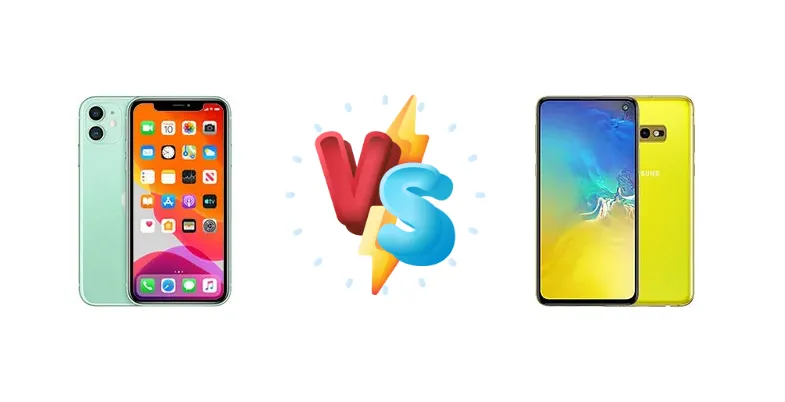
iPhone 11 vs Galaxy S10e: A Detailed Comparison for 2024
| Phones Images | |||||
|---|---|---|---|---|---|
|
🏆 Quick Verdict
For most users, the iPhone 11 emerges as the better choice. Its superior battery endurance (94h vs 83h) and consistently strong performance from the A13 Bionic chip outweigh the S10e’s slightly more versatile display. However, the S10e’s reverse wireless charging and potentially lower price point make it a viable alternative.
| PHONES | ||
|---|---|---|
| Phone Names | Apple iPhone 11 | Samsung Galaxy S10e |
| Network | ||
|---|---|---|
| 2G bands | GSM 850 / 900 / 1800 / 1900 | GSM 850 / 900 / 1800 / 1900 |
| 3G bands | HSDPA 850 / 900 / 1700(AWS) / 1900 / 2100 | HSDPA 850 / 900 / 1700(AWS) / 1900 / 2100 - Global, USA |
| 4G bands | 1, 2, 3, 4, 5, 7, 8, 11, 12, 13, 17, 18, 19, 20, 21, 25, 26, 28, 29, 30, 32, 34, 38, 39, 40, 41, 42, 46, 48, 66 - A2221 | 1, 2, 3, 4, 5, 7, 8, 12, 13, 17, 18, 19, 20, 25, 26, 28, 32, 38, 39, 40, 41, 66 - Global |
| Speed | HSPA 42.2/5.76 Mbps, LTE Cat16 1024/150 Mbps, EV-DO Rev.A 3.1 Mbps | HSPA 42.2/5.76 Mbps, LTE (7CA) Cat20 2000/150 Mbps |
| Technology | GSM / CDMA / HSPA / EVDO / LTE | GSM / CDMA / HSPA / EVDO / LTE |
| 1, 2, 3, 4, 5, 7, 8, 12, 13, 14, 17, 18, 19, 20, 25, 26, 29, 30, 34, 38, 39, 40, 41, 42, 46, 48, 66, 71 - A2111, A2223 | 1, 2, 3, 4, 5, 7, 8, 12, 13, 14, 17, 18, 19, 20, 25, 26, 28, 29, 30, 38, 39, 40, 41, 46, 66, 71 - USA | |
| Launch | ||
|---|---|---|
| Announced | 2019, September 10 | 2019, February 20. Released 2019, March 08 |
| Status | Available. Released 2019, September 20 | Discontinued |
| Body | ||
|---|---|---|
| Build | Glass front (Corning-made glass), glass back (Corning-made glass), aluminum frame (7000 series) | Glass front (Gorilla Glass 5), glass back (Gorilla Glass 5), aluminum frame |
| Dimensions | 150.9 x 75.7 x 8.3 mm (5.94 x 2.98 x 0.33 in) | 142.2 x 69.9 x 7.9 mm (5.60 x 2.75 x 0.31 in) |
| SIM | · Nano-SIM + eSIM· Nano-SIM + Nano-SIM (China) | · Nano-SIM· Nano-SIM + Nano-SIM |
| Weight | 194 g (6.84 oz) | 150 g (5.29 oz) |
| IP68 dust/water resistant (up to 2m for 30 min) Apple Pay (Visa, MasterCard, AMEX certified) | IP68 dust/water resistant (up to 1.5m for 30 min) | |
| Display | ||
|---|---|---|
| Protection | Scratch-resistant glass | Corning Gorilla Glass 5 |
| Resolution | 828 x 1792 pixels, 19.5:9 ratio (~326 ppi density) | 1080 x 2280 pixels, 19:9 ratio (~438 ppi density) |
| Size | 6.1 inches, 90.3 cm2 (~79.0% screen-to-body ratio) | 5.8 inches, 82.8 cm2 (~83.3% screen-to-body ratio) |
| Type | Liquid Retina IPS LCD, 625 nits (typ) | Dynamic AMOLED, HDR10+ |
| - | Always-on display | |
| Platform | ||
|---|---|---|
| CPU | Hexa-core (2x2.65 GHz Lightning + 4x1.8 GHz Thunder) | Octa-core (2x2.73 GHz Mongoose M4 & 2x2.31 GHz Cortex-A75 & 4x1.95 GHz Cortex-A55) - EMEA/LATAMOcta-core (1x2.84 GHz Kryo 485 & 3x2.42 GHz Kryo 485 & 4x1.78 GHz Kryo 485) - USA/China |
| Chipset | Apple A13 Bionic (7 nm+) | Exynos 9820 (8 nm) - EMEA/LATAMQualcomm SM8150 Snapdragon 855 (7 nm) - USA/China |
| GPU | Apple GPU (4-core graphics) | Mali-G76 MP12 - EMEA/LATAM Adreno 640 - USA/China |
| OS | iOS 13, upgradable to iOS 26.1 | Android 9.0 (Pie), upgradable to Android 12, One UI 4.1 |
| Memory | ||
|---|---|---|
| Card slot | No | microSDXC (uses shared SIM slot) - dual SIM model only |
| Internal | 64GB 4GB RAM, 128GB 4GB RAM, 256GB 4GB RAM | 128GB 6GB RAM, 128GB 8GB RAM, 256GB 8GB RAM |
| NVMe | UFS 2.1 | |
| Main Camera | ||
|---|---|---|
| Dual | 12 MP, f/1.8, 26mm (wide), 1/2.55", 1.4µm, dual pixel PDAF, OIS 12 MP, f/2.4, 120˚, 13mm (ultrawide), 1/3.6" | 12 MP, f/1.5-2.4, 26mm (wide), 1/2.55", 1.4µm, dual pixel PDAF, OIS 16 MP, f/2.2, 12mm (ultrawide), 1/3.1", 1.0µm, Super Steady video |
| Features | Dual-LED dual-tone flash, HDR (photo/panorama) | LED flash, auto-HDR, panorama |
| Video | 4K@24/25/30/60fps, 1080p@25/30/60/120/240fps, HDR, stereo sound rec. | 4K@60fps (no EIS), 4K@30fps, 1080p@30/60/240fps, 720p@960fps, HDR10+, stereo sound rec., gyro-EIS & OIS |
| Selfie camera | ||
|---|---|---|
| Features | HDR | HDR |
| Single | 12 MP, f/2.2, 23mm (wide), 1/3.6", 1.0µm SL 3D, (depth/biometrics sensor) | 10 MP, f/1.9, 26mm (wide), 1/3", 1.22µm, dual pixel PDAF |
| Video | 4K@24/25/30/60fps, 1080p@25/30/60/120fps, gyro-EIS | 4K@30/60fps, 1080p@30fps |
| Sound | ||
|---|---|---|
| 3.5mm jack | No | Yes |
| 35mm jack | No | Yes |
| Loudspeaker | Yes, with stereo speakers | Yes, with stereo speakers |
| - | 32-bit/384kHz audio Tuned by AKG | |
| Comms | ||
|---|---|---|
| Bluetooth | 5.0, A2DP, LE | 5.0, A2DP, LE, aptX |
| NFC | Yes | Yes |
| Positioning | GPS, GLONASS, GALILEO, QZSS | GPS, GLONASS, BDS, GALILEO |
| Radio | No | FM radio (USA & Canada only) |
| USB | Lightning, USB 2.0 | USB Type-C 3.1 |
| WLAN | Wi-Fi 802.11 a/b/g/n/ac/6, dual-band, hotspot | Wi-Fi 802.11 a/b/g/n/ac/6, dual-band, Wi-Fi Direct |
| Features | ||
|---|---|---|
| Sensors | Face ID, accelerometer, gyro, proximity, compass, barometer | Fingerprint (side-mounted), accelerometer, gyro, proximity, compass, barometer |
| Ultra Wideband (UWB) support | ANT+ Bixby natural language commands and dictation Samsung Pay (Visa, MasterCard certified) | |
| Battery | ||
|---|---|---|
| Charging | Wired, PD2.0, 50% in 30 min Wireless (Qi) | 15W wired, PD2.0 15W wireless (Qi) 4.5W reverse wireless |
| Type | Li-Ion 3110 mAh, non-removable (11.91 Wh) | Li-Ion 3100 mAh, non-removable |
| Misc | ||
|---|---|---|
| Colors | Black, Green, Yellow, Purple, Red, White | Prism White, Prism Black, Prism Green, Prism Blue, Canary Yellow, Flamingo Pink |
| Models | A2221, A2111, A2223, iPhone12,1 | SM-G970F, SM-G970U, SM-G970W, SM-G9700, SM-G970U1, SM-G970N, SM-G970X |
| Price | $ 167.50 / C$ 228.68 / £ 175.00 / € 193.32 | About 130 EUR |
| SAR | 1.09 W/kg (head) 1.18 W/kg (body) | 0.56 W/kg (head) 0.70 W/kg (body) |
| SAR EU | 0.95 W/kg (head) 0.99 W/kg (body) | 0.58 W/kg (head) 1.57 W/kg (body) |
| Pricing | ||
|---|---|---|
| 128GB 4GB RAM | $ 359.95 | - |
| 256GB 4GB RAM | $ 469.99 | - |
| 64GB 4GB RAM | $ 292.79 | - |
| RENEWED | £ 214.00 | - |
| Tests | ||
|---|---|---|
| Audio quality | Noise -94.2dB / Crosstalk -80.8dB | Noise -92.9dB / Crosstalk -89.4dB |
| Battery life | Endurance rating 94h | Endurance rating 83h |
| Camera | Photo / Video | Photo / Video |
| Display | Contrast ratio: 1505:1 (nominal) | Contrast ratio: infinite |
| Loudspeaker | Voice 70dB / Noise 72dB / Ring 76dB | Voice 71dB / Noise 76dB / Ring 80dB |
| Performance | AnTuTu: 419453 (v7) GeekBench: 13882 (v4.4) GFXBench: 60fps (ES 3.1 onscreen) | AnTuTu: 325192 (v7), 389694 (v8) GeekBench: 10081 (v4.4), 2141 (v5.1) GFXBench: 40fps (ES 3.1 onscreen) |
Apple iPhone 11
- Superior battery life (94h endurance)
- Faster and more efficient A13 Bionic chip
- Long-term software support from Apple
- LCD display lacks the vibrancy of AMOLED
- No reverse wireless charging
Samsung Galaxy S10e
- Vibrant AMOLED display with 'infinite' contrast
- Reverse wireless charging for accessories
- Potentially lower price point in the used market
- Shorter battery life (83h endurance)
- Performance lags behind the iPhone 11
- Software updates are no longer guaranteed
Display Comparison
The Galaxy S10e boasts an 'infinite' contrast ratio, indicative of its AMOLED panel, offering richer blacks and more vibrant colors compared to the iPhone 11’s 1505:1 contrast ratio LCD. However, the iPhone 11 counters with a measured peak brightness of 644 nits, potentially offering better visibility in direct sunlight. Both displays feature Qi wireless charging, but the S10e’s AMOLED tech provides a more visually striking experience, though at the cost of potential burn-in over time.
Camera Comparison
Both phones offer capable photo and video recording, but differ in their approach. The iPhone 11’s image processing prioritizes natural colors and dynamic range, while the S10e tends towards more saturated, punchy images. While both have dual-camera systems, the iPhone 11’s computational photography often yields more consistent results in challenging lighting conditions. The S10e’s camera system is more versatile with features like a dedicated Night Mode, but the iPhone 11’s video recording quality is generally considered superior.
Performance
The iPhone 11’s Apple A13 Bionic (7nm+) chip consistently outperforms the Samsung Galaxy S10e’s Exynos 9820 (8nm) or Snapdragon 855 (7nm) in CPU-intensive tasks. The A13’s hexa-core architecture, with its Lightning and Thunder cores, delivers faster processing speeds. While the S10e’s octa-core CPU is capable, the A13’s optimized software integration and efficient design provide a smoother, more responsive user experience. The 7nm process node used in the Snapdragon 855 variant of the S10e offers better efficiency than the 8nm Exynos, but still trails the A13.
Battery Life
The iPhone 11’s endurance rating of 94 hours significantly surpasses the Galaxy S10e’s 83 hours. This translates to a noticeable difference in real-world usage, with the iPhone 11 comfortably lasting a full day on a single charge for most users. Both support PD2.0 wired charging, with the iPhone 11 achieving 50% charge in 30 minutes. The S10e adds the convenience of 15W wireless charging and 4.5W reverse wireless charging, allowing it to charge accessories, a feature absent on the iPhone 11.
Buying Guide
Buy the Apple iPhone 11 if you prioritize long-term software support, consistent performance, and all-day battery life. It’s ideal for users deeply embedded in the Apple ecosystem or those seeking a reliable, easy-to-use smartphone. Buy the Samsung Galaxy S10e if you value a more customizable experience, the convenience of reverse wireless charging, and potentially a lower upfront cost, understanding that software updates will cease sooner.