
iPhone 11 vs. Galaxy S10 Lite: A Detailed Comparison for Budget-Conscious Buyers
| Phones Images | |||||
|---|---|---|---|---|---|
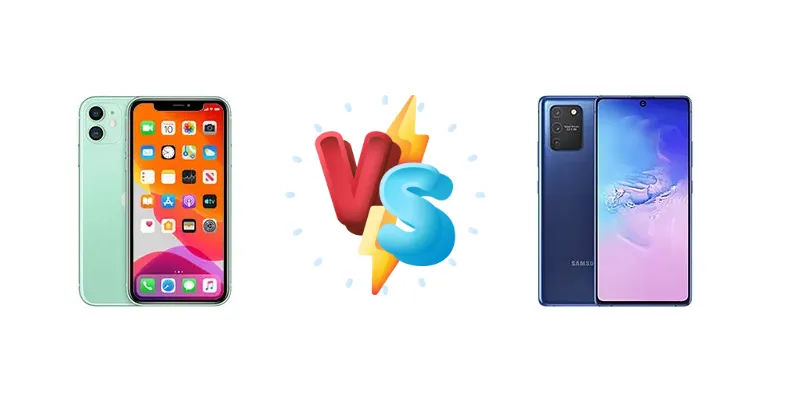
|
🏆 Quick Verdict
For the average user prioritizing long-term software support and a streamlined user experience, the iPhone 11 is the better choice. However, the Galaxy S10 Lite’s superior battery life and faster charging, coupled with its more powerful CPU core configuration, make it a strong alternative for Android power users.
| PHONES | ||
|---|---|---|
| Phone Names | Apple iPhone 11 | Samsung Galaxy S10 Lite |
| Network | ||
|---|---|---|
| 2G bands | GSM 850 / 900 / 1800 / 1900 | GSM 850 / 900 / 1800 / 1900 |
| 3G bands | HSDPA 850 / 900 / 1700(AWS) / 1900 / 2100 | HSDPA 850 / 900 / 1700(AWS) / 1900 / 2100 |
| 4G bands | 1, 2, 3, 4, 5, 7, 8, 11, 12, 13, 17, 18, 19, 20, 21, 25, 26, 28, 29, 30, 32, 34, 38, 39, 40, 41, 42, 46, 48, 66 - A2221 | 1, 2, 3, 4, 5, 7, 8, 12, 13, 17, 20, 26, 28, 38, 40, 41, 66 |
| Speed | HSPA 42.2/5.76 Mbps, LTE Cat16 1024/150 Mbps, EV-DO Rev.A 3.1 Mbps | HSPA, LTE |
| Technology | GSM / CDMA / HSPA / EVDO / LTE | GSM / HSPA / LTE |
| 1, 2, 3, 4, 5, 7, 8, 12, 13, 14, 17, 18, 19, 20, 25, 26, 29, 30, 34, 38, 39, 40, 41, 42, 46, 48, 66, 71 - A2111, A2223 | - | |
| Launch | ||
|---|---|---|
| Announced | 2019, September 10 | 2020, January 03 |
| Status | Available. Released 2019, September 20 | Available. Released 2020, February 03 |
| Body | ||
|---|---|---|
| Build | Glass front (Corning-made glass), glass back (Corning-made glass), aluminum frame (7000 series) | Glass front (Gorilla Glass 3+), aluminum frame, plastic back |
| Dimensions | 150.9 x 75.7 x 8.3 mm (5.94 x 2.98 x 0.33 in) | 162.5 x 75.6 x 8.1 mm (6.40 x 2.98 x 0.32 in) |
| SIM | · Nano-SIM + eSIM· Nano-SIM + Nano-SIM (China) | · Nano-SIM· Nano-SIM + Nano-SIM |
| Weight | 194 g (6.84 oz) | 186 g (6.56 oz) |
| IP68 dust/water resistant (up to 2m for 30 min) Apple Pay (Visa, MasterCard, AMEX certified) | - | |
| Display | ||
|---|---|---|
| Protection | Scratch-resistant glass | Corning Gorilla Glass 3+ |
| Resolution | 828 x 1792 pixels, 19.5:9 ratio (~326 ppi density) | 1080 x 2400 pixels, 20:9 ratio (~394 ppi density) |
| Size | 6.1 inches, 90.3 cm2 (~79.0% screen-to-body ratio) | 6.7 inches, 107.8 cm2 (~87.8% screen-to-body ratio) |
| Type | Liquid Retina IPS LCD, 625 nits (typ) | Super AMOLED Plus, HDR10+ |
| - | Always-on display | |
| Platform | ||
|---|---|---|
| CPU | Hexa-core (2x2.65 GHz Lightning + 4x1.8 GHz Thunder) | Octa-core (1x2.84 GHz Kryo 485 & 3x2.42 GHz Kryo 485 & 4x1.78 GHz Kryo 485) |
| Chipset | Apple A13 Bionic (7 nm+) | Qualcomm SM8150 Snapdragon 855 (7 nm) |
| GPU | Apple GPU (4-core graphics) | Adreno 640 |
| OS | iOS 13, upgradable to iOS 26.1 | Android 10, upgradable to Android 13, One UI 5 |
| Memory | ||
|---|---|---|
| Card slot | No | microSDXC (uses shared SIM slot) |
| Internal | 64GB 4GB RAM, 128GB 4GB RAM, 256GB 4GB RAM | 128GB 6GB RAM, 128GB 8GB RAM, 512GB 8GB RAM |
| NVMe | UFS 2.1 | |
| Main Camera | ||
|---|---|---|
| Dual | 12 MP, f/1.8, 26mm (wide), 1/2.55", 1.4µm, dual pixel PDAF, OIS 12 MP, f/2.4, 120˚, 13mm (ultrawide), 1/3.6" | - |
| Features | Dual-LED dual-tone flash, HDR (photo/panorama) | LED flash, panorama, HDR |
| Triple | - | 48 MP, f/2.0, 26mm (wide), 1/2.0", 0.8µm, PDAF, Super Steady OIS 12 MP, f/2.2, 12mm (ultrawide) 5 MP (macro) |
| Video | 4K@24/25/30/60fps, 1080p@25/30/60/120/240fps, HDR, stereo sound rec. | 4K@30/60fps, 1080p@30/60/240fps; gyro-EIS |
| Selfie camera | ||
|---|---|---|
| Features | HDR | HDR |
| Single | 12 MP, f/2.2, 23mm (wide), 1/3.6", 1.0µm SL 3D, (depth/biometrics sensor) | 32 MP, f/2.2, 25mm (wide), 1/2.8", 0.8µm |
| Video | 4K@24/25/30/60fps, 1080p@25/30/60/120fps, gyro-EIS | 1080p@30fps |
| Sound | ||
|---|---|---|
| 3.5mm jack | No | No |
| 35mm jack | No | No |
| Loudspeaker | Yes, with stereo speakers | Yes |
| Comms | ||
|---|---|---|
| Bluetooth | 5.0, A2DP, LE | 5.0, A2DP, LE |
| NFC | Yes | Yes |
| Positioning | GPS, GLONASS, GALILEO, QZSS | GPS, GLONASS, GALILEO, BDS |
| Radio | No | FM radio (market/region dependent) |
| USB | Lightning, USB 2.0 | USB Type-C 2.0 |
| WLAN | Wi-Fi 802.11 a/b/g/n/ac/6, dual-band, hotspot | Wi-Fi 802.11 a/b/g/n/ac, dual-band, Wi-Fi Direct |
| Features | ||
|---|---|---|
| Sensors | Face ID, accelerometer, gyro, proximity, compass, barometer | Fingerprint (under display, optical), accelerometer, gyro, proximity, compass |
| Ultra Wideband (UWB) support | ANT+ | |
| Battery | ||
|---|---|---|
| Charging | Wired, PD2.0, 50% in 30 min Wireless (Qi) | 45W wired |
| Type | Li-Ion 3110 mAh, non-removable (11.91 Wh) | Li-Po 4500 mAh, non-removable |
| Misc | ||
|---|---|---|
| Colors | Black, Green, Yellow, Purple, Red, White | Prism White, Prism Black, Prism Blue |
| Models | A2221, A2111, A2223, iPhone12,1 | SM-G770F, SM-G770F/DS, SM-G770F/DSM, SM-G770U1 |
| Price | $ 167.50 / C$ 228.68 / £ 175.00 / € 193.32 | About 380 EUR |
| SAR | 1.09 W/kg (head) 1.18 W/kg (body) | 0.69 W/kg (head) 0.93 W/kg (body) |
| SAR EU | 0.95 W/kg (head) 0.99 W/kg (body) | 0.49 W/kg (head) 1.52 W/kg (body) |
| Pricing | ||
|---|---|---|
| 128GB 4GB RAM | $ 359.95 | - |
| 256GB 4GB RAM | $ 469.99 | - |
| 64GB 4GB RAM | $ 292.79 | - |
| RENEWED | £ 214.00 | - |
| Tests | ||
|---|---|---|
| Audio quality | Noise -94.2dB / Crosstalk -80.8dB | Noise -93.7dB / Crosstalk -94.7dB |
| Battery life | Endurance rating 94h | Endurance rating 110h |
| Camera | Photo / Video | Photo / Video |
| Display | Contrast ratio: 1505:1 (nominal) | Contrast ratio: Infinite (nominal) |
| Loudspeaker | Voice 70dB / Noise 72dB / Ring 76dB | -27.2 LUFS (Good) |
| Performance | AnTuTu: 419453 (v7) GeekBench: 13882 (v4.4) GFXBench: 60fps (ES 3.1 onscreen) | AnTuTu: 370751 (v7), 459497 (v8) GeekBench: 11151 (v4.4), 2732 (v5.1) GFXBench: 56fps (ES 3.1 onscreen) |
Apple iPhone 11
- Long-term software support from Apple
- Seamless integration with Apple ecosystem
- Excellent video recording quality
- Slower charging speeds
- Shorter battery life compared to S10 Lite
- Less customizable operating system
Samsung Galaxy S10 Lite
- Faster 45W wired charging
- Longer battery life
- More powerful peak CPU performance
- Android software updates are less consistent
- Lacks wireless charging
- Samsung’s image processing can be overly saturated
Display Comparison
The Galaxy S10 Lite boasts a higher measured brightness of 705 nits compared to the iPhone 11’s 644 nits, potentially offering better visibility in direct sunlight. While Samsung markets an 'Infinite' contrast ratio, the iPhone 11 delivers a measured 1505:1 contrast ratio, indicating excellent black levels and color separation. Both displays are capable, but the S10 Lite’s higher peak brightness gives it a slight edge for outdoor use. Neither display utilizes advanced panel technology like LTPO, meaning refresh rates are fixed.
Camera Comparison
Both phones offer capable photo and video recording, but details are limited without specific sensor information. The absence of detailed sensor specs necessitates a focus on processing. Apple’s image processing typically prioritizes natural colors and dynamic range, while Samsung often boosts saturation and contrast. The S10 Lite’s larger physical size *could* accommodate a larger main sensor, potentially improving low-light performance, but this is speculative without concrete data. The inclusion of OIS (Optical Image Stabilization) on both devices is crucial for stable video recording.
Performance
The iPhone 11’s Apple A13 Bionic (7nm+) chip features a hexa-core CPU, while the Galaxy S10 Lite utilizes the Qualcomm Snapdragon 855 (7nm) with an octa-core configuration. While the A13 Bionic is renowned for its single-core performance, the S10 Lite’s Kryo 485 cores, with a peak clock speed of 2.84 GHz, offer a higher maximum processing speed. This translates to potentially faster performance in multi-threaded tasks. However, Apple’s tight hardware-software integration often results in smoother overall responsiveness, despite the core count difference. The iPhone 11 has 4GB of RAM, while the S10 Lite also has 4GB, meaning RAM isn't a differentiating factor.
Battery Life
The Galaxy S10 Lite’s endurance rating of 110 hours significantly surpasses the iPhone 11’s 94 hours, indicating substantially longer battery life. This advantage is further amplified by the S10 Lite’s 45W wired charging, capable of reaching 50% charge in a significantly shorter time than the iPhone 11’s 30-minute PD2.0 50% charge. While the iPhone 11 supports Qi wireless charging, the S10 Lite lacks this feature. The S10 Lite’s superior charging speed and endurance make it the clear winner for users who prioritize minimizing downtime.
Buying Guide
Buy the Apple iPhone 11 if you need a phone with guaranteed software updates for years to come, a simple and intuitive operating system, and seamless integration with other Apple devices. Buy the Samsung Galaxy S10 Lite if you prefer a more customizable Android experience, prioritize battery endurance and faster charging speeds, and want a device with a more powerful peak CPU performance for demanding tasks.