
iPhone 11 vs LG G8 ThinQ: Which 2019 Flagship Holds Up in 2024?
| Phones Images | |||||
|---|---|---|---|---|---|
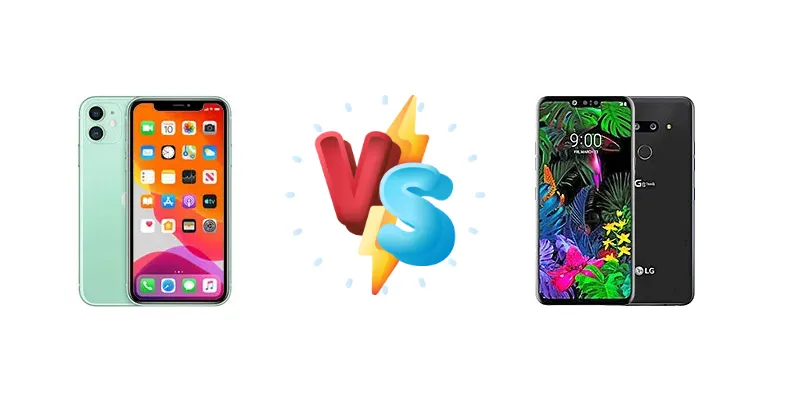
|
🏆 Quick Verdict
For the average user prioritizing long-term software support and a streamlined experience, the iPhone 11 emerges as the winner. Its A13 Bionic chip, while older, still delivers strong performance, and its 94-hour endurance rating significantly outlasts the LG G8 ThinQ's 79-hour score. However, the LG G8 ThinQ offers a compelling alternative for Android enthusiasts seeking a feature-rich device at a lower price point.
| PHONES | ||
|---|---|---|
| Phone Names | Apple iPhone 11 | LG G8 ThinQ |
| Network | ||
|---|---|---|
| 2G bands | GSM 850 / 900 / 1800 / 1900 | GSM 850 / 900 / 1800 / 1900 |
| 3G bands | HSDPA 850 / 900 / 1700(AWS) / 1900 / 2100 | HSDPA 850 / 900 / 1900 / 2100 |
| 4G bands | 1, 2, 3, 4, 5, 7, 8, 11, 12, 13, 17, 18, 19, 20, 21, 25, 26, 28, 29, 30, 32, 34, 38, 39, 40, 41, 42, 46, 48, 66 - A2221 | 1, 2, 3, 4, 5, 7, 8, 12, 13, 14, 17, 20, 25, 26, 28, 29, 30, 38, 39, 40, 41, 46, 48, 66, 71 - USA |
| Speed | HSPA 42.2/5.76 Mbps, LTE Cat16 1024/150 Mbps, EV-DO Rev.A 3.1 Mbps | HSPA 42.2/5.76 Mbps, LTE Cat19 1600/150 Mbps |
| Technology | GSM / CDMA / HSPA / EVDO / LTE | GSM / CDMA / HSPA / EVDO / LTE |
| 1, 2, 3, 4, 5, 7, 8, 12, 13, 14, 17, 18, 19, 20, 25, 26, 29, 30, 34, 38, 39, 40, 41, 42, 46, 48, 66, 71 - A2111, A2223 | 2, 3, 4, 5, 7, 13, 20, 28, 46, 48, 66 - Verison | |
| Launch | ||
|---|---|---|
| Announced | 2019, September 10 | 2019, February 24. Released 2019, April 11 |
| Status | Available. Released 2019, September 20 | Discontinued |
| Body | ||
|---|---|---|
| Build | Glass front (Corning-made glass), glass back (Corning-made glass), aluminum frame (7000 series) | Glass front (Gorilla Glass 5), glass back (Gorilla Glass 6), aluminum frame |
| Dimensions | 150.9 x 75.7 x 8.3 mm (5.94 x 2.98 x 0.33 in) | 151.9 x 71.8 x 8.4 mm (5.98 x 2.83 x 0.33 in) |
| SIM | · Nano-SIM + eSIM· Nano-SIM + Nano-SIM (China) | · Nano-SIM· Nano-SIM + Nano-SIM |
| Weight | 194 g (6.84 oz) | 167 g (5.89 oz) |
| IP68 dust/water resistant (up to 2m for 30 min) Apple Pay (Visa, MasterCard, AMEX certified) | IP68 dust/water resistant (up to 1.5m for 30 min) MIL-STD-810G compliant* Method 516.6, Procedure IV "Transit Drop" *does not guarantee ruggedness or use in extreme conditions | |
| Display | ||
|---|---|---|
| Protection | Scratch-resistant glass | Corning Gorilla Glass 5 |
| Resolution | 828 x 1792 pixels, 19.5:9 ratio (~326 ppi density) | 1440 x 3120 pixels, 19.5:9 ratio (~564 ppi density) |
| Size | 6.1 inches, 90.3 cm2 (~79.0% screen-to-body ratio) | 6.1 inches, 91.0 cm2 (~83.5% screen-to-body ratio) |
| Type | Liquid Retina IPS LCD, 625 nits (typ) | P-OLED, HDR10 |
| - | Always-on display | |
| Platform | ||
|---|---|---|
| CPU | Hexa-core (2x2.65 GHz Lightning + 4x1.8 GHz Thunder) | Octa-core (1x2.84 GHz Kryo 485 & 3x2.42 GHz Kryo 485 & 4x1.78 GHz Kryo 485) |
| Chipset | Apple A13 Bionic (7 nm+) | Qualcomm SM8150 Snapdragon 855 (7 nm) |
| GPU | Apple GPU (4-core graphics) | Adreno 640 |
| OS | iOS 13, upgradable to iOS 26.1 | Android 9.0 (Pie), upgradable to Android 11 |
| Memory | ||
|---|---|---|
| Card slot | No | microSDXC (dedicated slot) - single-SIM modelmicroSDXC (uses shared SIM slot) - dual-SIM model |
| Internal | 64GB 4GB RAM, 128GB 4GB RAM, 256GB 4GB RAM | 128GB 6GB RAM |
| NVMe | UFS 2.1 | |
| Main Camera | ||
|---|---|---|
| Dual | 12 MP, f/1.8, 26mm (wide), 1/2.55", 1.4µm, dual pixel PDAF, OIS 12 MP, f/2.4, 120˚, 13mm (ultrawide), 1/3.6" | - |
| Dual or Triple | - | 12 MP, f/1.5, 27mm (standard), 1/2.55", 1.4µm, dual pixel PDAF, OIS 16 MP, f/1.9, 16mm (ultrawide), 1/3.1", 1.0µm, no AF or 12 MP, f/1.5, 27mm (standard), 1/2.55", 1.4µm, dual pixel PDAF, OIS 16 MP, f/1.9, 16mm (ultrawide), 1/3.1", 1.0µm, no AF 12 MP, 52mm (telephoto), f/2.4, 1.0µm, 2x optical zoom, dual pixel PDAF, OIS |
| Features | Dual-LED dual-tone flash, HDR (photo/panorama) | LED flash, HDR, panorama |
| Video | 4K@24/25/30/60fps, 1080p@25/30/60/120/240fps, HDR, stereo sound rec. | 4K@30/60fps, 1080p@30/60fps, 720p@240fps, HDR10, 24-bit/192kHz stereo sound rec. |
| Selfie camera | ||
|---|---|---|
| Features | HDR | HDR |
| Single | 12 MP, f/2.2, 23mm (wide), 1/3.6", 1.0µm SL 3D, (depth/biometrics sensor) | 8 MP, f/1.7, 26mm (wide), 1/3.6", 1.22µm, AF TOF 3D, f/1.4, (depth/biometrics sensor) |
| Video | 4K@24/25/30/60fps, 1080p@25/30/60/120fps, gyro-EIS | 1080p@60fps |
| Sound | ||
|---|---|---|
| 3.5mm jack | No | Yes |
| 35mm jack | No | Yes |
| Loudspeaker | Yes, with stereo speakers | Yes |
| - | 32-bit/192kHz audio | |
| Comms | ||
|---|---|---|
| Bluetooth | 5.0, A2DP, LE | 5.0, A2DP, LE, aptX HD |
| NFC | Yes | Yes |
| Positioning | GPS, GLONASS, GALILEO, QZSS | GPS, GLONASS, GALILEO, BDS |
| Radio | No | FM radio (market/region dependent) |
| USB | Lightning, USB 2.0 | USB Type-C 3.1, OTG |
| WLAN | Wi-Fi 802.11 a/b/g/n/ac/6, dual-band, hotspot | Wi-Fi 802.11 a/b/g/n/ac, dual-band, Wi-Fi Direct, DLNA |
| Features | ||
|---|---|---|
| Sensors | Face ID, accelerometer, gyro, proximity, compass, barometer | Face ID, Hand ID, fingerprint (rear-mounted), accelerometer, gyro, proximity, compass, barometer |
| Ultra Wideband (UWB) support | - | |
| Battery | ||
|---|---|---|
| Charging | Wired, PD2.0, 50% in 30 min Wireless (Qi) | 21W wired, PD, QC3 9W wireless |
| Type | Li-Ion 3110 mAh, non-removable (11.91 Wh) | Li-Po 3500 mAh, non-removable |
| Misc | ||
|---|---|---|
| Colors | Black, Green, Yellow, Purple, Red, White | Platinum Gray, New Aurora Black, New Moroccan Blue, Carmine Red |
| Models | A2221, A2111, A2223, iPhone12,1 | LMG820QM7, LM-G820UMB, LMG820UM0, LMG820UM1, LMG820UM2, LM-G820N, LM-G820, LM-G820QM |
| Price | $ 167.50 / C$ 228.68 / £ 175.00 / € 193.32 | About 350 EUR |
| SAR | 1.09 W/kg (head) 1.18 W/kg (body) | - |
| SAR EU | 0.95 W/kg (head) 0.99 W/kg (body) | - |
| Pricing | ||
|---|---|---|
| 128GB 4GB RAM | $ 359.95 | - |
| 256GB 4GB RAM | $ 469.99 | - |
| 64GB 4GB RAM | $ 292.79 | - |
| RENEWED | £ 214.00 | - |
| Tests | ||
|---|---|---|
| Audio quality | Noise -94.2dB / Crosstalk -80.8dB | Noise -94.1dB / Crosstalk -87.6dB |
| Battery life | Endurance rating 94h | Endurance rating 79h |
| Camera | Photo / Video | Photo / Video |
| Display | Contrast ratio: 1505:1 (nominal) | Contrast ratio: infinite |
| Loudspeaker | Voice 70dB / Noise 72dB / Ring 76dB | Voice 68dB / Noise 74dB / Ring 92dB |
| Performance | AnTuTu: 419453 (v7) GeekBench: 13882 (v4.4) GFXBench: 60fps (ES 3.1 onscreen) | AnTuTu: 331537 (v7), 362730 (v8) GeekBench: 10735 (v4.4), 2700 (v5.1) GFXBench: 20fps (ES 3.1 onscreen) |
Apple iPhone 11
- Superior battery life (94h endurance)
- Stronger processor performance (A13 Bionic)
- Long-term software support from Apple
- LCD display with lower contrast ratio compared to OLED
- Limited customization options compared to Android
LG G8 ThinQ
- Faster wired charging (21W with PD/QC3)
- Wireless charging support
- More affordable price point
- Shorter battery life (79h endurance)
- Potentially less consistent camera performance
- Shorter software update lifespan
Display Comparison
The LG G8 ThinQ boasts an 'infinite' contrast ratio, a marketing term often used for OLED panels, while the iPhone 11 features a 1505:1 contrast ratio. In real-world use, the iPhone 11’s LCD panel delivers 644 nits of peak brightness, slightly less than the G8 ThinQ’s 655 nits. While the difference is minimal, the G8 ThinQ’s display may offer slightly better visibility in direct sunlight. However, the iPhone 11’s color accuracy is generally considered superior for content consumption, and the lack of PWM dimming on the iPhone 11 is a benefit for users sensitive to screen flicker.
Camera Comparison
Both devices offer capable photo and video recording, but the specifics are limited by the provided data. The iPhone 11’s image processing is known for its natural color reproduction and excellent dynamic range. The LG G8 ThinQ, with its Snapdragon 855 ISP, likely offers a more saturated and contrast-rich image profile, appealing to users who prefer a bolder look. Without detailed sensor size information, it’s difficult to definitively declare a winner, but Apple’s computational photography algorithms often provide a more consistent experience across various lighting conditions.
Performance
Apple’s A13 Bionic (7nm+) chip in the iPhone 11 utilizes a hexa-core architecture (2x2.65 GHz Lightning + 4x1.8 GHz Thunder), while the LG G8 ThinQ is powered by the Qualcomm Snapdragon 855 (7nm) with an octa-core configuration. Despite having more cores, the Snapdragon 855 generally trails the A13 Bionic in single-core performance, a metric crucial for everyday tasks. The A13’s efficient design also contributes to the iPhone 11’s superior battery life. While both phones offer sufficient power for most applications, the iPhone 11 maintains a performance edge, particularly in demanding tasks like video editing and gaming.
Battery Life
The iPhone 11’s 94-hour endurance rating is a significant advantage over the LG G8 ThinQ’s 79-hour rating. This translates to a noticeable difference in real-world usage, with the iPhone 11 lasting considerably longer on a single charge. While the LG G8 ThinQ supports faster 21W wired charging with Power Delivery (PD) and Quick Charge 3.0, and 9W wireless charging, the iPhone 11’s 50% charge in 30 minutes with PD2.0 is competitive. The iPhone 11’s superior efficiency, coupled with its larger battery capacity (implied by the endurance rating), makes it the clear winner in battery performance.
Buying Guide
Buy the Apple iPhone 11 if you need a phone with guaranteed software updates for years to come, a simple and intuitive user interface, and strong resale value. It’s ideal for users deeply embedded in the Apple ecosystem. Buy the LG G8 ThinQ if you prefer the flexibility of Android, prioritize features like wired and wireless charging with Quick Charge 3.0 support, and want a larger display without the premium Apple price tag. It’s a good choice for those who enjoy customization and open-source options.