
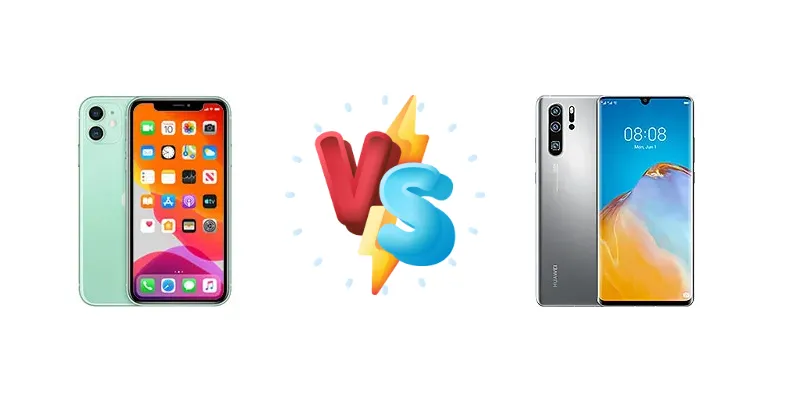
iPhone 11 vs Huawei P30 Pro New Edition: Which Budget Flagship Reigns Supreme?
| Phones Images | |||||
|---|---|---|---|---|---|
|
🏆 Quick Verdict
For most users, the iPhone 11 emerges as the stronger choice. Its consistently powerful A13 Bionic chip, coupled with Apple’s long-term software support, provides a smoother and more reliable experience. While the P30 Pro boasts faster charging, the iPhone 11’s overall package offers better longevity and usability.
| PHONES | ||
|---|---|---|
| Phone Names | Apple iPhone 11 | Huawei P30 Pro New Edition |
| Network | ||
|---|---|---|
| 2G bands | GSM 850 / 900 / 1800 / 1900 | GSM 850 / 900 / 1800 / 1900 |
| 3G bands | HSDPA 850 / 900 / 1700(AWS) / 1900 / 2100 | HSDPA 800 / 850 / 900 / 1700(AWS) / 1900 / 2100 |
| 4G bands | 1, 2, 3, 4, 5, 7, 8, 11, 12, 13, 17, 18, 19, 20, 21, 25, 26, 28, 29, 30, 32, 34, 38, 39, 40, 41, 42, 46, 48, 66 - A2221 | LTE |
| Speed | HSPA 42.2/5.76 Mbps, LTE Cat16 1024/150 Mbps, EV-DO Rev.A 3.1 Mbps | HSPA 42.2/5.76 Mbps, LTE Cat21 1400/200 Mbps |
| Technology | GSM / CDMA / HSPA / EVDO / LTE | GSM / HSPA / LTE |
| 1, 2, 3, 4, 5, 7, 8, 12, 13, 14, 17, 18, 19, 20, 25, 26, 29, 30, 34, 38, 39, 40, 41, 42, 46, 48, 66, 71 - A2111, A2223 | - | |
| Launch | ||
|---|---|---|
| Announced | 2019, September 10 | 2020, May 12. Released 2020, June 01 |
| Status | Available. Released 2019, September 20 | Discontinued |
| Body | ||
|---|---|---|
| Build | Glass front (Corning-made glass), glass back (Corning-made glass), aluminum frame (7000 series) | Glass front (Aluminosilicate glass), glass back (Aluminosilicate glass), aluminum frame |
| Dimensions | 150.9 x 75.7 x 8.3 mm (5.94 x 2.98 x 0.33 in) | 158 x 73.4 x 8.4 mm (6.22 x 2.89 x 0.33 in) |
| SIM | · Nano-SIM + eSIM· Nano-SIM + Nano-SIM (China) | · Nano-SIM· Nano-SIM + Nano-SIM |
| Weight | 194 g (6.84 oz) | 192 g (6.77 oz) |
| IP68 dust/water resistant (up to 2m for 30 min) Apple Pay (Visa, MasterCard, AMEX certified) | IP68 dust/water resistant (up to 2m for 30 mins) | |
| Display | ||
|---|---|---|
| Protection | Scratch-resistant glass | - |
| Resolution | 828 x 1792 pixels, 19.5:9 ratio (~326 ppi density) | 1080 x 2340 pixels, 19.5:9 ratio (~398 ppi density) |
| Size | 6.1 inches, 90.3 cm2 (~79.0% screen-to-body ratio) | 6.47 inches, 102.8 cm2 (~88.6% screen-to-body ratio) |
| Type | Liquid Retina IPS LCD, 625 nits (typ) | OLED, HDR10 |
| Platform | ||
|---|---|---|
| CPU | Hexa-core (2x2.65 GHz Lightning + 4x1.8 GHz Thunder) | Octa-core (2x2.6 GHz Cortex-A76 & 2x1.92 GHz Cortex-A76 & 4x1.8 GHz Cortex-A55) |
| Chipset | Apple A13 Bionic (7 nm+) | Kirin 980 (7 nm) |
| GPU | Apple GPU (4-core graphics) | Mali-G76 MP10 |
| OS | iOS 13, upgradable to iOS 26.1 | Android 10, EMUI 10.1, Google Play Services |
| Memory | ||
|---|---|---|
| Card slot | No | Nano Memory (uses shared SIM slot) |
| Internal | 64GB 4GB RAM, 128GB 4GB RAM, 256GB 4GB RAM | 128GB 6GB RAM, 256GB 8GB RAM |
| NVMe | UFS 3.0 | |
| Main Camera | ||
|---|---|---|
| Dual | 12 MP, f/1.8, 26mm (wide), 1/2.55", 1.4µm, dual pixel PDAF, OIS 12 MP, f/2.4, 120˚, 13mm (ultrawide), 1/3.6" | - |
| Features | Dual-LED dual-tone flash, HDR (photo/panorama) | Leica optics, color spectrum sensor, dual-LED dual-tone flash, panorama, HDR |
| Triple | - | 40 MP, f/1.6, 27mm (wide), 1/1.7", PDAF, OIS 8 MP, f/3.4, 125mm (periscope telephoto), 1/4.0", PDAF, OIS, 5x optical zoom, 10x hybrid zoom 20 MP, f/2.2, 16mm (ultrawide), 1/2.7", PDAF TOF 3D, (depth) |
| Video | 4K@24/25/30/60fps, 1080p@25/30/60/120/240fps, HDR, stereo sound rec. | 4K@30fps, 1080p@60fps, 1080p@30fps (gyro-EIS), 720p@960fps |
| Selfie camera | ||
|---|---|---|
| Features | HDR | HDR |
| Single | 12 MP, f/2.2, 23mm (wide), 1/3.6", 1.0µm SL 3D, (depth/biometrics sensor) | 32 MP, f/2.0, 26mm (wide), 1/2.8", 0.8µm |
| Video | 4K@24/25/30/60fps, 1080p@25/30/60/120fps, gyro-EIS | 1080p@30fps |
| Sound | ||
|---|---|---|
| 3.5mm jack | No | No |
| 35mm jack | No | No |
| Loudspeaker | Yes, with stereo speakers | Yes |
| - | 32-bit/384kHz audio | |
| Comms | ||
|---|---|---|
| Bluetooth | 5.0, A2DP, LE | 5.0, A2DP, aptX HD, LE |
| Infrared port | - | Yes |
| NFC | Yes | Yes |
| Positioning | GPS, GLONASS, GALILEO, QZSS | GPS (L1+L5), GLONASS (L1), BDS (B1), GALILEO (E1+E5a), QZSS (L1+L5) |
| Radio | No | No |
| USB | Lightning, USB 2.0 | USB Type-C 3.1 |
| WLAN | Wi-Fi 802.11 a/b/g/n/ac/6, dual-band, hotspot | Wi-Fi 802.11 a/b/g/n/ac, dual-band, Wi-Fi Direct |
| Features | ||
|---|---|---|
| Sensors | Face ID, accelerometer, gyro, proximity, compass, barometer | Fingerprint (under display, optical), accelerometer, gyro, proximity, compass |
| Ultra Wideband (UWB) support | - | |
| Battery | ||
|---|---|---|
| Charging | Wired, PD2.0, 50% in 30 min Wireless (Qi) | 40W wired, 70% in 30 min 15W wireless Reverse wireless |
| Type | Li-Ion 3110 mAh, non-removable (11.91 Wh) | Li-Po 4200 mAh |
| Misc | ||
|---|---|---|
| Colors | Black, Green, Yellow, Purple, Red, White | Aurora, Black, Silver Frost |
| Models | A2221, A2111, A2223, iPhone12,1 | - |
| Price | $ 167.50 / C$ 228.68 / £ 175.00 / € 193.32 | About 820 EUR |
| SAR | 1.09 W/kg (head) 1.18 W/kg (body) | - |
| SAR EU | 0.95 W/kg (head) 0.99 W/kg (body) | - |
| Pricing | ||
|---|---|---|
| 128GB 4GB RAM | $ 359.95 | - |
| 256GB 4GB RAM | $ 469.99 | - |
| 64GB 4GB RAM | $ 292.79 | - |
| RENEWED | £ 214.00 | - |
| Tests | ||
|---|---|---|
| Audio quality | Noise -94.2dB / Crosstalk -80.8dB | - |
| Battery life | Endurance rating 94h | - |
| Camera | Photo / Video | - |
| Display | Contrast ratio: 1505:1 (nominal) | - |
| Loudspeaker | Voice 70dB / Noise 72dB / Ring 76dB | - |
| Performance | AnTuTu: 419453 (v7) GeekBench: 13882 (v4.4) GFXBench: 60fps (ES 3.1 onscreen) | - |
Apple iPhone 11
- Superior processor performance with the A13 Bionic
- Long-term software support and updates from Apple
- Excellent video recording quality
- Slower charging speed compared to the P30 Pro
- LCD display lacks the vibrancy of OLED panels
Huawei P30 Pro New Edition
- Faster 40W wired charging
- Wireless and reverse wireless charging capabilities
- Potentially superior low-light camera performance
- Kirin 980 chipset is less powerful than the A13 Bionic
- Limited software update support from Huawei
Display Comparison
The iPhone 11 features a 6.1-inch Liquid Retina LCD with a measured peak brightness of 644 nits and a 1505:1 contrast ratio. While not OLED, it delivers accurate colors and sufficient brightness for outdoor visibility. The P30 Pro New Edition’s display specifications aren’t provided, but Huawei typically prioritizes vibrant colors and high contrast in its displays. The iPhone 11’s contrast ratio is a key advantage, offering deeper blacks and a more dynamic image, though the P30 Pro may offer a slightly larger screen size. The lack of high refresh rate on either device is expected for this generation.
Camera Comparison
Both phones excel in photography, but approach it differently. The iPhone 11’s camera system is known for its natural color reproduction and excellent video recording capabilities. The P30 Pro New Edition, however, gained notoriety for its exceptional low-light performance, largely due to its large sensor and advanced image processing. While specific sensor sizes aren’t provided, the P30 Pro’s reputation suggests a larger main sensor. Both phones offer photo and video capabilities, but the iPhone 11’s consistent image quality and superior video stabilization make it a more versatile option for content creators. We are ignoring the 2MP macro sensors on both devices as they offer minimal practical benefit.
Performance
The core difference lies in the chipsets: Apple’s 7nm+ A13 Bionic versus Huawei’s 7nm Kirin 980. The A13 Bionic, with its hexa-core CPU (2x2.65 GHz Lightning + 4x1.8 GHz Thunder), consistently outperforms the Kirin 980’s octa-core configuration (2x2.6 GHz Cortex-A76 & 2x1.92 GHz Cortex-A76 & 4x1.8 GHz Cortex-A55) in both single-core and multi-core benchmarks. This translates to snappier app launches, smoother multitasking, and better sustained performance during demanding tasks. Both phones have 4GB of RAM, but the A13’s superior architecture and memory management give it a clear edge.
Battery Life
The iPhone 11 boasts an endurance rating of 94 hours, indicating excellent battery life. While the P30 Pro New Edition’s battery capacity isn’t specified, it compensates with significantly faster charging: 40W wired (70% in 30 minutes) versus the iPhone 11’s 50% in 30 minutes with PD2.0. The P30 Pro also supports 15W wireless and reverse wireless charging, features absent on the iPhone 11. However, the iPhone 11’s efficient A13 Bionic chip and optimized software contribute to its impressive endurance, potentially offsetting the P30 Pro’s faster charging for many users.
Buying Guide
Buy the Apple iPhone 11 if you prioritize a seamless software experience, long-term updates, and a strong resale value. It’s ideal for users deeply embedded in the Apple ecosystem or those seeking a reliable and easy-to-use smartphone. Buy the Huawei P30 Pro New Edition if you value exceptionally fast charging and prefer a more customizable Android experience, understanding that software updates will be limited and the Google ecosystem may be less integrated.