
iPhone 11 vs. Google Pixel 4a 5G: A Detailed Comparison for Budget-Conscious Buyers
| Phones Images | |||||
|---|---|---|---|---|---|
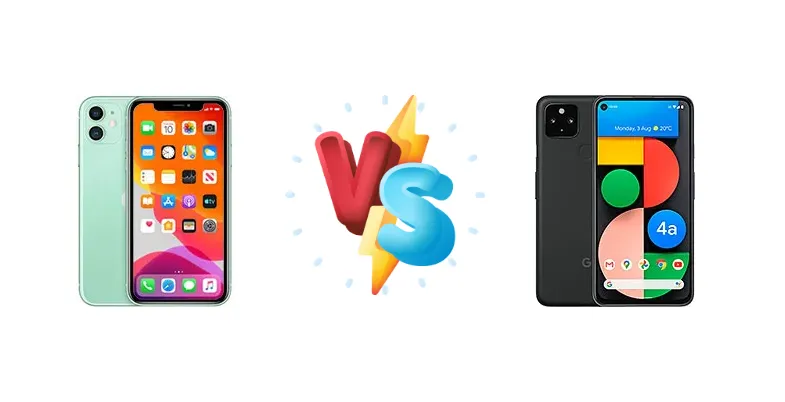
|
🏆 Quick Verdict
For most users, the iPhone 11 offers a more polished experience and superior long-term software support. Its A13 Bionic chip still delivers excellent performance, and the 94-hour endurance rating is impressive. However, the Pixel 4a 5G is a strong value proposition for those prioritizing 5G and Google’s computational photography.
| PHONES | ||
|---|---|---|
| Phone Names | Apple iPhone 11 | Google Pixel 4a 5G |
| Network | ||
|---|---|---|
| 2G bands | GSM 850 / 900 / 1800 / 1900 | GSM 850 / 900 / 1800 / 1900 |
| 3G bands | HSDPA 850 / 900 / 1700(AWS) / 1900 / 2100 | HSDPA 850 / 900 / 1700(AWS) / 1900 / 2100 |
| 4G bands | 1, 2, 3, 4, 5, 7, 8, 11, 12, 13, 17, 18, 19, 20, 21, 25, 26, 28, 29, 30, 32, 34, 38, 39, 40, 41, 42, 46, 48, 66 - A2221 | 1, 2, 3, 4, 5, 7, 8, 12, 13, 14, 17, 18, 19, 20, 25, 26, 28, 29, 30, 32, 38, 39, 40, 41, 42, 46, 48, 66, 71 |
| 5G bands | - | 1, 2, 3, 5, 7, 8, 12, 28, 41, 66, 71, 77, 78 Sub6, mmWave (market dependant) |
| Speed | HSPA 42.2/5.76 Mbps, LTE Cat16 1024/150 Mbps, EV-DO Rev.A 3.1 Mbps | HSPA, LTE, 5G |
| Technology | GSM / CDMA / HSPA / EVDO / LTE | GSM / HSPA / LTE / 5G |
| 1, 2, 3, 4, 5, 7, 8, 12, 13, 14, 17, 18, 19, 20, 25, 26, 29, 30, 34, 38, 39, 40, 41, 42, 46, 48, 66, 71 - A2111, A2223 | - | |
| Launch | ||
|---|---|---|
| Announced | 2019, September 10 | 2020, September 30 |
| Status | Available. Released 2019, September 20 | Available. Released 2020, November 05 |
| Body | ||
|---|---|---|
| Build | Glass front (Corning-made glass), glass back (Corning-made glass), aluminum frame (7000 series) | Glass front (Gorilla Glass 3), plastic back, plastic frame |
| Dimensions | 150.9 x 75.7 x 8.3 mm (5.94 x 2.98 x 0.33 in) | 153.9 x 74 x 8.2 mm (Sub-6) or 8.5 mm (Sub-6 and mmWave) |
| SIM | · Nano-SIM + eSIM· Nano-SIM + Nano-SIM (China) | Nano-SIM + eSIM |
| Weight | 194 g (6.84 oz) | 168 g (5G Sub-6); 171 g ( 5G Sub-6 and mmWave) (5.93 oz) |
| IP68 dust/water resistant (up to 2m for 30 min) Apple Pay (Visa, MasterCard, AMEX certified) | - | |
| Display | ||
|---|---|---|
| Protection | Scratch-resistant glass | Corning Gorilla Glass 3 |
| Resolution | 828 x 1792 pixels, 19.5:9 ratio (~326 ppi density) | 1080 x 2340 pixels, 19.5:9 ratio (~413 ppi density) |
| Size | 6.1 inches, 90.3 cm2 (~79.0% screen-to-body ratio) | 6.2 inches, 95.7 cm2 (~84.1% screen-to-body ratio) |
| Type | Liquid Retina IPS LCD, 625 nits (typ) | OLED, HDR |
| - | Always-on display | |
| Platform | ||
|---|---|---|
| CPU | Hexa-core (2x2.65 GHz Lightning + 4x1.8 GHz Thunder) | Octa-core (1x2.4 GHz Kryo 475 Prime & 1x2.2 GHz Kryo 475 Gold & 6x1.8 GHz Kryo 475 Silver) |
| Chipset | Apple A13 Bionic (7 nm+) | Qualcomm SM7250 Snapdragon 765G 5G (7 nm) |
| GPU | Apple GPU (4-core graphics) | Adreno 620 |
| OS | iOS 13, upgradable to iOS 26.1 | Android 11, upgradable to Android 14 |
| Memory | ||
|---|---|---|
| Card slot | No | No |
| Internal | 64GB 4GB RAM, 128GB 4GB RAM, 256GB 4GB RAM | 128GB 6GB RAM |
| NVMe | UFS 2.1 | |
| Main Camera | ||
|---|---|---|
| Dual | 12 MP, f/1.8, 26mm (wide), 1/2.55", 1.4µm, dual pixel PDAF, OIS 12 MP, f/2.4, 120˚, 13mm (ultrawide), 1/3.6" | 12.2 MP, f/1.7, 27mm (wide), 1/2.55", 1.4µm, dual pixel PDAF, OIS 16 MP, f/2.2, 107˚ (ultrawide), 1.0µm |
| Features | Dual-LED dual-tone flash, HDR (photo/panorama) | LED flash, Pixel Shift, Auto-HDR, panorama |
| Video | 4K@24/25/30/60fps, 1080p@25/30/60/120/240fps, HDR, stereo sound rec. | 4K@30/60fps, 1080p@30/60/120/240fps; gyro-EIS |
| Selfie camera | ||
|---|---|---|
| Features | HDR | HDR |
| Single | 12 MP, f/2.2, 23mm (wide), 1/3.6", 1.0µm SL 3D, (depth/biometrics sensor) | 8 MP, f/2.0, 24mm (wide), 1/4.0", 1.12µm |
| Video | 4K@24/25/30/60fps, 1080p@25/30/60/120fps, gyro-EIS | 1080p@30fps |
| Sound | ||
|---|---|---|
| 3.5mm jack | No | Yes |
| 35mm jack | No | Yes |
| Loudspeaker | Yes, with stereo speakers | Yes, with stereo speakers |
| Comms | ||
|---|---|---|
| Bluetooth | 5.0, A2DP, LE | 5.0, A2DP, LE, aptX HD |
| NFC | Yes | Yes |
| Positioning | GPS, GLONASS, GALILEO, QZSS | GPS, GLONASS, GALILEO, QZSS, BDS |
| Radio | No | No |
| USB | Lightning, USB 2.0 | USB Type-C 3.1 |
| WLAN | Wi-Fi 802.11 a/b/g/n/ac/6, dual-band, hotspot | Wi-Fi 802.11 a/b/g/n/ac, dual-band, Wi-Fi Direct |
| Features | ||
|---|---|---|
| Sensors | Face ID, accelerometer, gyro, proximity, compass, barometer | Fingerprint (rear-mounted), accelerometer, gyro, proximity, compass, barometer |
| Ultra Wideband (UWB) support | - | |
| Battery | ||
|---|---|---|
| Charging | Wired, PD2.0, 50% in 30 min Wireless (Qi) | 18W wired, PD2.0 |
| Type | Li-Ion 3110 mAh, non-removable (11.91 Wh) | Li-Po 3885 mAh |
| Misc | ||
|---|---|---|
| Colors | Black, Green, Yellow, Purple, Red, White | Just Black, Clearly White |
| Models | A2221, A2111, A2223, iPhone12,1 | GD1YQ, G025I, G025E, G025H, G6QU3 |
| Price | $ 167.50 / C$ 228.68 / £ 175.00 / € 193.32 | About 140 EUR |
| SAR | 1.09 W/kg (head) 1.18 W/kg (body) | - |
| SAR EU | 0.95 W/kg (head) 0.99 W/kg (body) | - |
| Pricing | ||
|---|---|---|
| 128GB 4GB RAM | $ 359.95 | - |
| 256GB 4GB RAM | $ 469.99 | - |
| 64GB 4GB RAM | $ 292.79 | - |
| RENEWED | £ 214.00 | - |
| Tests | ||
|---|---|---|
| Audio quality | Noise -94.2dB / Crosstalk -80.8dB | - |
| Battery life | Endurance rating 94h | - |
| Camera | Photo / Video | - |
| Display | Contrast ratio: 1505:1 (nominal) | - |
| Loudspeaker | Voice 70dB / Noise 72dB / Ring 76dB | - |
| Performance | AnTuTu: 419453 (v7) GeekBench: 13882 (v4.4) GFXBench: 60fps (ES 3.1 onscreen) | - |
Apple iPhone 11
- Exceptional performance with the A13 Bionic chip
- Long-lasting battery life (94h endurance)
- Strong resale value and software support
- Qi wireless charging support
- LCD display lacks the vibrancy of OLED
- Older design compared to newer smartphones
Google Pixel 4a 5G
- 5G connectivity for faster data speeds
- Google’s excellent computational photography
- Clean Android experience with timely updates
- Larger display size (6.2 inches)
- Less powerful processor than the A13 Bionic
- Slower charging speeds (18W)
Display Comparison
The iPhone 11 features a 6.1-inch LCD with a measured peak brightness of 644 nits and a 1505:1 contrast ratio. While adequate, it lacks the vibrancy and efficiency of modern OLED panels. The Pixel 4a 5G’s display specifications aren’t provided, but given its price point, it likely utilizes a similar LCD technology. The iPhone 11’s higher contrast ratio will result in deeper blacks and a more visually appealing image, but the Pixel 4a 5G’s larger screen size (6.2 inches) may be preferable for media consumption. Both lack high refresh rate technology.
Camera Comparison
Both phones excel in photography, but approach it differently. The iPhone 11’s camera system is capable of both excellent photos and videos, leveraging Apple’s image processing. The Pixel 4a 5G relies heavily on Google’s computational photography algorithms, particularly its HDR+ technology, to produce stunning images, especially in low light. Without specific sensor details for the Pixel 4a 5G, it’s difficult to make a direct comparison, but Google’s software prowess often compensates for hardware limitations. The iPhone 11’s video recording capabilities are generally considered superior due to its more advanced stabilization and dynamic range.
Performance
The iPhone 11’s Apple A13 Bionic (7nm+) chip remains a performance powerhouse. Its hexa-core CPU, with two high-performance Lightning cores clocked at 2.65 GHz and four efficiency Thunder cores, delivers exceptional speed. The Pixel 4a 5G utilizes the Qualcomm Snapdragon 765G (7nm), an octa-core processor designed for 5G connectivity. While capable, the Snapdragon 765G is demonstrably less powerful than the A13 Bionic, particularly in sustained workloads. The A13’s superior architecture translates to faster app loading times and smoother multitasking. The iPhone 11’s 4GB of RAM is matched by the Pixel 4a 5G, but the A13’s efficiency allows it to manage memory more effectively.
Battery Life
The iPhone 11 boasts an impressive endurance rating of 94 hours, indicating exceptional battery life. While the exact battery capacity isn’t specified, this rating suggests efficient power management combined with the A13 Bionic’s optimization. The Pixel 4a 5G’s battery capacity is also not provided, but its 18W wired charging is slower than the iPhone 11’s PD2.0 charging, which can reach 50% in 30 minutes. The iPhone 11 also supports Qi wireless charging, a feature absent on the Pixel 4a 5G. The iPhone 11’s longer endurance is a significant advantage for users who prioritize all-day battery life.
Buying Guide
Buy the Apple iPhone 11 if you need a device with proven longevity, a robust app ecosystem, and consistently strong performance across all tasks. It’s ideal for users heavily invested in the Apple ecosystem or those who value resale value. Buy the Google Pixel 4a 5G if you prioritize 5G connectivity, a clean Android experience, and Google’s exceptional camera processing, especially if you frequently capture photos in challenging lighting conditions.