
iPhone 11 Pro vs Xiaomi Mi 9T Pro: A Detailed Comparison of Two 2019 Flagships
| Phones Images | |||||
|---|---|---|---|---|---|
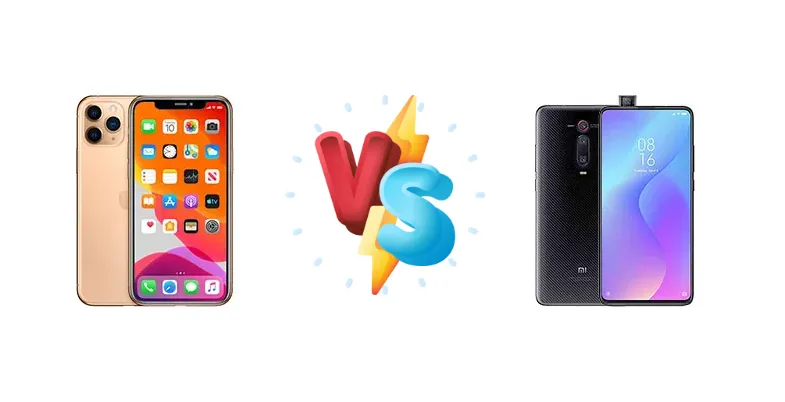
|
🏆 Quick Verdict
For the average user prioritizing longevity and a polished software experience, the iPhone 11 Pro remains a strong contender. However, the Xiaomi Mi 9T Pro delivers superior battery life – a 27-hour advantage – and faster charging, making it the better choice for power users and those frequently away from a charger.
| PHONES | ||
|---|---|---|
| Phone Names | Apple iPhone 11 Pro | Xiaomi Mi 9T Pro |
| Network | ||
|---|---|---|
| 2G bands | GSM 850 / 900 / 1800 / 1900 | GSM 850 / 900 / 1800 / 1900 |
| 3G bands | HSDPA 850 / 900 / 1700(AWS) / 1900 / 2100 | HSDPA 850 / 900 / 1700(AWS) / 1900 / 2100 |
| 4G bands | 1, 2, 3, 4, 5, 7, 8, 11, 12, 13, 17, 18, 19, 20, 21, 25, 26, 28, 29, 30, 32, 34, 38, 39, 40, 41, 42, 46, 48, 66 - A2215 | 1, 2, 3, 4, 5, 7, 8, 20, 28, 38, 40 |
| Speed | HSPA, LTE 1.6 Gbps DL, EV-DO Rev.A 3.1 Mbps | HSPA, LTE |
| Technology | GSM / CDMA / HSPA / EVDO / LTE | GSM / HSPA / LTE |
| 1, 2, 3, 4, 5, 7, 8, 12, 13, 14, 17, 18, 19, 20, 25, 26, 29, 30, 34, 38, 39, 40, 41, 42, 46, 48, 66, 71 - A2160, A2217 | - | |
| Launch | ||
|---|---|---|
| Announced | 2019, September 10 | 2019, August 21. Released 2019, August 21 |
| Status | Available. Released 2019, September 20 | Discontinued |
| Body | ||
|---|---|---|
| Build | Glass front (Corning-made glass), glass back (Corning-made glass), stainless steel frame | Glass front (Gorilla Glass 5), glass back (Gorilla Glass 5), aluminum frame |
| Dimensions | 144 x 71.4 x 8.1 mm (5.67 x 2.81 x 0.32 in) | 156.7 x 74.3 x 8.8 mm (6.17 x 2.93 x 0.35 in) |
| SIM | · Nano-SIM + eSIM· Nano-SIM + Nano-SIM (China) | Nano-SIM + Nano-SIM |
| Weight | 188 g (6.63 oz) | 191 g (6.74 oz) |
| IP68 dust/water resistant (up to 4m for 30 min) Apple Pay (Visa, MasterCard, AMEX certified) | - | |
| Display | ||
|---|---|---|
| Protection | Scratch-resistant glass | Corning Gorilla Glass 5 |
| Resolution | 1125 x 2436 pixels, 19.5:9 ratio (~458 ppi density) | 1080 x 2340 pixels, 19.5:9 ratio (~403 ppi density) |
| Size | 5.8 inches, 84.4 cm2 (~82.1% screen-to-body ratio) | 6.39 inches, 100.2 cm2 (~86.1% screen-to-body ratio) |
| Type | Super Retina XDR OLED, HDR10, Dolby Vision, 800 nits (HBM), 1200 nits (peak) | Super AMOLED, HDR |
| Platform | ||
|---|---|---|
| CPU | Hexa-core (2x2.65 GHz Lightning + 4x1.8 GHz Thunder) | Octa-core (1x2.84 GHz Kryo 485 & 3x2.42 GHz Kryo 485 & 4x1.78 GHz Kryo 485) |
| Chipset | Apple A13 Bionic (7 nm+) | Qualcomm SM8150 Snapdragon 855 (7 nm) |
| GPU | Apple GPU (4-core graphics) | Adreno 640 |
| OS | iOS 13, upgradable to iOS 26.1 | Android 9.0 (Pie), upgradable to Android 11, MIUI 12.5 |
| Memory | ||
|---|---|---|
| Card slot | No | No |
| Internal | 64GB 4GB RAM, 256GB 4GB RAM, 512GB 4GB RAM | 64GB 6GB RAM, 128GB 6GB RAM, 256GB 8GB RAM |
| NVMe | UFS 2.1 | |
| Main Camera | ||
|---|---|---|
| Features | Dual-LED dual-tone flash, HDR (photo/panorama) | Laser AF, Dual-LED flash, HDR, panorama |
| Single | 8 MP, f/2.0, AF | - |
| Triple | 12 MP, f/1.8, 26mm (wide), 1/2.55", 1.4µm, dual pixel PDAF, OIS 12 MP, f/2.0, 52mm (telephoto), 1/3.4", 1.0µm, PDAF, OIS, 2x optical zoom 12 MP, f/2.4, 120˚, 13mm (ultrawide), 1/3.6" | 48 MP, f/1.8, 26mm (wide), 1/2.0", 0.8µm, PDAF 8 MP, f/2.4, 53mm (telephoto), 1/4.0", 1.12µm, PDAF, 2x optical zoom 13 MP, f/2.4, 12mm (ultrawide), 1/3.1", 1.12µm |
| Video | 4K@24/25/30/60fps, 1080p@25/30/60/120/240fps, HDR, stereo sound rec. | 4K@30/60fps, 1080p@30/120/240fps, 1080p@960fps |
| Selfie camera | ||
|---|---|---|
| Features | HDR | HDR |
| Single | 12 MP, f/2.2, 23mm (wide), 1/3.6", 1.0µm SL 3D, (depth/biometrics sensor) | Motorized pop-up 20 MP, f/2.2, (wide), 1/3.4", 0.8µm |
| Video | 4K@24/25/30/60fps, 1080p@25/30/60/120fps, gyro-EIS | 1080p@30fps |
| Sound | ||
|---|---|---|
| 3.5mm jack | No | Yes |
| 35mm jack | No | Yes |
| Loudspeaker | Yes, with stereo speakers | Yes |
| - | 24-bit/192kHz audio | |
| Comms | ||
|---|---|---|
| Bluetooth | 5.0, A2DP, LE | 5.0, A2DP, LE, aptX HD |
| NFC | Yes | Yes |
| Positioning | GPS, GLONASS, GALILEO, QZSS | GPS (L1+L5), GLONASS (G1), BDS (B1), GALILEO (E1+E5a) |
| Radio | No | Yes |
| USB | Lightning, USB 2.0 | USB Type-C 2.0, OTG |
| WLAN | Wi-Fi 802.11 a/b/g/n/ac/6, dual-band, hotspot | Wi-Fi 802.11 a/b/g/n/ac, dual-band, Wi-Fi Direct |
| Features | ||
|---|---|---|
| Sensors | Face ID, accelerometer, gyro, proximity, compass, barometer | Fingerprint (under display, optical), accelerometer, gyro, proximity, compass |
| Ultra Wideband (UWB) support | - | |
| Battery | ||
|---|---|---|
| Charging | Wired, PD2.0, 50% in 30 min Wireless (Qi) | 27W wired, QC4 |
| Stand-by | Up to 353 h (3G) | - |
| Talk time | Up to 18 h 30 min (3G) | - |
| Type | Li-Ion 3046 mAh, non-removable (11.67 Wh) | Li-Po 4000 mAh, non-removable |
| Misc | ||
|---|---|---|
| Colors | Matte Space Gray, Matte Silver, Matte Gold, Matte Midnight Green | Carbon black, Red flame, Glacier blue |
| Models | A2215, A2160, A2217, iPhone12,3 | M1903F11G |
| Price | About 240 EUR | About 150 EUR |
| SAR | 1.18 W/kg (head) 1.16 W/kg (body) | 1.03 W/kg (head) 0.72 W/kg (body) |
| SAR EU | 0.99 W/kg (head) 0.99 W/kg (body) | 1.30 W/kg (head) 1.51 W/kg (body) |
| Tests | ||
|---|---|---|
| Audio quality | Noise -94.2dB / Crosstalk -81.0dB | Noise -93.9dB / Crosstalk -94.2dB |
| Battery life | Endurance rating 86h | Endurance rating 103h |
| Camera | Photo / Video | - |
| Display | Contrast ratio: Infinite (nominal) | Contrast ratio: Infinite (nominal) |
| Loudspeaker | -24.3 LUFS (Very good) | -26.9 LUFS (Good) |
| Performance | AnTuTu: 460784 (v7) GeekBench: 13829 (v4.4) GFXBench: 57fps (ES 3.1 onscreen) | AnTuTu: 368846 (v7), 437823 (v8) GeekBench: 10684 (v4.4), 2732 (v5.1) GFXBench: 36fps (ES 3.1 onscreen) |
Apple iPhone 11 Pro
- Superior single-core performance with the A13 Bionic.
- Excellent video recording capabilities.
- Polished iOS ecosystem and software support.
- Shorter battery life compared to the Mi 9T Pro.
- Slower charging speeds.
- Higher initial cost (even now).
Xiaomi Mi 9T Pro
- Significantly longer battery life (103h endurance).
- Faster 27W wired charging with QC4.
- More affordable price point.
- A13 Bionic offers superior single-core performance.
- Android software experience may not appeal to all users.
- Potentially less refined camera image processing.
Display Comparison
Both the iPhone 11 Pro and Mi 9T Pro feature displays with an 'Infinite' contrast ratio, indicating excellent black levels. However, the iPhone 11 Pro boasts a measured peak brightness of 805 nits, suggesting superior visibility in direct sunlight compared to the Mi 9T Pro (brightness data unavailable). While both likely utilize OLED technology, Apple’s display benefits from its color calibration and potentially wider color gamut, though without specific data on the Mi 9T Pro’s color accuracy, a definitive statement is difficult. The lack of high refresh rate support on either device is a notable omission by today’s standards.
Camera Comparison
Both phones are listed as having 'Photo / Video' capabilities, but lack specific sensor details. Given Apple’s historical emphasis on computational photography and video quality, the iPhone 11 Pro likely excels in video recording, offering features like Cinematic Mode (though not available on the 11 Pro initially). The Mi 9T Pro, while capable, likely focuses on delivering versatile camera options at a competitive price. Without sensor size or aperture information, a direct comparison is limited, but Apple’s image processing pipeline is generally known for its natural-looking results, while Xiaomi often leans towards more saturated colors.
Performance
The Apple A13 Bionic, fabricated on a 7nm+ process, employs a hexa-core architecture with two high-performance 'Lightning' cores clocked at 2.65 GHz and four efficiency cores ('Thunder') at 1.8 GHz. This contrasts with the Qualcomm Snapdragon 855 (7nm) in the Mi 9T Pro, which utilizes an octa-core configuration. While the Snapdragon 855’s core count is higher, the A13 Bionic’s architectural advantages and tighter software integration generally translate to superior single-core performance and optimized power efficiency. The A13’s Neural Engine also provides a significant edge in machine learning tasks. While the Snapdragon 855 is capable, the A13 Bionic offers a more refined and consistently powerful experience.
Battery Life
The Xiaomi Mi 9T Pro significantly outperforms the iPhone 11 Pro in battery endurance, achieving a rating of 103 hours versus the iPhone’s 86 hours. This 17-hour difference is substantial and highlights the Mi 9T Pro’s advantage. Furthermore, the Mi 9T Pro supports 27W wired charging with Quick Charge 4 (QC4) technology, allowing for faster charging speeds than the iPhone 11 Pro’s 50% charge in 30 minutes via PD2.0. While both support wireless charging (Qi), the Mi 9T Pro’s faster wired charging and larger battery capacity make it the clear winner for users prioritizing battery life and convenience.
Buying Guide
Buy the Apple iPhone 11 Pro if you need a seamless iOS experience, prioritize video recording quality, and value Apple’s ecosystem integration. Buy the Xiaomi Mi 9T Pro if you prefer longer battery life, faster charging speeds, and a more customizable Android experience, all while staying within a tighter budget.