
iPhone 11 Pro vs LG V50 ThinQ 5G: A Detailed Comparison of Flagship Features
| Phones Images | |||||
|---|---|---|---|---|---|
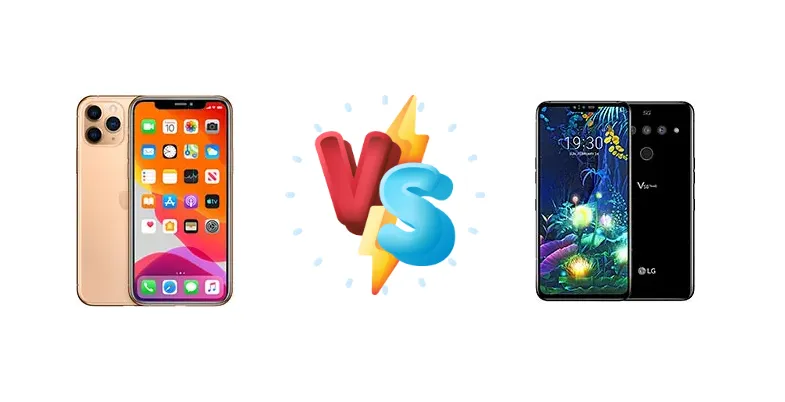
|
🏆 Quick Verdict
For the average user prioritizing longevity and consistent performance, the LG V50 ThinQ 5G emerges as the better choice. Its significantly higher endurance rating of 96 hours, compared to the iPhone 11 Pro’s 86 hours, provides a tangible benefit. However, the iPhone 11 Pro’s superior display brightness and tightly integrated ecosystem remain compelling advantages.
| PHONES | ||
|---|---|---|
| Phone Names | Apple iPhone 11 Pro | LG V50 ThinQ 5G |
| Network | ||
|---|---|---|
| 2G bands | GSM 850 / 900 / 1800 / 1900 | GSM 850 / 900 / 1800 / 1900 |
| 3G bands | HSDPA 850 / 900 / 1700(AWS) / 1900 / 2100 | HSDPA 850 / 900 / 1700(AWS) / 1900 / 2100 - USA |
| 4G bands | 1, 2, 3, 4, 5, 7, 8, 11, 12, 13, 17, 18, 19, 20, 21, 25, 26, 28, 29, 30, 32, 34, 38, 39, 40, 41, 42, 46, 48, 66 - A2215 | 1, 2, 3, 4, 5, 7, 8, 12, 13, 17, 20, 25, 26, 28, 40, 41, 46, 66, 71 - USA |
| 5G bands | - | 41, 260, 261 NSA |
| Speed | HSPA, LTE 1.6 Gbps DL, EV-DO Rev.A 3.1 Mbps | HSPA 42.2/5.76 Mbps, LTE (6CA) Cat18 1200/75 Mbps, 5G (2+ Gbps DL) |
| Technology | GSM / CDMA / HSPA / EVDO / LTE | GSM / CDMA / HSPA / EVDO / LTE / 5G |
| 1, 2, 3, 4, 5, 7, 8, 12, 13, 14, 17, 18, 19, 20, 25, 26, 29, 30, 34, 38, 39, 40, 41, 42, 46, 48, 66, 71 - A2160, A2217 | CDMA2000 1xEV-DO | |
| Launch | ||
|---|---|---|
| Announced | 2019, September 10 | 2019, February 24. Released 2019, April 19 |
| Status | Available. Released 2019, September 20 | Discontinued |
| Body | ||
|---|---|---|
| Build | Glass front (Corning-made glass), glass back (Corning-made glass), stainless steel frame | Glass front (Gorilla Glass 5), glass back (Gorilla Glass 6), aluminum frame |
| Dimensions | 144 x 71.4 x 8.1 mm (5.67 x 2.81 x 0.32 in) | 159.2 x 76.1 x 8.3 mm (6.27 x 3.00 x 0.33 in) |
| SIM | · Nano-SIM + eSIM· Nano-SIM + Nano-SIM (China) | · Nano-SIM· Nano-SIM + Nano-SIM |
| Weight | 188 g (6.63 oz) | 183 g (6.46 oz) |
| IP68 dust/water resistant (up to 4m for 30 min) Apple Pay (Visa, MasterCard, AMEX certified) | IP68 dust/water resistant (up to 1.5m for 30 min) MIL-STD-810G compliant* *does not guarantee ruggedness or use in extreme conditions | |
| Display | ||
|---|---|---|
| Protection | Scratch-resistant glass | Corning Gorilla Glass 5 |
| Resolution | 1125 x 2436 pixels, 19.5:9 ratio (~458 ppi density) | 1440 x 3120 pixels, 19.5:9 ratio (~538 ppi density) |
| Size | 5.8 inches, 84.4 cm2 (~82.1% screen-to-body ratio) | 6.4 inches, 100.2 cm2 (~82.7% screen-to-body ratio) |
| Type | Super Retina XDR OLED, HDR10, Dolby Vision, 800 nits (HBM), 1200 nits (peak) | P-OLED, HDR10 |
| - | Always-on display | |
| Platform | ||
|---|---|---|
| CPU | Hexa-core (2x2.65 GHz Lightning + 4x1.8 GHz Thunder) | Octa-core (1x2.84 GHz Kryo 485 & 3x2.42 GHz Kryo 485 & 4x1.78 GHz Kryo 485) |
| Chipset | Apple A13 Bionic (7 nm+) | Qualcomm SM8150 Snapdragon 855 (7 nm) |
| GPU | Apple GPU (4-core graphics) | Adreno 640 |
| OS | iOS 13, upgradable to iOS 26.1 | Android 9.0 (Pie), upgradable to Android 11 |
| Memory | ||
|---|---|---|
| Card slot | No | microSDXC (dedicated slot) |
| Internal | 64GB 4GB RAM, 256GB 4GB RAM, 512GB 4GB RAM | 128GB 6GB RAM |
| NVMe | UFS 2.1 | |
| Main Camera | ||
|---|---|---|
| Features | Dual-LED dual-tone flash, HDR (photo/panorama) | LED flash, HDR, panorama |
| Single | 8 MP, f/2.0, AF | - |
| Triple | 12 MP, f/1.8, 26mm (wide), 1/2.55", 1.4µm, dual pixel PDAF, OIS 12 MP, f/2.0, 52mm (telephoto), 1/3.4", 1.0µm, PDAF, OIS, 2x optical zoom 12 MP, f/2.4, 120˚, 13mm (ultrawide), 1/3.6" | 12 MP, 27mm (wide), f/1.5, 1/2.55", 1.4µm, dual pixel PDAF, 3-axis OIS 12 MP, 52mm (telephoto), f/2.4, 1/3.4", 1.0µm, 2x optical zoom, PDAF, OIS 16 MP, 16mm (ultrawide), f/1.9, 1/3.1", 1.0µm, no AF |
| Video | 4K@24/25/30/60fps, 1080p@25/30/60/120/240fps, HDR, stereo sound rec. | 4K@30/60fps, 1080p@30/60/240fps, 24-bit/192kHz stereo sound rec., HDR10 video, gyro-EIS |
| Selfie camera | ||
|---|---|---|
| Dual | - | 8 MP, f/1.9, 26mm (wide), 1/4.0", 1.12µm 5 MP, 21mm (wide), f/2.2, 1/5.0", 1.12µm |
| Features | HDR | HDR |
| Single | 12 MP, f/2.2, 23mm (wide), 1/3.6", 1.0µm SL 3D, (depth/biometrics sensor) | - |
| Video | 4K@24/25/30/60fps, 1080p@25/30/60/120fps, gyro-EIS | 1080p@60fps |
| Sound | ||
|---|---|---|
| 3.5mm jack | No | Yes |
| 35mm jack | No | Yes |
| Loudspeaker | Yes, with stereo speakers | Yes, with stereo speakers |
| - | 32-bit/192kHz audio 24-bit/192kHz audio recording Tuned with Meridian Audio | |
| Comms | ||
|---|---|---|
| Bluetooth | 5.0, A2DP, LE | 5.0, A2DP, LE, aptX HD |
| NFC | Yes | Yes |
| Positioning | GPS, GLONASS, GALILEO, QZSS | GPS, GLONASS, GALILEO |
| Radio | No | FM radio |
| USB | Lightning, USB 2.0 | USB Type-C 3.1 |
| WLAN | Wi-Fi 802.11 a/b/g/n/ac/6, dual-band, hotspot | Wi-Fi 802.11 a/b/g/n/ac, dual-band, Wi-Fi Direct, DLNA |
| Features | ||
|---|---|---|
| Sensors | Face ID, accelerometer, gyro, proximity, compass, barometer | Fingerprint (rear-mounted), accelerometer, gyro, proximity, compass, barometer |
| Ultra Wideband (UWB) support | - | |
| Battery | ||
|---|---|---|
| Charging | Wired, PD2.0, 50% in 30 min Wireless (Qi) | 18W wired, PD2.0, QC3, 50% in 36 min 10W wireless (Qi) |
| Stand-by | Up to 353 h (3G) | - |
| Talk time | Up to 18 h 30 min (3G) | - |
| Type | Li-Ion 3046 mAh, non-removable (11.67 Wh) | Li-Po 4000 mAh, non-removable |
| Misc | ||
|---|---|---|
| Colors | Matte Space Gray, Matte Silver, Matte Gold, Matte Midnight Green | New Aurora Black |
| Models | A2215, A2160, A2217, iPhone12,3 | LM-V500, LM-V500N, LM-V500EM, LM-V500XM, LM-V450PM, LM-V450 |
| Price | About 240 EUR | About 550 EUR |
| SAR | 1.18 W/kg (head) 1.16 W/kg (body) | - |
| SAR EU | 0.99 W/kg (head) 0.99 W/kg (body) | - |
| Tests | ||
|---|---|---|
| Audio quality | Noise -94.2dB / Crosstalk -81.0dB | Noise -92.5dB / Crosstalk -92.6dB |
| Battery life | Endurance rating 86h | Endurance rating 96h |
| Camera | Photo / Video | Photo / Video |
| Display | Contrast ratio: Infinite (nominal) | Contrast ratio: 194000:1 (nominal) |
| Loudspeaker | -24.3 LUFS (Very good) | -25.2 LUFS (Very good) |
| Performance | AnTuTu: 460784 (v7) GeekBench: 13829 (v4.4) GFXBench: 57fps (ES 3.1 onscreen) | AnTuTu: 343758 (v7), 421934 (v8) GeekBench: 10928 (v4.4), 2672 (v5.1) GFXBench: 22fps (ES 3.1 onscreen) |
Apple iPhone 11 Pro
- Brighter display for outdoor visibility
- More efficient processor (A13 Bionic)
- Seamless Apple ecosystem integration
- Lower battery endurance (86h)
- Less contrast on the display
- Potentially higher repair costs
LG V50 ThinQ 5G
- Superior battery life (96h)
- Higher display contrast ratio
- 5G connectivity
- Dimmer display in bright sunlight
- Slower wired charging
- Android fragmentation and update delays
Display Comparison
The LG V50 ThinQ 5G boasts a contrast ratio of 194000:1, significantly exceeding the iPhone 11 Pro’s ‘infinite’ (nominal) ratio. This translates to deeper blacks and a more vibrant image, particularly in dark scenes. However, the iPhone 11 Pro counters with a measured peak brightness of 805 nits, substantially brighter than the V50’s 533 nits. This brightness advantage makes the iPhone 11 Pro far more usable in direct sunlight. While both utilize OLED technology, the V50’s higher contrast is noticeable, but the iPhone’s visibility is superior outdoors.
Camera Comparison
Both devices offer capable photo and video recording, but details differ. Without specific sensor size data, it’s difficult to make a definitive judgment. However, Apple’s image processing is known for its natural color reproduction and dynamic range, while LG often leans towards more saturated colors. The absence of detailed camera specs necessitates focusing on the overall ecosystem; Apple’s computational photography benefits from tight hardware-software integration. The LG V50’s 5G capabilities could facilitate faster uploads of high-resolution photos and videos.
Performance
The Apple A13 Bionic, fabricated on a 7nm+ process, features a hexa-core CPU configuration, while the LG V50 utilizes the Qualcomm Snapdragon 855 (7nm) with an octa-core CPU. While core count differs, real-world performance is nuanced. The A13’s architecture prioritizes single-core performance, leading to snappier app launches and smoother overall responsiveness. The Snapdragon 855, however, excels in multi-threaded tasks. Both chipsets are capable, but the A13’s efficiency contributes to the iPhone 11 Pro’s overall system stability. The V50’s 5G modem adds a layer of complexity, potentially impacting thermal management during sustained 5G usage.
Battery Life
The LG V50 ThinQ 5G clearly wins in battery endurance, achieving a measured 96 hours compared to the iPhone 11 Pro’s 86 hours. This 10-hour advantage is significant for users who heavily utilize their smartphones. While both support PD2.0 and Qi wireless charging, the V50’s 18W wired charging (50% in 36 minutes) is slightly slower than the iPhone 11 Pro’s 50% in 30 minutes. However, the V50’s larger battery capacity offsets this charging speed difference, providing longer overall usage.
Buying Guide
Buy the Apple iPhone 11 Pro if you need a compact, highly polished smartphone experience with a bright, color-accurate display and seamless integration with the Apple ecosystem. Buy the LG V50 ThinQ 5G if you prioritize maximum battery life, 5G connectivity, and a higher contrast display, and are comfortable with Android's customization options.