
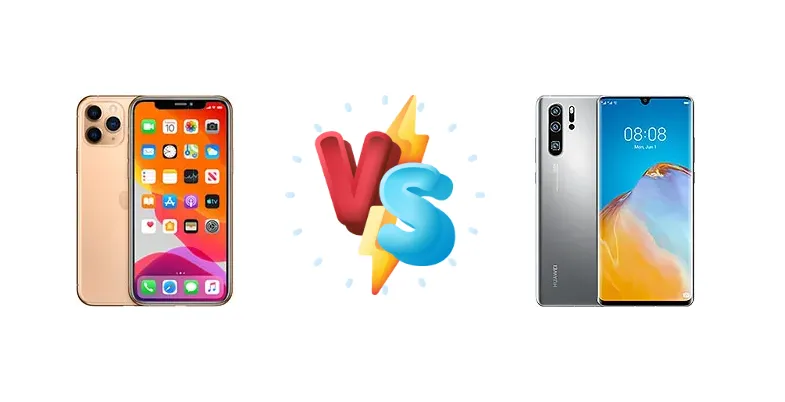
iPhone 11 Pro vs Huawei P30 Pro New Edition: Which Flagship Still Holds Up?
| Phones Images | |||||
|---|---|---|---|---|---|
|
🏆 Quick Verdict
For the average user in 2024, the iPhone 11 Pro emerges as the stronger choice. Its enduring software support, coupled with the efficient A13 Bionic chip, provides a smoother and more secure experience. While the P30 Pro New Edition boasts faster charging, the iPhone’s overall package is more compelling.
| PHONES | ||
|---|---|---|
| Phone Names | Apple iPhone 11 Pro | Huawei P30 Pro New Edition |
| Network | ||
|---|---|---|
| 2G bands | GSM 850 / 900 / 1800 / 1900 | GSM 850 / 900 / 1800 / 1900 |
| 3G bands | HSDPA 850 / 900 / 1700(AWS) / 1900 / 2100 | HSDPA 800 / 850 / 900 / 1700(AWS) / 1900 / 2100 |
| 4G bands | 1, 2, 3, 4, 5, 7, 8, 11, 12, 13, 17, 18, 19, 20, 21, 25, 26, 28, 29, 30, 32, 34, 38, 39, 40, 41, 42, 46, 48, 66 - A2215 | LTE |
| Speed | HSPA, LTE 1.6 Gbps DL, EV-DO Rev.A 3.1 Mbps | HSPA 42.2/5.76 Mbps, LTE Cat21 1400/200 Mbps |
| Technology | GSM / CDMA / HSPA / EVDO / LTE | GSM / HSPA / LTE |
| 1, 2, 3, 4, 5, 7, 8, 12, 13, 14, 17, 18, 19, 20, 25, 26, 29, 30, 34, 38, 39, 40, 41, 42, 46, 48, 66, 71 - A2160, A2217 | - | |
| Launch | ||
|---|---|---|
| Announced | 2019, September 10 | 2020, May 12. Released 2020, June 01 |
| Status | Available. Released 2019, September 20 | Discontinued |
| Body | ||
|---|---|---|
| Build | Glass front (Corning-made glass), glass back (Corning-made glass), stainless steel frame | Glass front (Aluminosilicate glass), glass back (Aluminosilicate glass), aluminum frame |
| Dimensions | 144 x 71.4 x 8.1 mm (5.67 x 2.81 x 0.32 in) | 158 x 73.4 x 8.4 mm (6.22 x 2.89 x 0.33 in) |
| SIM | · Nano-SIM + eSIM· Nano-SIM + Nano-SIM (China) | · Nano-SIM· Nano-SIM + Nano-SIM |
| Weight | 188 g (6.63 oz) | 192 g (6.77 oz) |
| IP68 dust/water resistant (up to 4m for 30 min) Apple Pay (Visa, MasterCard, AMEX certified) | IP68 dust/water resistant (up to 2m for 30 mins) | |
| Display | ||
|---|---|---|
| Protection | Scratch-resistant glass | - |
| Resolution | 1125 x 2436 pixels, 19.5:9 ratio (~458 ppi density) | 1080 x 2340 pixels, 19.5:9 ratio (~398 ppi density) |
| Size | 5.8 inches, 84.4 cm2 (~82.1% screen-to-body ratio) | 6.47 inches, 102.8 cm2 (~88.6% screen-to-body ratio) |
| Type | Super Retina XDR OLED, HDR10, Dolby Vision, 800 nits (HBM), 1200 nits (peak) | OLED, HDR10 |
| Platform | ||
|---|---|---|
| CPU | Hexa-core (2x2.65 GHz Lightning + 4x1.8 GHz Thunder) | Octa-core (2x2.6 GHz Cortex-A76 & 2x1.92 GHz Cortex-A76 & 4x1.8 GHz Cortex-A55) |
| Chipset | Apple A13 Bionic (7 nm+) | Kirin 980 (7 nm) |
| GPU | Apple GPU (4-core graphics) | Mali-G76 MP10 |
| OS | iOS 13, upgradable to iOS 26.1 | Android 10, EMUI 10.1, Google Play Services |
| Memory | ||
|---|---|---|
| Card slot | No | Nano Memory (uses shared SIM slot) |
| Internal | 64GB 4GB RAM, 256GB 4GB RAM, 512GB 4GB RAM | 128GB 6GB RAM, 256GB 8GB RAM |
| NVMe | UFS 3.0 | |
| Main Camera | ||
|---|---|---|
| Features | Dual-LED dual-tone flash, HDR (photo/panorama) | Leica optics, color spectrum sensor, dual-LED dual-tone flash, panorama, HDR |
| Single | 8 MP, f/2.0, AF | - |
| Triple | 12 MP, f/1.8, 26mm (wide), 1/2.55", 1.4µm, dual pixel PDAF, OIS 12 MP, f/2.0, 52mm (telephoto), 1/3.4", 1.0µm, PDAF, OIS, 2x optical zoom 12 MP, f/2.4, 120˚, 13mm (ultrawide), 1/3.6" | 40 MP, f/1.6, 27mm (wide), 1/1.7", PDAF, OIS 8 MP, f/3.4, 125mm (periscope telephoto), 1/4.0", PDAF, OIS, 5x optical zoom, 10x hybrid zoom 20 MP, f/2.2, 16mm (ultrawide), 1/2.7", PDAF TOF 3D, (depth) |
| Video | 4K@24/25/30/60fps, 1080p@25/30/60/120/240fps, HDR, stereo sound rec. | 4K@30fps, 1080p@60fps, 1080p@30fps (gyro-EIS), 720p@960fps |
| Selfie camera | ||
|---|---|---|
| Features | HDR | HDR |
| Single | 12 MP, f/2.2, 23mm (wide), 1/3.6", 1.0µm SL 3D, (depth/biometrics sensor) | 32 MP, f/2.0, 26mm (wide), 1/2.8", 0.8µm |
| Video | 4K@24/25/30/60fps, 1080p@25/30/60/120fps, gyro-EIS | 1080p@30fps |
| Sound | ||
|---|---|---|
| 3.5mm jack | No | No |
| 35mm jack | No | No |
| Loudspeaker | Yes, with stereo speakers | Yes |
| - | 32-bit/384kHz audio | |
| Comms | ||
|---|---|---|
| Bluetooth | 5.0, A2DP, LE | 5.0, A2DP, aptX HD, LE |
| Infrared port | - | Yes |
| NFC | Yes | Yes |
| Positioning | GPS, GLONASS, GALILEO, QZSS | GPS (L1+L5), GLONASS (L1), BDS (B1), GALILEO (E1+E5a), QZSS (L1+L5) |
| Radio | No | No |
| USB | Lightning, USB 2.0 | USB Type-C 3.1 |
| WLAN | Wi-Fi 802.11 a/b/g/n/ac/6, dual-band, hotspot | Wi-Fi 802.11 a/b/g/n/ac, dual-band, Wi-Fi Direct |
| Features | ||
|---|---|---|
| Sensors | Face ID, accelerometer, gyro, proximity, compass, barometer | Fingerprint (under display, optical), accelerometer, gyro, proximity, compass |
| Ultra Wideband (UWB) support | - | |
| Battery | ||
|---|---|---|
| Charging | Wired, PD2.0, 50% in 30 min Wireless (Qi) | 40W wired, 70% in 30 min 15W wireless Reverse wireless |
| Stand-by | Up to 353 h (3G) | - |
| Talk time | Up to 18 h 30 min (3G) | - |
| Type | Li-Ion 3046 mAh, non-removable (11.67 Wh) | Li-Po 4200 mAh |
| Misc | ||
|---|---|---|
| Colors | Matte Space Gray, Matte Silver, Matte Gold, Matte Midnight Green | Aurora, Black, Silver Frost |
| Models | A2215, A2160, A2217, iPhone12,3 | - |
| Price | About 240 EUR | About 820 EUR |
| SAR | 1.18 W/kg (head) 1.16 W/kg (body) | - |
| SAR EU | 0.99 W/kg (head) 0.99 W/kg (body) | - |
| Tests | ||
|---|---|---|
| Audio quality | Noise -94.2dB / Crosstalk -81.0dB | - |
| Battery life | Endurance rating 86h | - |
| Camera | Photo / Video | - |
| Display | Contrast ratio: Infinite (nominal) | - |
| Loudspeaker | -24.3 LUFS (Very good) | - |
| Performance | AnTuTu: 460784 (v7) GeekBench: 13829 (v4.4) GFXBench: 57fps (ES 3.1 onscreen) | - |
Apple iPhone 11 Pro
- Long-term software support from Apple
- Efficient A13 Bionic chip for sustained performance
- Excellent video recording capabilities
- Slower charging speeds compared to P30 Pro
- No reverse wireless charging
Huawei P30 Pro New Edition
- 40W SuperCharge for incredibly fast wired charging
- Reverse wireless charging for accessories
- Potentially superior low-light camera performance
- Software updates may be limited or discontinued
- Kirin 980 may exhibit more thermal throttling
Display Comparison
The iPhone 11 Pro’s display achieves a peak brightness of 805 nits, ensuring excellent visibility even in direct sunlight. While the P30 Pro’s brightness isn’t specified, Huawei displays of this era typically fell slightly behind Apple in peak luminance. Both devices lack high refresh rate panels, a common feature in modern smartphones. The iPhone 11 Pro’s ‘infinite’ contrast ratio, typical of OLED technology, delivers deeper blacks and more vibrant colors compared to the P30 Pro’s likely LCD or lower-contrast OLED panel. This impacts media consumption and overall visual fidelity.
Camera Comparison
Both phones prioritize photography, but with different philosophies. The iPhone 11 Pro’s camera system excels in video recording and natural-looking photos, leveraging Apple’s computational photography. The P30 Pro New Edition, however, was renowned for its low-light capabilities and zoom performance, though specific sensor sizes aren’t provided. The P30 Pro’s image processing tends towards more saturated and contrast-rich images, appealing to users who prefer a bolder aesthetic. The absence of detailed sensor information for the P30 Pro makes a direct comparison difficult, but its reputation suggests a focus on maximizing light capture.
Performance
The Apple A13 Bionic (7nm+) chipset in the iPhone 11 Pro and the Kirin 980 (7nm) in the P30 Pro New Edition represent competing approaches to mobile silicon. The A13’s hexa-core architecture (2x2.65 GHz Lightning + 4x1.8 GHz Thunder) is optimized for both peak performance and power efficiency. The Kirin 980’s octa-core configuration (2x2.6 GHz Cortex-A76 & 2x1.92 GHz Cortex-A76 & 4x1.8 GHz Cortex-A55) aims for broader task handling. While both are 7nm chips, Apple’s architectural advantages and software optimization generally translate to superior sustained performance and efficiency, particularly in demanding tasks like video editing and gaming. The iPhone 11 Pro will likely exhibit less thermal throttling under prolonged load.
Battery Life
The iPhone 11 Pro boasts an endurance rating of 86 hours, indicating strong battery life. The P30 Pro New Edition compensates for potentially lower capacity with significantly faster charging: 40W wired, achieving 70% charge in 30 minutes, compared to the iPhone’s 50% in 30 minutes with PD2.0. The P30 Pro also offers 15W wireless charging and reverse wireless charging, features absent on the iPhone 11 Pro. While the iPhone 11 Pro excels in longevity, the P30 Pro prioritizes quick top-ups, catering to users who frequently need a rapid power boost.
Buying Guide
Buy the Apple iPhone 11 Pro if you prioritize long-term software updates, a seamless user experience within the Apple ecosystem, and consistent performance. Buy the Huawei P30 Pro New Edition if you value exceptionally fast charging speeds and are comfortable with a potentially less-updated software experience, and prefer Huawei's image processing style.