
iPhone 11 Pro vs. Google Pixel 4 XL: A Detailed Comparison of Flagship Phones
| Phones Images | |||||
|---|---|---|---|---|---|
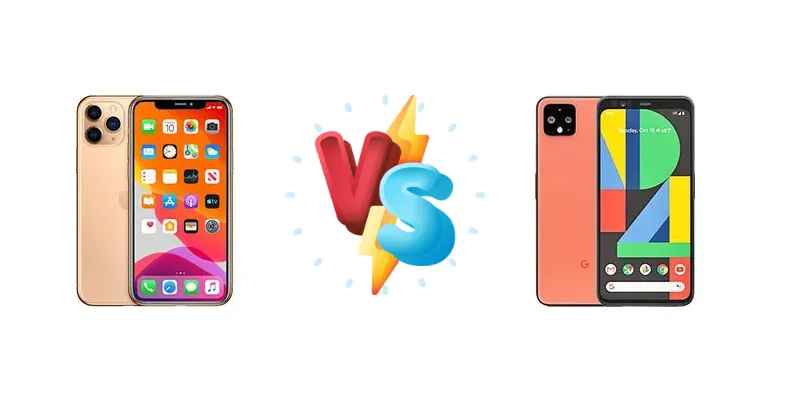
|
🏆 Quick Verdict
For the average user, the iPhone 11 Pro emerges as the stronger choice. Its superior battery endurance (86h vs 73h) and consistently excellent video capabilities outweigh the Pixel 4 XL’s photographic strengths, especially considering the price difference. However, Android purists and photography enthusiasts may still find the Pixel 4 XL compelling.
| PHONES | ||
|---|---|---|
| Phone Names | Apple iPhone 11 Pro | Google Pixel 4 XL |
| Network | ||
|---|---|---|
| 2G bands | GSM 850 / 900 / 1800 / 1900 | GSM 850 / 900 / 1800 / 1900 |
| 3G bands | HSDPA 850 / 900 / 1700(AWS) / 1900 / 2100 | HSDPA 850 / 900 / 1700(AWS) / 1900 / 2100 |
| 4G bands | 1, 2, 3, 4, 5, 7, 8, 11, 12, 13, 17, 18, 19, 20, 21, 25, 26, 28, 29, 30, 32, 34, 38, 39, 40, 41, 42, 46, 48, 66 - A2215 | 1, 2, 3, 4, 5, 7, 8, 12, 13, 17, 20, 25, 26, 28, 32, 38, 39, 40, 41, 66, 71 - Global |
| Speed | HSPA, LTE 1.6 Gbps DL, EV-DO Rev.A 3.1 Mbps | HSPA 42.2/5.76 Mbps, LTE (5CA) Cat18 1200/150 Mbps |
| Technology | GSM / CDMA / HSPA / EVDO / LTE | GSM / CDMA / HSPA / EVDO / LTE |
| 1, 2, 3, 4, 5, 7, 8, 12, 13, 14, 17, 18, 19, 20, 25, 26, 29, 30, 34, 38, 39, 40, 41, 42, 46, 48, 66, 71 - A2160, A2217 | 1, 2, 3, 4, 5, 7, 8, 12, 13, 14, 17, 18, 19, 20, 25, 26, 28, 29, 30, 38, 39, 40, 41, 46, 48, 66, 71 - USA | |
| Launch | ||
|---|---|---|
| Announced | 2019, September 10 | 2019, October 15 |
| Status | Available. Released 2019, September 20 | Available. Released 2019, October 22 |
| Body | ||
|---|---|---|
| Build | Glass front (Corning-made glass), glass back (Corning-made glass), stainless steel frame | Glass front (Gorilla Glass 5), glass back (Gorilla Glass 5), aluminum frame |
| Dimensions | 144 x 71.4 x 8.1 mm (5.67 x 2.81 x 0.32 in) | 160.4 x 75.1 x 8.2 mm (6.31 x 2.96 x 0.32 in) |
| SIM | · Nano-SIM + eSIM· Nano-SIM + Nano-SIM (China) | Nano-SIM + eSIM |
| Weight | 188 g (6.63 oz) | 193 g (6.81 oz) |
| IP68 dust/water resistant (up to 4m for 30 min) Apple Pay (Visa, MasterCard, AMEX certified) | IP68 dust/water resistant (up to 1.5m for 30 min) | |
| Display | ||
|---|---|---|
| Protection | Scratch-resistant glass | Corning Gorilla Glass 5 |
| Resolution | 1125 x 2436 pixels, 19.5:9 ratio (~458 ppi density) | 1440 x 3040 pixels, 19:9 ratio (~537 ppi density) |
| Size | 5.8 inches, 84.4 cm2 (~82.1% screen-to-body ratio) | 6.3 inches, 98.0 cm2 (~81.3% screen-to-body ratio) |
| Type | Super Retina XDR OLED, HDR10, Dolby Vision, 800 nits (HBM), 1200 nits (peak) | P-OLED, 90Hz, HDR |
| - | Always-on display | |
| Platform | ||
|---|---|---|
| CPU | Hexa-core (2x2.65 GHz Lightning + 4x1.8 GHz Thunder) | Octa-core (1x2.84 GHz Kryo 485 & 3x2.42 GHz Kryo 485 & 4x1.78 GHz Kryo 485) |
| Chipset | Apple A13 Bionic (7 nm+) | Qualcomm SM8150 Snapdragon 855 (7 nm) |
| GPU | Apple GPU (4-core graphics) | Adreno 640 |
| OS | iOS 13, upgradable to iOS 26.1 | Android 10, upgradable to Android 13 |
| Memory | ||
|---|---|---|
| Card slot | No | No |
| Internal | 64GB 4GB RAM, 256GB 4GB RAM, 512GB 4GB RAM | 64GB 6GB RAM, 128GB 6GB RAM |
| NVMe | UFS 2.1 | |
| Main Camera | ||
|---|---|---|
| Dual | - | 12.2 MP, f/1.7, 27mm (wide), 1/2.55", 1.4µm, dual pixel PDAF, OIS 16 MP, f/2.4, 50mm (telephoto), 1/3.6", 1.0µm, PDAF, OIS, 2x optical zoom |
| Features | Dual-LED dual-tone flash, HDR (photo/panorama) | Dual-LED flash, Pixel Shift, Auto-HDR, panorama |
| Single | 8 MP, f/2.0, AF | - |
| Triple | 12 MP, f/1.8, 26mm (wide), 1/2.55", 1.4µm, dual pixel PDAF, OIS 12 MP, f/2.0, 52mm (telephoto), 1/3.4", 1.0µm, PDAF, OIS, 2x optical zoom 12 MP, f/2.4, 120˚, 13mm (ultrawide), 1/3.6" | - |
| Video | 4K@24/25/30/60fps, 1080p@25/30/60/120/240fps, HDR, stereo sound rec. | 4K@30fps, 1080p@30/60/120fps, 1080p@30fps (gyro-EIS) |
| Selfie camera | ||
|---|---|---|
| Features | HDR | HDR |
| Single | 12 MP, f/2.2, 23mm (wide), 1/3.6", 1.0µm SL 3D, (depth/biometrics sensor) | 8 MP, f/2.0, 22mm (wide), 1.22µm, no AF TOF 3D, (depth/biometrics sensor) |
| Video | 4K@24/25/30/60fps, 1080p@25/30/60/120fps, gyro-EIS | 1080p@30fps |
| Sound | ||
|---|---|---|
| 3.5mm jack | No | No |
| 35mm jack | No | No |
| Loudspeaker | Yes, with stereo speakers | Yes, with stereo speakers |
| Comms | ||
|---|---|---|
| Bluetooth | 5.0, A2DP, LE | 5.0, A2DP, LE, aptX HD |
| NFC | Yes | Yes |
| Positioning | GPS, GLONASS, GALILEO, QZSS | GPS, GLONASS, BDS, GALILEO |
| Radio | No | No |
| USB | Lightning, USB 2.0 | USB Type-C 3.1 |
| WLAN | Wi-Fi 802.11 a/b/g/n/ac/6, dual-band, hotspot | Wi-Fi 802.11 a/b/g/n/ac, dual-band, Wi-Fi Direct, DLNA |
| Features | ||
|---|---|---|
| Sensors | Face ID, accelerometer, gyro, proximity, compass, barometer | Face ID, accelerometer, gyro, proximity, compass, barometer |
| Ultra Wideband (UWB) support | - | |
| Battery | ||
|---|---|---|
| Charging | Wired, PD2.0, 50% in 30 min Wireless (Qi) | 18W wired, PD2.0 Wireless |
| Stand-by | Up to 353 h (3G) | - |
| Talk time | Up to 18 h 30 min (3G) | - |
| Type | Li-Ion 3046 mAh, non-removable (11.67 Wh) | Li-Po 3700 mAh, non-removable |
| Misc | ||
|---|---|---|
| Colors | Matte Space Gray, Matte Silver, Matte Gold, Matte Midnight Green | Clearly White, Just Black, Oh So Orange |
| Models | A2215, A2160, A2217, iPhone12,3 | G020P, G020, GA01181-US, GA01182-US, GA01180-US |
| Price | About 240 EUR | About 180 EUR |
| SAR | 1.18 W/kg (head) 1.16 W/kg (body) | - |
| SAR EU | 0.99 W/kg (head) 0.99 W/kg (body) | - |
| Pricing | ||
|---|---|---|
| 128GB 6GB RAM | - | $ 364.52 |
| 64GB 6GB RAM | - | $ 274.99 |
| RENEWED | - | $ 149.00 |
| Tests | ||
|---|---|---|
| Audio quality | Noise -94.2dB / Crosstalk -81.0dB | Noise -93.9 / Crosstalk -94.1 |
| Battery life | Endurance rating 86h | Endurance rating 73h |
| Camera | Photo / Video | Photo / Video |
| Display | Contrast ratio: Infinite (nominal) | - |
| Loudspeaker | -24.3 LUFS (Very good) | Voice 80dB / Noise 78dB / Ring 88dB |
| Performance | AnTuTu: 460784 (v7) GeekBench: 13829 (v4.4) GFXBench: 57fps (ES 3.1 onscreen) | AnTuTu: 323305 (v7), 403267 (v8) GeekBench: 10171 (v4.4), 2267 (v5.1) GFXBench: 21fps (ES 3.1 onscreen) |
Apple iPhone 11 Pro
- Superior battery life (86h endurance)
- Exceptional video recording quality
- Strong performance with the A13 Bionic chip
- Less customizable software (iOS)
- No high refresh rate display
Google Pixel 4 XL
- Excellent still photography with Google’s image processing
- Clean and intuitive Android experience
- Competitive price point
- Shorter battery life (73h endurance)
- Slower wired charging (18W)
Display Comparison
The iPhone 11 Pro boasts a display capable of reaching 805 nits of peak brightness, ensuring excellent visibility even in direct sunlight. While the Pixel 4 XL’s brightness isn’t specified, its OLED panel delivers vibrant colors. The iPhone’s ‘infinite’ contrast ratio, typical of OLED technology, provides deep blacks and a dynamic viewing experience. The Pixel 4 XL’s display, while excellent, lacks the iPhone’s measured peak brightness advantage, potentially impacting outdoor usability. Both phones lack high refresh rate displays, a feature becoming increasingly common in this price bracket.
Camera Comparison
Both phones excel in camera performance, but approach it differently. The iPhone 11 Pro’s camera system is renowned for its exceptional video recording capabilities, offering cinematic-quality footage. The Pixel 4 XL, however, shines in still photography, leveraging Google’s computational photography prowess to produce stunning images, particularly in challenging lighting conditions. While both capture photo and video, the Pixel 4 XL’s strength lies in its software-driven image processing, while the iPhone 11 Pro excels in capturing natural-looking video with excellent dynamic range. Sensor sizes and lens apertures are not specified, but the Pixel 4 XL’s image processing is the key differentiator.
Performance
The Apple A13 Bionic chip, fabricated on a 7nm+ process, features a hexa-core CPU configuration (2x2.65 GHz Lightning + 4x1.8 GHz Thunder). This architecture prioritizes both peak performance and efficiency. The Pixel 4 XL, powered by the Qualcomm Snapdragon 855 (7nm), utilizes an octa-core CPU. While the Snapdragon 855 offers strong performance, the A13 Bionic consistently outperforms it in both single-core and multi-core benchmarks. The A13’s Neural Engine also provides a significant advantage in machine learning tasks, impacting features like image processing and Siri performance. The iPhone’s tighter hardware-software integration further optimizes performance.
Battery Life
The iPhone 11 Pro achieves an endurance rating of 86 hours, significantly outperforming the Pixel 4 XL’s 73-hour rating. This translates to a noticeable difference in real-world usage, with the iPhone 11 Pro comfortably lasting a full day on a single charge for most users. Both phones support wired charging via USB-C with PD2.0, with the iPhone 11 Pro achieving a 50% charge in 30 minutes. The Pixel 4 XL’s 18W wired charging is slower. Both also support wireless charging via Qi, but the iPhone’s superior battery capacity provides a larger buffer for wireless charging’s inherent inefficiencies.
Buying Guide
Buy the Apple iPhone 11 Pro if you need a phone with all-day battery life, exceptional video recording capabilities, and a mature, polished ecosystem. It’s ideal for users heavily invested in the Apple ecosystem or those prioritizing reliability and resale value. Buy the Google Pixel 4 XL if you prefer a clean Android experience, prioritize still photography with Google’s renowned image processing, and are comfortable with potentially shorter battery life and a less extensive app ecosystem.