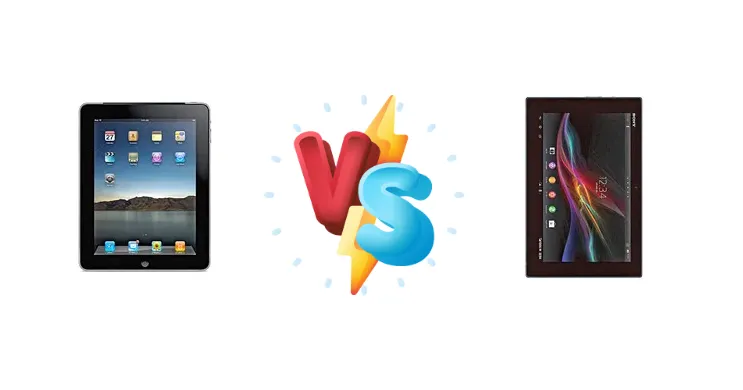
In 2013, Apple's iPad continued to define the tablet landscape, but Sony entered the fray with the Xperia Z Tablet, aiming to disrupt with a focus on multimedia and connectivity. This comparison revisits these devices, analyzing their core specifications and performance to determine which offered the better experience given the technology of the time.
🏆 Quick Verdict
For the average user in 2013, the Sony Xperia Z Tablet LTE was the superior choice. While the iPad offered a polished ecosystem, the Xperia Z Tablet’s significantly more powerful Qualcomm Snapdragon S4 Pro chipset delivered a demonstrably faster and more responsive experience, justifying its higher price point.
| Network |
|---|
| 2G bands | GSM 850 / 900 / 1800 / 1900 | GSM 850 / 900 / 1800 / 1900 |
| 3G bands | HSDPA 850 / 1900 / 2100 | HSDPA 850 / 900 / 2100 - SGP321 |
| 4G bands | - | 1, 3, 5, 7, 8, 20 - SGP321 |
| Speed | HSPA | HSPA 42.2/5.76 Mbps, LTE Cat3 100/50 Mbps |
| Technology | GSM / HSPA | GSM / HSPA / LTE |
| | - | 4 - SGP351 |
| Launch |
|---|
| Announced | 2010, January. Released 2010, March | 2013, February. Released 2013, May |
| Status | Discontinued | Discontinued |
| Body |
|---|
| Dimensions | 242.8 x 189.7 x 13.4 mm (9.56 x 7.47 x 0.53 in) | 266 x 172 x 6.9 mm (10.47 x 6.77 x 0.27 in) |
| SIM | Micro-SIM | Micro-SIM |
| Weight | 730 g (1.61 lb) | 495 g (1.09 lb) |
| | - | IP57 dust proof and water resistant |
| Display |
|---|
| Protection | Scratch-resistant glass, oleophobic coating | Shatter proof glass |
| Resolution | 768 x 1024 pixels, 4:3 ratio (~132 ppi density) | 1200 x 1920 pixels, 16:10 ratio (~224 ppi density) |
| Size | 9.7 inches, 291.4 cm2 (~63.3% screen-to-body ratio) | 10.1 inches, 295.8 cm2 (~64.7% screen-to-body ratio) |
| Type | IPS LCD | LED-backlit LCD, |
| Platform |
|---|
| CPU | 1.0 GHz Cortex-A8 | Quad-core 1.5 GHz Krait |
| Chipset | Apple A4 (45 nm) | Qualcomm APQ8064 Snapdragon S4 Pro |
| GPU | PowerVR SGX535 | Adreno 320 |
| OS | iOS 4, upgradable to iOS 5.1.1 | Android 4.1.2 (Jelly Bean), upgradable to 5.1.1 (Lollipop) |
| Memory |
|---|
| Card slot | No | microSDXC (dedicated slot); microSDHC (SGP351) |
| Internal | 16GB 256MB RAM, 32GB 256MB RAM, 64GB 256MB RAM | 16GB 2GB RAM |
| Main Camera |
|---|
| Features | - | HDR, panorama |
| Single | - | 8.1 MP, AF |
| Video | - | 1080p@30fps, HDR |
| Selfie camera |
|---|
| Single | - | 2.2 MP |
| Video | - | 1080p@30fps |
| Sound |
|---|
| 3.5mm jack | - | Yes |
| 35mm jack | Yes | Yes |
| Loudspeaker | Yes | Yes, with stereo speakers |
| | - | 3D surround sound |
| Comms |
|---|
| Bluetooth | 2.1, A2DP, EDR | 4.0, A2DP |
| Infrared port | - | Yes |
| NFC | - | Yes |
| Positioning | GPS, A-GPS | GPS, GLONASS |
| Radio | No | Stereo FM radio, RDS |
| USB | 2.0 | microUSB 2.0 (MHL TV-out) |
| WLAN | Wi-Fi 802.11 a/b/g/n, dual-band | Wi-Fi 802.11 a/b/g/n, dual-band, Wi-Fi Direct, DLNA, hotspot |
| Features |
|---|
| Browser | HTML (Safari) | - |
| Sensors | Accelerometer, compass | Accelerometer, gyro, compass |
| Battery |
|---|
| Music play | - | Up to 110 h |
| Stand-by | - | Up to 1230 h (2G) / Up to 1270 h (3G) |
| Talk time | - | Up to 10 h (multimedia) |
| Type | Non-removable Li-Po 6600 mAh battery (24.8 Wh) | Li-Po 6000 mAh, non-removable |
| Misc |
|---|
| Colors | Silver | Black, White |
| Models | iPad1,2 | SGP321, SO-03E, SGP351 |
| Price | About 410 EUR | About 350 EUR |
| SAR EU | - | 1.69 W/kg (body) |
| Tests |
|---|
| Audio quality | - |
Noise -87.0dB / Crosstalk -87.8dB |
| Camera | - |
Photo / Video |
| Display | - |
Contrast ratio: 996:1 (nominal) |
| Loudspeaker | - |
Voice 66dB / Noise 64dB / Ring 70dB
|
Apple iPad Wi-Fi + 3G
- Mature App Ecosystem
- Simple User Interface
- Strong Brand Recognition
- Outdated Processor
- Limited Multitasking Capability
- Potentially Lower Graphics Performance
Sony Xperia Tablet Z LTE
- Powerful Snapdragon S4 Pro Chipset
- LTE Connectivity for Faster Data Speeds
- Sony’s Display and Camera Expertise
- Less Polished Software Experience
- Potentially Shorter Battery Life with LTE Active
- Higher Price Point
Display Comparison
Both tablets share a nominal contrast ratio of 996:1, suggesting similar black levels and color reproduction capabilities for the time. However, the iPad’s display size and resolution are not specified, while the Xperia Z Tablet’s 10.1-inch display was a key selling point. The lack of information on the iPad’s panel technology makes a direct comparison difficult, but the Xperia Z Tablet likely benefited from Sony’s display expertise, offering potentially wider viewing angles and more accurate color calibration. Bezels were a significant design element in 2013, and the Xperia Z Tablet aimed for a slimmer profile.
Camera Comparison
Both devices feature photo and video capabilities, but details are sparse. Given the era, camera quality wasn’t a primary focus for tablets. The Xperia Z Tablet, benefiting from Sony’s camera technology, likely offered a more refined camera experience with better image processing. However, without specific sensor sizes or aperture information, a definitive comparison is impossible. It’s reasonable to assume the Xperia Z Tablet’s camera would have been more competitive than the iPad’s, given Sony’s expertise in imaging.
Performance
The performance gap between these tablets is substantial. The Apple iPad, powered by a 1.0 GHz Cortex-A8 CPU and the 45nm Apple A4 chipset, was showing its age in 2013. In contrast, the Sony Xperia Z Tablet’s quad-core 1.5 GHz Krait CPU, built on the Qualcomm APQ8064 Snapdragon S4 Pro, offered a significant leap in processing power. The Krait architecture was known for its efficiency and performance, allowing for smoother multitasking, faster app loading times, and a more responsive user interface. The Snapdragon S4 Pro also included an Adreno 320 GPU, providing a superior graphics experience compared to the iPad’s PowerVR SGX535. This difference would be most noticeable in gaming and graphically intensive applications.
Battery Life
Battery life is difficult to assess without specific mAh ratings. However, the efficiency of the Snapdragon S4 Pro chipset in the Xperia Z Tablet likely offset any potential capacity disadvantage compared to the iPad. The 45nm manufacturing process of the Apple A4 was less efficient than the Snapdragon S4 Pro’s fabrication process, potentially leading to higher power consumption under load. The Xperia Z Tablet’s LTE connectivity would also impact battery life, but the faster data speeds could reduce overall data usage, mitigating some of the drain.
Buying Guide
Buy the Apple iPad Wi-Fi + 3G if you prioritized seamless integration with the Apple ecosystem, a mature app store, and a generally simpler user experience. Buy the Sony Xperia Tablet Z LTE if you valued raw performance, faster data speeds with LTE connectivity, and a more versatile multimedia experience, even if it meant navigating a less refined software environment.
Frequently Asked Questions
❓ Does the Apple A4 chipset struggle with modern web browsing, even for its time?
Yes, the 1.0 GHz Cortex-A8 and A4 chipset were quickly becoming outdated in 2013. Complex websites with heavy JavaScript and multimedia content would likely experience significant slowdowns and rendering issues on the iPad, impacting the browsing experience.
❓ How much faster was the Xperia Z Tablet’s Snapdragon S4 Pro in real-world tasks compared to the iPad?
The Snapdragon S4 Pro offered a substantial performance advantage, estimated to be 2-3x faster in CPU-intensive tasks and significantly better in graphics performance. This translated to smoother multitasking, faster app loading, and a more responsive user interface on the Xperia Z Tablet.
❓ Was the LTE connectivity on the Xperia Z Tablet a significant benefit in 2013?
Absolutely. In 2013, 4G LTE was becoming increasingly prevalent, and the Xperia Z Tablet’s LTE support allowed users to enjoy significantly faster data speeds compared to the iPad’s 3G connectivity, especially in areas with strong LTE coverage.