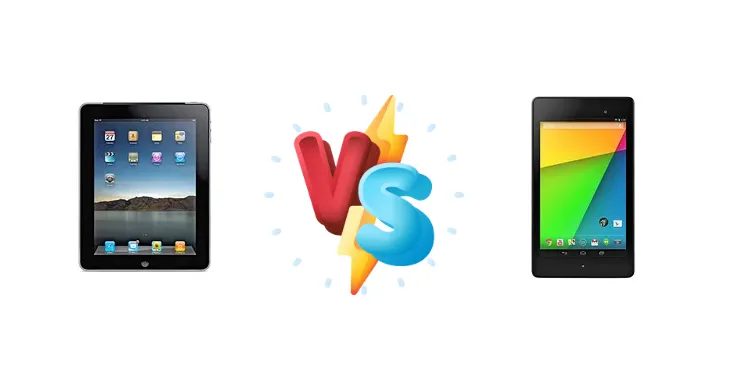
In 2013, the tablet landscape was rapidly evolving. Apple’s iPad, representing the first generation of the modern tablet, faced a new wave of competition, exemplified by the Asus Google Nexus 7. This comparison dissects the core differences between these devices, focusing on the architectural leap in processing power and the implications for the user experience.
🏆 Quick Verdict
For the average user in 2023 seeking a functional tablet, the Asus Google Nexus 7 (2013) is the superior choice. While the iPad offers the convenience of 3G connectivity, the Nexus 7’s quad-core Snapdragon S4 Pro provides a dramatically faster and more responsive experience, making it better suited for modern app usage.
| Network |
|---|
| 2G bands | GSM 850 / 900 / 1800 / 1900 | GSM 850 / 900 / 1800 / 1900 - all versions |
| 3G bands | HSDPA 850 / 1900 / 2100 | HSDPA 850 / 900 / 1700 / 1900 / 2100 |
| 4G bands | - | 1, 2, 3, 4, 5, 7, 20 - EU |
| Speed | HSPA | HSPA, LTE |
| Technology | GSM / HSPA | GSM / HSPA / LTE |
| | - | 1, 2, 3, 4, 5, 13, 17 - North America |
| Launch |
|---|
| Announced | 2010, January. Released 2010, March | 2013, July. Released 2013, July |
| Status | Discontinued | Discontinued |
| Body |
|---|
| Dimensions | 242.8 x 189.7 x 13.4 mm (9.56 x 7.47 x 0.53 in) | 200 x 114 x 8.7 mm (7.87 x 4.49 x 0.34 in) |
| SIM | Micro-SIM | Micro-SIM |
| Weight | 730 g (1.61 lb) | 290 g (Wi-Fi), 299 g (LTE) (10.55 oz) |
| Display |
|---|
| Protection | Scratch-resistant glass, oleophobic coating | Corning Gorilla Glass |
| Resolution | 768 x 1024 pixels, 4:3 ratio (~132 ppi density) | 1200 x 1920 pixels, 16:10 ratio (~323 ppi density) |
| Size | 9.7 inches, 291.4 cm2 (~63.3% screen-to-body ratio) | 7.0 inches, 142.1 cm2 (~62.3% screen-to-body ratio) |
| Type | IPS LCD | LED-backlit IPS LCD |
| Platform |
|---|
| CPU | 1.0 GHz Cortex-A8 | Quad-core 1.5 GHz Krait |
| Chipset | Apple A4 (45 nm) | Qualcomm Snapdragon S4 Pro |
| GPU | PowerVR SGX535 | Adreno 320 |
| OS | iOS 4, upgradable to iOS 5.1.1 | Android 4.3 (Jelly Bean), upgradable to 6.0 (Marshmallow) |
| Memory |
|---|
| Card slot | No | No |
| Internal | 16GB 256MB RAM, 32GB 256MB RAM, 64GB 256MB RAM | 16GB 2GB RAM, 32GB 2GB RAM |
| Main Camera |
|---|
| Single | - | 5 MP, f/2.4, AF |
| Video | - | 1080p@30fps |
| Selfie camera |
|---|
| Single | - | 1.2 MP |
| Sound |
|---|
| 3.5mm jack | - | Yes |
| 35mm jack | Yes | Yes |
| Loudspeaker | Yes | Yes, with stereo speakers |
| Comms |
|---|
| Bluetooth | 2.1, A2DP, EDR | 4.0, A2DP, LE |
| NFC | - | Yes |
| Positioning | GPS, A-GPS | GPS |
| Radio | No | No |
| USB | 2.0 | microUSB 2.0 (SlimPort) |
| WLAN | Wi-Fi 802.11 a/b/g/n, dual-band | Wi-Fi 802.11 a/b/g/n, dual-band |
| Features |
|---|
| Browser | HTML (Safari) | - |
| Sensors | Accelerometer, compass | Accelerometer, gyro, proximity, compass |
| Battery |
|---|
| Charging | - | Wireless (Qi) |
| Talk time | - | Up to 9 h (multimedia) |
| Type | Non-removable Li-Po 6600 mAh battery (24.8 Wh) | Li-Ion 3950 mAh, non-removable |
| Misc |
|---|
| Colors | Silver | Black |
| Models | iPad1,2 | - |
| Price | About 410 EUR | About 230 EUR |
| Tests |
|---|
| Audio quality | - |
Noise -92.2dB / Crosstalk -92.3dB |
Apple iPad Wi-Fi + 3G
- Integrated 3G connectivity for on-the-go access.
- Established Apple ecosystem and app support (at the time).
- Brand recognition and perceived reliability.
- Significantly slower processor compared to the Nexus 7.
- Limited multitasking capabilities.
- Less responsive user experience.
Asus Google Nexus 7 (2013)
- Quad-core Snapdragon S4 Pro delivers superior performance.
- Wireless (Qi) charging for added convenience.
- More responsive and fluid user experience.
- Lacks integrated 3G connectivity.
- Relies on Wi-Fi for internet access.
- May not receive software updates as long as the iPad.
Display Comparison
The iPad’s display specifications are not provided, but based on its release timeframe, it likely features an IPS LCD panel. The Nexus 7 (2013) also utilizes an IPS LCD, but the key difference lies in processing power driving the display. The iPad’s A4 chipset, manufactured on a 45nm process, would struggle to deliver the same level of graphical fidelity or responsiveness as the Snapdragon S4 Pro. While both likely offer similar color accuracy, the Nexus 7’s more powerful GPU would enable smoother animations and faster rendering of web pages.
Camera Comparison
Neither device was known for its camera prowess. Without specific camera specs for the iPad, a direct comparison is difficult. However, given the era, both likely featured relatively low-resolution sensors. The Nexus 7’s camera performance would likely be superior due to the Snapdragon S4 Pro’s image signal processor (ISP), which offers more advanced image processing capabilities than the A4’s limited processing power. The focus here isn't image quality, but the ability to *process* images quickly.
Performance
The performance gap between these devices is substantial. The iPad’s 1.0 GHz Cortex-A8 CPU, built on Apple’s A4 chipset (45nm), is a single-core processor. In contrast, the Nexus 7 (2013) boasts a quad-core 1.5 GHz Krait CPU based on the Qualcomm Snapdragon S4 Pro. This represents a generational leap in processing capability. The Krait architecture, coupled with the higher clock speed and multiple cores, allows the Nexus 7 to handle multitasking, demanding applications, and complex web content with significantly greater ease. The 45nm process of the A4 also means it will generate more heat under load, potentially leading to thermal throttling.
Battery Life
Battery capacity figures are unavailable for both devices. However, the Snapdragon S4 Pro’s more efficient architecture, despite its higher performance, likely results in comparable or even better battery life on the Nexus 7. Furthermore, the Nexus 7 (2013) supports Qi wireless charging, a feature absent on the iPad, offering a convenient alternative to traditional cable charging. The iPad’s reliance on a 45nm process for its A4 chip would contribute to higher power consumption.
Buying Guide
Buy the Apple iPad Wi-Fi + 3G if you absolutely require cellular connectivity for on-the-go use and are primarily focused on basic tasks like email and web browsing. Buy the Asus Google Nexus 7 (2013) if you prioritize performance, responsiveness, and future-proofing for a wider range of applications, and are comfortable relying on Wi-Fi networks. The Nexus 7 also offers the modern convenience of wireless charging.
Frequently Asked Questions
❓ Is the iPad's 3G connectivity still relevant in 2023?
While 3G connectivity was valuable in 2013, modern 4G and 5G networks offer significantly faster speeds. Most users now rely on Wi-Fi hotspots or their smartphones for internet access, diminishing the iPad's 3G advantage.
❓ Will the iPad be able to run modern apps smoothly?
The iPad's A4 processor is severely underpowered by today's standards. Many modern apps will experience significant lag, crashes, or may not even be compatible. The Nexus 7's Snapdragon S4 Pro, while also dated, offers a much better chance of running newer software.
❓ Does the Nexus 7's wireless charging work with all Qi chargers?
The Nexus 7 (2013) supports the Qi standard, but older or non-compliant chargers may not function correctly. It's best to use a Qi charger specifically designed for mobile devices to ensure optimal charging performance.