
iPad Pro 13 (2025) vs Xiaomi Pad 7 Pro: A Deep Dive into Tablet Power
| Phones Images | |||||
|---|---|---|---|---|---|
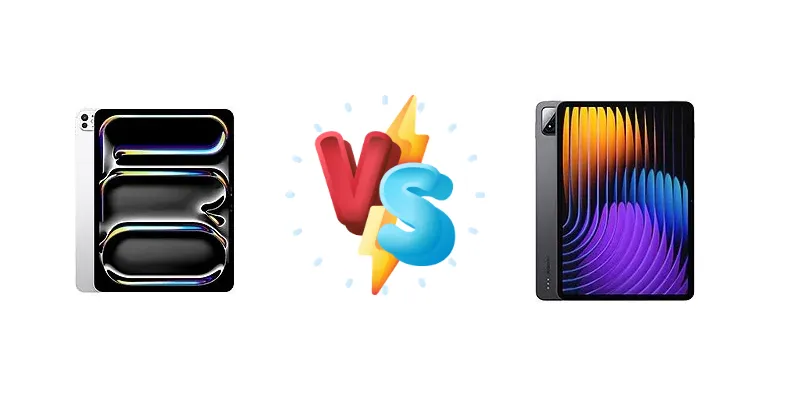
|
🏆 Quick Verdict
For professional creatives and those deeply embedded in the Apple ecosystem, the iPad Pro 13 (2025) is the clear winner, thanks to its superior chip, longer battery endurance, and optimized software. However, the Xiaomi Pad 7 Pro delivers impressive performance and significantly faster charging at a potentially lower price point, making it a compelling choice for gamers and everyday users.
| PHONES | ||
|---|---|---|
| Phone Names | Apple iPad Pro 13 (2025) | Xiaomi Pad 7 Pro |
| Network | ||
|---|---|---|
| 2G bands | GSM 850 / 900 / 1800 / 1900 - cellular model only | N/A |
| 3G bands | HSDPA 850 / 900 / 1700(AWS) / 1900 / 2100 - cellular model only | N/A |
| 4G bands | 1, 2, 3, 4, 5, 7, 8, 11, 12, 13, 14, 17, 18, 19, 20, 21, 25, 26, 28, 29, 30, 32, 34, 38, 39, 40, 41, 42, 48, 66, 71 - A3361 - cellular model only | - |
| 5G bands | 1, 2, 3, 5, 7, 8, 12, 14, 20, 25, 26, 28, 29, 30, 38, 40, 41, 48, 66, 70, 71, 75, 77, 78, 79 SA/NSA/Sub6 - A3361, A3362 - cellular model only | - |
| EDGE | - | N/A |
| GPRS | - | N/A |
| Speed | HSPA, LTE, 5G - cellular model only | - |
| Technology | GSM / HSPA / LTE / 5G | No cellular connectivity |
| Launch | ||
|---|---|---|
| Announced | 2025, October 16 | 2024, October 29 |
| Status | Available. Released 2025, October 22 | Available. Released 2024, October 29 |
| Body | ||
|---|---|---|
| Build | Glass front, aluminum back, aluminum frame | Glass front, aluminum frame, aluminum back |
| Dimensions | 281.6 x 215.5 x 5.1 mm (11.09 x 8.48 x 0.20 in) | 251.2 x 173.4 x 6.2 mm (9.89 x 6.83 x 0.24 in) |
| SIM | eSIM - cellular model only | No |
| Weight | 579 g (Wi-Fi), 582 g (5G) (1.28 lb) | 500 g (1.10 lb) |
| Display | ||
|---|---|---|
| Protection | Scratch-resistant glass, oleophobic coating, Mohs level 4 | - |
| Resolution | 2064 x 2752 pixels, 4:3 ratio (~265 ppi density) | 2136 x 3200 pixels, 3:2 ratio (~345 ppi density) |
| Size | 13.0 inches, 523.4 cm2 (~86.2% screen-to-body ratio) | 11.2 inches, 371.5 cm2 (~85.3% screen-to-body ratio) |
| Type | Ultra Retina Tandem OLED, 120Hz, HDR10, Dolby Vision, 1000 nits (HBM), 1600 nits (peak) | IPS LCD, 68B colors, 144Hz, HDR10, Dolby Vision, 800 nits (peak) |
| Platform | ||
|---|---|---|
| CPU | 9-core (3 performance cores, 6 efficiency cores) - 256/512GB models10-core (4 performance cores, 6 efficiency cores) - 1/2TB models | Octa-core (1x3.0 GHz Cortex-X4 & 4x2.8 GHz Cortex-A720 & 3x2.0 GHz Cortex-A520) |
| Chipset | Apple M5 | Qualcomm SM8635 Snapdragon 8s Gen 3 (4 nm) |
| GPU | Apple GPU (10-core graphics) | Adreno 735 |
| OS | iPadOS 26, upgradable to iPadOS 26.1 | Android 15, HyperOS 2 |
| Memory | ||
|---|---|---|
| Card slot | No | No |
| Internal | 256GB 12GB RAM, 512GB 12GB RAM, 1TB 16GB RAM, 2TB 16GB RAM | 128GB 8GB RAM, 256GB 8GB RAM, 256GB 12GB RAM, 512GB 12GB RAM |
| Main Camera | ||
|---|---|---|
| Dual | - | 50 MP, f/1.8, (wide), 1/2.76", 0.64µm, PDAF Auxiliary lens |
| Features | Quad-LED dual-tone flash, HDR | LED flash, HDR, panorama |
| Single | 12 MP, f/1.8, (wide), dual pixel PDAF TOF 3D LiDAR scanner (depth) | - |
| Video | 4K@24/25/30/60fps, 1080p@25/30/60/120/240fps; gyro-EIS, ProRes (4K, 1080p) | 4K@30/60fps, 1080p@30/60fps |
| Selfie camera | ||
|---|---|---|
| Features | Face detection, HDR, panorama | HDR |
| Single | 12 MP, f/2.0, 122˚ (ultrawide) | 32 MP, f/2.2, 19mm (ultrawide), 1/3.6", 0.61µm |
| Video | 1080p@25/30/60fps, gyro-EIS, HDR | 1080p@30fps |
| Sound | ||
|---|---|---|
| 35mm jack | No | No |
| Loudspeaker | Yes, with stereo speakers (4 speakers) | Yes, with stereo speakers (4 speakers) |
| Comms | ||
|---|---|---|
| Bluetooth | 6.0, A2DP, LE, EDR | 5.4, A2DP, LE, LHDC 5 |
| Infrared port | - | Yes |
| NFC | No | No |
| Positioning | GPS, GLONASS, GALILEO, QZSS (Wi‑Fi + Cellular model only) | No |
| Radio | No | No |
| USB | USB Type-C 4 (Thunderbolt 3), DisplayPort, magnetic connector | USB Type-C 3.2, accessory connector |
| WLAN | Wi-Fi 802.11 a/b/g/n/ac/6e/7, dual-band, hotspot | Wi-Fi 802.11 a/b/g/n/ac/6e/7, dual-band, Wi-Fi Direct |
| Features | ||
|---|---|---|
| Sensors | Face ID, accelerometer, gyro, compass, barometer | Fingerprint (side-mounted), accelerometer, gyro, proximity, compass |
| Battery | ||
|---|---|---|
| Charging | 50% in 30 min | 67W wired, PD3.0, QC3+, 40% in 20 min |
| Type | Li-Po 10290 mAh | 8850 mAh |
| Misc | ||
|---|---|---|
| Colors | Silver, Space Black | Gray, Blue, Green |
| Models | A3360, A3361, A3362 | 24091RPADG |
| Price | About 1450 EUR | About 500 EUR |
| SAR EU | - | 0.99 W/kg (body) |
| EU LABEL | ||
|---|---|---|
| Battery | 76:00h endurance, 1000 cycles | - |
| Energy | Class G | - |
| Free fall | Class E (40 falls) | - |
| Repairability | Class C | - |
Apple iPad Pro 13 (2025)
- Exceptional performance with Apple M5 chip
- Industry-leading battery endurance (76 hours)
- Long-term battery health with 1000 charge cycles
- Potentially higher price point
- Slower charging speed compared to Xiaomi Pad 7 Pro
Xiaomi Pad 7 Pro
- Fast 67W charging with PD3.0 and QC3+ support
- Powerful Snapdragon 8s Gen 3 processor
- Potentially more affordable price
- Significantly shorter battery life (10h 12m)
- Less optimized software ecosystem compared to iPadOS
Display Comparison
While display specifications are missing for both devices, the iPad Pro line historically features mini-LED displays with ProMotion (adaptive refresh rates up to 120Hz). This suggests superior brightness and color accuracy compared to what is typically found in Android tablets. The Xiaomi Pad 7 Pro likely utilizes an LCD or AMOLED panel, but without specific nit ratings or color gamut coverage, it’s difficult to assess its visual fidelity. The iPad Pro’s LTPO technology dynamically adjusts the refresh rate, conserving battery life, a feature likely absent on the Xiaomi Pad 7 Pro.
Camera Comparison
Camera details are absent for both devices, but tablets are rarely purchased for their photographic capabilities. However, Apple typically includes advanced image signal processing within its M-series chips, potentially offering better image quality even with similar sensor specifications. Given Xiaomi’s focus on value, the Pad 7 Pro likely features a more modest camera setup, prioritizing functionality over flagship-level image quality. The absence of detailed camera specs suggests neither device is a primary photography tool.
Performance
The core of the difference lies in the chipsets. Apple’s M5, with either a 9-core (256/512GB models) or 10-core (1/2TB models) configuration, is built on a unified memory architecture, offering significant performance advantages in tasks optimized for Apple Silicon. The Xiaomi Pad 7 Pro’s Qualcomm Snapdragon 8s Gen 3 (4nm) is a powerful chip, utilizing an octa-core configuration with a Cortex-X4 prime core, but it’s unlikely to match the M5’s raw processing power or efficiency. The M5’s neural engine also provides a substantial edge in machine learning tasks. The iPad Pro’s LPDDR5X RAM further enhances memory bandwidth, contributing to smoother multitasking.
Battery Life
The iPad Pro 13 (2025) boasts an impressive 76-hour endurance and a 1000-cycle battery lifespan, indicating a long-term investment in battery health. In contrast, the Xiaomi Pad 7 Pro offers 10 hours and 12 minutes of active use. While the Xiaomi Pad 7 Pro compensates with 67W wired charging, achieving 40% charge in 20 minutes, the iPad Pro’s longevity and overall endurance are significant advantages. The iPad Pro’s 30-minute 50% charge time is slower, but the extended battery lifespan mitigates this concern.
Buying Guide
Buy the Apple iPad Pro 13 (2025) if you require the absolute best performance for demanding tasks like video editing, 3D rendering, or professional-grade creative work, and if seamless integration with other Apple devices is a priority. Buy the Xiaomi Pad 7 Pro if you prioritize value, fast charging, and a versatile Android experience, particularly for gaming and media consumption, without sacrificing significant performance.