
Apple iPad Pro 13 (2025) vs Huawei MatePad Pro 13.2 (2025): A Deep Dive Comparison
| Phones Images | |||||
|---|---|---|---|---|---|
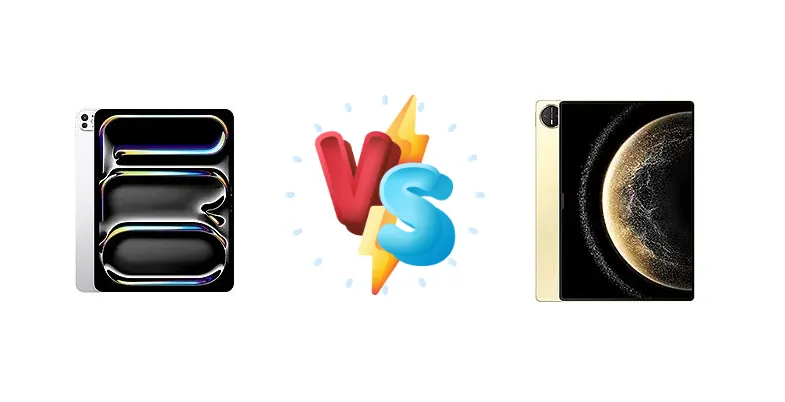
|
🏆 Quick Verdict
For demanding creative professionals and those deeply embedded in the Apple ecosystem, the iPad Pro 13 (2025) with its M5 chip is the superior choice. However, the Huawei MatePad Pro 13.2 (2025) offers a compelling package for users who value fast charging and a potentially more open software experience.
| PHONES | ||
|---|---|---|
| Phone Names | Apple iPad Pro 13 (2025) | Huawei MatePad Pro 13.2 (2025) |
| Network | ||
|---|---|---|
| 2G bands | GSM 850 / 900 / 1800 / 1900 - cellular model only | GSM 850 / 900 / 1800 / 1900 |
| 3G bands | HSDPA 850 / 900 / 1700(AWS) / 1900 / 2100 - cellular model only | HSDPA 850 / 900 / 1900 / 2100 |
| 4G bands | 1, 2, 3, 4, 5, 7, 8, 11, 12, 13, 14, 17, 18, 19, 20, 21, 25, 26, 28, 29, 30, 32, 34, 38, 39, 40, 41, 42, 48, 66, 71 - A3361 - cellular model only | LTE |
| 5G bands | 1, 2, 3, 5, 7, 8, 12, 14, 20, 25, 26, 28, 29, 30, 38, 40, 41, 48, 66, 70, 71, 75, 77, 78, 79 SA/NSA/Sub6 - A3361, A3362 - cellular model only | - |
| Speed | HSPA, LTE, 5G - cellular model only | HSPA, LTE - cellular model only |
| Technology | GSM / HSPA / LTE / 5G | GSM / HSPA / LTE |
| Launch | ||
|---|---|---|
| Announced | 2025, October 16 | 2024, November 26 |
| Status | Available. Released 2025, October 22 | Available. Released 2024, December 12 |
| Body | ||
|---|---|---|
| Build | Glass front, aluminum back, aluminum frame | Glass front, nylon fiber back, magnesium alloy frame |
| Dimensions | 281.6 x 215.5 x 5.1 mm (11.09 x 8.48 x 0.20 in) | 289.1 x 196.1 x 5.5 mm (11.38 x 7.72 x 0.22 in) |
| SIM | eSIM - cellular model only | Nano-SIM (cellular model only) |
| Weight | 579 g (Wi-Fi), 582 g (5G) (1.28 lb) | 580 g (Wi-FI) or 590 g (LTE) (1.28 lb) |
| Display | ||
|---|---|---|
| Protection | Scratch-resistant glass, oleophobic coating, Mohs level 4 | - |
| Resolution | 2064 x 2752 pixels, 4:3 ratio (~265 ppi density) | 2880 x 1920 pixels, 3:2 ratio (~262 ppi density) |
| Size | 13.0 inches, 523.4 cm2 (~86.2% screen-to-body ratio) | 13.2 inches, 518.8 cm2 (~91.5% screen-to-body ratio) |
| Type | Ultra Retina Tandem OLED, 120Hz, HDR10, Dolby Vision, 1000 nits (HBM), 1600 nits (peak) | OLED, 1B colors, 144Hz, HDR Vivid, 1000 nits (peak) |
| Platform | ||
|---|---|---|
| CPU | 9-core (3 performance cores, 6 efficiency cores) - 256/512GB models10-core (4 performance cores, 6 efficiency cores) - 1/2TB models | Octa-core |
| Chipset | Apple M5 | Kirin T92 |
| GPU | Apple GPU (10-core graphics) | - |
| OS | iPadOS 26, upgradable to iPadOS 26.1 | Harmony OS 4.3 |
| Memory | ||
|---|---|---|
| Card slot | No | No |
| Internal | 256GB 12GB RAM, 512GB 12GB RAM, 1TB 16GB RAM, 2TB 16GB RAM | 256GB 12GB RAM, 512GB 12GB RAM, 1TB 16GB RAM |
| Main Camera | ||
|---|---|---|
| Dual | - | 50 MP, f/1.8, (wide), PDAF 8 MP, f/2.2, (ultrawide) |
| Features | Quad-LED dual-tone flash, HDR | LED flash |
| Single | 12 MP, f/1.8, (wide), dual pixel PDAF TOF 3D LiDAR scanner (depth) | - |
| Video | 4K@24/25/30/60fps, 1080p@25/30/60/120/240fps; gyro-EIS, ProRes (4K, 1080p) | 4K@30fps, 1080p@30fps |
| Selfie camera | ||
|---|---|---|
| Features | Face detection, HDR, panorama | - |
| Single | 12 MP, f/2.0, 122˚ (ultrawide) | 16 MP, f/2.2 |
| Video | 1080p@25/30/60fps, gyro-EIS, HDR | 1080p@30fps |
| Sound | ||
|---|---|---|
| 35mm jack | No | No |
| Loudspeaker | Yes, with stereo speakers (4 speakers) | Yes, with stereo speakers (6 speakers) |
| Comms | ||
|---|---|---|
| Bluetooth | 6.0, A2DP, LE, EDR | 5.2, A2DP, LE, L2HC |
| NFC | No | No |
| Positioning | GPS, GLONASS, GALILEO, QZSS (Wi‑Fi + Cellular model only) | GPS, GALILEO, GLONASS, BDS |
| Radio | No | No |
| USB | USB Type-C 4 (Thunderbolt 3), DisplayPort, magnetic connector | USB Type-C 3.1, OTG, DisplayPort 1.2, accessory connector pins |
| WLAN | Wi-Fi 802.11 a/b/g/n/ac/6e/7, dual-band, hotspot | Wi-Fi 802.11 a/b/g/n/ac/6, dual-band |
| Features | ||
|---|---|---|
| Sensors | Face ID, accelerometer, gyro, compass, barometer | Fingerprint (side-mounted), accelerometer, gyro, compass, proximity (accessories only) |
| Battery | ||
|---|---|---|
| Charging | 50% in 30 min | 100W wired 7.5W reverse wired |
| Type | Li-Po 10290 mAh | Li-Po 10100 mAh |
| Misc | ||
|---|---|---|
| Colors | Silver, Space Black | Black, White, Gold |
| Models | A3360, A3361, A3362 | WEB-W00, PCE-W29 |
| Price | About 1450 EUR | About 680 EUR |
| EU LABEL | ||
|---|---|---|
| Battery | 76:00h endurance, 1000 cycles | - |
| Energy | Class G | - |
| Free fall | Class E (40 falls) | - |
| Repairability | Class C | - |
Apple iPad Pro 13 (2025)
- Superior processing power with Apple M5 chip
- Exceptional battery endurance (76 hours)
- Long-term battery health (1000 cycles)
- Slower charging speed (50% in 30 minutes)
- Potentially higher price point
Huawei MatePad Pro 13.2 (2025)
- Ultra-fast 100W wired charging
- 7.5W reverse wired charging
- Potentially more affordable price
- Lower processing power compared to Apple M5
- Battery endurance likely lower than iPad Pro
Display Comparison
While specific display details are absent, both tablets likely feature high-resolution panels. The iPad Pro’s potential for ProMotion (adaptive refresh rate) and industry-leading color accuracy are expected, leveraging Apple’s display expertise. The MatePad Pro 13.2, given Huawei’s recent advancements, will likely offer a vibrant display, but may not match Apple’s color calibration. The absence of LTPO information for the MatePad Pro suggests potentially lower power efficiency in display operation compared to the iPad Pro.
Camera Comparison
Without specific camera specs, a detailed comparison is limited. However, Apple typically prioritizes camera quality in its iPad Pro line, focusing on natural image processing and video capabilities. Huawei often emphasizes computational photography, potentially offering more vibrant, albeit sometimes less natural, images. The absence of details suggests neither tablet is positioned as a primary camera device, but rather for video conferencing and occasional snapshots.
Performance
The core of the difference lies in the chipsets. Apple’s M5, with its 9 or 10-core CPU configuration (depending on storage capacity), is expected to deliver significantly higher single-core and multi-core performance than the Huawei MatePad Pro 13.2’s octa-core Kirin T92. The M5’s unified memory architecture also provides a performance advantage in graphics-intensive tasks. While the Kirin T92 is a capable chipset, it’s unlikely to match the M5’s raw processing power. The iPad Pro’s LPDDR5X RAM will further enhance performance, especially in multitasking scenarios.
Battery Life
The iPad Pro 13 (2025) boasts an impressive 76-hour endurance and a 1000-cycle battery lifespan, indicating long-term reliability and sustained performance. While the MatePad Pro 13.2’s battery capacity is unknown, its 100W wired charging is a significant advantage, allowing for a full charge in a fraction of the time compared to the iPad Pro’s 30-minute 50% charge. The 7.5W reverse wired charging on the MatePad Pro is a useful feature for topping up smaller devices, a capability absent on the iPad Pro.
Buying Guide
Buy the Apple iPad Pro 13 (2025) if you require the absolute best performance for demanding tasks like video editing, 3D rendering, or professional-grade photo manipulation, and if seamless integration with other Apple devices is crucial. Buy the Huawei MatePad Pro 13.2 (2025) if you prioritize rapid charging, appreciate a potentially more customizable software experience, and seek a high-performance tablet without the Apple premium.