
Apple iPad Pro 13 (2025) vs. Google Pixel Tablet: A Deep Dive into Performance and Ecosystem
| Phones Images | |||||
|---|---|---|---|---|---|
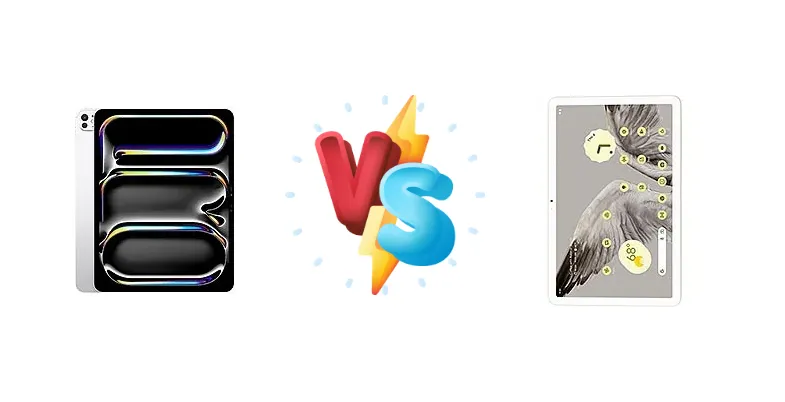
|
🏆 Quick Verdict
For users prioritizing raw power and professional workflows, the Apple iPad Pro 13 (2025) is the clear winner, thanks to the M5 chip and its superior CPU core count. However, the Google Pixel Tablet offers a compelling value proposition for those deeply invested in the Google ecosystem and seeking a tablet that doubles as a smart home hub.
| PHONES | ||
|---|---|---|
| Phone Names | Apple iPad Pro 13 (2025) | Google Pixel Tablet |
| Network | ||
|---|---|---|
| 2G bands | GSM 850 / 900 / 1800 / 1900 - cellular model only | N/A |
| 3G bands | HSDPA 850 / 900 / 1700(AWS) / 1900 / 2100 - cellular model only | N/A |
| 4G bands | 1, 2, 3, 4, 5, 7, 8, 11, 12, 13, 14, 17, 18, 19, 20, 21, 25, 26, 28, 29, 30, 32, 34, 38, 39, 40, 41, 42, 48, 66, 71 - A3361 - cellular model only | N/A |
| 5G bands | 1, 2, 3, 5, 7, 8, 12, 14, 20, 25, 26, 28, 29, 30, 38, 40, 41, 48, 66, 70, 71, 75, 77, 78, 79 SA/NSA/Sub6 - A3361, A3362 - cellular model only | - |
| EDGE | - | No |
| GPRS | - | No |
| Speed | HSPA, LTE, 5G - cellular model only | - |
| Technology | GSM / HSPA / LTE / 5G | No cellular connectivity |
| Launch | ||
|---|---|---|
| Announced | 2025, October 16 | 2023, May 10 |
| Status | Available. Released 2025, October 22 | Available. Released 2023, June 20 |
| Body | ||
|---|---|---|
| Build | Glass front, aluminum back, aluminum frame | Glass front, aluminum frame, aluminum back |
| Dimensions | 281.6 x 215.5 x 5.1 mm (11.09 x 8.48 x 0.20 in) | 258 x 169 x 8.1 mm (10.16 x 6.65 x 0.32 in) |
| SIM | eSIM - cellular model only | No |
| Weight | 579 g (Wi-Fi), 582 g (5G) (1.28 lb) | 493 g (1.09 lb) |
| - | Stylus support | |
| Display | ||
|---|---|---|
| Protection | Scratch-resistant glass, oleophobic coating, Mohs level 4 | - |
| Resolution | 2064 x 2752 pixels, 4:3 ratio (~265 ppi density) | 1600 x 2560 pixels, 16:10 ratio (~276 ppi density) |
| Size | 13.0 inches, 523.4 cm2 (~86.2% screen-to-body ratio) | 10.95 inches, 347.7 cm2 (~79.7% screen-to-body ratio) |
| Type | Ultra Retina Tandem OLED, 120Hz, HDR10, Dolby Vision, 1000 nits (HBM), 1600 nits (peak) | IPS LCD |
| Platform | ||
|---|---|---|
| CPU | 9-core (3 performance cores, 6 efficiency cores) - 256/512GB models10-core (4 performance cores, 6 efficiency cores) - 1/2TB models | Octa-core (2x2.85 GHz Cortex-X1 & 2x2.35 GHz Cortex-A78 & 4x1.80 GHz Cortex-A55) |
| Chipset | Apple M5 | Google Tensor G2 (5 nm) |
| GPU | Apple GPU (10-core graphics) | Mali-G710 MP7 |
| OS | iPadOS 26, upgradable to iPadOS 26.1 | Android 13, upgradable to Android 15 |
| Memory | ||
|---|---|---|
| Card slot | No | No |
| Internal | 256GB 12GB RAM, 512GB 12GB RAM, 1TB 16GB RAM, 2TB 16GB RAM | 128GB 8GB RAM, 256GB 8GB RAM |
| - | UFS 3.1 | |
| Main Camera | ||
|---|---|---|
| Features | Quad-LED dual-tone flash, HDR | HDR, panorama |
| Single | 12 MP, f/1.8, (wide), dual pixel PDAF TOF 3D LiDAR scanner (depth) | 8 MP, f/2.0, 24mm (wide), 1/4.0", 1.12µm |
| Video | 4K@24/25/30/60fps, 1080p@25/30/60/120/240fps; gyro-EIS, ProRes (4K, 1080p) | 1080p@30fps |
| Selfie camera | ||
|---|---|---|
| Features | Face detection, HDR, panorama | HDR, panorama |
| Single | 12 MP, f/2.0, 122˚ (ultrawide) | 8 MP, f/2.0, 24mm (wide), 1/4.0", 1.12µm |
| Video | 1080p@25/30/60fps, gyro-EIS, HDR | 1080p@30fps |
| Sound | ||
|---|---|---|
| 3.5mm jack | - | No |
| 35mm jack | No | No |
| Loudspeaker | Yes, with stereo speakers (4 speakers) | Yes, with stereo speakers (4 speakers) |
| Comms | ||
|---|---|---|
| Bluetooth | 6.0, A2DP, LE, EDR | 5.2, A2DP, LE |
| NFC | No | No |
| Positioning | GPS, GLONASS, GALILEO, QZSS (Wi‑Fi + Cellular model only) | No |
| Radio | No | No |
| USB | USB Type-C 4 (Thunderbolt 3), DisplayPort, magnetic connector | USB Type-C 3.2 (Gen 1), magnetic connector |
| WLAN | Wi-Fi 802.11 a/b/g/n/ac/6e/7, dual-band, hotspot | Wi-Fi 802.11 a/b/g/n/ac/6, dual-band |
| Features | ||
|---|---|---|
| Sensors | Face ID, accelerometer, gyro, compass, barometer | Accelerometer, gyro, compass, proximity (accessories only) |
| - | Ultra Wideband (UWB) support | |
| Battery | ||
|---|---|---|
| Charging | 50% in 30 min | 15W wired |
| Type | Li-Po 10290 mAh | Li-Po 7020 mAh (27 Wh) |
| Misc | ||
|---|---|---|
| Colors | Silver, Space Black | Porcelain, Hazel, Rose |
| Models | A3360, A3361, A3362 | GA06156-EU, GA06157-EU, GA06158-EU |
| Price | About 1450 EUR | About 670 EUR |
| EU LABEL | ||
|---|---|---|
| Battery | 76:00h endurance, 1000 cycles | - |
| Energy | Class G | - |
| Free fall | Class E (40 falls) | - |
| Repairability | Class C | - |
Apple iPad Pro 13 (2025)
- Unmatched performance with the Apple M5 chip
- Exceptional battery life and longevity (76h endurance, 1000 cycles)
- Fast charging (50% in 30 min)
- Likely superior display quality (mini-LED, ProMotion)
- Higher price point
- iPadOS ecosystem may not appeal to all users
Google Pixel Tablet
- Seamless Google ecosystem integration
- Smart home hub functionality
- More affordable price
- Tensor G2 optimized for AI tasks
- Significantly lower performance compared to the M5
- Slower charging (15W wired)
- Likely inferior display quality
Display Comparison
While display specifications are missing for the iPad Pro 13 (2025), Apple typically employs mini-LED backlighting and ProMotion (adaptive refresh rate) technology in its Pro models, suggesting a superior visual experience compared to the Pixel Tablet. The Pixel Tablet’s display, while likely adequate for everyday use, will likely lack the peak brightness and color accuracy of an iPad Pro. The absence of LTPO in the Pixel Tablet suggests a fixed refresh rate, potentially impacting smoothness during scrolling and animations.
Camera Comparison
Camera details are absent for both devices. However, given Apple’s history, the iPad Pro 13 (2025) will likely feature a more sophisticated camera system with larger sensors and advanced image processing capabilities. The Pixel Tablet, while potentially offering Google’s computational photography prowess, will likely prioritize functionality over outright image quality. Without specific sensor sizes or aperture information, it’s difficult to make a definitive comparison, but Apple typically excels in video recording quality.
Performance
The Apple iPad Pro 13 (2025) boasts either a 9-core (256/512GB) or 10-core (1/2TB) CPU built around the Apple M5 chipset, representing a significant leap in performance over the Google Pixel Tablet’s Tensor G2. The Tensor G2, a 5nm chip with an octa-core configuration, is optimized for AI and machine learning tasks, but its Cortex-X1 and Cortex-A78 cores are architecturally older and less powerful than Apple’s custom performance cores. The M5’s higher core count and architectural advantages translate to faster app launch times, smoother multitasking, and superior performance in demanding applications. The iPad Pro’s likely use of LPDDR5X RAM further enhances memory bandwidth, contributing to overall system responsiveness.
Battery Life
The Apple iPad Pro 13 (2025) claims an impressive 76-hour endurance and a 1000-cycle battery lifespan, indicating exceptional longevity and sustained performance over time. While the Pixel Tablet’s battery capacity is unknown, its 15W wired charging is significantly slower than the iPad Pro’s 50% charge in 30 minutes. This faster charging capability on the iPad Pro minimizes downtime and ensures users can quickly get back to work or play. The iPad Pro’s battery endurance suggests a larger capacity, allowing for extended use without needing frequent recharges.
Buying Guide
Buy the Apple iPad Pro 13 (2025) if you need a powerhouse for demanding tasks like video editing, graphic design, or 3D rendering, and if you value the mature iPadOS ecosystem. Buy the Google Pixel Tablet if you prioritize seamless integration with Google Assistant, smart home control, and a more affordable entry point into the tablet space, accepting a performance trade-off.