
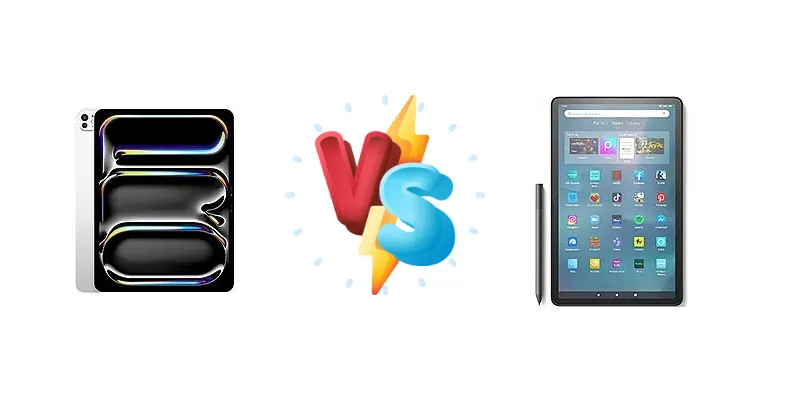
iPad Pro 13 (2025) vs Amazon Fire Max 11: A Deep Dive into Tablet Performance and Value
| Phones Images | |||||
|---|---|---|---|---|---|
|
🏆 Quick Verdict
For demanding users – creative professionals, power users, and those prioritizing longevity – the Apple iPad Pro 13 (2025) is the clear choice. Its M5 chipset and 76-hour battery endurance offer a level of performance and usability the Fire Max 11 simply can’t match. However, the Amazon Fire Max 11 provides a compelling value proposition for casual users focused on media consumption and basic tasks.
| PHONES | ||
|---|---|---|
| Phone Names | Apple iPad Pro 13 (2025) | Amazon Fire Max 11 |
| Network | ||
|---|---|---|
| 2G bands | GSM 850 / 900 / 1800 / 1900 - cellular model only | N/A |
| 3G bands | HSDPA 850 / 900 / 1700(AWS) / 1900 / 2100 - cellular model only | - |
| 4G bands | 1, 2, 3, 4, 5, 7, 8, 11, 12, 13, 14, 17, 18, 19, 20, 21, 25, 26, 28, 29, 30, 32, 34, 38, 39, 40, 41, 42, 48, 66, 71 - A3361 - cellular model only | - |
| 5G bands | 1, 2, 3, 5, 7, 8, 12, 14, 20, 25, 26, 28, 29, 30, 38, 40, 41, 48, 66, 70, 71, 75, 77, 78, 79 SA/NSA/Sub6 - A3361, A3362 - cellular model only | - |
| EDGE | - | No |
| GPRS | - | No |
| Speed | HSPA, LTE, 5G - cellular model only | - |
| Technology | GSM / HSPA / LTE / 5G | No cellular connectivity |
| Launch | ||
|---|---|---|
| Announced | 2025, October 16 | 2023, May 23 |
| Status | Available. Released 2025, October 22 | Available. Released 2023, May 23 |
| Body | ||
|---|---|---|
| Build | Glass front, aluminum back, aluminum frame | - |
| Dimensions | 281.6 x 215.5 x 5.1 mm (11.09 x 8.48 x 0.20 in) | 259.1 x 163.7 x 7.5 mm (10.20 x 6.44 x 0.30 in) |
| SIM | eSIM - cellular model only | No |
| Weight | 579 g (Wi-Fi), 582 g (5G) (1.28 lb) | 490 g (1.08 lb) |
| Display | ||
|---|---|---|
| Protection | Scratch-resistant glass, oleophobic coating, Mohs level 4 | - |
| Resolution | 2064 x 2752 pixels, 4:3 ratio (~265 ppi density) | 2000 x 1200 pixels, 5:3 ratio (~212 ppi density) |
| Size | 13.0 inches, 523.4 cm2 (~86.2% screen-to-body ratio) | 11.0 inches, 344.4 cm2 (~81.2% screen-to-body ratio) |
| Type | Ultra Retina Tandem OLED, 120Hz, HDR10, Dolby Vision, 1000 nits (HBM), 1600 nits (peak) | IPS LCD |
| Platform | ||
|---|---|---|
| CPU | 9-core (3 performance cores, 6 efficiency cores) - 256/512GB models10-core (4 performance cores, 6 efficiency cores) - 1/2TB models | Octa-core (2x2.2 GHz Cortex-A78 & 6x2.0 GHz Cortex-A55) |
| Chipset | Apple M5 | Mediatek MT8188J |
| GPU | Apple GPU (10-core graphics) | Mali-G57 MC2 |
| OS | iPadOS 26, upgradable to iPadOS 26.1 | Android 11, Fire OS 8 |
| Memory | ||
|---|---|---|
| Card slot | No | microSDXC (dedicated slot) |
| Internal | 256GB 12GB RAM, 512GB 12GB RAM, 1TB 16GB RAM, 2TB 16GB RAM | 64GB 4GB RAM, 128GB 4GB RAM |
| Main Camera | ||
|---|---|---|
| Features | Quad-LED dual-tone flash, HDR | - |
| Single | 12 MP, f/1.8, (wide), dual pixel PDAF TOF 3D LiDAR scanner (depth) | 8 MP, AF |
| Video | 4K@24/25/30/60fps, 1080p@25/30/60/120/240fps; gyro-EIS, ProRes (4K, 1080p) | 1080p |
| Selfie camera | ||
|---|---|---|
| Features | Face detection, HDR, panorama | - |
| Single | 12 MP, f/2.0, 122˚ (ultrawide) | 8 MP |
| Video | 1080p@25/30/60fps, gyro-EIS, HDR | 1080p |
| Sound | ||
|---|---|---|
| 35mm jack | No | No |
| Loudspeaker | Yes, with stereo speakers (4 speakers) | Yes, with stereo speakers |
| Comms | ||
|---|---|---|
| Bluetooth | 6.0, A2DP, LE, EDR | 5.3, A2DP, LE |
| NFC | No | No |
| Positioning | GPS, GLONASS, GALILEO, QZSS (Wi‑Fi + Cellular model only) | No |
| Radio | No | No |
| USB | USB Type-C 4 (Thunderbolt 3), DisplayPort, magnetic connector | USB Type-C 2.0, OTG, magnetic accessory connector |
| WLAN | Wi-Fi 802.11 a/b/g/n/ac/6e/7, dual-band, hotspot | Wi-Fi 802.11 a/b/g/n/ac/6, dual-band |
| Features | ||
|---|---|---|
| Sensors | Face ID, accelerometer, gyro, compass, barometer | Fingerprint (side-mounted), accelerometer, proximity (accessories only) |
| Battery | ||
|---|---|---|
| Charging | 50% in 30 min | 15W wired |
| Type | Li-Po 10290 mAh | Li-Ion |
| Misc | ||
|---|---|---|
| Colors | Silver, Space Black | Gray |
| Models | A3360, A3361, A3362 | KFSNWI |
| Price | About 1450 EUR | About 270 EUR |
| EU LABEL | ||
|---|---|---|
| Battery | 76:00h endurance, 1000 cycles | - |
| Energy | Class G | - |
| Free fall | Class E (40 falls) | - |
| Repairability | Class C | - |
Apple iPad Pro 13 (2025)
- Exceptional performance with Apple M5 chip
- Long-lasting battery life (76 hours)
- High-quality display with ProMotion technology (expected)
- Significantly higher price
- Potential for software lock-in within the Apple ecosystem
Amazon Fire Max 11
- Extremely affordable price point
- Access to Amazon’s content ecosystem
- Suitable for basic tasks and media consumption
- Limited performance compared to the iPad Pro
- Lower-quality display (likely IPS LCD)
- Slower charging speed
Display Comparison
While display specifications are absent for the Fire Max 11, the iPad Pro 13 (2025) is expected to feature a Liquid Retina XDR display with ProMotion technology. This implies a high peak brightness, excellent color accuracy, and adaptive refresh rates up to 120Hz. The Fire Max 11, given its price point, likely utilizes an IPS LCD panel. The absence of LTPO in the Fire Max 11 suggests a fixed refresh rate, potentially impacting smoothness during scrolling and animations. The iPad Pro’s superior panel technology will be noticeable to users sensitive to image quality and motion clarity.
Camera Comparison
Camera details for the Fire Max 11 are unavailable, but typically tablets in this price range feature modest camera setups. The iPad Pro 13 (2025) is expected to feature an advanced camera system, though specifics are currently unknown. Given Apple’s history, we can anticipate features like sensor-shift optical image stabilization and advanced image processing algorithms. The M5’s image signal processor (ISP) will contribute to superior image quality and video recording capabilities compared to the Fire Max 11, making the iPad Pro the better choice for content creators.
Performance
The performance gap between these devices is substantial. The Apple iPad Pro 13 (2025) boasts either a 9-core (256/512GB) or 10-core (1/2TB) CPU built around the Apple M5 chipset. This architecture, with its dedicated performance and efficiency cores, delivers significantly faster processing speeds and improved power efficiency compared to the Amazon Fire Max 11’s Mediatek MT8188J. The MT8188J, an octa-core processor, is adequate for basic tasks, but will struggle with demanding applications and multitasking. The M5’s unified memory architecture and optimized software integration further enhance the iPad Pro’s performance advantage, particularly in graphics-intensive workloads.
Battery Life
The Apple iPad Pro 13 (2025) offers a remarkable 76-hour battery endurance and is rated for 1000 charge cycles, indicating exceptional longevity. The Amazon Fire Max 11, with its 15W wired charging, will likely have a shorter battery life and a lower cycle count. While 15W charging is sufficient for casual use, the iPad Pro’s faster charging (50% in 30 minutes) minimizes downtime. The iPad Pro’s superior battery endurance is particularly beneficial for users who rely on their tablet for extended periods away from a power source.
Buying Guide
Buy the Apple iPad Pro 13 (2025) if you require professional-grade performance for tasks like video editing, graphic design, or demanding gaming, and if long-term battery health and software support are critical. Buy the Amazon Fire Max 11 if you prioritize affordability, primarily consume media, and need a tablet for light productivity tasks like email and web browsing, and are comfortable with Amazon’s Fire OS ecosystem.