
Apple iPad Pro 13 (2024) vs. Lenovo Tab P12 Pro: A Deep Dive into Performance and Value
| Phones Images | |||||
|---|---|---|---|---|---|
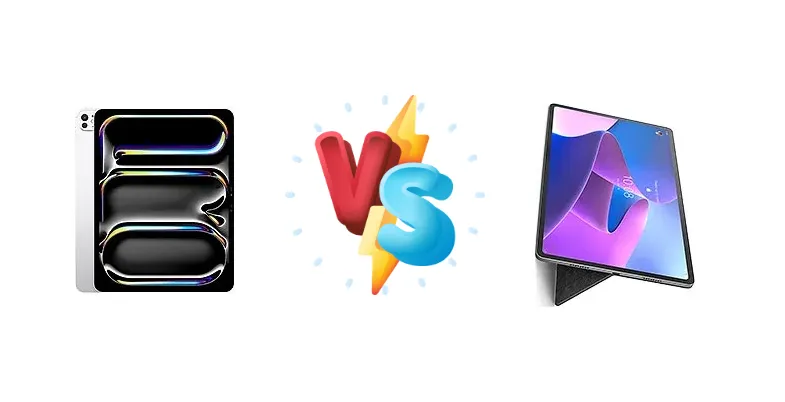
|
🏆 Quick Verdict
For demanding creative professionals and power users, the Apple iPad Pro 13 (2024) is the clear winner, thanks to the M4 chip's superior processing capabilities and impressive 77-hour battery endurance. However, the Lenovo Tab P12 Pro offers excellent value and 5G connectivity for everyday tasks and media consumption.
| PHONES | ||
|---|---|---|
| Phone Names | Apple iPad Pro 13 (2024) | Lenovo Tab P12 Pro |
| Network | ||
|---|---|---|
| 2G bands | GSM 850 / 900 / 1800 / 1900 | GSM 850 / 900 / 1800 / 1900 |
| 3G bands | HSDPA 850 / 900 / 1700(AWS) / 1900 / 2100 | HSDPA 850 / 900 / 1900 / 2100 |
| 4G bands | 1, 2, 3, 4, 5, 7, 8, 11, 12, 13, 14, 17, 18, 19, 20, 21, 25, 26, 28, 29, 30, 32, 34, 38, 39, 40, 41, 42, 48, 66, 71 - A2926 | 1, 2, 3, 4, 5, 7, 8, 19, 20, 26, 28, 34, 38, 39, 40, 41 |
| 5G bands | 1, 2, 3, 5, 7, 8, 12, 14, 20, 25, 26, 28, 29, 30, 38, 40, 41, 48, 66, 70, 71, 75, 76, 77, 78, 79 - A2926, A3007 | 1, 3, 7, 8, 20, 28, 38, 41, 77, 78 SA/NSA/Sub6 |
| Speed | HSPA, LTE, 5G | HSPA, LTE, 5G - cellular model only |
| Technology | GSM / HSPA / LTE / 5G | GSM / HSPA / LTE / 5G |
| Launch | ||
|---|---|---|
| Announced | 2024, May 07 | 2021, September 08 |
| Status | Available. Released 2024, May 15 | Available. Released 2021, November 19 |
| Body | ||
|---|---|---|
| Build | Glass front, aluminum back, aluminum frame | - |
| Dimensions | 281.6 x 215.5 x 5.1 mm (11.09 x 8.48 x 0.20 in) | 285.6 x 184.5 x 5.6 mm (11.24 x 7.26 x 0.22 in) |
| SIM | eSIM | Nano-SIM (cellular model only) |
| Weight | 579 g (Wi-Fi), 582 g (5G) (1.28 lb) | 565 g (1.25 lb) |
| - | Stylus support | |
| Display | ||
|---|---|---|
| Protection | Scratch-resistant glass, oleophobic coating, Mohs level 4 | - |
| Resolution | 2064 x 2752 pixels, 4:3 ratio (~264 ppi density) | 1600 x 2560 pixels, 16:10 ratio (~240 ppi density) |
| Size | 13.0 inches, 527.3 cm2 (~86.9% screen-to-body ratio) | 12.6 inches, 460.3 cm2 (~87.4% screen-to-body ratio) |
| Type | Ultra Retina Tandem OLED, 120Hz, HDR10, Dolby Vision, 1000 nits (HBM), 1600 nits (peak) | AMOLED, 120Hz, HDR10+, Dolby Vision, 600 nits (HBM) |
| Platform | ||
|---|---|---|
| CPU | 9-core 4.4 GHz (3 performance cores, 6 efficiency cores) - 256/512GB models10-core 4.4 GHz (4 performance cores, 6 efficiency cores) - 1/2TB models | Octa-core (1x3.2 GHz Kryo 585 & 3x2.42 GHz Kryo 585 & 4x1.80 GHz Kryo 585) |
| Chipset | Apple M4 | Qualcomm SM8250-AC Snapdragon 870 5G (7 nm) |
| GPU | Apple GPU (10-core graphics) | Adreno 650 |
| OS | iPadOS 17.5.1, upgradable to iPadOS 26.1 | Android 11 |
| Memory | ||
|---|---|---|
| Card slot | No | microSDXC (dedicated slot) |
| Internal | 256GB 8GB RAM, 512GB 8GB RAM, 1TB 16GB RAM, 2TB 16GB RAM | 128GB 6GB RAM, 256GB 8GB RAM |
| Main Camera | ||
|---|---|---|
| Dual | - | 13 MP, (wide), AF 5 MP, (ultrawide) |
| Features | Quad-LED dual-tone flash, HDR | - |
| Single | 12 MP, f/1.8, (wide), dual pixel PDAF TOF 3D LiDAR scanner (depth) | - |
| Video | 4K@24/25/30/60fps, 1080p@25/30/60/120/240fps; gyro-EIS, ProRes (4K, 1080p) | 4K@30fps, 1080p@30fps |
| Selfie camera | ||
|---|---|---|
| Features | Face detection, HDR, panorama | - |
| Single | 12 MP, f/2.4, 122˚ (ultrawide) | 8 MP, (wide) 8 MP, IR TOF 3D, (biometrics sensor only) |
| Video | 1080p@25/30/60fps, gyro-EIS, HDR | 1080p@30fps |
| Sound | ||
|---|---|---|
| 3.5mm jack | - | No |
| 35mm jack | No | No |
| Loudspeaker | Yes, with stereo speakers (4 speakers) | Yes, with stereo speakers (4 speakers) |
| - | JBL speakers | |
| Comms | ||
|---|---|---|
| Bluetooth | 5.3, A2DP, LE, EDR | 5.2, A2DP, LE |
| NFC | No | Yes (wireless charging and data transfer only) |
| Positioning | GPS, GLONASS, GALILEO, QZSS (Wi‑Fi + Cellular model only) | GPS, GLONASS, BDS - cellular model only |
| Radio | No | Unspecified |
| USB | USB Type-C 4 (Thunderbolt 3), DisplayPort, magnetic connector | USB Type-C 3.1 |
| WLAN | Wi-Fi 802.11 a/b/g/n/ac/6e, dual-band, hotspot | Wi-Fi 802.11 a/b/g/n/ac/6, dual-band, Wi-Fi Direct |
| Features | ||
|---|---|---|
| Sensors | Face ID, accelerometer, gyro, compass, barometer | Fingerprint (side-mounted), accelerometer, gyro, proximity |
| Battery | ||
|---|---|---|
| Charging | - | 45W wired, QC4 |
| Type | Li-Po 10290 mAh | Li-Po 10200 mAh |
| Misc | ||
|---|---|---|
| Colors | Silver, Space Black | Storm Grey |
| Models | A2925, A2926, A3007, iPad16,5, iPad16,6 | TB-Q706Z, TB-Q706F |
| Price | About 1550 EUR | About 520 EUR |
| EU LABEL | ||
|---|---|---|
| Battery | 77:00h endurance, 1000 cycles | - |
| Energy | Class G | - |
| Free fall | Class E (0 falls) | - |
| Repairability | Class C | - |
Apple iPad Pro 13 (2024)
- Unmatched performance with Apple M4 chip
- Exceptional battery life (77 hours)
- Long-term battery health (1000 cycles)
- Higher price point
- Potential for software ecosystem lock-in
Lenovo Tab P12 Pro
- More affordable price
- 5G connectivity for on-the-go access
- Fast charging with 45W QC4
- Less powerful processor (Snapdragon 870)
- Potentially shorter battery lifespan
Display Comparison
While display specifications are missing for the Lenovo Tab P12 Pro, the iPad Pro 13 (2024) is expected to feature a Liquid Retina XDR display with ProMotion technology. The Lenovo Tab P12 Pro's display is likely a high-resolution LCD, but without specific nit brightness or color accuracy data, a direct comparison is difficult. The iPad Pro's potential for LTPO technology suggests variable refresh rates for improved power efficiency and smoother visuals, a feature likely absent on the Lenovo model.
Camera Comparison
Camera details for both devices are limited. However, given Apple’s focus on computational photography, the iPad Pro 13 (2024) is expected to offer superior image processing. The Snapdragon 870’s ISP is capable, but likely won’t match the M4’s advanced capabilities. Without specific sensor sizes or aperture information for the Lenovo Tab P12 Pro, it’s difficult to assess its low-light performance relative to the iPad Pro.
Performance
The core difference lies in the chipsets. The Apple iPad Pro 13 (2024) utilizes the Apple M4, available in 9-core (256/512GB) and 10-core (1/2TB) configurations, both clocked at 4.4 GHz. This represents a significant architectural advantage over the Lenovo Tab P12 Pro’s Qualcomm Snapdragon 870 5G (7nm). The M4’s unified memory architecture and optimized neural engine will deliver substantially faster performance in demanding applications and machine learning tasks. The Snapdragon 870, while capable, is a generation behind and will exhibit throttling under sustained load compared to the M4’s superior thermal management.
Battery Life
The Apple iPad Pro 13 (2024) boasts an impressive 77-hour endurance and a 1000-cycle battery lifespan, indicating a focus on long-term battery health. The Lenovo Tab P12 Pro offers 45W wired charging with Quick Charge 4 (QC4) support, allowing for faster charging speeds. While the Tab P12 Pro’s battery capacity is unknown, the iPad Pro’s endurance suggests a larger battery or significantly more efficient power management thanks to the M4 chip.
Buying Guide
Buy the Apple iPad Pro 13 (2024) if you require uncompromising performance for tasks like video editing, 3D rendering, or professional-grade graphic design, and value long-term battery health with its 1000 charge cycles. Buy the Lenovo Tab P12 Pro if you prioritize a more affordable tablet with 5G connectivity for on-the-go productivity, streaming, and casual gaming, and appreciate the convenience of 45W Quick Charge.