
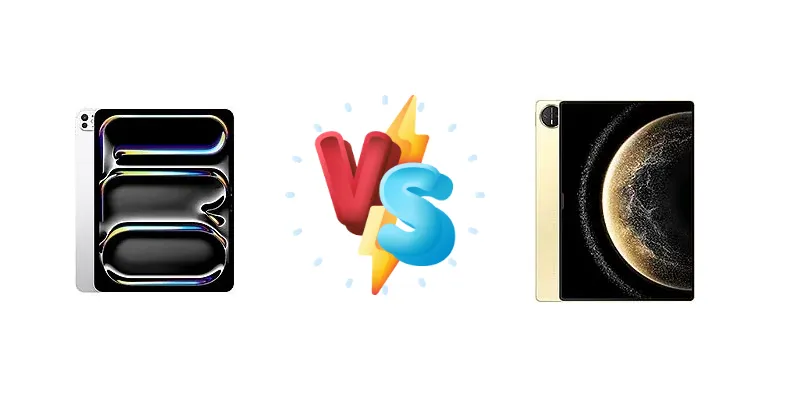
Apple iPad Pro 13 (2024) vs Huawei MatePad Pro 13.2 (2025): A Deep Dive into Performance and Power
| Phones Images | |||||
|---|---|---|---|---|---|
|
🏆 Quick Verdict
For users deeply embedded in the Apple ecosystem and prioritizing sustained performance for demanding tasks, the iPad Pro 13 (2024) with its M4 chip is the clear winner. However, the Huawei MatePad Pro 13.2 (2025) offers a compelling alternative with its rapid 100W charging, potentially appealing to those prioritizing convenience and quick power-ups.
| PHONES | ||
|---|---|---|
| Phone Names | Apple iPad Pro 13 (2024) | Huawei MatePad Pro 13.2 (2025) |
| Network | ||
|---|---|---|
| 2G bands | GSM 850 / 900 / 1800 / 1900 | GSM 850 / 900 / 1800 / 1900 |
| 3G bands | HSDPA 850 / 900 / 1700(AWS) / 1900 / 2100 | HSDPA 850 / 900 / 1900 / 2100 |
| 4G bands | 1, 2, 3, 4, 5, 7, 8, 11, 12, 13, 14, 17, 18, 19, 20, 21, 25, 26, 28, 29, 30, 32, 34, 38, 39, 40, 41, 42, 48, 66, 71 - A2926 | LTE |
| 5G bands | 1, 2, 3, 5, 7, 8, 12, 14, 20, 25, 26, 28, 29, 30, 38, 40, 41, 48, 66, 70, 71, 75, 76, 77, 78, 79 - A2926, A3007 | - |
| Speed | HSPA, LTE, 5G | HSPA, LTE - cellular model only |
| Technology | GSM / HSPA / LTE / 5G | GSM / HSPA / LTE |
| Launch | ||
|---|---|---|
| Announced | 2024, May 07 | 2024, November 26 |
| Status | Available. Released 2024, May 15 | Available. Released 2024, December 12 |
| Body | ||
|---|---|---|
| Build | Glass front, aluminum back, aluminum frame | Glass front, nylon fiber back, magnesium alloy frame |
| Dimensions | 281.6 x 215.5 x 5.1 mm (11.09 x 8.48 x 0.20 in) | 289.1 x 196.1 x 5.5 mm (11.38 x 7.72 x 0.22 in) |
| SIM | eSIM | Nano-SIM (cellular model only) |
| Weight | 579 g (Wi-Fi), 582 g (5G) (1.28 lb) | 580 g (Wi-FI) or 590 g (LTE) (1.28 lb) |
| Display | ||
|---|---|---|
| Protection | Scratch-resistant glass, oleophobic coating, Mohs level 4 | - |
| Resolution | 2064 x 2752 pixels, 4:3 ratio (~264 ppi density) | 2880 x 1920 pixels, 3:2 ratio (~262 ppi density) |
| Size | 13.0 inches, 527.3 cm2 (~86.9% screen-to-body ratio) | 13.2 inches, 518.8 cm2 (~91.5% screen-to-body ratio) |
| Type | Ultra Retina Tandem OLED, 120Hz, HDR10, Dolby Vision, 1000 nits (HBM), 1600 nits (peak) | OLED, 1B colors, 144Hz, HDR Vivid, 1000 nits (peak) |
| Platform | ||
|---|---|---|
| CPU | 9-core 4.4 GHz (3 performance cores, 6 efficiency cores) - 256/512GB models10-core 4.4 GHz (4 performance cores, 6 efficiency cores) - 1/2TB models | Octa-core |
| Chipset | Apple M4 | Kirin T92 |
| GPU | Apple GPU (10-core graphics) | - |
| OS | iPadOS 17.5.1, upgradable to iPadOS 26.1 | Harmony OS 4.3 |
| Memory | ||
|---|---|---|
| Card slot | No | No |
| Internal | 256GB 8GB RAM, 512GB 8GB RAM, 1TB 16GB RAM, 2TB 16GB RAM | 256GB 12GB RAM, 512GB 12GB RAM, 1TB 16GB RAM |
| Main Camera | ||
|---|---|---|
| Dual | - | 50 MP, f/1.8, (wide), PDAF 8 MP, f/2.2, (ultrawide) |
| Features | Quad-LED dual-tone flash, HDR | LED flash |
| Single | 12 MP, f/1.8, (wide), dual pixel PDAF TOF 3D LiDAR scanner (depth) | - |
| Video | 4K@24/25/30/60fps, 1080p@25/30/60/120/240fps; gyro-EIS, ProRes (4K, 1080p) | 4K@30fps, 1080p@30fps |
| Selfie camera | ||
|---|---|---|
| Features | Face detection, HDR, panorama | - |
| Single | 12 MP, f/2.4, 122˚ (ultrawide) | 16 MP, f/2.2 |
| Video | 1080p@25/30/60fps, gyro-EIS, HDR | 1080p@30fps |
| Sound | ||
|---|---|---|
| 35mm jack | No | No |
| Loudspeaker | Yes, with stereo speakers (4 speakers) | Yes, with stereo speakers (6 speakers) |
| Comms | ||
|---|---|---|
| Bluetooth | 5.3, A2DP, LE, EDR | 5.2, A2DP, LE, L2HC |
| NFC | No | No |
| Positioning | GPS, GLONASS, GALILEO, QZSS (Wi‑Fi + Cellular model only) | GPS, GALILEO, GLONASS, BDS |
| Radio | No | No |
| USB | USB Type-C 4 (Thunderbolt 3), DisplayPort, magnetic connector | USB Type-C 3.1, OTG, DisplayPort 1.2, accessory connector pins |
| WLAN | Wi-Fi 802.11 a/b/g/n/ac/6e, dual-band, hotspot | Wi-Fi 802.11 a/b/g/n/ac/6, dual-band |
| Features | ||
|---|---|---|
| Sensors | Face ID, accelerometer, gyro, compass, barometer | Fingerprint (side-mounted), accelerometer, gyro, compass, proximity (accessories only) |
| Battery | ||
|---|---|---|
| Charging | - | 100W wired 7.5W reverse wired |
| Type | Li-Po 10290 mAh | Li-Po 10100 mAh |
| Misc | ||
|---|---|---|
| Colors | Silver, Space Black | Black, White, Gold |
| Models | A2925, A2926, A3007, iPad16,5, iPad16,6 | WEB-W00, PCE-W29 |
| Price | About 1550 EUR | About 680 EUR |
| EU LABEL | ||
|---|---|---|
| Battery | 77:00h endurance, 1000 cycles | - |
| Energy | Class G | - |
| Free fall | Class E (0 falls) | - |
| Repairability | Class C | - |
Apple iPad Pro 13 (2024)
- Superior processing power with the Apple M4 chip.
- Exceptional battery life and longevity (77h endurance, 1000 cycles).
- Seamless integration with the Apple ecosystem.
- Potentially higher price point.
- Software ecosystem can be restrictive for some users.
Huawei MatePad Pro 13.2 (2025)
- Ultra-fast 100W wired charging.
- Potentially more open software environment.
- Competitive price point compared to the iPad Pro.
- Kirin T92 chipset likely lags behind the M4 in sustained performance.
- Battery endurance figures are currently unknown.
Display Comparison
While specific display details are absent, both tablets target the premium segment, suggesting high-quality panels. The iPad Pro’s likely use of ProMotion (LTPO) technology for adaptive refresh rates would provide smoother scrolling and animations, potentially offering an advantage over a standard refresh rate panel on the MatePad Pro. Bezels are expected to be minimal on both, but the iPad Pro’s tighter integration with Apple’s display calibration processes likely results in superior color accuracy out of the box.
Camera Comparison
Without specific camera specs, a direct comparison is difficult. However, given Apple’s history, the iPad Pro likely features a more sophisticated image signal processor (ISP) and potentially larger sensor sizes, resulting in better low-light performance and dynamic range. Huawei often focuses on computational photography, so the MatePad Pro may offer vibrant, processed images, but likely won't match the iPad Pro's natural image quality. The absence of details suggests neither tablet prioritizes camera capabilities as a primary selling point.
Performance
The core of this comparison lies in the chipset battle. Apple’s M4, with its 9 or 10 cores (depending on storage configuration), represents a significant architectural advantage over the Huawei Kirin T92’s octa-core design. The M4’s unified memory architecture and dedicated neural engine will excel in tasks like machine learning and video processing. While the Kirin T92 is a capable chip, the M4’s raw processing power and efficiency, coupled with LPDDR5X RAM, will translate to noticeably faster performance in demanding applications. The M4’s 4.4 GHz clock speed also suggests a performance edge.
Battery Life
The iPad Pro 13 (2024) boasts an impressive 77-hour endurance and a 1000-cycle battery lifespan, indicating a focus on long-term reliability and usability. While the MatePad Pro 13.2 (2025) lacks specific endurance figures, its 100W wired charging is a significant advantage. This allows for incredibly fast charging times, potentially mitigating any capacity differences. The 7.5W reverse wired charging on the MatePad Pro is a useful addition for topping up accessories.
Buying Guide
Buy the Apple iPad Pro 13 (2024) if you require the absolute best sustained performance for professional workflows like video editing, 3D rendering, or complex graphic design, and value the seamless integration with other Apple devices. Buy the Huawei MatePad Pro 13.2 (2025) if you prioritize fast charging, appreciate a potentially more open software ecosystem, and seek a premium tablet experience without the Apple price premium.