
Apple iPad Pro 12.9 (2021) vs Xiaomi Pad 6 Pro: A Deep Dive into Tablet Power
| Phones Images | |||||
|---|---|---|---|---|---|
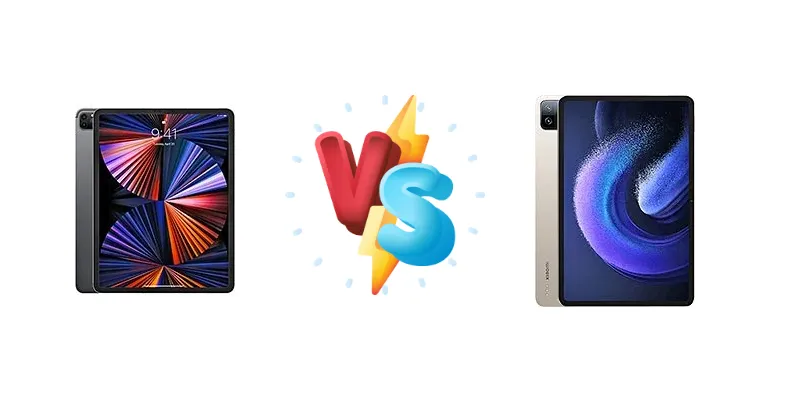
|
🏆 Quick Verdict
For professional creative workflows demanding sustained performance and a mature ecosystem, the iPad Pro 12.9 (2021) remains the superior choice. However, the Xiaomi Pad 6 Pro delivers exceptional value with its Snapdragon 8+ Gen 1, fast 67W charging, and competitive price, making it ideal for gamers and everyday users.
| PHONES | ||
|---|---|---|
| Phone Names | Apple iPad Pro 12.9 (2021) | Xiaomi Pad 6 Pro |
| Network | ||
|---|---|---|
| 2G bands | GSM 850 / 900 / 1800 / 1900 | N/A |
| 3G bands | HSDPA 850 / 900 / 1700(AWS) / 1900 / 2100 | N/A |
| 4G bands | 1, 2, 3, 4, 5, 7, 8, 11, 12, 13, 14, 17, 18, 19, 20, 21, 25, 26, 28, 29, 30, 32, 34, 38, 39, 40, 41, 42, 46, 48, 66, 71 - A2379, A2461, A2462 | - |
| 5G bands | 1, 2, 3, 5, 7, 8, 12, 20, 25, 28, 38, 40, 41, 66, 71, 77, 78, 79, 260, 261 SA/NSA/Sub6/mmWave - A2379 | - |
| EDGE | - | N/A |
| GPRS | - | N/A |
| Speed | HSPA, LTE, EV-DO Rev.A 3.1 Mbps, 5G | - |
| Technology | GSM / CDMA / HSPA / EVDO / LTE / 5G | No cellular connectivity |
| 1, 2, 3, 5, 7, 8, 12, 20, 25, 28, 38, 40, 41, 66, 71, 77, 78, 79 SA/NSA/Sub6 - A2461, A2462 | - | |
| Launch | ||
|---|---|---|
| Announced | 2021, April 20 | 2023, April 18 |
| Status | Available. Released 2021, May 21 | Available. Released 2023, April 30 |
| Body | ||
|---|---|---|
| Build | Glass front, aluminum back, aluminum frame | Glass front (Gorilla Glass 3), aluminum frame, aluminum back |
| Dimensions | 280.6 x 214.9 x 6.4 mm (11.05 x 8.46 x 0.25 in) | 254 x 165.2 x 6.5 mm (10.0 x 6.50 x 0.26 in) |
| SIM | Nano-SIM + eSIM | No |
| Weight | 682 g (Wi-Fi), 685 g (5G) (1.50 lb) | 490 g (1.08 lb) |
| Stylus support (Bluetooth integration; magnetic) | Stylus support (magnetic) | |
| Display | ||
|---|---|---|
| Protection | Scratch-resistant glass, oleophobic coating | Corning Gorilla Glass 3 |
| Resolution | 2048 x 2732 pixels, 4:3 ratio (~265 ppi density) | 1800 x 2880 pixels, 16:10 ratio (~309 ppi density) |
| Size | 12.9 inches, 515.3 cm2 (~85.4% screen-to-body ratio) | 11.0 inches, 350.9 cm2 (~83.6% screen-to-body ratio) |
| Type | Liquid Retina XDR mini-LED LCD, 120Hz, HDR10, Dolby Vision, 1000 nits (typ), 1600 nits (peak) | IPS LCD, 1B colors, 144Hz, HDR10, Dolby Vision, 550 nits |
| Platform | ||
|---|---|---|
| CPU | Octa-core (4x3.2 GHz & 4xX.X GHz) | Octa-core (1x3.19 GHz Cortex-X2 & 3x2.75 GHz Cortex-A710 & 4x1.80 GHz Cortex-A510) |
| Chipset | Apple M1 | Qualcomm SM8475 Snapdragon 8+ Gen 1 (4 nm) |
| GPU | Apple GPU (8-core graphics) | Adreno 730 |
| OS | iPadOS 14.5.1, upgradable to iPadOS 26.1 | Android 13, MIUI 14 |
| Memory | ||
|---|---|---|
| Card slot | No | No |
| Internal | 128GB 8GB RAM, 256GB 8GB RAM, 512GB 8GB RAM, 1TB 16GB RAM, 2TB 16GB RAM | 128GB 8GB RAM, 256GB 8GB RAM, 256GB 12GB RAM, 512GB 12GB RAM |
| - | UFS 3.1 | |
| Main Camera | ||
|---|---|---|
| Dual | 12 MP, f/1.8, (wide), 1/3.0", 1.22µm, dual pixel PDAF 10 MP, f/2.4, 125˚ (ultrawide) TOF 3D LiDAR scanner (depth) | 50 MP, f/1.8, (wide), 1/2.76", 0.64µm, PDAF Auxiliary lens |
| Features | Quad-LED dual-tone flash, HDR | Dual-LED flash, HDR, panorama |
| Single | 12 MP, f/2.4, 122˚ (ultrawide) | - |
| Video | 4K@24/25/30/60fps, 1080p@25/30/60/120/240fps; gyro-EIS | 4K@30/60fps, 1080p@30/60fps |
| Selfie camera | ||
|---|---|---|
| Features | Face detection, HDR, panorama | - |
| Single | 12 MP, f/2.4, 122˚ (ultrawide) | 20 MP, f/2.2, (wide), 1/3.4", 0.8µm |
| Video | 1080p@25/30/60fps, gyro-EIS | 1080p@30/60fps |
| Sound | ||
|---|---|---|
| 3.5mm jack | No | No |
| 35mm jack | No | No |
| Loudspeaker | Yes, with stereo speakers (4 speakers) | Yes, with stereo speakers (4 speakers) |
| - | 24-bit/192kHz audio | |
| Comms | ||
|---|---|---|
| Bluetooth | 5.0, A2DP, LE, EDR | 5.3, A2DP, LE |
| NFC | No | No |
| Positioning | GPS, GLONASS, GALILEO, QZSS (Wi‑Fi + Cellular model only) | No |
| Radio | No | No |
| USB | USB Type-C 4 (Thunderbolt 4), DisplayPort, magnetic connector | USB Type-C 3.2, accessory connector |
| WLAN | Wi-Fi 802.11 a/b/g/n/ac/6, dual-band, hotspot | Wi-Fi 802.11 a/b/g/n/a/6e, dual-band, Wi-Fi Direct |
| Features | ||
|---|---|---|
| Sensors | Face ID, accelerometer, gyro, barometer | Accelerometer, gyro, proximity (accessories only) |
| Battery | ||
|---|---|---|
| Charging | - | 67W wired, PD3.0, QC4, 100% in 1 hour |
| Type | Li-Po 10758 mAh (40.88 Wh) | Li-Po 8600 mAh |
| Misc | ||
|---|---|---|
| Colors | Silver, Space Gray | Black, Blue, Gold |
| Models | A2379, A2461, A2462, iPad13,8, iPad13,9, iPad13,10, iPad13,11 | 23046RP50C |
| Price | About 1200 EUR | About 330 EUR |
Apple iPad Pro 12.9 (2021)
- Exceptional M1 performance for demanding tasks
- Industry-leading Liquid Retina XDR display with ProMotion
- Mature iPadOS ecosystem with extensive app support
- Significantly higher price
- Slower charging speeds
Xiaomi Pad 6 Pro
- Excellent Snapdragon 8+ Gen 1 performance
- Ultra-fast 67W charging
- More affordable price point
- Android tablet app ecosystem less mature than iPadOS
- Camera system likely less refined than iPad Pro
Display Comparison
While both tablets offer excellent displays, key differences exist. The iPad Pro 12.9 (2021) utilizes a Liquid Retina XDR display with mini-LED backlighting, offering exceptional contrast and brightness, though specific nit values aren't provided. The Xiaomi Pad 6 Pro’s display specs are not provided, but Xiaomi typically focuses on color accuracy and high refresh rates. The iPad Pro’s ProMotion technology (LTPO) dynamically adjusts the refresh rate up to 120Hz for smoother scrolling and animations, a feature likely present on the Pad 6 Pro as well, though its implementation may differ. Bezels are likely comparable, with both aiming for a modern, immersive viewing experience.
Camera Comparison
Camera performance isn’t a primary focus for tablets, but differences exist. The iPad Pro 12.9 (2021) features a more sophisticated camera system, though specific details aren’t provided. The Xiaomi Pad 6 Pro’s camera specs are not provided, but Xiaomi typically includes a capable main sensor. Image processing will differ significantly, with Apple prioritizing natural colors and detail, while Xiaomi may lean towards more vibrant, social media-friendly images. The absence of detailed camera specs for the Xiaomi Pad 6 Pro makes a definitive comparison difficult.
Performance
The core of this comparison lies in the chipsets. Apple’s M1, an octa-core processor with 4 performance cores clocked at 3.2 GHz, is renowned for its efficiency and raw power. The Xiaomi Pad 6 Pro counters with the Qualcomm Snapdragon 8+ Gen 1 (4nm), an octa-core CPU featuring a Cortex-X2 prime core at 3.19 GHz, alongside Cortex-A710 and A510 cores. The 4nm process node of the Snapdragon 8+ Gen 1 provides improved thermal efficiency compared to older Snapdragon generations, potentially mitigating throttling during extended gaming sessions. While the M1 generally outperforms the Snapdragon 8+ Gen 1 in sustained CPU-intensive tasks, the Snapdragon’s Adreno GPU is a strong contender for gaming. Both devices likely utilize LPDDR5 RAM, but the iPad Pro may benefit from Apple’s memory optimization.
Battery Life
Battery capacity details for both tablets are unavailable. However, the Xiaomi Pad 6 Pro boasts a significant advantage with its 67W wired charging, supporting PD3.0 and QC4, achieving a full charge in approximately one hour. Apple’s iPad Pro charging speeds are considerably slower, typically requiring several hours for a full charge. This faster charging capability is a major convenience factor for the Xiaomi Pad 6 Pro, offsetting any potential difference in battery capacity.
Buying Guide
Buy the Apple iPad Pro 12.9 (2021) if you require the industry-leading performance of the M1 chip for demanding tasks like video editing, 3D rendering, or professional-grade graphic design, and if you’re invested in the Apple ecosystem. Buy the Xiaomi Pad 6 Pro if you prioritize gaming, fast charging, and a more open Android experience, all at a significantly lower price point.