
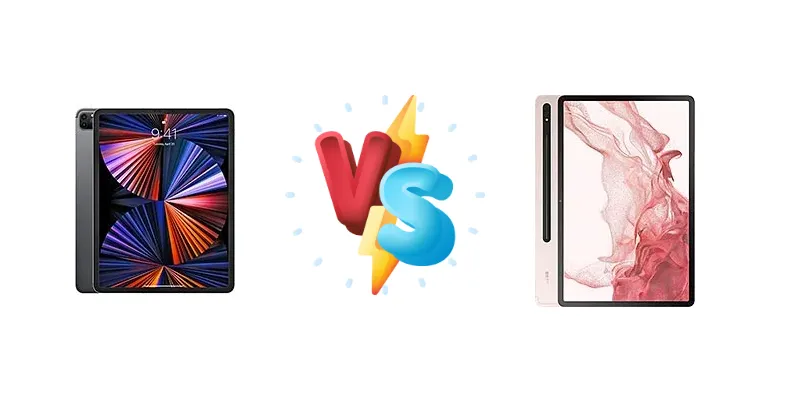
Apple iPad Pro 12.9 (2021) vs Samsung Galaxy Tab S8+: A Deep Dive into Tablet Powerhouses
| Phones Images | |||||
|---|---|---|---|---|---|
|
🏆 Quick Verdict
For users deeply embedded in the Apple ecosystem and prioritizing raw CPU performance for tasks like video editing, the iPad Pro 12.9 (2021) is the clear winner. However, the Samsung Galaxy Tab S8+ offers a more versatile Android experience with faster charging and a compelling price point, making it ideal for those seeking flexibility and gaming prowess.
| PHONES | ||
|---|---|---|
| Phone Names | Apple iPad Pro 12.9 (2021) | Samsung Galaxy Tab S8+ |
| Network | ||
|---|---|---|
| 2G bands | GSM 850 / 900 / 1800 / 1900 | GSM 850 / 900 / 1800 / 1900 |
| 3G bands | HSDPA 850 / 900 / 1700(AWS) / 1900 / 2100 | HSDPA 850 / 900 / 1700(AWS) / 1900 / 2100 |
| 4G bands | 1, 2, 3, 4, 5, 7, 8, 11, 12, 13, 14, 17, 18, 19, 20, 21, 25, 26, 28, 29, 30, 32, 34, 38, 39, 40, 41, 42, 46, 48, 66, 71 - A2379, A2461, A2462 | LTE |
| 5G bands | 1, 2, 3, 5, 7, 8, 12, 20, 25, 28, 38, 40, 41, 66, 71, 77, 78, 79, 260, 261 SA/NSA/Sub6/mmWave - A2379 | SA/NSA |
| Speed | HSPA, LTE, EV-DO Rev.A 3.1 Mbps, 5G | HSPA, LTE, 5G - cellular model only |
| Technology | GSM / CDMA / HSPA / EVDO / LTE / 5G | GSM / HSPA / LTE / 5G |
| 1, 2, 3, 5, 7, 8, 12, 20, 25, 28, 38, 40, 41, 66, 71, 77, 78, 79 SA/NSA/Sub6 - A2461, A2462 | - | |
| Launch | ||
|---|---|---|
| Announced | 2021, April 20 | 2022, February 09 |
| Status | Available. Released 2021, May 21 | Available. Released 2022, April 14 |
| Body | ||
|---|---|---|
| Build | Glass front, aluminum back, aluminum frame | - |
| Dimensions | 280.6 x 214.9 x 6.4 mm (11.05 x 8.46 x 0.25 in) | 285 x 185 x 5.7 mm (11.22 x 7.28 x 0.22 in) |
| SIM | Nano-SIM + eSIM | Nano-SIM (cellular model only) |
| Weight | 682 g (Wi-Fi), 685 g (5G) (1.50 lb) | 567 g (Wi-Fi), 572 g (5G) (1.25 lb) |
| Stylus support (Bluetooth integration; magnetic) | Stylus, 6.2ms latency (Bluetooth integration, accelerometer, gyro) | |
| Display | ||
|---|---|---|
| Protection | Scratch-resistant glass, oleophobic coating | Corning Gorilla Glass 5 |
| Resolution | 2048 x 2732 pixels, 4:3 ratio (~265 ppi density) | 1752 x 2800 pixels, 16:10 ratio (~266 ppi density) |
| Size | 12.9 inches, 515.3 cm2 (~85.4% screen-to-body ratio) | 12.4 inches, 446.1 cm2 (~84.6% screen-to-body ratio) |
| Type | Liquid Retina XDR mini-LED LCD, 120Hz, HDR10, Dolby Vision, 1000 nits (typ), 1600 nits (peak) | Super AMOLED, 120Hz, HDR10+ |
| Platform | ||
|---|---|---|
| CPU | Octa-core (4x3.2 GHz & 4xX.X GHz) | Octa-core (1x3.00 GHz Cortex-X2 & 3x2.50 GHz Cortex-A710 & 4x1.80 GHz Cortex-A510) |
| Chipset | Apple M1 | Qualcomm SM8450 Snapdragon 8 Gen 1 (4 nm) |
| GPU | Apple GPU (8-core graphics) | Adreno 730 |
| OS | iPadOS 14.5.1, upgradable to iPadOS 26.1 | Android 12, up to 4 major Android upgrades, One UI 6.1.1 |
| Memory | ||
|---|---|---|
| Card slot | No | microSDXC (dedicated slot) |
| Internal | 128GB 8GB RAM, 256GB 8GB RAM, 512GB 8GB RAM, 1TB 16GB RAM, 2TB 16GB RAM | 128GB 8GB RAM, 256GB 8GB RAM, 256GB 12GB RAM, 512GB 8GB RAM, 512GB 16GB RAM |
| - | UFS | |
| Main Camera | ||
|---|---|---|
| Dual | 12 MP, f/1.8, (wide), 1/3.0", 1.22µm, dual pixel PDAF 10 MP, f/2.4, 125˚ (ultrawide) TOF 3D LiDAR scanner (depth) | 13 MP, f/2.0, 26mm (wide), 1/3.4", 1.0µm, AF 6 MP, f/2.2, (ultrawide) |
| Features | Quad-LED dual-tone flash, HDR | LED flash, HDR, panorama |
| Single | 12 MP, f/2.4, 122˚ (ultrawide) | - |
| Video | 4K@24/25/30/60fps, 1080p@25/30/60/120/240fps; gyro-EIS | 4K@30/60fps, 1080p@30fps |
| Selfie camera | ||
|---|---|---|
| Dual | - | 12 MP, f/2.4, 120˚ (ultrawide) |
| Features | Face detection, HDR, panorama | HDR |
| Single | 12 MP, f/2.4, 122˚ (ultrawide) | - |
| Video | 1080p@25/30/60fps, gyro-EIS | 4K@30/60fps, 1080p@30fps |
| Sound | ||
|---|---|---|
| 3.5mm jack | No | No |
| 35mm jack | No | No |
| Loudspeaker | Yes, with stereo speakers (4 speakers) | Yes, with stereo speakers (4 speakers) |
| - | Tuned by AKG | |
| Comms | ||
|---|---|---|
| Bluetooth | 5.0, A2DP, LE, EDR | 5.2, A2DP, LE |
| NFC | No | No |
| Positioning | GPS, GLONASS, GALILEO, QZSS (Wi‑Fi + Cellular model only) | GPS, GLONASS, BDS, GALILEO - cellular model only |
| Radio | No | No |
| USB | USB Type-C 4 (Thunderbolt 4), DisplayPort, magnetic connector | USB Type-C 3.2, magnetic connector |
| WLAN | Wi-Fi 802.11 a/b/g/n/ac/6, dual-band, hotspot | Wi-Fi 802.11 a/b/g/n/ac/6e, dual-band, Wi-Fi Direct |
| Features | ||
|---|---|---|
| Sensors | Face ID, accelerometer, gyro, barometer | Fingerprint (under display, optical), accelerometer, gyro, proximity, compass |
| - | Wireless Samsung DeX | |
| Battery | ||
|---|---|---|
| Charging | - | 45W wired, 100% in 82 min |
| Type | Li-Po 10758 mAh (40.88 Wh) | Li-Po 10090 mAh |
| Misc | ||
|---|---|---|
| Colors | Silver, Space Gray | Graphite, Silver, Pink Gold |
| Models | A2379, A2461, A2462, iPad13,8, iPad13,9, iPad13,10, iPad13,11 | SM-X800, SM-X806, SM-X806B, SM-X806U, SM-X806N |
| Price | About 1200 EUR | About 950 EUR |
| SAR EU | - | 0.68 W/kg (body) |
Apple iPad Pro 12.9 (2021)
- Unmatched CPU performance with the Apple M1 chip.
- Superior display quality with Mini-LED technology.
- Tight integration with the Apple ecosystem.
- Slower charging speeds compared to the Galaxy Tab S8+.
- Higher price point.
- Less flexible operating system (iPadOS).
Samsung Galaxy Tab S8+
- Faster 45W charging with a full charge in 82 minutes.
- Open and versatile Android operating system.
- Included S Pen for enhanced productivity.
- CPU performance trails behind the Apple M1.
- AMOLED display may not match the peak brightness of the iPad Pro.
- Software updates may be less consistent than on iPadOS.
Display Comparison
Both tablets feature large, high-resolution displays, but differ in technology. While specific nit brightness isn't provided, the iPad Pro 12.9 (2021) utilizes a Mini-LED backlit LCD, offering exceptional contrast and HDR performance. The Galaxy Tab S8+ employs a Super AMOLED panel, known for its vibrant colors and deep blacks. The Tab S8+'s AMOLED panel likely has a higher contrast ratio, while the iPad Pro's Mini-LED provides superior peak brightness for outdoor visibility. Both likely feature 120Hz refresh rates for smooth scrolling, but the iPad Pro's ProMotion technology dynamically adjusts the refresh rate for power efficiency.
Camera Comparison
Camera performance isn't a primary focus for tablets, but both offer capable systems. Details on sensor sizes are unavailable, but the iPad Pro typically excels in video recording quality. The Snapdragon 8 Gen 1’s image signal processor (ISP) in the Tab S8+ provides advanced image processing capabilities, potentially resulting in better low-light photography. However, the iPad Pro’s computational photography algorithms are highly refined. The inclusion of features like ProRes video recording on the iPad Pro further solidifies its position for content creators.
Performance
The core of the difference lies in the chipsets. Apple’s M1, with its 8-core CPU (4x3.2 GHz & 4xX.X GHz), is built on a 5nm process and delivers exceptional single-core and multi-core performance. The Samsung Galaxy Tab S8+ utilizes the Qualcomm Snapdragon 8 Gen 1 (4nm), an octa-core processor (1x3.00 GHz Cortex-X2 & 3x2.50 GHz Cortex-A710 & 4x1.80 GHz Cortex-A510). The 4nm process of the Snapdragon 8 Gen 1 offers improved power efficiency compared to the M1’s 5nm, potentially leading to better sustained performance under heavy load. However, Apple’s M1 benefits from tight software integration and a unified memory architecture, giving it an edge in tasks optimized for Apple’s silicon. The iPad Pro likely has faster memory bandwidth due to Apple's custom memory controllers.
Battery Life
Battery capacity details are missing, but the Samsung Galaxy Tab S8+ boasts 45W wired charging, reaching 100% in 82 minutes. Apple’s iPad Pro typically offers slower charging speeds, relying on 20W or 30W charging. This means the Tab S8+ offers significantly faster top-ups, a crucial advantage for users who need to quickly recharge their device. While the iPad Pro’s battery optimization may provide comparable real-world usage, the Tab S8+’s charging speed is a clear win for convenience.
Buying Guide
Buy the Apple iPad Pro 12.9 (2021) if you need unmatched CPU performance for demanding creative workflows, seamless integration with other Apple devices, and a mature tablet operating system optimized for professional applications. Buy the Samsung Galaxy Tab S8+ if you prefer the openness of Android, prioritize faster charging speeds, enjoy mobile gaming, and value the included S Pen for note-taking and drawing.