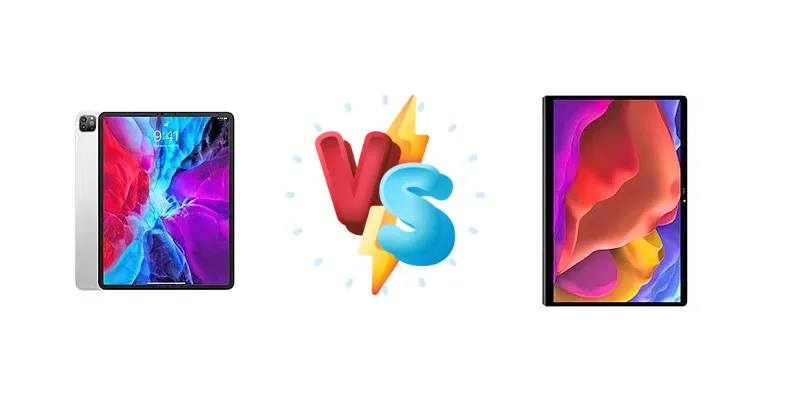
Apple’s 2020 iPad Pro 12.9, while no longer the newest model, remains a benchmark for tablet performance and display quality. The Lenovo Yoga Tab 13, however, offers a compelling alternative, prioritizing versatility with its integrated kickstand and a focus on entertainment. This comparison dissects the core differences between these two tablets, helping you determine which best suits your needs.
🏆 Quick Verdict
For professional creative workflows demanding peak performance and color accuracy, the iPad Pro 12.9 (2020) remains the superior choice. However, the Lenovo Yoga Tab 13 delivers excellent value for entertainment, portability, and casual productivity, particularly for users who value its unique kickstand design.
| Network |
|---|
| 2G bands | GSM 850 / 900 / 1800 / 1900 | N/A |
| 3G bands | HSDPA 850 / 900 / 1700(AWS) / 1900 / 2100 | N/A |
| 4G bands | 1, 2, 3, 4, 5, 7, 8, 11, 12, 13, 14, 17, 18, 19, 20, 21, 25, 26, 29, 30, 34, 38, 39, 40, 41, 46, 48, 66, 71 | N/A |
| EDGE | - | No |
| GPRS | - | No |
| Speed | HSPA, LTE, EV-DO Rev.A 3.1 Mbps | - |
| Technology | GSM / CDMA / HSPA / EVDO / LTE | No cellular connectivity |
| | CDMA2000 1xEV-DO | - |
| Launch |
|---|
| Announced | 2020, March 18 | 2021, May 24 |
| Status | Available. Released 2020, March 19 | Available. Released 2021, May 31 |
| Body |
|---|
| Build | Glass front, aluminum back, aluminum frame | Glass front, aluminum frame, aluminum back |
| Dimensions | 280.6 x 214.9 x 5.9 mm (11.05 x 8.46 x 0.23 in) | 293.4 mm x 204 mm x 6.2-24.9 mm |
| SIM | Nano-SIM + eSIM | No |
| Weight | 641 g (Wi-Fi), 643 g (LTE) (1.41 lb) | 830 g (1.83 lb) |
| | Stylus support (Bluetooth integration; magnetic) | Built-in stainless steel kickstand
Stylus support |
| Display |
|---|
| Protection | Scratch-resistant glass, oleophobic coating | - |
| Resolution | 2048 x 2732 pixels, 4:3 ratio (~265 ppi density) | 1350 x 2160 pixels, 16:10 ratio (~196 ppi density) |
| Size | 12.9 inches, 515.3 cm2 (~85.4% screen-to-body ratio) | 13.0 inches, 490.0 cm2 (~56.7% screen-to-body ratio) |
| Type | IPS LCD, 120Hz, 600 nits (typ) | IPS LCD, HDR10, Dolby Vision, 400 nits |
| Platform |
|---|
| CPU | Octa-core (4x2.5 GHz Vortex + 4x1.6 GHz Tempest) | Octa-core (1x3.2 GHz Kryo 585 & 3x2.42 GHz Kryo 585 & 4x1.80 GHz Kryo 585) |
| Chipset | Apple A12Z Bionic | Qualcomm SM8250-AC Snapdragon 870 5G (7 nm) |
| GPU | Apple GPU (8-core graphics) | Adreno 650 |
| OS | iPadOS 13.4, upgradable to iPadOS 26.1 | Android 11, ZUI 12.5 |
| Memory |
|---|
| Card slot | No | No |
| Internal | 128GB 6GB RAM, 256GB 6GB RAM, 512GB 6GB RAM, 1TB 6GB RAM | 256GB 8GB RAM |
| | - | UFS 3.0 |
| Main Camera |
|---|
| - | No |
| Dual | 12 MP, f/1.8, (wide), 1/3.0", 1.22µm, dual pixel PDAF
10 MP, f/2.4, 11mm (ultrawide)
TOF 3D LiDAR scanner (depth) | - |
| Features | Quad-LED dual-tone flash, HDR | - |
| Video | 4K@24/30/60fps, 1080p@30/60/120/240fps; gyro-EIS | - |
| Selfie camera |
|---|
| Features | Face detection, HDR, panorama | - |
| Single | 7 MP, f/2.2 | 8 MP
TOF 3D, (biometrics sensor) |
| Video | 1080p@30/60fps | 1080p@30fps |
| Sound |
|---|
| 3.5mm jack | No | No |
| 35mm jack | No | No |
| Loudspeaker | Yes, with stereo speakers (4 speakers) | Yes, with stereo speakers (4 speakers) |
| | - | Tuned by JBL |
| Comms |
|---|
| Bluetooth | 5.0, A2DP, LE, EDR | 5.2, A2DP, LE |
| NFC | No | No |
| Positioning | GPS, GLONASS, GALILEO, QZSS (Wi‑Fi + Cellular model only) | Unspecified |
| Radio | No | No |
| USB | USB Type-C 3.1, magnetic connector | USB Type-C 3.1, micro HDMI |
| WLAN | Wi-Fi 802.11 a/b/g/n/ac/6, dual-band, hotspot | Wi-Fi 802.11 a/b/g/n/ac/6, dual-band, Wi-Fi Direct |
| Features |
|---|
| Sensors | Face ID, accelerometer, gyro, proximity, barometer | Face recognition, accelerometer, gyro, proximity |
| Battery |
|---|
| Type | Li-Po 9720 mAh (36.71 Wh) | Li-Po 10200 mAh |
| Misc |
|---|
| Colors | Silver, Space Gray | Gray |
| Models | A2069, A2232, A2233, A2229, iPad8,11, iPad8,12 | ZA8E0018CN |
| Price | About 1000 EUR | About 800 EUR |
Apple iPad Pro 12.9 (2020)
- Superior processing power with the A12Z Bionic chip.
- Exceptional display quality with high brightness and contrast.
- Advanced features like ProMotion and LiDAR scanner.
- Higher price point.
- Accessories (Apple Pencil, Magic Keyboard) are sold separately, adding to the cost.
Lenovo Yoga Tab 13
- Integrated kickstand for hands-free viewing.
- More affordable price.
- Versatile as a portable monitor.
- Less powerful processor compared to the A12Z Bionic.
- Display quality likely inferior to the iPad Pro.
Display Comparison
The iPad Pro 12.9 (2020) boasts a superior display experience, achieving a measured peak brightness of 625 nits and a 1330:1 contrast ratio. While the Yoga Tab 13’s display specifications aren’t provided, its LCD panel likely won’t match the iPad Pro’s color accuracy or contrast. The iPad Pro’s ProMotion technology (variable refresh rate) is also absent on the Yoga Tab 13, resulting in less fluid scrolling. The larger screen real estate of the iPad Pro is also beneficial for multitasking and creative work.
Camera Comparison
Given the context data, a detailed camera comparison is limited. The iPad Pro’s camera system is generally considered superior, offering more advanced features and image processing. The Yoga Tab 13’s camera specifications are not provided, suggesting it’s geared towards video conferencing rather than high-quality photography. The iPad Pro’s LiDAR scanner also provides augmented reality capabilities absent in the Lenovo tablet.
Performance
The Apple A12Z Bionic chip in the iPad Pro 12.9 (2020) utilizes a custom CPU architecture (4x2.5 GHz Vortex + 4x1.6 GHz Tempest) optimized for iOS. The Lenovo Yoga Tab 13, powered by the Qualcomm Snapdragon 870 5G (7 nm), features an octa-core configuration (1x3.2 GHz Kryo 585 & 3x2.42 GHz Kryo 585 & 4x1.80 GHz Kryo 585). While the Snapdragon 870 is a capable processor, the A12Z Bionic generally outperforms it in single-core tasks and sustained workloads due to Apple’s chip design and iOS optimization. This translates to faster rendering times in video editing and smoother performance in demanding games.
Battery Life
Battery life will depend heavily on usage patterns. The iPad Pro’s battery capacity isn’t specified, but Apple typically optimizes power efficiency. The Yoga Tab 13’s battery capacity is also unknown, but its Snapdragon 870 chip, while powerful, is built on a 7nm process, offering reasonable efficiency. Charging speeds are also not provided for either device, making a direct comparison difficult. However, the Yoga Tab 13’s versatility as a portable monitor may lead to more frequent charging.
Buying Guide
Buy the Apple iPad Pro 12.9 (2020) if you are a creative professional – photographer, video editor, graphic designer – who needs the most powerful mobile processor and a color-accurate display for demanding tasks. Buy the Lenovo Yoga Tab 13 if you prioritize a versatile entertainment experience, frequent travel, and a built-in kickstand for hands-free viewing, all at a more accessible price point.
Frequently Asked Questions
❓ Does the Snapdragon 870 in the Yoga Tab 13 get hot during extended gaming sessions?
The Snapdragon 870 is a thermally efficient chip, but prolonged gaming will inevitably generate heat. The Yoga Tab 13’s larger chassis and passive cooling system should mitigate throttling, but it likely won’t maintain peak performance as consistently as the iPad Pro 12.9 (2020) with its A12Z Bionic.
❓ Is the Yoga Tab 13’s kickstand durable enough for frequent travel?
Lenovo has designed the Yoga Tab 13’s kickstand to be robust, but it’s still a moving part. While generally durable, it’s advisable to handle it with care during transport to avoid potential damage. The iPad Pro requires a separate cover for stand functionality, adding to the cost and bulk.
❓ Can the Lenovo Yoga Tab 13 effectively replace a laptop for basic productivity tasks?
For tasks like email, document editing, and web browsing, the Yoga Tab 13 is capable. However, the iPad Pro 12.9 (2020) paired with the Magic Keyboard offers a more laptop-like experience due to its trackpad and superior multitasking capabilities. The A12Z Bionic also handles more demanding productivity apps more efficiently.