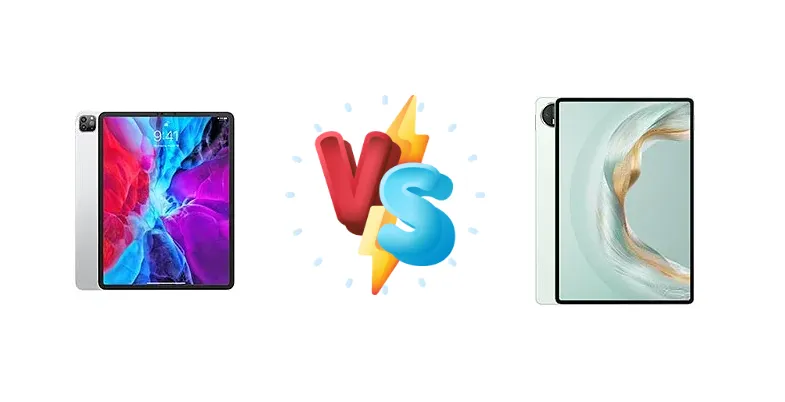
Apple’s iPad Pro 12.9 (2020) remains a relevant contender in the premium tablet space, but Huawei’s MatePad Pro 12.2 (2025) arrives with newer silicon and a focus on rapid charging. This comparison dissects the core differences between these two devices, evaluating whether the newer model justifies an upgrade or if the 2020 iPad Pro still holds its own.
🏆 Quick Verdict
For the average user prioritizing battery life and fast charging, the Huawei MatePad Pro 12.2 (2025) is the superior choice. Its 11:24 active use battery score and 100W charging significantly outperform the iPad Pro. However, the iPad Pro’s established ecosystem and potentially optimized software remain compelling advantages for Apple users.
| Network |
|---|
| 2G bands | GSM 850 / 900 / 1800 / 1900 | N/A |
| 3G bands | HSDPA 850 / 900 / 1700(AWS) / 1900 / 2100 | N/A |
| 4G bands | 1, 2, 3, 4, 5, 7, 8, 11, 12, 13, 14, 17, 18, 19, 20, 21, 25, 26, 29, 30, 34, 38, 39, 40, 41, 46, 48, 66, 71 | N/A |
| EDGE | - | No |
| GPRS | - | No |
| Speed | HSPA, LTE, EV-DO Rev.A 3.1 Mbps | - |
| Technology | GSM / CDMA / HSPA / EVDO / LTE | No cellular connectivity |
| | CDMA2000 1xEV-DO | - |
| Launch |
|---|
| Announced | 2020, March 18 | 2025, May 15 |
| Status | Available. Released 2020, March 19 | Available. Released 2025, May 15 |
| Body |
|---|
| Build | Glass front, aluminum back, aluminum frame | - |
| Dimensions | 280.6 x 214.9 x 5.9 mm (11.05 x 8.46 x 0.23 in) | 271.3 x 182.5 x 5.5 mm (10.68 x 7.19 x 0.22 in) |
| SIM | Nano-SIM + eSIM | No |
| Weight | 641 g (Wi-Fi), 643 g (LTE) (1.41 lb) | 508 g (1.12 lb) |
| | Stylus support (Bluetooth integration; magnetic) | - |
| Display |
|---|
| Protection | Scratch-resistant glass, oleophobic coating | - |
| Resolution | 2048 x 2732 pixels, 4:3 ratio (~265 ppi density) | 2800 x 1840 pixels, 3:2 ratio (~275 ppi density) |
| Size | 12.9 inches, 515.3 cm2 (~85.4% screen-to-body ratio) | 12.2 inches, 440.7 cm2 (~89.0% screen-to-body ratio) |
| Type | IPS LCD, 120Hz, 600 nits (typ) | Double-layer OLED, 1B colors, 144Hz, 2000 nits (peak), HDR Vivid |
| Platform |
|---|
| CPU | Octa-core (4x2.5 GHz Vortex + 4x1.6 GHz Tempest) | Octa-core (1x2.4 GHz & 3x2.00 GHz & 4x1.6GHz) |
| Chipset | Apple A12Z Bionic | Kirin T92A (7 nm) |
| GPU | Apple GPU (8-core graphics) | Maleoon 920 |
| OS | iPadOS 13.4, upgradable to iPadOS 26.1 | HarmonyOS 4.3 |
| Memory |
|---|
| Card slot | No | No |
| Internal | 128GB 6GB RAM, 256GB 6GB RAM, 512GB 6GB RAM, 1TB 6GB RAM | 256GB 12GB RAM, 512GB 12GB RAM, 1TB 16GB RAM |
| Main Camera |
|---|
| Dual | 12 MP, f/1.8, (wide), 1/3.0", 1.22µm, dual pixel PDAF
10 MP, f/2.4, 11mm (ultrawide)
TOF 3D LiDAR scanner (depth) | 50 MP, f/1.8, (wide), PDAF
8 MP, f/2.2, (ultrawide) |
| Features | Quad-LED dual-tone flash, HDR | LED flash, HDR, panorama |
| Video | 4K@24/30/60fps, 1080p@30/60/120/240fps; gyro-EIS | 4K@30fps, 1080p@30fps |
| Selfie camera |
|---|
| Features | Face detection, HDR, panorama | - |
| Single | 7 MP, f/2.2 | 8 MP, f/2.0 |
| Video | 1080p@30/60fps | 1080p@30fps |
| Sound |
|---|
| 3.5mm jack | No | - |
| 35mm jack | No | No |
| Loudspeaker | Yes, with stereo speakers (4 speakers) | Yes, with stereo speakers (4 speakers) |
| Comms |
|---|
| Bluetooth | 5.0, A2DP, LE, EDR | 5.2, A2DP, LE |
| NFC | No | No |
| Positioning | GPS, GLONASS, GALILEO, QZSS (Wi‑Fi + Cellular model only) | GPS, GLONASS, BDS, GALILEO, QZSS |
| Radio | No | No |
| USB | USB Type-C 3.1, magnetic connector | USB Type-C 3.1, OTG |
| WLAN | Wi-Fi 802.11 a/b/g/n/ac/6, dual-band, hotspot | Wi-Fi 802.11 a/b/g/n/ac/6/7, dual-band |
| Features |
|---|
| Sensors | Face ID, accelerometer, gyro, proximity, barometer | Fingerprint (side-mounted), accelerometer, gyro, proximity (accessories only), compass |
| Battery |
|---|
| Charging | - | 100W wired, 85% in 40 min, 100% in 55 min
7.5W reverse wired |
| Type | Li-Po 9720 mAh (36.71 Wh) | Li-Po 10100 mAh |
| Misc |
|---|
| Colors | Silver, Space Gray | Black, Green |
| Models | A2069, A2232, A2233, A2229, iPad8,11, iPad8,12 | MRDI-W09 |
| Price | About 1000 EUR | About 850 EUR |
Apple iPad Pro 12.9 (2020)
- Established iPadOS ecosystem
- Strong single-core CPU performance (A12Z)
- Higher contrast ratio for deeper blacks
- Slower charging speeds
- Lower peak display brightness
- Potentially shorter battery life
Huawei MatePad Pro 12.2 (2025)
- Exceptional battery life (11:24h)
- Ultra-fast 100W charging
- Brighter display for outdoor visibility
- HarmonyOS or alternative OS may not suit all users
- CPU architecture may prioritize efficiency over raw power
- Camera specs unknown
Display Comparison
The Huawei MatePad Pro 12.2 (2025) boasts a brighter display, reaching a measured 1045 nits compared to the iPad Pro’s 625 nits. This translates to better visibility in direct sunlight. While both are large-format tablets, the contrast ratio favors the iPad Pro at 1330:1, suggesting deeper blacks. However, without knowing the panel technology (OLED, IPS, etc.) for either device, it’s difficult to assess color accuracy and viewing angles definitively. The higher brightness of the MatePad Pro is a clear win for outdoor use.
Camera Comparison
Context data doesn't provide camera details for either device, making a direct comparison impossible. However, given the iPad Pro’s positioning, it likely features a more sophisticated camera system with features like LiDAR for augmented reality applications. Huawei often prioritizes camera technology, so the MatePad Pro could offer competitive image quality, but without sensor size, aperture, or image processing details, it remains speculative. We can assume both tablets are capable of adequate video conferencing and casual photography.
Performance
The iPad Pro’s A12Z Bionic chipset, built on a 7nm process, features an octa-core CPU with a performance core configuration of 4x2.5 GHz Vortex and 4x1.6 GHz Tempest. The Huawei MatePad Pro 12.2 (2025) counters with the Kirin T92A, also a 7nm chip, but with a different core arrangement: 1x2.4 GHz, 3x2.00 GHz, and 4x1.6GHz. While core counts are similar, the A12Z Bionic is known for its strong single-core performance, crucial for responsive app launches and UI navigation. The Kirin T92A likely focuses on efficiency, potentially benefiting multi-threaded tasks. Without benchmark data, it’s hard to declare a clear winner, but Apple’s chip design historically delivers superior sustained performance.
Battery Life
The Huawei MatePad Pro 12.2 (2025) shines in battery performance, achieving an impressive 11:24 hours of active use. This significantly surpasses what was typical for the 2020 iPad Pro, which generally offered around 8-10 hours depending on usage. Furthermore, the MatePad Pro’s 100W wired charging is a game-changer, reaching 85% charge in just 40 minutes and 100% in 55 minutes. The iPad Pro lacks this level of fast charging. The 7.5W reverse wired charging on the MatePad Pro is a useful addition for topping up accessories.
Buying Guide
Buy the Apple iPad Pro 12.9 (2020) if you are deeply embedded in the Apple ecosystem, rely on iPadOS-specific apps, and prioritize a proven track record of software updates. Buy the Huawei MatePad Pro 12.2 (2025) if you value long battery life, incredibly fast charging, and are comfortable with Huawei’s HarmonyOS or a more open app ecosystem.
Frequently Asked Questions
❓ Does the Kirin T92A chipset in the MatePad Pro get hot during extended gaming sessions?
While the 7nm process suggests good thermal efficiency, we lack specific thermal testing data. However, Huawei typically implements thermal management solutions to prevent overheating. The Kirin T92A’s core configuration suggests a focus on sustained performance rather than peak bursts, potentially reducing thermal throttling compared to chips prioritizing maximum clock speeds.
❓ Is the lack of Apple Pencil 2 support on the MatePad Pro a significant drawback for artists and note-takers?
The Apple Pencil 2 is renowned for its low latency and precise input. The MatePad Pro utilizes a different stylus (sold separately), and its performance may not match the Apple Pencil 2 experience. Artists and note-takers heavily invested in the Apple Pencil ecosystem will likely find this a significant limitation.
❓ How does HarmonyOS compare to iPadOS in terms of app availability and user experience?
HarmonyOS has been steadily improving its app ecosystem, but it still lags behind iPadOS in terms of native app availability, particularly for professional creative applications. The user experience differs significantly, with HarmonyOS emphasizing customization and cross-device connectivity. Users accustomed to iPadOS may experience a learning curve.