
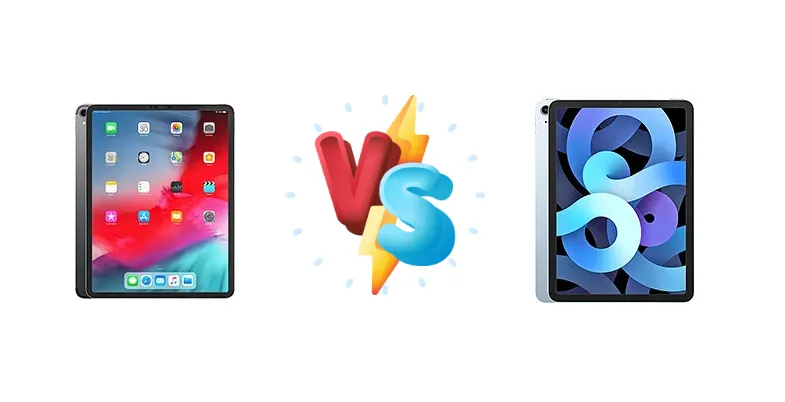
Apple iPad Pro 12.9 (2018) vs. iPad Air (2020): A Detailed Comparison
| Phones Images | |||||
|---|---|---|---|---|---|
|
🏆 Quick Verdict
The iPad Air (2020) offers a compelling blend of performance and value, thanks to its A14 Bionic chip and updated design. While the iPad Pro 12.9 (2018) still holds up, the Air's efficiency and lower price make it the winner for most users.
| PHONES | ||
|---|---|---|
| Phone Names | Apple iPad Pro 12.9 (2018) | Apple iPad Air (2020) |
| Network | ||
|---|---|---|
| 2G bands | GSM 850 / 900 / 1800 / 1900 | GSM 850 / 900 / 1800 / 1900 |
| 3G bands | HSDPA 850 / 900 / 1700(AWS) / 1900 / 2100 | HSDPA 850 / 900 / 1700(AWS) / 1900 / 2100 |
| 4G bands | 1, 2, 3, 4, 5, 7, 8, 11, 12, 13, 14, 17, 18, 19, 20, 21, 25, 26, 29, 30, 34, 38, 39, 40, 41, 46, 66, 71 - A2014 | 1, 2, 3, 4, 5, 7, 8, 11, 12, 13, 14, 17, 18, 19, 20, 21, 25, 26, 29, 30, 34, 38, 39, 40, 41, 46, 48, 66, 71 - A2324 |
| Speed | HSPA 42.2/5.76 Mbps, LTE (4CA) Cat16 1024/150 Mbps, EV-DO Rev.A 3.1 Mbps | HSPA, LTE |
| Technology | GSM / CDMA / HSPA / EVDO / LTE | GSM / HSPA / LTE |
| 1, 2, 3, 4, 5, 7, 8, 11, 12, 13, 14, 17, 18, 19, 20, 21, 25, 26, 28, 29, 30, 34, 38, 39, 40, 41, 42, 46, 66, 71 - A1895 | 1, 2, 3, 4, 5, 7, 8, 11, 12, 13, 14, 17, 18, 19, 20, 21, 25, 26, 28, 29, 30, 32, 34, 38, 39, 40, 41, 42, 46, 48, 66 - A2072 | |
| Launch | ||
|---|---|---|
| Announced | 2018, October. Released 2018, November | 2020, September 15 |
| Status | Discontinued | Available. Released 2020, October 23 |
| Body | ||
|---|---|---|
| Build | Glass front, aluminum back, aluminum frame | Glass front, aluminum back, aluminum frame |
| Dimensions | 280.6 x 214.9 x 5.9 mm (11.05 x 8.46 x 0.23 in) | 247.6 x 178.5 x 6.1 mm (9.75 x 7.03 x 0.24 in) |
| SIM | Nano-SIM + eSIM | Nano-SIM + eSIM |
| Weight | 631 g (Wi-Fi), 633 g (LTE) (1.39 lb) | 458 g (Wi-Fi) / 460 g (3G/LTE) (1.01 lb) |
| Stylus support (Bluetooth integration; magnetic) | Stylus support | |
| Display | ||
|---|---|---|
| Protection | Scratch-resistant glass, oleophobic coating | Scratch-resistant glass, oleophobic coating |
| Resolution | 2048 x 2732 pixels, 4:3 ratio (~265 ppi density) | 1640 x 2360 pixels (~264 ppi density) |
| Size | 12.9 inches, 515.3 cm2 (~85.4% screen-to-body ratio) | 10.9 inches, 359.2 cm2 (~81.3% screen-to-body ratio) |
| Type | IPS LCD, 120Hz | Liquid Retina IPS LCD, 500 nits (typ) |
| Platform | ||
|---|---|---|
| CPU | Octa-core (4x2.5 GHz Vortex + 4x1.6 GHz Tempest) | Hexa-core (2x3.0 GHz Firestorm + 4x1.8 GHz Icestorm) |
| Chipset | Apple A12X Bionic (7 nm) | Apple A14 Bionic (5 nm) |
| GPU | Apple GPU (7-core graphics) | Apple GPU (4-core graphics) |
| OS | iOS 12, upgradable to iPadOS 26.1 | iPadOS 14.1, upgradable to iPadOS 26.1 |
| Memory | ||
|---|---|---|
| Card slot | No | No |
| Internal | 64GB 4GB RAM, 256GB 4GB RAM, 512GB 4GB RAM, 1TB 6GB RAM | 64GB 4GB RAM, 256GB 4GB RAM |
| Main Camera | ||
|---|---|---|
| Features | Quad-LED dual-tone flash, HDR | HDR |
| Single | 12 MP, f/1.8, 29mm (standard), 1/3.0", 1.22µm, PDAF | 12 MP, f/1.8, (wide), 1/3.0", 1.22µm, dual pixel PDAF |
| Video | 4K@30/60fps, 1080p@30/60/120fps, 720p@240fps | 4K@24/30/60fps, 1080p@30/60/120/240fps; gyro-EIS |
| Selfie camera | ||
|---|---|---|
| Features | Face detection, HDR, panorama | HDR |
| Single | 7 MP, f/2.2, 32mm (standard) | 7 MP, f/2.0, 31mm (standard) |
| Video | 1080p@30fps | 1080p@30/60fps |
| Sound | ||
|---|---|---|
| 3.5mm jack | No | No |
| 35mm jack | No | No |
| Loudspeaker | Yes, with stereo speakers (4 speakers) | Yes, with stereo speakers |
| Comms | ||
|---|---|---|
| Bluetooth | 5.0, A2DP, LE, EDR | 5.0, A2DP, EDR |
| NFC | No | No |
| Positioning | GPS, GLONASS, GALILEO, QZSS (Wi‑Fi + Cellular model only) | GPS, GLONASS (LTE model only) |
| Radio | No | No |
| USB | USB Type-C 3.1, magnetic connector | USB Type-C, magnetic connector |
| WLAN | Wi-Fi 802.11 a/b/g/n/ac, dual-band, hotspot | Wi-Fi 802.11 a/b/g/n/ac/6, dual-band, hotspot |
| Features | ||
|---|---|---|
| Sensors | Face ID, accelerometer, gyro, proximity, barometer | Fingerprint (top-mounted), accelerometer, gyro, compass, barometer |
| Battery | ||
|---|---|---|
| Type | Li-Po 9720 mAh, non-removable (36.71 Wh) | Li-Ion 7606 mAh (28.93 Wh) |
| Misc | ||
|---|---|---|
| Colors | Silver, Space Gray | Space Gray, Silver, Rose Gold, Green, Sky Blue |
| Models | A2014, A1895, A1876, A1983, iPad8,5, iPad8,6, iPad8,7, iPad8,8 | A2324, A2072, A2325, A2316, iPad13,1, iPad13,2 |
| Price | About 1100 EUR | About 640 EUR |
| SAR | 1.19 W/kg (body) | - |
| SAR EU | 0.99 W/kg (body) | - |
| Tests | ||
|---|---|---|
| Loudspeaker | -22.1 LUFS (Excellent) | - |
| Performance | AnTuTu: 552771 (v7) GeekBench: 5040 (v4.4) GFXBench: 39fps (ES 3.1 onscreen) | - |
Apple iPad Pro 12.9 (2018)
- Larger, stunning Liquid Retina display with ProMotion
- More powerful camera system with LiDAR
- Raw processing power for demanding tasks
- Four speakers for immersive audio
- Older chipset (A12X Bionic)
- Higher price
- Larger and heavier than the iPad Air
Apple iPad Air (2020)
- More efficient A14 Bionic chip
- Modern design
- Lower price
- Excellent performance for everyday tasks
- USB-C charging
- Smaller display (10.9 inches)
- Lacks ProMotion
- Single camera system
- Less raw power than the iPad Pro
Display Comparison
The iPad Pro 12.9 (2018) boasts a stunning 12.9-inch Liquid Retina display with ProMotion (adaptive refresh rate up to 120Hz) for incredibly smooth scrolling and responsiveness. The iPad Air (2020) features a 10.9-inch Liquid Retina display, which is vibrant and sharp, but lacks ProMotion. The Pro's larger size and ProMotion give it a noticeable edge for visual tasks.
Camera Comparison
The iPad Pro (2018) has a more advanced camera system with a dual-camera setup (12MP wide, 10MP telephoto) and a LiDAR scanner for improved AR experiences. The iPad Air (2020) has a single 12MP wide camera. For photography enthusiasts or AR applications, the Pro is the better choice.
Performance
The A14 Bionic in the iPad Air (2020) is significantly more efficient than the A12X Bionic in the iPad Pro (2018), despite the Pro having more CPU cores. While the A12X was powerful, the A14's 5nm process delivers better performance per watt. Expect smoother multitasking and faster app loading on the Air.
Battery Life
Both tablets offer excellent battery life, typically lasting around 10 hours of mixed usage. However, the iPad Air (2020)'s more efficient A14 chip may provide slightly longer battery life in some scenarios.
Buying Guide
The iPad Pro 12.9 (2018) is ideal for creative professionals needing a large, high-quality display and raw processing power for demanding tasks like video editing and graphic design. The iPad Air (2020) is perfect for students, casual users, and those seeking a powerful tablet for everyday tasks, media consumption, and light creative work without breaking the bank.