
Apple iPad Pro 11 (2025) vs Xiaomi Pad 6 Pro: A Deep Dive into Performance and Value
| Phones Images | |||||
|---|---|---|---|---|---|
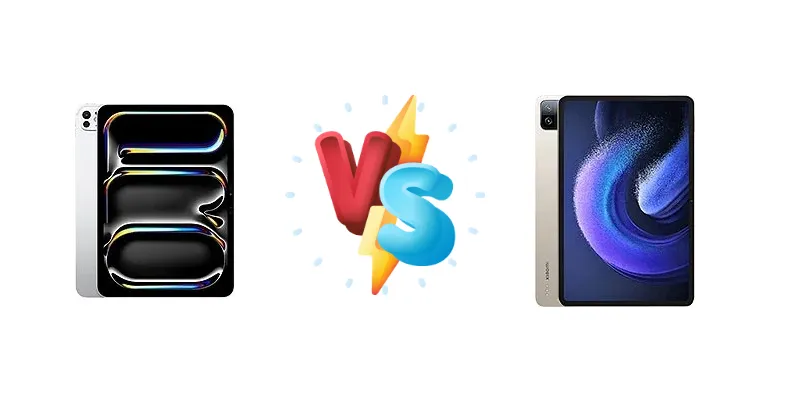
|
🏆 Quick Verdict
For users deeply embedded in the Apple ecosystem and prioritizing long-term software support, the iPad Pro 11 (2025) is the superior choice, thanks to its more powerful M5 chip and exceptional 71-hour battery endurance. However, the Xiaomi Pad 6 Pro offers compelling performance at a significantly lower price point, making it ideal for Android enthusiasts.
| PHONES | ||
|---|---|---|
| Phone Names | Apple iPad Pro 11 (2025) | Xiaomi Pad 6 Pro |
| Network | ||
|---|---|---|
| 2G bands | GSM 850 / 900 / 1800 / 1900 - cellular model only | N/A |
| 3G bands | HSDPA 850 / 900 / 1700(AWS) / 1900 / 2100 - cellular model only | N/A |
| 4G bands | 1, 2, 3, 4, 5, 7, 8, 11, 12, 13, 14, 17, 18, 19, 20, 21, 25, 26, 28, 29, 30, 32, 34, 38, 39, 40, 41, 42, 48, 66, 71 - A3358 - cellular model only | - |
| 5G bands | 1, 2, 3, 5, 7, 8, 12, 14, 20, 25, 26, 28, 29, 30, 38, 40, 41, 48, 66, 70, 71, 75, 77, 78, 79 SA/NSA/Sub6 - A3358, A3359 - cellular model only | - |
| EDGE | - | N/A |
| GPRS | - | N/A |
| Speed | HSPA, LTE, 5G - cellular model only | - |
| Technology | GSM / HSPA / LTE / 5G | No cellular connectivity |
| Launch | ||
|---|---|---|
| Announced | 2025, October 16 | 2023, April 18 |
| Status | Available. Released 2025, October 22 | Available. Released 2023, April 30 |
| Body | ||
|---|---|---|
| Build | Glass front, aluminum back, aluminum frame | Glass front (Gorilla Glass 3), aluminum frame, aluminum back |
| Dimensions | 249.7 x 177.5 x 5.3 mm (9.83 x 6.99 x 0.21 in) | 254 x 165.2 x 6.5 mm (10.0 x 6.50 x 0.26 in) |
| SIM | eSIM - cellular model only | No |
| Weight | 444 g (Wi-Fi), 446 g (5G) (1.03 lb) | 490 g (1.08 lb) |
| - | Stylus support (magnetic) | |
| Display | ||
|---|---|---|
| Protection | Scratch-resistant glass, oleophobic coating, Mohs level 4 | Corning Gorilla Glass 3 |
| Resolution | 1668 x 2420 pixels, 3:2 ratio (~267 ppi density) | 1800 x 2880 pixels, 16:10 ratio (~309 ppi density) |
| Size | 11.0 inches, 364.8 cm2 (~82.3% screen-to-body ratio) | 11.0 inches, 350.9 cm2 (~83.6% screen-to-body ratio) |
| Type | Ultra Retina Tandem OLED, 120Hz, HDR10, Dolby Vision, 1000 nits (HBM), 1600 nits (peak) | IPS LCD, 1B colors, 144Hz, HDR10, Dolby Vision, 550 nits |
| Platform | ||
|---|---|---|
| CPU | 9-core (3 performance cores, 6 efficiency cores) - 256/512GB models10-core (4 performance cores, 6 efficiency cores) - 1/2TB models | Octa-core (1x3.19 GHz Cortex-X2 & 3x2.75 GHz Cortex-A710 & 4x1.80 GHz Cortex-A510) |
| Chipset | Apple M5 | Qualcomm SM8475 Snapdragon 8+ Gen 1 (4 nm) |
| GPU | Apple GPU (10-core graphics) | Adreno 730 |
| OS | iPadOS 26, upgradable to iPadOS 26.1 | Android 13, MIUI 14 |
| Memory | ||
|---|---|---|
| Card slot | No | No |
| Internal | 256GB 12GB RAM, 512GB 12GB RAM, 1TB 16GB RAM, 2TB 16GB RAM | 128GB 8GB RAM, 256GB 8GB RAM, 256GB 12GB RAM, 512GB 12GB RAM |
| - | UFS 3.1 | |
| Main Camera | ||
|---|---|---|
| Dual | - | 50 MP, f/1.8, (wide), 1/2.76", 0.64µm, PDAF Auxiliary lens |
| Features | Quad-LED dual-tone flash, HDR | Dual-LED flash, HDR, panorama |
| Single | 12 MP, f/1.8, (wide), dual pixel PDAF TOF 3D LiDAR scanner (depth) | - |
| Video | 4K@24/25/30/60fps, 1080p@25/30/60/120/240fps; gyro-EIS, ProRes (4K, 1080p) | 4K@30/60fps, 1080p@30/60fps |
| Selfie camera | ||
|---|---|---|
| Features | Face detection, HDR, panorama | - |
| Single | 12 MP, f/2.0, 122˚ (ultrawide) | 20 MP, f/2.2, (wide), 1/3.4", 0.8µm |
| Video | 1080p@25/30/60fps, gyro-EIS, HDR | 1080p@30/60fps |
| Sound | ||
|---|---|---|
| 3.5mm jack | - | No |
| 35mm jack | No | No |
| Loudspeaker | Yes, with stereo speakers (4 speakers) | Yes, with stereo speakers (4 speakers) |
| - | 24-bit/192kHz audio | |
| Comms | ||
|---|---|---|
| Bluetooth | 6.0, A2DP, LE, EDR | 5.3, A2DP, LE |
| NFC | No | No |
| Positioning | GPS, GLONASS, GALILEO, QZSS (Wi‑Fi + Cellular model only) | No |
| Radio | No | No |
| USB | USB Type-C 4 (Thunderbolt 3), DisplayPort, magnetic connector | USB Type-C 3.2, accessory connector |
| WLAN | Wi-Fi 802.11 a/b/g/n/ac/6e/7, dual-band, hotspot | Wi-Fi 802.11 a/b/g/n/a/6e, dual-band, Wi-Fi Direct |
| Features | ||
|---|---|---|
| Sensors | Face ID, accelerometer, gyro, compass, barometer | Accelerometer, gyro, proximity (accessories only) |
| Battery | ||
|---|---|---|
| Charging | 50% in 30 min | 67W wired, PD3.0, QC4, 100% in 1 hour |
| Type | Li-Po 8160 mAh | Li-Po 8600 mAh |
| Misc | ||
|---|---|---|
| Colors | Silver, Space Black | Black, Blue, Gold |
| Models | A3357, A3358, A3359 | 23046RP50C |
| Price | About 1100 EUR | About 330 EUR |
| EU LABEL | ||
|---|---|---|
| Battery | 71:00h endurance, 1000 cycles | - |
| Energy | Class G | - |
| Free fall | Class E (47 falls) | - |
| Repairability | Class C | - |
Apple iPad Pro 11 (2025)
- Superior performance with Apple M5 chip
- Exceptional 71-hour battery life
- Long-term software support and ecosystem integration
- Higher price point
- Potentially slower charging than Xiaomi Pad 6 Pro
Xiaomi Pad 6 Pro
- Faster 67W charging
- More affordable price
- Android operating system flexibility
- Less powerful processor than Apple M5
- Shorter battery life compared to iPad Pro
Display Comparison
While display specifications are missing for the iPad Pro 11 (2025), Apple typically employs LTPO technology for variable refresh rates, maximizing battery efficiency. The Xiaomi Pad 6 Pro’s display details are unavailable, but its market positioning suggests a high-quality LCD or OLED panel. The iPad Pro’s likely higher peak brightness and color accuracy, coupled with ProMotion technology, would give it an edge for color-critical work. Bezels are expected to be minimal on both devices, reflecting current design trends.
Camera Comparison
Camera details are absent for both devices. However, tablets are rarely purchased for their camera capabilities. The Xiaomi Pad 6 Pro may include a more versatile camera system, given Xiaomi’s focus on smartphone photography, but the iPad Pro is likely to offer superior image processing and video recording quality, leveraging Apple’s computational photography expertise. The absence of detailed camera specs makes a definitive comparison impossible.
Performance
The core of this comparison lies in the chipsets. Apple’s M5, with its 9 or 10-core CPU configuration (depending on storage capacity), is expected to deliver significantly higher single-core and multi-core performance than the Qualcomm Snapdragon 8+ Gen 1. The M5’s unified memory architecture also provides a performance advantage. The Snapdragon 8+ Gen 1, fabricated on a 4nm process, is still a very capable chip, but the M5’s architectural advantages and core count give Apple a clear lead in raw processing power. The iPad Pro’s LPDDR5X RAM will further enhance performance, especially in memory-intensive tasks.
Battery Life
The iPad Pro 11 (2025) boasts an impressive 71-hour battery endurance, a testament to the efficiency of the M5 chip and Apple’s software optimization. The Xiaomi Pad 6 Pro compensates with its 67W wired charging, achieving a full charge in just one hour. While the iPad Pro’s charging time is listed as 50% in 30 minutes, the Xiaomi Pad 6 Pro’s faster charging is a significant convenience factor. The iPad Pro’s longevity, with 1000 charge cycles, suggests a longer lifespan before battery degradation becomes noticeable.
Buying Guide
Buy the Apple iPad Pro 11 (2025) if you require the absolute best performance for demanding tasks like video editing and 3D rendering, value seamless integration with other Apple devices, and prioritize longevity with Apple’s 1000-cycle battery health. Buy the Xiaomi Pad 6 Pro if you prefer the Android operating system, need fast 67W charging, and are looking for a high-performance tablet without the premium Apple price tag.