
iPad Pro 11 (2025) vs OnePlus Pad Lite: A Deep Dive into Tablet Performance and Value
| Phones Images | |||||
|---|---|---|---|---|---|
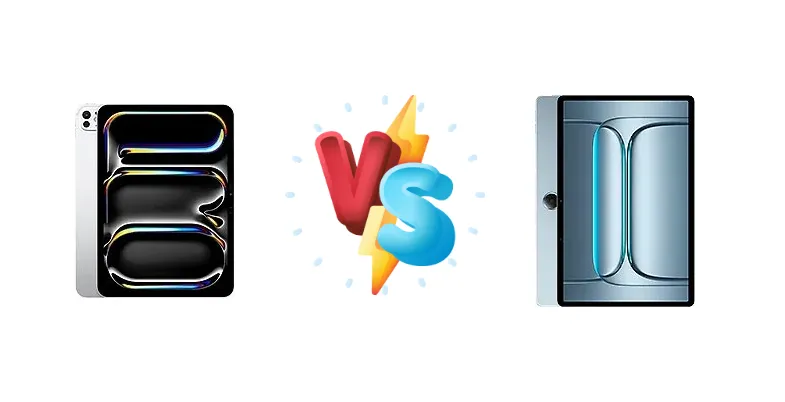
|
🏆 Quick Verdict
For users demanding uncompromising performance and longevity, the Apple iPad Pro 11 (2025) is the clear winner. Its M5 chip and 71-hour battery endurance justify the higher price. However, the OnePlus Pad Lite provides a compelling value proposition for those prioritizing affordability and basic tablet functionality.
| PHONES | ||
|---|---|---|
| Phone Names | Apple iPad Pro 11 (2025) | OnePlus Pad Lite |
| Network | ||
|---|---|---|
| 2G bands | GSM 850 / 900 / 1800 / 1900 - cellular model only | GSM 850 / 900 / 1800 / 1900 - cellular model only |
| 3G bands | HSDPA 850 / 900 / 1700(AWS) / 1900 / 2100 - cellular model only | HSDPA 850 / 900 / 2100 - cellular model only |
| 4G bands | 1, 2, 3, 4, 5, 7, 8, 11, 12, 13, 14, 17, 18, 19, 20, 21, 25, 26, 28, 29, 30, 32, 34, 38, 39, 40, 41, 42, 48, 66, 71 - A3358 - cellular model only | LTE - cellular model only |
| 5G bands | 1, 2, 3, 5, 7, 8, 12, 14, 20, 25, 26, 28, 29, 30, 38, 40, 41, 48, 66, 70, 71, 75, 77, 78, 79 SA/NSA/Sub6 - A3358, A3359 - cellular model only | - |
| Speed | HSPA, LTE, 5G - cellular model only | HSPA, LTE - cellular model only |
| Technology | GSM / HSPA / LTE / 5G | GSM / HSPA / LTE |
| Launch | ||
|---|---|---|
| Announced | 2025, October 16 | 2025, July 08 |
| Status | Available. Released 2025, October 22 | Available. Released 2025, August 14 |
| Body | ||
|---|---|---|
| Build | Glass front, aluminum back, aluminum frame | - |
| Dimensions | 249.7 x 177.5 x 5.3 mm (9.83 x 6.99 x 0.21 in) | 254.9 x 166.5 x 7.4 mm (10.04 x 6.56 x 0.29 in) |
| SIM | eSIM - cellular model only | Yes - cellular model only |
| Weight | 444 g (Wi-Fi), 446 g (5G) (1.03 lb) | 530 g (1.17 lb) |
| Display | ||
|---|---|---|
| Protection | Scratch-resistant glass, oleophobic coating, Mohs level 4 | - |
| Resolution | 1668 x 2420 pixels, 3:2 ratio (~267 ppi density) | 1200 x 1920 pixels, 16:10 ratio (~207 ppi density) |
| Size | 11.0 inches, 364.8 cm2 (~82.3% screen-to-body ratio) | 11.0 inches, 347.5 cm2 (~81.9% screen-to-body ratio) |
| Type | Ultra Retina Tandem OLED, 120Hz, HDR10, Dolby Vision, 1000 nits (HBM), 1600 nits (peak) | IPS LCD, 1B colors, 90Hz, 500 nits |
| Platform | ||
|---|---|---|
| CPU | 9-core (3 performance cores, 6 efficiency cores) - 256/512GB models10-core (4 performance cores, 6 efficiency cores) - 1/2TB models | Octa-core (2x2.2 GHz Cortex-A76 & 6x2.0 GHz Cortex-A55) |
| Chipset | Apple M5 | Mediatek Helio G100 (6 nm) |
| GPU | Apple GPU (10-core graphics) | Mali-G57 MC2 |
| OS | iPadOS 26, upgradable to iPadOS 26.1 | Android 15, OxygenOS 15 |
| Memory | ||
|---|---|---|
| Card slot | No | Unspecified |
| Internal | 256GB 12GB RAM, 512GB 12GB RAM, 1TB 16GB RAM, 2TB 16GB RAM | 128GB 6GB RAM, 128GB 8GB RAM |
| Main Camera | ||
|---|---|---|
| Features | Quad-LED dual-tone flash, HDR | - |
| Single | 12 MP, f/1.8, (wide), dual pixel PDAF TOF 3D LiDAR scanner (depth) | 5 MP |
| Video | 4K@24/25/30/60fps, 1080p@25/30/60/120/240fps; gyro-EIS, ProRes (4K, 1080p) | 1080p@30fps |
| Selfie camera | ||
|---|---|---|
| Features | Face detection, HDR, panorama | - |
| Single | 12 MP, f/2.0, 122˚ (ultrawide) | 5 MP |
| Video | 1080p@25/30/60fps, gyro-EIS, HDR | 1080p@30fps |
| Sound | ||
|---|---|---|
| 35mm jack | No | No |
| Loudspeaker | Yes, with stereo speakers (4 speakers) | Yes, with stereo speakers (4 speakers, Hi-Res audio) |
| Comms | ||
|---|---|---|
| Bluetooth | 6.0, A2DP, LE, EDR | 5.2, A2DP, LE, aptX HD |
| NFC | No | No |
| Positioning | GPS, GLONASS, GALILEO, QZSS (Wi‑Fi + Cellular model only) | GPS, (cellular model only) - unconfirmed |
| Radio | No | No |
| USB | USB Type-C 4 (Thunderbolt 3), DisplayPort, magnetic connector | USB Type-C 2.0 |
| WLAN | Wi-Fi 802.11 a/b/g/n/ac/6e/7, dual-band, hotspot | Wi-Fi 802.11 a/b/g/n/ac, dual-band |
| Features | ||
|---|---|---|
| Sensors | Face ID, accelerometer, gyro, compass, barometer | Unspecified |
| Battery | ||
|---|---|---|
| Charging | 50% in 30 min | 33W wired |
| Type | Li-Po 8160 mAh | Li-Po 9340 mAh |
| Misc | ||
|---|---|---|
| Colors | Silver, Space Black | Aero Blue |
| Models | A3357, A3358, A3359 | OPD2480 |
| Price | About 1100 EUR | About 200 EUR |
| EU LABEL | ||
|---|---|---|
| Battery | 71:00h endurance, 1000 cycles | - |
| Energy | Class G | - |
| Free fall | Class E (47 falls) | - |
| Repairability | Class C | - |
Apple iPad Pro 11 (2025)
- Unmatched performance with the Apple M5 chip
- Exceptional battery life and longevity (71h endurance, 1000 cycles)
- Potential for advanced display features like ProMotion and LTPO
- Significantly higher price point
- Slower charging speed compared to OnePlus Pad Lite
OnePlus Pad Lite
- More affordable price point
- Faster 33W wired charging
- Suitable for basic tablet tasks and media consumption
- Significantly less powerful processor (Helio G100)
- Likely shorter battery life and lower build quality
Display Comparison
While display specifications are missing for the OnePlus Pad Lite, the iPad Pro 11 (2025) is expected to feature a Liquid Retina display with ProMotion technology, likely offering a 120Hz adaptive refresh rate. This contrasts with the Pad Lite, which will likely have a standard 60Hz panel. The iPad Pro’s potential for LTPO technology would further enhance power efficiency by dynamically adjusting the refresh rate. Color accuracy and peak brightness are expected to be significantly higher on the iPad Pro, making it superior for content creation and HDR video playback.
Camera Comparison
Camera details for the OnePlus Pad Lite are unavailable, but tablets generally prioritize front-facing cameras for video conferencing. The iPad Pro 11 (2025) is expected to feature an advanced camera system, though details are currently unknown. Given Apple’s history, expect improved image signal processing and potentially ProRes video recording capabilities. The focus here isn’t on photography, but on video call quality and potential AR applications, where the M5’s image processing capabilities will shine.
Performance
The core difference lies in the chipsets. The iPad Pro 11 (2025) boasts Apple’s M5 chip, available in 9-core (256/512GB) and 10-core (1/2TB) configurations, offering a substantial performance advantage over the OnePlus Pad Lite’s Mediatek Helio G100 (6nm). The M5’s unified memory architecture and optimized neural engine will excel in demanding tasks like video editing and 3D rendering. The Helio G100, while capable for everyday tasks, will struggle with sustained workloads. The iPad Pro’s LPDDR5X RAM further enhances memory bandwidth, contributing to smoother multitasking.
Battery Life
The iPad Pro 11 (2025) claims an impressive 71-hour endurance and a 1000-cycle battery lifespan, indicating long-term reliability. While the OnePlus Pad Lite’s battery capacity is unknown, its 33W wired charging is faster than the iPad Pro’s 50% in 30-minute charging. However, the iPad Pro’s superior power efficiency, thanks to the M5 chip and potential LTPO display, likely translates to longer real-world usage despite the slower charging speed. The 1000 cycle lifespan of the iPad Pro also suggests a longer usable life.
Buying Guide
Buy the Apple iPad Pro 11 (2025) if you require professional-grade performance for tasks like video editing, graphic design, or demanding gaming, and if long-term battery health and software support are critical. Buy the OnePlus Pad Lite if you primarily need a tablet for media consumption, light productivity, and casual gaming, and if budget is your primary concern.