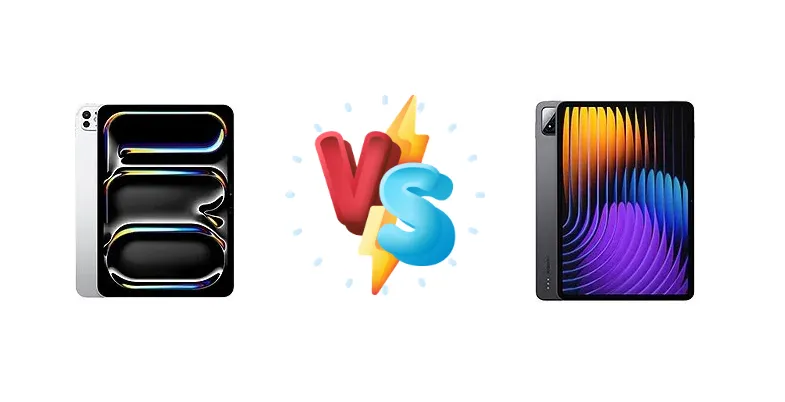
Apple’s 2024 iPad Pro 11 introduces the M4 chip, promising a leap in mobile silicon. But Xiaomi’s Pad 7 Pro, powered by the Snapdragon 8s Gen 3, offers a compelling alternative with a focus on value and fast charging. This comparison dissects the core differences to determine which tablet best suits your needs.
🏆 Quick Verdict
For professional creatives and users deeply embedded in the Apple ecosystem, the iPad Pro 11 (2024) with its M4 chip and superior display is the clear winner. However, the Xiaomi Pad 7 Pro delivers excellent performance and a vibrant experience at a significantly lower price point, making it ideal for mainstream users.
| Network |
|---|
| 2G bands | GSM 850 / 900 / 1800 / 1900 | N/A |
| 3G bands | HSDPA 850 / 900 / 1700(AWS) / 1900 / 2100 | N/A |
| 4G bands | 1, 2, 3, 4, 5, 7, 8, 11, 12, 13, 14, 17, 18, 19, 20, 21, 25, 26, 28, 29, 30, 32, 34, 38, 39, 40, 41, 42, 48, 66, 71 - A2837 | - |
| 5G bands | 1, 2, 3, 5, 7, 8, 12, 14, 20, 25, 26, 28, 29, 30, 38, 40, 41, 48, 66, 70, 71, 75, 76, 77, 78, 79 SA/NSA - A2837, A3006 | - |
| EDGE | - | N/A |
| GPRS | - | N/A |
| Speed | HSPA, LTE, 5G | - |
| Technology | GSM / HSPA / LTE / 5G | No cellular connectivity |
| Launch |
|---|
| Announced | 2024, May 07 | 2024, October 29 |
| Status | Available. Released 2024, May 15 | Available. Released 2024, October 29 |
| Body |
|---|
| Build | Glass front, aluminum back, aluminum frame | Glass front, aluminum frame, aluminum back |
| Dimensions | 249.7 x 177.5 x 5.3 mm (9.83 x 6.99 x 0.21 in) | 251.2 x 173.4 x 6.2 mm (9.89 x 6.83 x 0.24 in) |
| SIM | eSIM | No |
| Weight | 444 g (Wi-Fi), 446 g (5G) (1.03 lb) | 500 g (1.10 lb) |
| Display |
|---|
| Protection | Scratch-resistant glass, oleophobic coating, Mohs level 4 | - |
| Resolution | 1668 x 2420 pixels, 3:2 ratio (~264 ppi density) | 2136 x 3200 pixels, 3:2 ratio (~345 ppi density) |
| Size | 11.0 inches, 373.1 cm2 (~84.2% screen-to-body ratio) | 11.2 inches, 371.5 cm2 (~85.3% screen-to-body ratio) |
| Type | Ultra Retina Tandem OLED, 120Hz, HDR10, Dolby Vision, 1000 nits (HBM), 1600 nits (peak) | IPS LCD, 68B colors, 144Hz, HDR10, Dolby Vision, 800 nits (peak) |
| Platform |
|---|
| CPU | 9-core 4.4 GHz (3 performance cores, 6 efficiency cores) - 256/512GB models10-core 4.4 GHz (4 performance cores, 6 efficiency cores) - 1/2TB models | Octa-core (1x3.0 GHz Cortex-X4 & 4x2.8 GHz Cortex-A720 & 3x2.0 GHz Cortex-A520) |
| Chipset | Apple M4 | Qualcomm SM8635 Snapdragon 8s Gen 3 (4 nm) |
| GPU | Apple GPU (10-core graphics) | Adreno 735 |
| OS | iPadOS 17.5.1, upgradable to iPadOS 26.1 | Android 15, HyperOS 2 |
| Memory |
|---|
| Card slot | No | No |
| Internal | 256GB 8GB RAM, 512GB 8GB RAM, 1TB 16GB RAM, 2TB 16GB RAM | 128GB 8GB RAM, 256GB 8GB RAM, 256GB 12GB RAM, 512GB 12GB RAM |
| Main Camera |
|---|
| Dual | - | 50 MP, f/1.8, (wide), 1/2.76", 0.64µm, PDAF
Auxiliary lens |
| Features | Quad-LED dual-tone flash, HDR | LED flash, HDR, panorama |
| Single | 12 MP, f/1.8, (wide), dual pixel PDAF
TOF 3D LiDAR scanner (depth) | - |
| Video | 4K@24/25/30/60fps, 1080p@25/30/60/120/240fps; gyro-EIS, ProRes (4K, 1080p) | 4K@30/60fps, 1080p@30/60fps |
| Selfie camera |
|---|
| Features | Face detection, HDR, panorama | HDR |
| Single | 12 MP, f/2.4, 122˚ (ultrawide) | 32 MP, f/2.2, 19mm (ultrawide), 1/3.6", 0.61µm |
| Video | 1080p@25/30/60fps, gyro-EIS, HDR | 1080p@30fps |
| Sound |
|---|
| 35mm jack | No | No |
| Loudspeaker | Yes, with stereo speakers (4 speakers) | Yes, with stereo speakers (4 speakers) |
| Comms |
|---|
| Bluetooth | 5.3, A2DP, LE, EDR | 5.4, A2DP, LE, LHDC 5 |
| Infrared port | - | Yes |
| NFC | No | No |
| Positioning | GPS, GLONASS, GALILEO, QZSS (Wi‑Fi + Cellular model only) | No |
| Radio | No | No |
| USB | USB Type-C 4 (Thunderbolt 3), DisplayPort, magnetic connector | USB Type-C 3.2, accessory connector |
| WLAN | Wi-Fi 802.11 a/b/g/n/ac/6e, dual-band, hotspot | Wi-Fi 802.11 a/b/g/n/ac/6e/7, dual-band, Wi-Fi Direct |
| Features |
|---|
| Sensors | Face ID, accelerometer, gyro, compass, barometer | Fingerprint (side-mounted), accelerometer, gyro, proximity, compass |
| Battery |
|---|
| Charging | - | 67W wired, PD3.0, QC3+, 40% in 20 min |
| Type | Li-Po 8160 mAh | 8850 mAh |
| Misc |
|---|
| Colors | Silver, Space Black | Gray, Blue, Green |
| Models | A2836, A2837, A3006, iPad16,3, iPad16,4 | 24091RPADG |
| Price | About 1200 EUR | About 500 EUR |
| SAR EU | - | 0.99 W/kg (body) |
| EU LABEL |
|---|
| Battery | 73:00h endurance, 1000 cycles | - |
| Energy | Class G | - |
| Free fall | Class E (0 falls) | - |
| Repairability | Class C | - |
Apple iPad Pro 11 (2024)
- Unmatched performance with the Apple M4 chip
- Superior display quality with high brightness and potential LTPO
- Exceptional battery life and 1000 charge cycles
- Higher price point
- Slower charging speeds compared to Xiaomi
Xiaomi Pad 7 Pro
- Significantly more affordable
- Rapid 67W wired charging
- Capable performance with the Snapdragon 8s Gen 3
- Lower overall performance compared to the M4
- Shorter battery life than the iPad Pro
Display Comparison
The iPad Pro 11 (2024) boasts a peak brightness of 994 nits, ensuring excellent visibility even in bright outdoor conditions. While Xiaomi doesn’t provide nits data, the iPad Pro’s display technology likely offers superior color accuracy and potentially LTPO for adaptive refresh rates, contributing to better battery efficiency. The iPad Pro’s display is geared towards professional color work, while the Xiaomi Pad 7 Pro likely prioritizes vibrant colors for entertainment. Bezels are comparable, but the iPad Pro’s ProMotion technology (if present) offers a smoother scrolling experience.
Camera Comparison
Neither tablet is primarily focused on camera performance, but the iPad Pro likely benefits from Apple’s image signal processing expertise. Given the context data, a detailed camera comparison is limited. However, Apple typically prioritizes natural-looking images, while Xiaomi often leans towards more saturated colors. The absence of detailed camera specs for the Xiaomi Pad 7 Pro suggests it’s not a key selling point.
Performance
Apple’s M4 chip, with its 9-core CPU (4.4 GHz), represents a significant architectural advantage. The M4’s unified memory architecture and optimized neural engine provide a performance edge in tasks like machine learning and video processing. The Xiaomi Pad 7 Pro’s Snapdragon 8s Gen 3 (4nm) is a capable processor, featuring an octa-core configuration with a Cortex-X4 prime core, but it’s unlikely to match the M4’s raw processing power or efficiency. The M4’s performance cores will handle intensive tasks more effectively, while the efficiency cores contribute to the iPad Pro’s impressive 73-hour battery endurance.
Battery Life
The iPad Pro 11 (2024) demonstrates exceptional battery life, achieving a 73-hour endurance rating and 12:37 hours of active use. The Xiaomi Pad 7 Pro offers a respectable 10:12 hours of active use, but falls short of the iPad Pro’s longevity. However, the Xiaomi Pad 7 Pro compensates with its 67W wired charging, capable of adding 40% charge in just 20 minutes, a significant advantage over the iPad Pro’s slower charging speeds.
Buying Guide
Buy the Apple iPad Pro 11 (2024) if you require the absolute best performance for demanding tasks like video editing, 3D rendering, or professional-grade photo manipulation, and if seamless integration with other Apple devices is a priority. Buy the Xiaomi Pad 7 Pro if you prioritize value, fast charging (67W wired), and a capable all-around tablet experience for media consumption, casual gaming, and everyday productivity.
Frequently Asked Questions
❓ How does the Snapdragon 8s Gen 3 handle sustained performance under heavy load, like prolonged gaming?
The Snapdragon 8s Gen 3 is a capable chip, but its thermal management is crucial. While the 4nm process helps with efficiency, prolonged gaming may lead to some throttling to prevent overheating. The iPad Pro 11 (2024)'s M4, with its more efficient architecture, is likely to maintain higher sustained performance levels.
❓ Does the Xiaomi Pad 7 Pro support stylus input and keyboard accessories, and how does the experience compare to the Apple Pencil and Magic Keyboard?
The Xiaomi Pad 7 Pro does support stylus input and keyboard accessories, but the experience is unlikely to match the seamless integration and precision of the Apple Pencil and Magic Keyboard. Apple’s accessories are specifically designed for the iPad Pro, offering lower latency and advanced features like pressure sensitivity and tilt recognition.
❓ What kind of storage options are available for each tablet, and what impact does storage speed have on performance?
The iPad Pro 11 (2024) offers 256GB, 512GB, 1TB, and 2TB storage options. The Xiaomi Pad 7 Pro's storage options are not specified in the provided data. Faster storage (like the iPad Pro's likely NVMe-based storage) significantly improves app launch times, file transfer speeds, and overall system responsiveness, especially when working with large files.