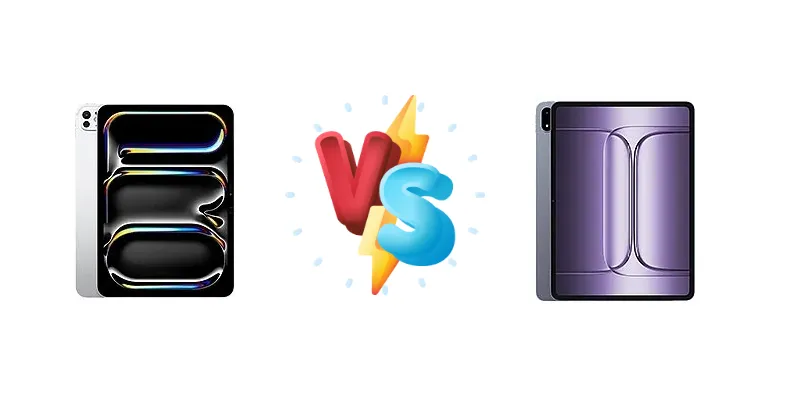
Apple’s 2024 iPad Pro 11 represents the latest in their tablet innovation, boasting the new M4 chip. The OnePlus Pad 2 Pro, however, enters the arena as a compelling Android alternative, leveraging Qualcomm’s cutting-edge Snapdragon 8 Elite. This comparison dissects these two premium tablets, focusing on performance, display quality, and battery life to determine which best suits your needs.
🏆 Quick Verdict
For users deeply embedded in the Apple ecosystem and prioritizing sustained performance for demanding tasks, the iPad Pro 11 (2024) is the clear winner. However, the OnePlus Pad 2 Pro offers a compelling value proposition with its rapid 67W charging and strong performance, making it ideal for Android enthusiasts.
| Network |
|---|
| 2G bands | GSM 850 / 900 / 1800 / 1900 | N/A |
| 3G bands | HSDPA 850 / 900 / 1700(AWS) / 1900 / 2100 | N/A |
| 4G bands | 1, 2, 3, 4, 5, 7, 8, 11, 12, 13, 14, 17, 18, 19, 20, 21, 25, 26, 28, 29, 30, 32, 34, 38, 39, 40, 41, 42, 48, 66, 71 - A2837 | N/A |
| 5G bands | 1, 2, 3, 5, 7, 8, 12, 14, 20, 25, 26, 28, 29, 30, 38, 40, 41, 48, 66, 70, 71, 75, 76, 77, 78, 79 SA/NSA - A2837, A3006 | - |
| EDGE | - | No |
| GPRS | - | No |
| Speed | HSPA, LTE, 5G | - |
| Technology | GSM / HSPA / LTE / 5G | No cellular connectivity |
| Launch |
|---|
| Announced | 2024, May 07 | 2025, May 13 |
| Status | Available. Released 2024, May 15 | Available. Released 2025, May 20 |
| Body |
|---|
| Build | Glass front, aluminum back, aluminum frame | Glass front, aluminum frame, aluminum back |
| Dimensions | 249.7 x 177.5 x 5.3 mm (9.83 x 6.99 x 0.21 in) | 289.6 x 209.7 x 6 mm (11.40 x 8.26 x 0.24 in) |
| SIM | eSIM | No |
| Weight | 444 g (Wi-Fi), 446 g (5G) (1.03 lb) | 675 g (1.49 lb) |
| Display |
|---|
| Protection | Scratch-resistant glass, oleophobic coating, Mohs level 4 | - |
| Resolution | 1668 x 2420 pixels, 3:2 ratio (~264 ppi density) | 2400 x 3392 pixels (~315 ppi density) |
| Size | 11.0 inches, 373.1 cm2 (~84.2% screen-to-body ratio) | 13.2 inches, 530.0 cm2 (~87.3% screen-to-body ratio) |
| Type | Ultra Retina Tandem OLED, 120Hz, HDR10, Dolby Vision, 1000 nits (HBM), 1600 nits (peak) | IPS LCD, 68B colors, Dolby Vision, 144Hz, 900 nits (HBM) |
| Platform |
|---|
| CPU | 9-core 4.4 GHz (3 performance cores, 6 efficiency cores) - 256/512GB models10-core 4.4 GHz (4 performance cores, 6 efficiency cores) - 1/2TB models | Octa-core (2x4.32 GHz Oryon V2 Phoenix L + 6x3.53 GHz Oryon V2 Phoenix M) |
| Chipset | Apple M4 | Qualcomm SM8750-AB Snapdragon 8 Elite (3 nm) |
| GPU | Apple GPU (10-core graphics) | Adreno 830 |
| OS | iPadOS 17.5.1, upgradable to iPadOS 26.1 | Android 15, ColorOS 15 |
| Memory |
|---|
| Card slot | No | No |
| Internal | 256GB 8GB RAM, 512GB 8GB RAM, 1TB 16GB RAM, 2TB 16GB RAM | 256GB 8GB RAM, 256GB 12GB RAM, 512GB 12GB RAM, 512GB 16GB RAM |
| Main Camera |
|---|
| Features | Quad-LED dual-tone flash, HDR | Color spectrum sensor, LED flash |
| Single | 12 MP, f/1.8, (wide), dual pixel PDAF
TOF 3D LiDAR scanner (depth) | 13 MP |
| Video | 4K@24/25/30/60fps, 1080p@25/30/60/120/240fps; gyro-EIS, ProRes (4K, 1080p) | 4K@30fps, 1080p@30ps, gyro-EIS |
| Selfie camera |
|---|
| Features | Face detection, HDR, panorama | - |
| Single | 12 MP, f/2.4, 122˚ (ultrawide) | 8 MP |
| Video | 1080p@25/30/60fps, gyro-EIS, HDR | 1080p@30fps |
| Sound |
|---|
| 35mm jack | No | No |
| Loudspeaker | Yes, with stereo speakers (4 speakers) | Yes, with stereo speakers (4 speakers) |
| Comms |
|---|
| Bluetooth | 5.3, A2DP, LE, EDR | 5.4, A2DP, LE |
| NFC | No | No |
| Positioning | GPS, GLONASS, GALILEO, QZSS (Wi‑Fi + Cellular model only) | No |
| Radio | No | No |
| USB | USB Type-C 4 (Thunderbolt 3), DisplayPort, magnetic connector | USB Type-C 3.2, OTG, accessory connector |
| WLAN | Wi-Fi 802.11 a/b/g/n/ac/6e, dual-band, hotspot | Wi-Fi 802.11 a/b/g/n/ac/6/7, dual-band |
| Features |
|---|
| Sensors | Face ID, accelerometer, gyro, compass, barometer | Accelerometer, proximity (accessories only), gyro, compass |
| Battery |
|---|
| Charging | - | 67W wired |
| Type | Li-Po 8160 mAh | 12140 mAh |
| Misc |
|---|
| Colors | Silver, Space Black | Blue, Silver |
| Models | A2836, A2837, A3006, iPad16,3, iPad16,4 | OPD2413 |
| Price | About 1200 EUR | About 400 EUR |
| EU LABEL |
|---|
| Battery | 73:00h endurance, 1000 cycles | - |
| Energy | Class G | - |
| Free fall | Class E (0 falls) | - |
| Repairability | Class C | - |
Apple iPad Pro 11 (2024)
- Superior sustained performance with the Apple M4 chip
- Excellent display brightness and likely LTPO technology
- Long battery life and 1000 cycle lifespan
- Slower charging speeds compared to OnePlus Pad 2 Pro
- Higher price point
OnePlus Pad 2 Pro
- Rapid 67W wired charging
- Powerful Snapdragon 8 Elite processor
- Potentially more affordable price
- Performance may trail the iPad Pro in sustained workloads
- Display specifications currently unknown
Display Comparison
The iPad Pro 11 (2024) features a display capable of reaching 994 nits of peak brightness, ensuring excellent visibility even in bright outdoor conditions. While the OnePlus Pad 2 Pro’s display specifications are currently unavailable, it’s reasonable to expect a high-quality panel given its ‘Pro’ designation. The iPad Pro’s likely use of LTPO technology allows for variable refresh rates, conserving battery life during static content viewing. The absence of detailed display specs for the OnePlus Pad 2 Pro makes a direct comparison challenging, but the iPad Pro’s measured brightness provides a strong benchmark.
Camera Comparison
Camera details for both tablets are currently limited. Given the tablet form factor, camera quality is less of a primary concern than on smartphones. However, the iPad Pro’s history suggests a focus on image signal processing and computational photography. Without specific sensor details for the OnePlus Pad 2 Pro, it’s difficult to assess its camera capabilities. We anticipate both tablets will offer adequate cameras for video conferencing and casual photography.
Performance
The core of the iPad Pro 11 (2024) is the Apple M4 chip, available in 9-core (256/512GB) and 10-core (1/2TB) configurations, both clocked at 4.4 GHz. This represents a significant leap in Apple Silicon, promising substantial performance gains. The OnePlus Pad 2 Pro counters with the Qualcomm SM8750-AB Snapdragon 8 Elite, an octa-core processor utilizing Oryon V2 Phoenix cores clocked up to 4.32 GHz. While the Snapdragon 8 Elite is built on a 3nm process, potentially offering improved efficiency, the M4’s architecture and tight software integration give Apple a performance advantage, particularly in sustained workloads. The iPad Pro’s unified memory architecture also contributes to faster data access.
Battery Life
The iPad Pro 11 (2024) boasts an impressive 73-hour endurance rating and a 12:37-hour active use score, indicating excellent battery life. The OnePlus Pad 2 Pro, however, features 67W wired charging, a significant advantage over the iPad Pro’s slower charging speeds. While the OnePlus Pad 2 Pro’s battery capacity is unknown, the faster charging allows for quicker top-ups, mitigating any potential capacity disadvantage. The iPad Pro’s 1000 cycle battery lifespan also suggests long-term reliability.
Buying Guide
Buy the Apple iPad Pro 11 (2024) if you require seamless integration with other Apple devices, prioritize long-term software support, and need the absolute best sustained performance for professional applications like video editing or graphic design. Buy the OnePlus Pad 2 Pro if you prefer the Android operating system, value fast charging capabilities, and seek a high-performance tablet at a potentially more accessible price point.
Frequently Asked Questions
❓ How does the Snapdragon 8 Elite’s 3nm process affect the OnePlus Pad 2 Pro’s thermal performance during extended gaming sessions?
The 3nm process should contribute to improved thermal efficiency compared to older nodes. However, sustained performance will depend on OnePlus’ thermal management solution. While the Snapdragon 8 Elite is powerful, the iPad Pro’s M4 and Apple’s software optimization are likely to provide more consistent performance under heavy load.
❓ Does the Apple M4 chip’s Neural Engine offer significant advantages for on-device machine learning tasks compared to the Snapdragon 8 Elite?
Apple’s Neural Engine is renowned for its efficiency and speed in machine learning tasks. The M4’s Neural Engine is likely to outperform the Snapdragon 8 Elite’s equivalent capabilities, benefiting applications like image processing, voice recognition, and augmented reality.
❓ What type of display technology does the OnePlus Pad 2 Pro use, and how does it compare to the iPad Pro 11's display in terms of color accuracy and viewing angles?
Currently, the display technology of the OnePlus Pad 2 Pro is unknown. However, given its 'Pro' designation, it's expected to be a high-quality panel. The iPad Pro 11 is expected to utilize a Liquid Retina XDR display with ProMotion technology, offering excellent color accuracy and wide viewing angles. Without specific details on the OnePlus Pad 2 Pro's display, a direct comparison is difficult.