
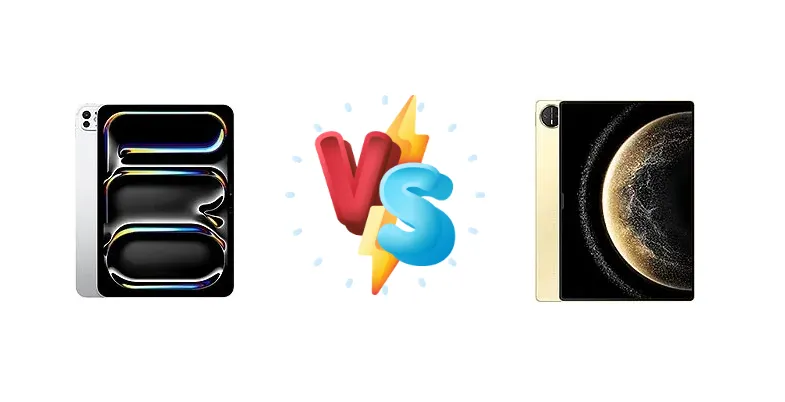
Apple iPad Pro 11 (2024) vs Huawei MatePad Pro 13.2 (2025): A Performance and Battery Showdown
| Phones Images | |||||
|---|---|---|---|---|---|
|
🏆 Quick Verdict
For users deeply embedded in the Apple ecosystem and prioritizing raw processing power for demanding tasks, the iPad Pro 11 (2024) is the clear winner. Its M4 chip and 73-hour battery endurance offer unmatched longevity. However, the MatePad Pro 13.2’s 100W charging and larger display make it a strong contender for those prioritizing convenience and media consumption.
| PHONES | ||
|---|---|---|
| Phone Names | Apple iPad Pro 11 (2024) | Huawei MatePad Pro 13.2 (2025) |
| Network | ||
|---|---|---|
| 2G bands | GSM 850 / 900 / 1800 / 1900 | GSM 850 / 900 / 1800 / 1900 |
| 3G bands | HSDPA 850 / 900 / 1700(AWS) / 1900 / 2100 | HSDPA 850 / 900 / 1900 / 2100 |
| 4G bands | 1, 2, 3, 4, 5, 7, 8, 11, 12, 13, 14, 17, 18, 19, 20, 21, 25, 26, 28, 29, 30, 32, 34, 38, 39, 40, 41, 42, 48, 66, 71 - A2837 | LTE |
| 5G bands | 1, 2, 3, 5, 7, 8, 12, 14, 20, 25, 26, 28, 29, 30, 38, 40, 41, 48, 66, 70, 71, 75, 76, 77, 78, 79 SA/NSA - A2837, A3006 | - |
| Speed | HSPA, LTE, 5G | HSPA, LTE - cellular model only |
| Technology | GSM / HSPA / LTE / 5G | GSM / HSPA / LTE |
| Launch | ||
|---|---|---|
| Announced | 2024, May 07 | 2024, November 26 |
| Status | Available. Released 2024, May 15 | Available. Released 2024, December 12 |
| Body | ||
|---|---|---|
| Build | Glass front, aluminum back, aluminum frame | Glass front, nylon fiber back, magnesium alloy frame |
| Dimensions | 249.7 x 177.5 x 5.3 mm (9.83 x 6.99 x 0.21 in) | 289.1 x 196.1 x 5.5 mm (11.38 x 7.72 x 0.22 in) |
| SIM | eSIM | Nano-SIM (cellular model only) |
| Weight | 444 g (Wi-Fi), 446 g (5G) (1.03 lb) | 580 g (Wi-FI) or 590 g (LTE) (1.28 lb) |
| Display | ||
|---|---|---|
| Protection | Scratch-resistant glass, oleophobic coating, Mohs level 4 | - |
| Resolution | 1668 x 2420 pixels, 3:2 ratio (~264 ppi density) | 2880 x 1920 pixels, 3:2 ratio (~262 ppi density) |
| Size | 11.0 inches, 373.1 cm2 (~84.2% screen-to-body ratio) | 13.2 inches, 518.8 cm2 (~91.5% screen-to-body ratio) |
| Type | Ultra Retina Tandem OLED, 120Hz, HDR10, Dolby Vision, 1000 nits (HBM), 1600 nits (peak) | OLED, 1B colors, 144Hz, HDR Vivid, 1000 nits (peak) |
| Platform | ||
|---|---|---|
| CPU | 9-core 4.4 GHz (3 performance cores, 6 efficiency cores) - 256/512GB models10-core 4.4 GHz (4 performance cores, 6 efficiency cores) - 1/2TB models | Octa-core |
| Chipset | Apple M4 | Kirin T92 |
| GPU | Apple GPU (10-core graphics) | - |
| OS | iPadOS 17.5.1, upgradable to iPadOS 26.1 | Harmony OS 4.3 |
| Memory | ||
|---|---|---|
| Card slot | No | No |
| Internal | 256GB 8GB RAM, 512GB 8GB RAM, 1TB 16GB RAM, 2TB 16GB RAM | 256GB 12GB RAM, 512GB 12GB RAM, 1TB 16GB RAM |
| Main Camera | ||
|---|---|---|
| Dual | - | 50 MP, f/1.8, (wide), PDAF 8 MP, f/2.2, (ultrawide) |
| Features | Quad-LED dual-tone flash, HDR | LED flash |
| Single | 12 MP, f/1.8, (wide), dual pixel PDAF TOF 3D LiDAR scanner (depth) | - |
| Video | 4K@24/25/30/60fps, 1080p@25/30/60/120/240fps; gyro-EIS, ProRes (4K, 1080p) | 4K@30fps, 1080p@30fps |
| Selfie camera | ||
|---|---|---|
| Features | Face detection, HDR, panorama | - |
| Single | 12 MP, f/2.4, 122˚ (ultrawide) | 16 MP, f/2.2 |
| Video | 1080p@25/30/60fps, gyro-EIS, HDR | 1080p@30fps |
| Sound | ||
|---|---|---|
| 35mm jack | No | No |
| Loudspeaker | Yes, with stereo speakers (4 speakers) | Yes, with stereo speakers (6 speakers) |
| Comms | ||
|---|---|---|
| Bluetooth | 5.3, A2DP, LE, EDR | 5.2, A2DP, LE, L2HC |
| NFC | No | No |
| Positioning | GPS, GLONASS, GALILEO, QZSS (Wi‑Fi + Cellular model only) | GPS, GALILEO, GLONASS, BDS |
| Radio | No | No |
| USB | USB Type-C 4 (Thunderbolt 3), DisplayPort, magnetic connector | USB Type-C 3.1, OTG, DisplayPort 1.2, accessory connector pins |
| WLAN | Wi-Fi 802.11 a/b/g/n/ac/6e, dual-band, hotspot | Wi-Fi 802.11 a/b/g/n/ac/6, dual-band |
| Features | ||
|---|---|---|
| Sensors | Face ID, accelerometer, gyro, compass, barometer | Fingerprint (side-mounted), accelerometer, gyro, compass, proximity (accessories only) |
| Battery | ||
|---|---|---|
| Charging | - | 100W wired 7.5W reverse wired |
| Type | Li-Po 8160 mAh | Li-Po 10100 mAh |
| Misc | ||
|---|---|---|
| Colors | Silver, Space Black | Black, White, Gold |
| Models | A2836, A2837, A3006, iPad16,3, iPad16,4 | WEB-W00, PCE-W29 |
| Price | About 1200 EUR | About 680 EUR |
| EU LABEL | ||
|---|---|---|
| Battery | 73:00h endurance, 1000 cycles | - |
| Energy | Class G | - |
| Free fall | Class E (0 falls) | - |
| Repairability | Class C | - |
Apple iPad Pro 11 (2024)
- Unmatched performance with the Apple M4 chip
- Exceptional battery life (73h endurance)
- Bright and color-accurate display (994 nits)
- Ecosystem lock-in
- Accessories sold separately (Apple Pencil, Magic Keyboard)
Huawei MatePad Pro 13.2 (2025)
- Ultra-fast 100W wired charging
- Larger 13.2-inch display for immersive viewing
- Reverse wired charging capability
- Performance likely lags behind the Apple M4
- Battery endurance details currently unavailable
Display Comparison
The iPad Pro 11 (2024) boasts a bright display, reaching a measured 994 nits of peak brightness, ensuring excellent visibility even in outdoor conditions. While the MatePad Pro 13.2’s display specifications are currently unavailable, Huawei typically employs high-quality panels. The iPad Pro’s smaller 11-inch form factor offers greater portability, while the MatePad Pro’s 13.2-inch screen provides a more expansive viewing area. The absence of LTPO information for the MatePad Pro suggests it may not achieve the same variable refresh rate efficiency as the iPad Pro, potentially impacting battery life during dynamic content viewing.
Camera Comparison
Given the context data, a detailed camera comparison is not possible. Both tablets likely feature capable camera systems for video conferencing and casual photography, but neither is positioned as a photography-focused device. The iPad Pro’s camera system is generally known for its high-quality video recording capabilities, while Huawei often emphasizes computational photography. Without specific sensor details for the MatePad Pro, it’s difficult to assess its image quality relative to the iPad Pro.
Performance
The core differentiator lies in the chipsets. Apple’s M4, with its 9 or 10-core CPU (depending on storage configuration – 256/512GB vs 1/2TB), delivers a substantial performance advantage over the Huawei MatePad Pro 13.2’s Kirin T92. The M4’s architecture, built on a leading-edge process node (likely 3nm), provides superior efficiency and sustained performance. While the Kirin T92 is an octa-core processor, its architecture and manufacturing process are unknown, making a direct performance comparison difficult. However, given Apple’s historical dominance in silicon design, the M4 is expected to excel in CPU-intensive tasks like video editing and 3D rendering. The iPad Pro’s LPDDR5X RAM further contributes to its performance edge.
Battery Life
The iPad Pro 11 (2024) demonstrates impressive battery endurance, achieving 73 hours of measured endurance and 12.37 hours of active use. This longevity is a significant advantage for users who rely on their tablets for extended periods. The MatePad Pro 13.2 compensates for potentially lower endurance with its blazing-fast 100W wired charging, allowing for a full charge in a fraction of the time. It also offers 7.5W reverse wired charging, a useful feature for topping up accessories. The difference in charging speed is substantial, offering a convenience factor the iPad Pro cannot match.
Buying Guide
Buy the Apple iPad Pro 11 (2024) if you need the absolute best performance for professional creative workflows, seamless integration with other Apple devices, and a long-lasting battery. Buy the Huawei MatePad Pro 13.2 (2025) if you prioritize rapid charging, a larger screen for immersive media experiences, and aren't heavily invested in the Apple ecosystem.